by COWBERRY

10 minute read
Mustard oil: names, nutrition, benefits and how to cook with it

Mustard oil is the oil pressed from mustard seeds (Brassica spp.), the sharp, pungent oil that Hindi speakers call sarson ka tel. Per 100 g it is 100 g of fat and 884 kcal, and Indian kitchens reach for it for cooking, pickling and traditional preparations. What it is called across India, what is in it, who should limit it and how to cook, store and buy it follow.
What is mustard oil?
Mustard oil is the oil pressed from the seeds of a Brassica plant; a 2022 review in the Journal of Clinical Lipidology calls it a cooking oil used widely across Asia, and India's in particular. What the bottle holds next depends on the extraction. A kachi ghani bottle is pressed without any heat in the press; the dietary guidelines note that this leaves the antioxidants and phytonutrients in the oil, even though unwanted compounds remain too, much as in crude oil. Refining cleans the oil with chemicals instead, removing unwanted compounds and the odour and giving a longer shelf life. COWBERRY presses its own bottle cold, from mustard seed grown in Rajasthan and Bengal, and the seeds themselves double as a spice in the Indian kitchen, though this page is about the oil pressed from them. What the term kachi ghani meaning covers, wood pressing against cold pressing, has its own page.
The purity side of the story has its own page too: how to identify pure mustard oil walks through the home tests and the label checks, and the buying section below condenses them.
Names of mustard oil across India
In Hindi the oil is sarson ka tel, also written sarso ka tel, and in English it is mustard oil; botanists group the source plants as Brassica spp. Other Indian languages have their own words for the same bottle. Bengali says shorsher tel, Punjabi sarhon da tel, Gujarati rai nu tel or sarisav nu tel, Marathi mohariche tel, Odia sorisa tela and Assamese horiyoh tel, while the southern names are kadugu ennai in Tamil, kadugu enna in Malayalam, aava nune in Telugu and sasive enne in Kannada. Sanskrit records sarshapa taila, and Urdu writes the same sarson ka tel as Hindi. The table below carries the complete list.
| Language | Name (romanised) |
|---|---|
| English | Mustard oil |
| Hindi | Sarson ka tel |
| Marathi | Mohariche tel |
| Gujarati | Sarisav nu tel, Rai nu tel |
| Punjabi | Sarhon da tel |
| Bengali | Shorsher tel |
| Odia | Sorisa tela |
| Assamese | Horiyoh tel |
| Kannada | Sasive enne |
| Telugu | Aava nune |
| Tamil | Kadugu ennai |
| Malayalam | Kadugu enna |
| Urdu | Sarson ka tel |
| Sanskrit | Sarshapa taila |
| Botanical name | Brassica spp. |
Source: IFCT 2017 (ICMR-NIN) local-names list. — means no name recorded in the source.
Mustard oil nutrition per 100 g
Per 100 g, mustard oil is 884 kcal and 100 g of fat, with no protein, carbohydrate or fibre. The Indian tables record mustard oil under fatty acids alone: IFCT 2017 gives the oil no energy line and no micronutrient line, so the figures below are the USDA FoodData Central ones, with groundnut oil set beside them.
The fatty acids tell the real story: 11.6 g of saturates, 59.2 g of monounsaturates and 21.2 g of polyunsaturates, the last split into 15.3 g of linoleic acid and 5.9 g of alpha-linolenic acid, the omega 6 and the omega 3. Within the monounsaturates, erucic acid (22:1) stands at 41.2 g and oleic acid (18:1) at 11.6 g. In the pan, one tablespoon, 15 g, is about 133 kcal and one teaspoon, 5 g, about 44 kcal. The ratio between the two omegas, the erucic acid number and every per-spoon figure are worked out on the mustard oil omega 3 page.
| Nutrient | Mustard oil | Groundnut oil |
|---|---|---|
| Energy (kcal) | 884 | 884 |
| Protein (g) | 0 | 0 |
| Fat (g) | 100 | 100 |
| Carbohydrates (g) | 0 | 0 |
| Dietary fibre (g) | 0 | 0 |
| Iron (mg) | 0 | 0 |
| Calcium (mg) | 0 | 0 |
| Magnesium (mg) | 0 | 0 |
| Potassium (mg) | 0 | 0 |
| Sodium (mg) | 0 | 0 |
| Zinc (mg) | 0 | 0 |
| Folate (mcg) | 0 | 0 |
| Vitamin C (mg) | 0 | 0 |
Per 100 g raw, edible portion. Composition: USDA FoodData Central (SR Legacy), FDC ID 172337, NDB 4583; USDA FoodData Central (SR Legacy), FDC ID 171410, NDB 4042. — means not reported. These are average values for the food; the label on a pack gives the values for that product.
Benefits of mustard oil
Each point below rests on the numbers in the table above, and the sources named at the foot of the page.
More monounsaturates than saturates
Mustard oil's 59.2 g of monounsaturates per 100 g stands against 11.6 g of saturates. WHO's 2023 guideline sets the frame: bring saturated fatty acids down to 10 percent of daily energy and replace them with polyunsaturated fatty acids or monounsaturated fatty acids from plant sources.
One of the plant sources of omega 3
The 5.9 g of alpha-linolenic acid per 100 g is the plant omega 3, an essential fat the body has to get from food, and the dietary guidelines put mustard on their list of plant n-3 PUFA sources.
No cholesterol
Cholesterol is absent: plant foods carry none, in the guidelines' words, so mustard oil contributes no cholesterol to the plate.
What the reviews say
On the health record, the guidance is split, and the Journal of Clinical Lipidology carried a 2022 review that walks both sides. The Lipid Association of India calls the oil heart-healthy, the review records, while the US FDA keeps it banned from cooking, and the review's authors ask for the FDA's erucic acid limits to be looked at again. The whole controversy is weighed in refined oil vs mustard oil.
Fit into the day's fat budget
The dietary guidelines hold visible fats to 20 to 50 g a day per person, depending on physical activity, and a tablespoon of mustard oil takes about 133 kcal of that budget. The oil earns its place by the amount poured, not by anything the oil alone can do.
Side effects of mustard oil and who should limit it
Mustard oil sits in many Indian kitchens, but the research attaches three cautions to it.
Erucic acid
Erucic acid typically turns up in mustard and rape, and it is the reason this oil carries a caution. A 2014 study measured erucic acid in nine mustard oil samples from Germany and Australia: the spread ran from 0.3 to 50.8 percent, and seven of the nine crossed the 5 percent limit its authors cite. In laboratory rats, erucic acid at high levels has been tied to myocardial lipidosis and to lesions on the heart; that rodent evidence is what the US FDA's cooking ban rests on, while Australia, New Zealand and the European Union answer with upper limits rather than a ban. Before mustard oil becomes the household oil, anyone managing a heart condition should settle it with their doctor or dietitian.
Saturates
At 11.6 g of saturates per 100 g, mustard oil is not a low-saturated-fat oil; fit the 11.6 g inside the day's fat budget; WHO's 2023 guideline recommends reducing saturated fatty acids to 10 percent of daily energy.
Repeated heating
Once a bottle of oil has done a fry, the guidelines set its rules: strain what is left, keep it for curries and nothing else, and use it up within a day or two, because deterioration runs faster in oil that has been heated; the same guidelines add that heating polyunsaturated fats repeatedly turns them into harmful compounds. A 2019 critical review takes the warning further: oils heated again and again generate polycyclic aromatic hydrocarbons, some of them reported as carcinogenic, and in the studies it collected, heavy use of these oils went with lung, colorectal, breast and prostate cancers.
How to cook with mustard oil
Mustard oil is, first, a cooking oil. The product page for COWBERRY's cold-pressed bottle names a high smoke point and lists its uses: deep frying, sauteing, high-heat cooking, salad dressings, marinades and dips, with a strong flavour throughout. That high smoke point is what lets the bottle stand up to frying heat, and the heat of the pan, the crackle of cumin and garlic and the sharp smell rising from the oil are how many Indian dals and subzis begin.
In pickles, curries and traditional preparations the oil's pungency is half the recipe, and a mustard-oil tadka over a dal or a subzi is the finishing touch in many Indian kitchens. The mango pickle recipe on this site steeps sun-dried raw mango in kachi ghani mustard oil with roasted spices. Where a flavourless, odourless oil is wanted instead, refined oil is the other choice, set out point by point in refined oil vs mustard oil. For frying in particular, respect the used-oil rules from the cautions above: strain, hold for curries, finish within a day or two.
How to store mustard oil
A sealed bottle keeps well in a cool, dry spot out of direct sunlight, which is COWBERRY's printed storage advice, and the guidelines add that how warm it is and how long it sits shape food quality, so leave the bottle capped and well away from the stove, and after every pour, cap it, shade it and keep it clear of the heat. Go by the use-by date on the pack.
Used frying oil is a different case with its own short clock. Strain the leftover oil after a fry, hold it back for curries and use it up inside a day or two, as the guidelines advise; once oil has been heated, it turns faster.
Mustard oil recipes
The site's mustard-oil recipe is mango pickle (aam ka achar): raw green mango dried in the sun with salt and turmeric, then rested in kachi ghani mustard oil with roasted spices, and the recipe page keeps the full method and the ingredient list.
Beyond the pickle jar, the oil's everyday work is the tadka: a spoonful heated in the pan before the cumin and garlic go in, over dals, bhindi and aloo subzis, and in fish curries where the pungency stands up to the fish.
How to buy mustard oil: what to check
Read every bottle the same way. The pack should name mustard oil and carry an FSSAI logo with a licence number, the mark of a licensed manufacturer, as the dietary guidelines explain, and the guidelines warn that oil bought loose from unsealed containers invites adulteration. The ingredient list should be one line for one oil, and a cold-pressed or kachi ghani pack should say so in those words.
Organic packs carry certification marks; COWBERRY's cold-pressed mustard oil, pressed from Rajasthan and Bengal seed, is India Organic, USDA & EU certified. The home tests and the laboratory-only checks behind each of these points are on how to identify pure mustard oil.
FAQs
What is mustard oil?
It is the oil pressed from mustard seeds (Brassica spp.), known across India as sarson ka tel. Per 100 g the oil is 100 g of fat and 884 kcal, and its character carries pickles, curries and traditional preparations.
Does mustard oil expire?
Yes, in the sense the pack says: read the use-by or expiry date printed on the bottle and keep the oil cool, dry and out of direct sunlight. Oil from a finished fry is the one with the short clock: the dietary guidelines say to strain it, hold it for curries and use it up within a day or two.
Is mustard oil good for health?
It is a cooking fat with a divided report card. The profile reads 59.2 g of monounsaturates and 11.6 g of saturates per 100 g, and a 2022 review notes the Lipid Association of India calls it heart-healthy while the US FDA bars cooking with it over erucic acid. Pour it inside the guidelines' daily visible-fat span of 20 to 50 g.
Can mustard oil be used for cooking?
Yes. COWBERRY's product page gives its cold-pressed mustard oil a high smoke point and lists deep frying, sauteing and high-heat cooking among its uses; the strong flavour is also at home in salad dressings, marinades and dips, and pickles and curries are its traditional ground. After frying, strain the oil and hold it for curries only.
Why mustard oil is banned in us?
Erucic acid is why the US Food and Drug Administration bars mustard oil from cooking. The 2022 review published in the Journal of Clinical Lipidology ties that ban to myocardial lipidosis seen in rodents, counts 29 countries that still allow limited amounts for people, and notes that Australia, New Zealand and the European Union chose upper limits rather than a ban.
How mustard oil is made?
Mustard seeds are pressed, and the pressing decides the kind of oil. A kachi ghani press works without heat; the guidelines note that cold pressing of this kind keeps the antioxidants and phytonutrients, while the oil still carries unwanted compounds, as crude oil does. COWBERRY cold-presses its mustard oil from seeds grown in Rajasthan and Bengal.
References
- Indian Food Composition Tables (IFCT) 2017, ICMR-National Institute of Nutrition
- Dietary Guidelines for Indians, ICMR-National Institute of Nutrition
- WHO guideline: saturated fatty acid and trans-fatty acid intake for adults and children (2023)
- Poddar KH, Sikand G, Kalra D et al. Mustard oil and cardiovascular health: why the controversy? J Clin Lipidol, 2022
- Wendlinger C, Hammann S, Vetter W. Various concentrations of erucic acid in mustard oil and mustard. Food Chem, 2014
- USDA FoodData Central (SR Legacy): Oil, mustard, FDC ID 172337
- Ganesan K, Sukalingam K, Xu B. Impact of consumption of repeatedly heated cooking oils on the incidence of various cancers- A critical review. Crit Rev Food Sci Nutr, 2019
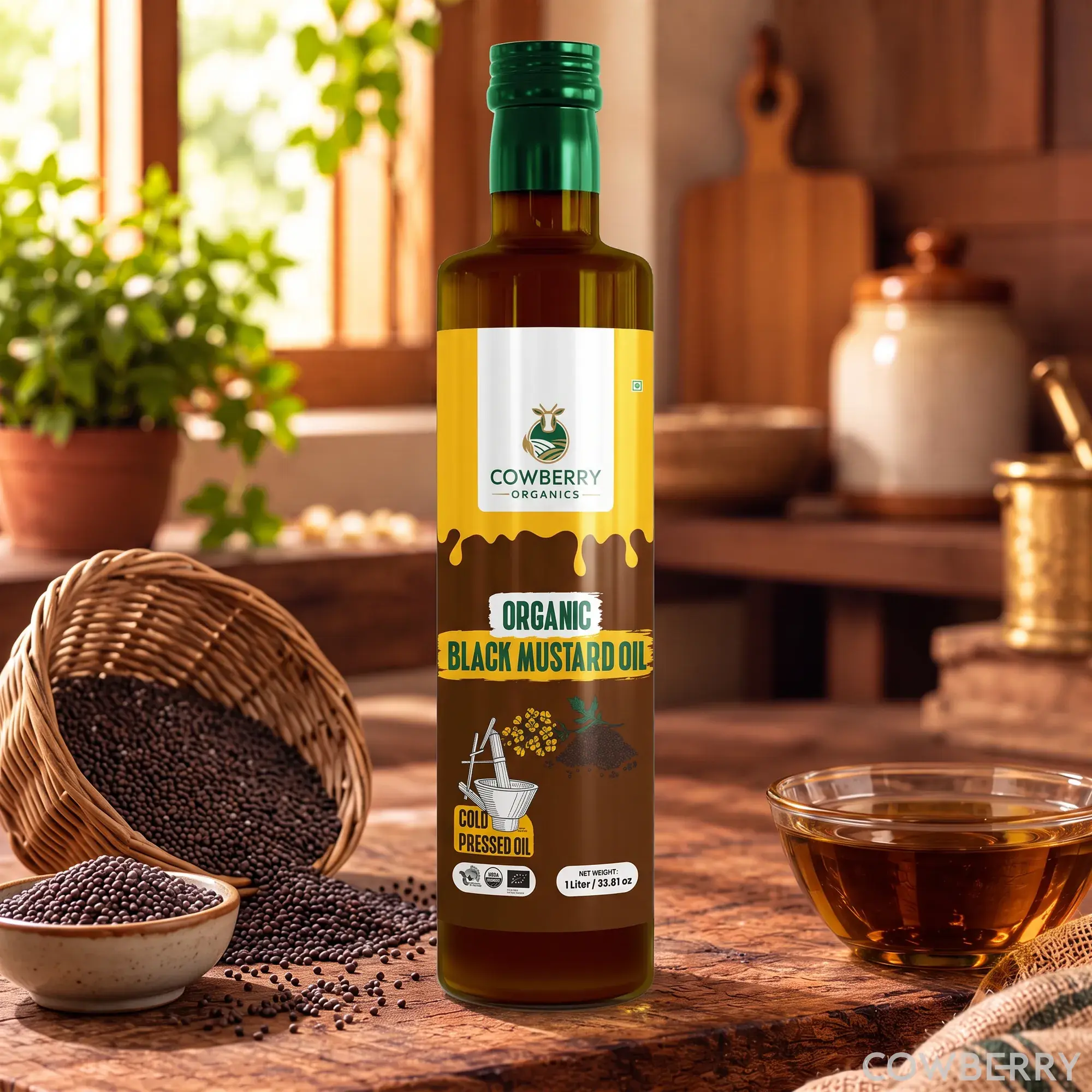
Shop this article
Keep reading
Cold pressed oil benefits: why they survive processing better
Mustard oil vs refined oil: nutrition, cooking and which to choose
Mustard oil omega 3: nutrition, calories and fat per 100g