by COWBERRY

10 minute read
Kachi ghani meaning: wood pressed vs cold pressed oil explained

Kachi ghani meaning, in short: oil pressed without heat. The ICMR-NIN Dietary Guidelines for Indians give 'Kachi ghani tel' as the Indian term for cold-pressed oil, pressed out by a mechanical expeller with no heat applied, and they add that the oil keeps its antioxidants and phytonutrients. This guide explains the name, the press, the nutrition and how to buy and use the oil.
Kachi ghani meaning: what the words say
The definition sits in the Dietary Guidelines for Indians: cold-pressed oil, which the text prints as 'Kachi ghani tel', is pressed out by machine, by expeller pressing, with no heat applied and without altering the nature of the oil. The ghani is the traditional oil press, so the name simply describes oil that leaves a press run cold; English labels render the same words as cold pressed oil.
Two consequences follow in the same text. Because nothing in the pressing alters the oil, its antioxidants and phytonutrients are preserved. And because nothing is removed either, kachi ghani oil can carry the same unwanted compounds as any unrefined crude oil. In short, the seed decides the fat, and the press decides what travels with it.
Kachi ghani in english: wood pressed and cold pressed
Kachi ghani in english is cold-pressed oil; the guidelines print the two together as one name. Wood pressed oil meaning is oil from a wooden press, a term the guidelines do not use. For cold pressed oil vs wood pressed oil, the guidelines therefore say nothing either way: they define only kachi ghani, or cold-pressed, oil, pressed mechanically with no heat applied.
The guidelines draw the real lines between four terms. Crude oil is what mechanical expelling gives first, still carrying compounds such as gums, waxes, pesticide residues, aflatoxins, free fatty acids and allergens. Cold-pressed, or kachi ghani, oil is pressed the same way without heat. Virgin oil comes from the same mechanical pressing, this time with heat applied. Refined oil has been through refining, which strips out those compounds, takes away the odour, lengthens the shelf life and adds preservatives; the fatty acids themselves are left as they were. The fuller comparison is on cold pressed oil vs refined oil.
Kachi ghani vs cold pressed: is there a difference?
Kachi ghani vs cold pressed: the difference is one of words, not of method; the guidelines use the two names for one oil, pressed mechanically without heat. An oil labelled kachi ghani and one labelled cold pressed are made the same way, so choose between them on the seed, the seller and the care at the press, not on the words.
Three distinctions from the same chapter matter more. First, refining strips away small amounts of minor components, antioxidants and phytosterols among them, so the cold-pressed oil keeps them. Second, the guidelines note that the natural flavour of an oil is largely due to these minor components, most of which are antioxidants. Third, every extracted seed oil, crude or refined, is to be used in moderation, because the extraction procedure may leave undesirable substances. What survives pressing, and why it matters, is the theme of cold pressed oil benefits.
What is cold pressed mustard oil?
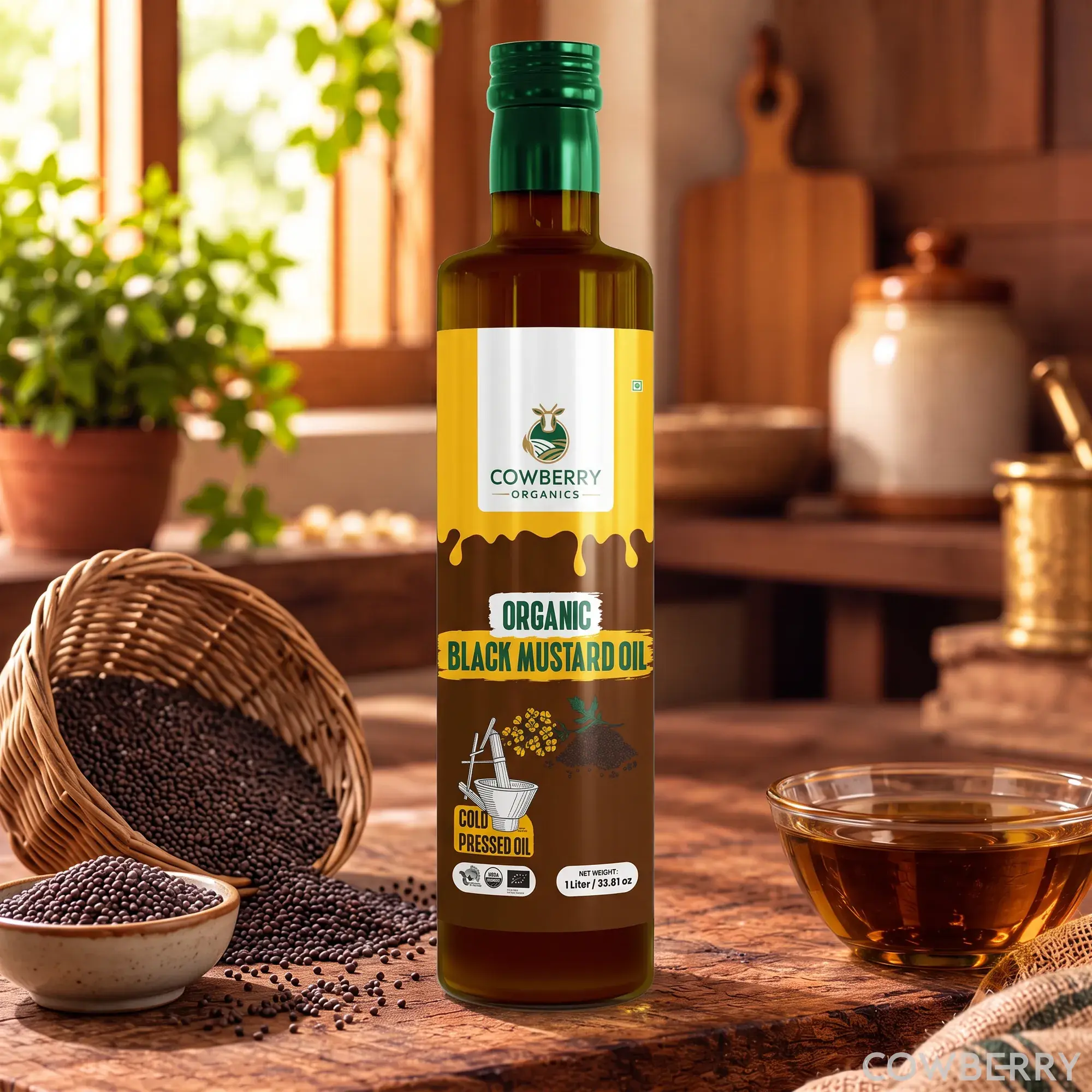
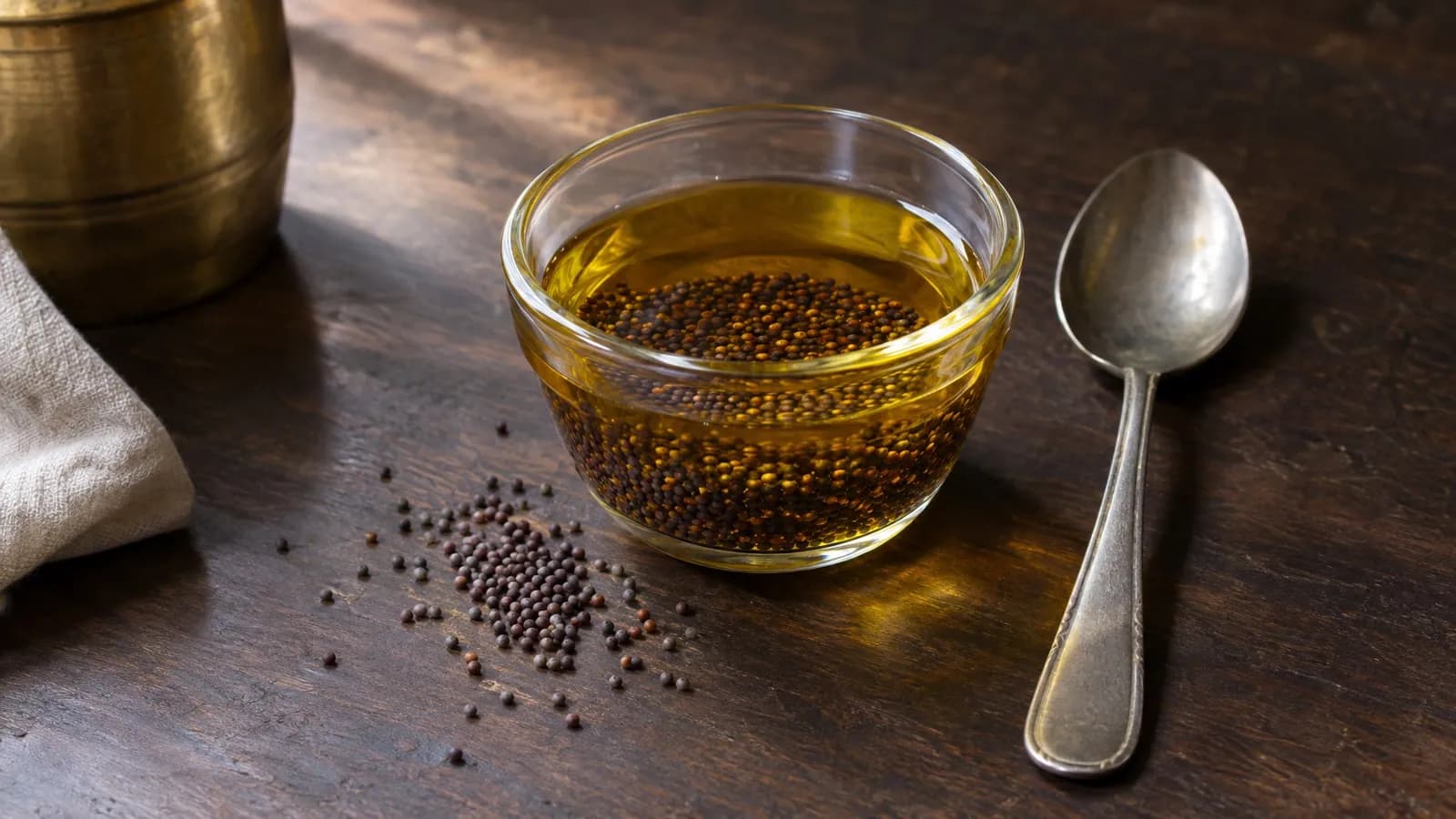
Cold pressed mustard oil means kachi ghani sarson ka tel: mustard seed pressed without heat and bottled unrefined, deep in colour and sharp on the nose. It is a staple in Indian kitchens, from sarson ka saag and pickles to fish curries.
Two things set it apart on paper. First, omega-3: in the guidelines' table of foods that furnish 100 mg of n-3 PUFA, mustard/rapeseed oil appears at 0.7 g, one of only four vegetable oils listed, beside soyabean at 1.5 g, canola at 0.5 g and flaxseed at 0.2 g. Second, its standing: a 2022 paper in the Journal of Clinical Lipidology calls mustard oil low in saturated fat, and popular in South Asia, and notes the Lipid Association of India's own recommendation of it as heart-healthy.
The same review explains the controversy around the oil. Erucic acid makes up a large part of it, and in rodents this fatty acid is tied to myocardial lipidosis; on that evidence the US FDA bars the oil from cooking, while Australia, New Zealand and the European Union set upper limits instead. The paper asks the FDA to revisit its erucic acid safety limits.
Across India the oil answers to many names, as IFCT 2017 records. COWBERRY presses its cold-pressed mustard oil slowly, without heat or chemicals, from seed grown across Rajasthan and Bengal; the whole story is on the mustard oil hub.
| Language | Name (romanised) |
|---|---|
| English | Mustard oil |
| Hindi | Sarson ka tel |
| Marathi | Mohariche tel |
| Gujarati | Sarisav nu tel, Rai nu tel |
| Punjabi | Sarhon da tel |
| Bengali | Shorsher tel |
| Odia | Sorisa tela |
| Assamese | Horiyoh tel |
| Kannada | Sasive enne |
| Telugu | Aava nune |
| Tamil | Kadugu ennai |
| Malayalam | Kadugu enna |
| Urdu | Sarson ka tel |
| Sanskrit | Sarshapa taila |
| Botanical name | Brassica spp. |
Source: IFCT 2017 (ICMR-NIN) local-names list. — means no name recorded in the source.
What a press produces: oil, seedcake and sediment
A press is a simple machine, and oil is not all it gives. A 2023 study in the journal Foods pressed batches of six oilseeds, pumpkin, flax, hemp, milk thistle, sesame and cumin, and measured the oil yield, the seedcake and the sediment. Sesame came first on oil yield and cumin last, and over longer storage the sediment in the oil fell and the percentage oil yield rose. None of the six was mustard or groundnut, so the figures say nothing about those two oils.
Sediment is one of the things the study counted alongside the oil and the seedcake. The study's statistical tests also found that quality parameters differed significantly between oilseeds, one more reason to judge a kachi ghani bottle seed by seed, not press by press.
Kachi ghani oil nutrition per 100 g and per spoon
On paper, kachi ghani oil is oil, and the press does not change that. For mustard oil and groundnut oil, the two oils with nutrition tables on this site, USDA FoodData Central prints 884 kcal and 100 g of fat per 100 g, with 0 g of protein and 0 g of carbohydrate; IFCT 2017 lists both oils only in its fatty-acid tables. Groundnut oil's entry adds a little iron, 0.03 mg, and zinc, 0.01 mg. Neither carries cholesterol: the guidelines note that animal-source foods are the only foods with cholesterol, and that plant foods have none.
In spoon terms, a level teaspoon of either oil, taken as 5 g, is 44 kcal, and a tablespoon, taken as 15 g, is 133 kcal. The guidelines cap visible fat, the term they use for cooking oil, ghee and butter put together, at 20 to 50 g per person a day, four to ten teaspoons, with not more than 27 to 30 g on a 2000 kcal day; even a kachi ghani kitchen counts spoons.
What the press does change is what travels with the fat, the antioxidants and the flavour above. Choosing an oil by its fat is the subject of low cholesterol oil, and groundnut oil's own numbers sit on the groundnut oil hub. How the two refined cousins compare: sunflower oil vs soybean oil.
| Nutrient | Mustard oil | Groundnut oil |
|---|---|---|
| Energy (kcal) | 884 | 884 |
| Protein (g) | 0 | 0 |
| Fat (g) | 100 | 100 |
| Carbohydrates (g) | 0 | 0 |
| Dietary fibre (g) | 0 | 0 |
| Iron (mg) | 0 | 0 |
| Calcium (mg) | 0 | 0 |
| Magnesium (mg) | 0 | 0 |
| Potassium (mg) | 0 | 0 |
| Sodium (mg) | 0 | 0 |
| Zinc (mg) | 0 | 0 |
| Folate (mcg) | 0 | 0 |
| Vitamin C (mg) | 0 | 0 |
Per 100 g raw, edible portion. Composition: USDA FoodData Central (SR Legacy), FDC ID 172337, NDB 4583; USDA FoodData Central (SR Legacy), FDC ID 171410, NDB 4042. — means not reported. These are average values for the food; the label on a pack gives the values for that product.
Buying, using and keeping kachi ghani oil
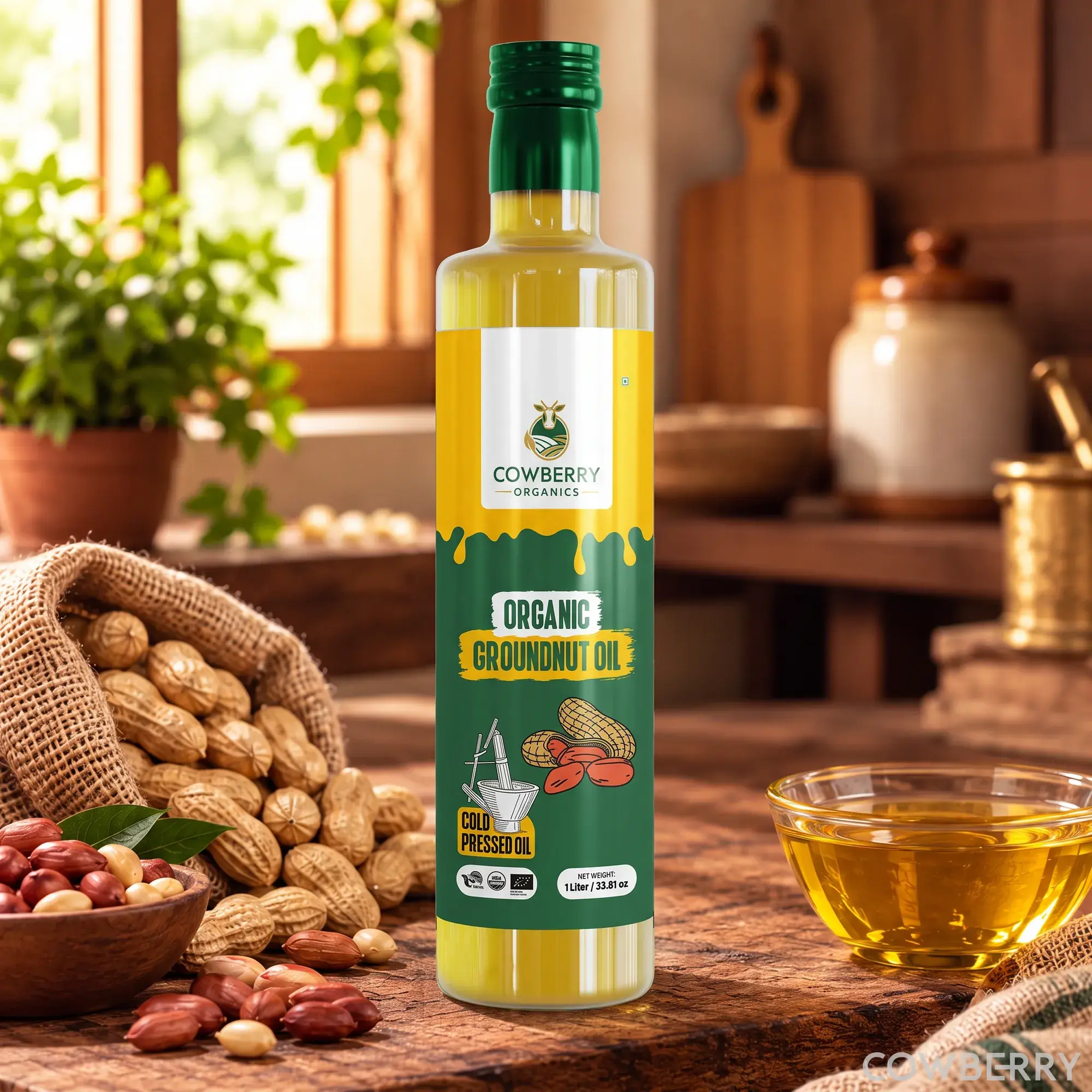
COWBERRY cold-presses two oils this way. Its cold-pressed groundnut oil starts with groundnuts from Saurashtra in Gujarat and Andhra Pradesh, dried in the sun and pressed without heat or chemicals; the product facts describe a golden colour, a nutty aroma and a high smoke point. Its cold-pressed mustard oil is pressed slowly from seed of Rajasthan and Bengal, again without heat or chemicals, with a deep colour, a strong aroma and a high smoke point. Both are India Organic, USDA & EU certified.
Use. The product facts list deep frying and sauteing among the uses of both oils, and name a high smoke point for each without a temperature, so none is quoted. For everyday cooking the guidelines prefer boiling, baking, grilling, steaming and sauteing over frying.
Reuse. The guidelines are specific: oil used for frying may be filtered and put to work in curries, but the same oil must not go back into the fryer, and it should be gone within a day or two. FSSAI's guidance on used cooking oil puts the line at 25 percent total polar compounds, and tells kitchens to stop when the oil smokes blue-grey, foams, turns dark and murky or changes consistency.
Keep and buy. A closed bottle, somewhere cool and dry, away from sunlight, as the product facts advise. On the label, look for the India Organic and Jaivik Bharat logos, the unified marks FSSAI's organic portal describes. Cook with it: mango pickle is built on mustard oil, and poha tikki cutlets are the shallow-fried side of the same careful kitchen.
FAQs
What is cold pressed mustard oil?
It is mustard seed pressed without heat and bottled unrefined, the kachi ghani tel of the ICMR-NIN guidelines, which define it as oil pressed out in a mechanical expeller with no heat applied, so that antioxidants and phytonutrients are preserved. COWBERRY presses its mustard oil slowly, from seed grown across Rajasthan and Bengal, without heat or chemicals.
Kachi ghani vs cold pressed: is there a difference?
No. The guidelines print the two as one name, 'Cold pressed oils (Kachi ghani tel)', so an oil labelled either way is pressed the same way, mechanically and without heat. Choose on the seed, the seller and the care at the press. The useful distinction is with virgin oil, which is pressed the same way, only with heat applied.
Difference between cold pressed and refined oil?
Cold-pressed oil is pressed mechanically without heat and bottled unrefined, keeping antioxidants and phytonutrients, and the compounds of crude oil along with them. Refined oil goes through chemical refining, which removes those compounds, the odour and the minor components, and adds preservatives; the fatty acids themselves stay as they were. Shelf life lengthens and the odour goes.
Is cold pressed oil good for cooking?
Yes, in moderation and for the right uses. COWBERRY's product facts name deep frying and sauteing as uses for its cold-pressed oils, and record a high smoke point for each. The guidelines add the amount: visible fat of 20 to 50 g a person a day, and oil used for frying should be filtered, kept for curry only and used up in a day or two.
Why is cold pressed oil better?
Better is a matter of what you value. The guidelines say cold pressing spares the oil's antioxidants and phytonutrients, and that the natural flavour of oils is largely due to these minor components. It is not lower in calories: both oils in the tables here read 884 kcal per 100 g. Its other side is that unrefined oil can keep the unwanted compounds of crude oil, which makes the seed and the seller matter.
What is kachi ghani oil in English?
Cold-pressed oil; the guidelines use the Hindi and English terms side by side, as 'Cold pressed oils (Kachi ghani tel)'. In English the method is what matters: a mechanical expeller pressing the seed with no heat applied. The guidelines do not use the term wood pressed, so they say nothing on how it compares.
References
- Dietary Guidelines for Indians, ICMR-National Institute of Nutrition
- Indian Food Composition Tables (IFCT) 2017, ICMR-National Institute of Nutrition
- Poddar KH, Sikand G, Kalra D et al. Mustard oil and cardiovascular health: why the controversy? J Clin Lipidol, 2022
- Kabutey A, Herak D, Mizera C et al. Assessment of quality and efficiency of cold-pressed oil from selected oilseeds. Foods, 2023
- USDA FoodData Central (SR Legacy): Oil, mustard, FDC ID 172337
- USDA FoodData Central (SR Legacy): Oil, peanut, salad or cooking, FDC ID 171410
- FSSAI Guidance Note No. 06/2018: Handling and disposal of used cooking oil (RUCO), including the 25% total polar compounds limit
- FSSAI Jaivik Bharat: organic food portal (India Organic and Jaivik Bharat logos)
Shop this article
Keep reading
Cold pressed oil benefits: why they survive processing better
Mustard oil vs refined oil: nutrition, cooking and which to choose
Mustard oil omega 3: nutrition, calories and fat per 100g