by COWBERRY

13 minute read
Khapli atta (emmer wheat): what it is, nutrition, benefits and uses

Khapli atta is flour milled from khapli wheat, the Indian name for emmer (Triticum dicoccum), a hulled wheat of a different species from the bread wheat in most atta today. It contains gluten, makes a soft, nutty roti, and the University of Sydney GI database holds just one emmer food, a boiled pasta with a GI of 40. This guide covers its names, nutrition, benefits, cooking, storage and buying.
What is khapli atta, and what is khapli wheat?
Khapli wheat is emmer. Botanically it is Triticum dicoccum, a hulled wheat: each kernel stays wrapped in a tough husk after threshing and has to be dehulled before milling, a step that bread wheat (Triticum aestivum, the species IFCT 2017 gives for whole wheat) does not need. A 2017 paper in Plant Science traces the crop back to wild emmer, one of the wild cereals whose cultivation began in southwest Asia.
COWBERRY's khapli comes from Deccan plateau farms in Maharashtra and Madhya Pradesh. Khapli atta is simply that grain ground whole, bran and germ included, into a coarse flour a shade darker than regular atta, and its rotis come out darker, nuttier and a little sweeter than sharbati rotis.
Two common mix-ups: khapli is not gluten-free (it is a wheat and has gluten), and it is not a millet. It is a different species from the wheat in regular atta and its dough handles differently, but none of the sources used here has measured its gluten. What the word itself means, and the word for wheat from Kannada to Tamil, are on the page khapli atta means: names in Indian languages.
Khapli wheat names in English and Indian languages
Khapli's English name is emmer wheat, and its botanical name, as printed in the University of Sydney GI database, is Triticum dicoccum. IFCT 2017 has no emmer entry, so no Indian-language name for it is on record. What the tables do give is the everyday word for wheat, such as gehun in Hindi, godhi in Kannada and godhumalu in Telugu, which covers any wheat; the grain itself is sold as khapli, the name on COWBERRY's packs too. The language-by-language table, and the grains khapli gets confused with, are on khapli wheat in English, Hindi, Kannada and other Indian languages.
Khapli atta nutrition per 100 g (and why the table shows whole wheat)
Here is the honest position: neither IFCT 2017 nor USDA FoodData Central has a composition entry for emmer or khapli, so there is no official per-100 g figure for khapli atta. The table below therefore shows IFCT's whole wheat as the closest measured stand-in, next to jowar and bajra, two other whole grains made into rotis. Read the wheat column as what a whole-wheat atta gives, not as a khapli-specific number. Khapli packs carry figures of their own, but no public table stands behind them, so this guide leaves them out.
Per 100 g, IFCT whole wheat gives 322 kcal, 10.6 g protein, 1.5 g fat, 64.7 g carbohydrate and 11.2 g fibre, with 3.97 mg iron, 125 mg magnesium, 366 mg potassium and 2.85 mg zinc. A 2023 study in Foods grew bread wheat, emmer and spelt in the same field trials at two fertiliser levels: emmer came out higher in protein, iron, zinc and magnesium, bread wheat higher in the two main types of fibre, and every component's range overlapped across the three, so the authors tied any health effect to how much is eaten and the rest of the diet.
Khapli wheat glycemic index. The University of Sydney database lists a single emmer food, a boiled Triticum dicoccum pasta tested in Italy on ten volunteers, and its GI is 40. The database has no entry for khapli roti, khapli atta or any Indian khapli dish. For context, its two India-tested wheat entries, steamed whole kernels at 30 and a wheat food it does not specify at 63, average 47. Both 40 and 47 fall in the low band, 55 or less, but neither is a khapli roti, so a claim that khapli roti has a GI of 40 goes beyond the data.
In roti terms, 30 g of atta (one medium roti) works out to about 97 kcal, 3.2 g protein and 3.4 g fibre on the whole-wheat figures; two rotis give 193 kcal, 6.4 g protein and 6.7 g fibre. The side-by-side with regular atta, including taste and cost, is on khapli wheat vs normal wheat.
| Nutrient | Whole wheat (IFCT; stand-in for khapli) | Jowar | Bajra |
|---|---|---|---|
| Energy (kcal) | 322 | 334 | 348 |
| Protein (g) | 11 | 10 | 11 |
| Fat (g) | 1.5 | 1.7 | 5.4 |
| Carbohydrates (g) | 65 | 68 | 62 |
| Dietary fibre (g) | 11 | 10 | 11 |
| Iron (mg) | 4 | 4 | 6.4 |
| Calcium (mg) | 39 | 28 | 27 |
| Magnesium (mg) | 125 | 133 | 124 |
| Potassium (mg) | 366 | 328 | 365 |
| Sodium (mg) | 2.5 | 5.4 | 4.1 |
| Zinc (mg) | 2.9 | 2 | 2.8 |
| Folate (mcg) | 30 | 39 | 36 |
| Glycemic index (GI) | 47 | 66 | 57 |
Per 100 g raw, edible portion. Composition: IFCT 2017 (ICMR-NIN). GI: University of Sydney GI database. — means not reported. These are average values for the food; the label on a pack gives the values for that product.
Khapli wheat benefits
Most of what khapli offers comes from eating the grain whole. On the IFCT whole-wheat figures a whole atta carries 11.2 g fibre per 100 g, about four times raw milled rice, with 3.97 mg iron, 2.85 mg zinc and 125 mg magnesium, and the 2023 field comparison found emmer grain higher in protein and in those minerals than bread wheat. The ICMR-NIN Dietary Guidelines for Indians advise preferring whole grains and millets to refined grains, and a whole khapli roti in place of maida follows that advice. Its low-GI reputation rests on a single pasta test, and it contains gluten. The eight benefits, each with its number, source and limits, are on khapli wheat benefits.
Is khapli atta gluten free? No: who should limit it
Khapli atta is not gluten free. Emmer is a true wheat, and wheat is one of the three cereals, with barley and rye, that the NHS says contain gluten, the protein behind coeliac disease. If you have coeliac disease or a wheat allergy, khapli is off the menu; use jowar, bajra or ragi instead, which are naturally free of gluten, as explained on is ragi gluten free.
Four other groups should keep an eye on quantity:
- Non-coeliac gluten sensitivity or IBS: khapli has gluten like any wheat, and none of this guide's sources shows it is easier to digest. If you want to try it, check with your doctor or dietitian, begin with one roti at a meal and write down any symptoms.
- New to whole atta: at 11.2 g fibre per 100 g it is a step up from maida or white rice, so switch over gradually and drink enough fluids, which the ICMR-NIN guidelines pair with fibre-rich foods against constipation.
- Diabetes: every khapli roti still counts as carbohydrate, about 19.4 g for 30 g of atta on the whole-wheat figures. Count it as your grain portion; if you hope to adjust medication or diet around it, talk to your doctor or dietitian first.
- Weight goals: no table gives khapli its own calorie figure; on IFCT whole-wheat figures a whole atta has 322 kcal per 100 g, so count a khapli roti like any other roti. Its fibre adds to fullness, but that does not cut the calories.
How to cook and use khapli atta
Khapli roti (chapati): khapli dough stretches less than sharbati dough and keeps taking up water as it rests. Knead a soft, slightly sticky dough with warm water, rest it covered for 30 minutes, and roll gently with a light dusting of the same atta. Cook on a hot tawa and smear with ghee while hot, and the roti stays soft enough to pack for lunch. The step-by-step is on khapli atta roti.
Halwa and sweets: the nutty flavour is at its best roasted in ghee. Khapli atte ka halwa uses the flour, ghee and jaggery; the same roasted atta goes into pinni, laddu and panjiri.
Whole khapli grain: rinse it and soak for 8 hours. It then needs 4 to 5 whistles in a pressure cooker, or 40 to 50 minutes of gentle simmering, to turn tender with a chewy bite. Use it in khichdi or salads, or crack it in a mixer for a coarse dalia and cook it as upma or sweet dalia.
Bread, cake and biscuits: khapli flour bakes into a denser, more flavourful loaf than bread flour. For bread, start with a blend of khapli and regular atta or maida, keep the dough slightly wet and give it a longer proof. For biscuits and cake, where a tender crumb is wanted, it can be used alone.
Other everyday uses: paratha (stuffed or plain), thepla, puri (roll thin; they puff well), and a khapli-and-besan chilla. Anywhere a recipe says whole wheat atta, khapli can go in at 100 percent; start with half-and-half if your family is used to sharbati.
How to store khapli wheat and khapli atta
Whole khapli grain is the easy one to keep. Sun-dry it for a few hours, pack it into an airtight steel or glass bin and keep it in a cool, dry cupboard, and it lasts for months. The atta is the part that needs care, as any whole-grain flour does: keep it airtight, finish it within about a month, and give it a shelf in the fridge through the monsoon. A bitter or musty smell means the flour has turned. Buy 1 kg packs unless you make rotis for a large family. The monsoon routine for keeping weevils out of grains and dals is on how to store atta.
Khapli wheat vs regular wheat: the short version
Regular atta in India is bread wheat, often sold under a variety name such as sharbati, and it makes a soft, puffy roti and good bread. Khapli is a different species, with a nuttier and slightly sweeter taste, a darker roti and a coarser flour. On composition, IFCT has no emmer entry, and the one side-by-side trial gave emmer the edge on protein and minerals and bread wheat the edge on the main fibres, with overlapping ranges; neither is clearly healthier on paper.
Where khapli wins is on taste: a nuttier, darker roti. Where regular atta wins is bread-making, cost and familiarity. Part of the reason khapli atta is costly is the husk: every kernel must be dehulled before milling, work that bread wheat never needs. The full comparison, with gluten, GI, nutrition and cooking, is on khapli wheat vs normal wheat.
How to buy khapli atta: what to look for
Grain or flour? Buy whole khapli wheat if you want to cook it as a whole grain, crack your own dalia or grind fresh flour at a local chakki; buy khapli atta for rotis and halwa, since it saves the milling.
Smell the flour: fresh khapli atta smells sweet and nutty; bitterness means old flour. Prefer the most recent milling date you can find.
Milling: choose whole-grain, stone-ground or slow-chakki flour with the bran and germ left in; the ICMR-NIN guidelines count refined flours among the foods that lose native fibre and nutrients in processing.
Certification: for organic khapli, check for a certification mark rather than the word organic alone; 'natural' and 'chemical-free' are label claims, not certification. What each mark means is on organic certification in India.
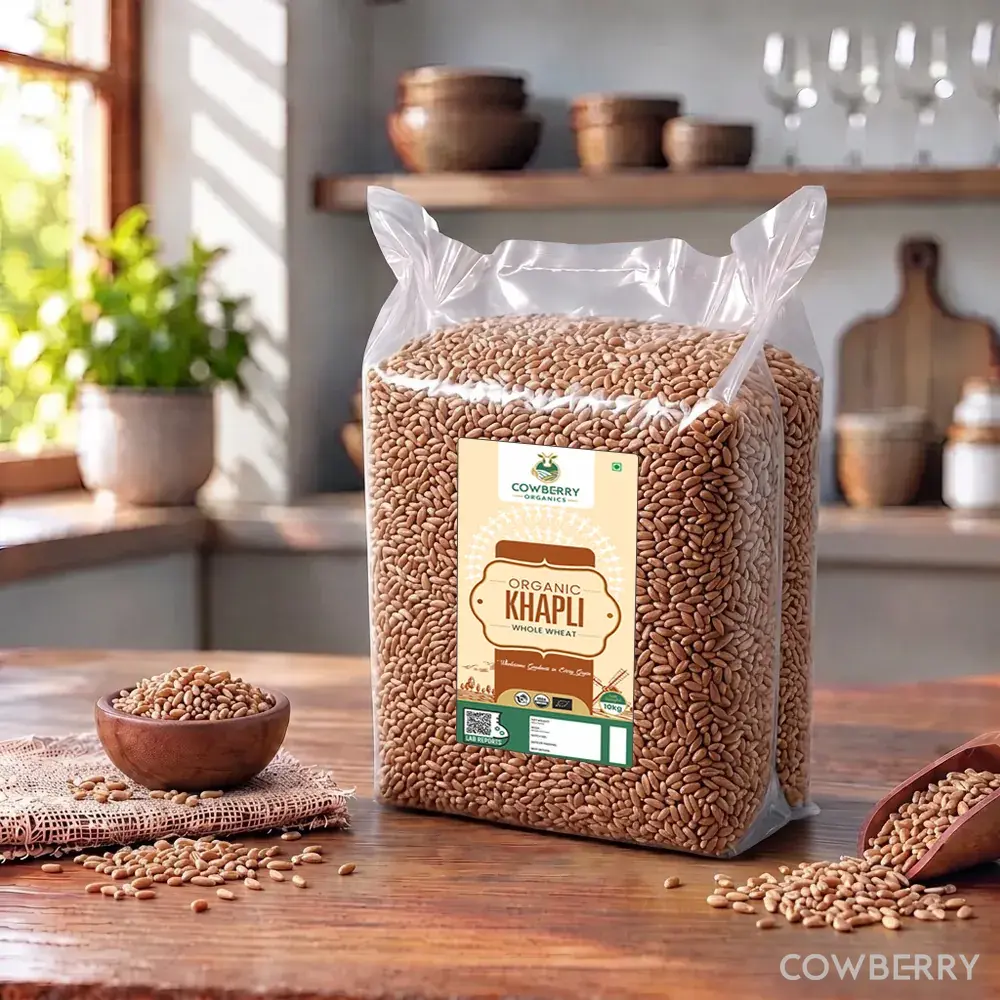
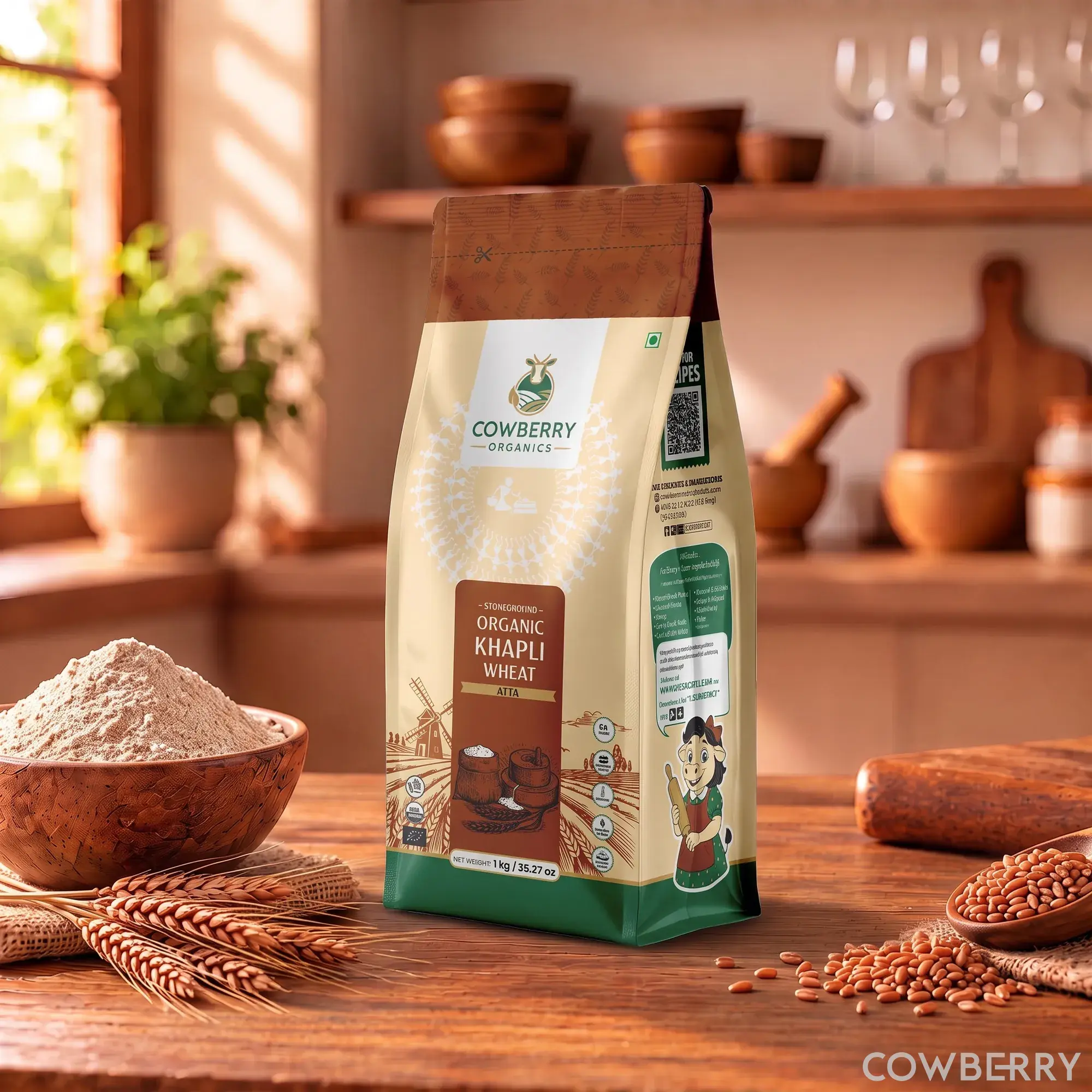
COWBERRY's khapli: the whole grain and the atta come from Deccan plateau farms in Maharashtra and Madhya Pradesh, grown with cow-based farming, hand-harvested at natural ripeness, and ground slowly in a stone chakki so the bran and germ stay in the flour; both are India Organic, USDA & EU certified.
More on khapli wheat
Once a pack of khapli atta is in the kitchen, the next questions are practical: does it fit a gluten-free diet, and what can you cook with it?
- Is khapli atta gluten free? Why it is not, and what that means for khapli roti, bread and halwa if you have coeliac disease.
- What emmer wheat is used for: roti, paratha, bread, halwa and upma from the flour, and khichdi and dalia from the whole grain.
- Khapli atta recipes grouped by meal, from rotis, parathas and theplas to a jaggery halwa.
- Khapli atta bread: a yeasted loaf of two parts khapli atta to one part sharbati atta.
- Khapli atta ke fayde aur nuksan: the benefits and side effects in Hinglish.
FAQs
What is khapli atta?
Khapli atta is whole-grain flour milled from khapli wheat, the Indian emmer (Triticum dicoccum), a hulled wheat and a separate species from the bread wheat in regular atta. It is coarser and a shade darker than sharbati atta and tastes nuttier. It contains gluten and is used like regular atta, with a softer dough and a 30-minute rest.
Is khapli atta gluten free?
No. Khapli is a wheat, and the NHS names only three gluten cereals: wheat, barley and rye. That rules it out for coeliac disease and wheat allergy. None of the sources used in this guide shows khapli is easier to digest than regular atta. Jowar, bajra or ragi make a roti without gluten.
What is emmer wheat?
Emmer wheat is Triticum dicoccum, the wheat sold in India as khapli and a different species from the bread wheat (Triticum aestivum) in regular atta. Its kernels stay in a husk after threshing and need dehulling before milling. A 2017 paper in Plant Science traces it to wild emmer, whose cultivation began in southwest Asia. Its flour makes nutty, soft rotis and halwa.
Does khapli atta have protein?
Yes. There is no measured khapli figure, but the IFCT 2017 whole-wheat stand-in has 10.6 g protein per 100 g, about 3.2 g in the 30 g of flour that makes one roti. In a 2023 field trial, emmer grain carried more protein than bread wheat grown beside it. Serve the roti with dal: the ICMR-NIN guidelines note that cereals and pulses together give better-quality protein.
Can khapli atta cause constipation?
Not as a rule. None of this guide's sources studies khapli and constipation directly, but as a whole atta it has about 11.2 g fibre per 100 g on the IFCT whole-wheat figures, and the ICMR-NIN guidelines say dietary fibre supports proper bowel function and reduces constipation. Add it a roti at a time and drink enough water, and if constipation carries on, talk to your doctor or dietitian.
How to eat khapli atta?
Use it wherever a recipe says wheat atta: roti, paratha, puri, thepla, halwa, laddu and pancakes. For rotis, knead a soft dough with warm water, a little wetter than for sharbati, and let it rest for 30 minutes. A family raised on sharbati can begin with a half-and-half mix, as the roti recipe suggests for the first week, then go fully khapli.
Is khapli atta good for diabetics?
It can take the place of your usual grain, not sit on top of it. Its only GI evidence is a boiled emmer pasta at 40; the two wheat entries tested in India average 47, and no khapli roti is in the database. Count the rotis, serve them with dal and vegetables, and before you rework your plan around khapli, talk to your doctor or dietitian.
Why is khapli atta costly?
Partly because it is a hulled wheat: every kernel has to be dehulled before milling, an extra step sharbati does not need. None of the sources used in this guide gives yield or crop-area figures, so no other cause is claimed here. You are paying for that extra work and for its taste, not for a different nutrition table; use it where its flavour matters most.
References
- Indian Food Composition Tables (IFCT) 2017, ICMR-National Institute of Nutrition
- University of Sydney glycemic index database (GI search)
- University of Sydney: about the glycemic index
- Lovegrove A, Dunn J, Pellny TK et al. Comparative compositions of grain of bread wheat, emmer and spelt grown with different levels of nitrogen fertilisation. Foods, 2023
- Hebelstrup KH. Differences in nutritional quality between wild and domesticated forms of barley and emmer wheat. Plant Sci, 2017
- NHS: coeliac disease
- Dietary Guidelines for Indians, ICMR-National Institute of Nutrition
Shop this article
Keep reading
Foxtail millet vs quinoa: nutrition, taste and which to choose
Foxtail millet in Kannada, Hindi, Tamil and other Indian names
10 benefits of kangni (foxtail millet) and its side effects