by COWBERRY

7 minute read
Kala chana for weight loss: calories, protein and portions

Kala chana for weight loss works as a swap, not an extra: a 30 g katori of cooked dal brings 86 kcal, 5.6 g of protein and 7.6 g of fibre, and in pooled trials, diets with pulses lost a modest 0.34 kg more than diets without, over a median of 6 weeks. The bean's full story is on the kala chana guide; what follows is the weight-loss case.
Short answer: does kala chana help with weight loss?
Yes, in one specific way: it helps you feel full on fewer calories, so it is easier to eat less without fighting hunger. ICMR-NIN puts the mechanism plainly: fibre in the diet slows the uptake of carbohydrate and fat and raises a meal's satiety value, while legumes provide sustained energy and help you feel full, trimming the need for extra calories. In a pooled analysis of 21 trials covering 940 people, diets with pulses lost an average of 0.34 kg more over a median of 6 weeks than diets without. The catch is that the chana has to replace something, and the rest of the diet has to stay sensible. The bean itself is on the kala chana guide.
The numbers: calories, protein and fibre per portion
IFCT 2017's numbers for raw whole kala chana, shown in the table, run per 100 g: 287 kcal, 18.77 g of protein, 25.22 g of fibre and 5.11 g of fat. Portions make the case: a 30 g katori of cooked dal holds about 86 kcal, 5.6 g of protein and 7.6 g of fibre, while one serving (50 g dry) holds about 144 kcal, 9.4 g of protein and 12.6 g of fibre. Across the pooled trials, the median intake was 132 g of pulses a day, about one serving by the paper's own measure, not the same as the 50 g dry serving above. What matters is not the exact gram but what the chana replaces and how full it leaves you, and ICMR-NIN's point is the fibre and protein together: fibre increases the satiety value of a meal.
| Nutrient | Kala chana (bengal gram, whole), raw |
|---|---|
| Energy (kcal) | 287 |
| Protein (g) | 19 |
| Fat (g) | 5.1 |
| Carbohydrates (g) | 40 |
| Dietary fibre (g) | 25 |
| Iron (mg) | 6.8 |
| Calcium (mg) | 150 |
| Magnesium (mg) | 160 |
| Potassium (mg) | 935 |
| Sodium (mg) | 27 |
| Zinc (mg) | 3.4 |
| Folate (mcg) | 233 |
| Glycemic index (GI) | 23 |
Per 100 g raw, edible portion. Composition: IFCT 2017 (ICMR-NIN). GI: University of Sydney GI database. — means not reported. These are average values for the food; the label on a pack gives the values for that product.
How much kala chana for weight loss, and how to eat it
Start where every swap starts: a 30 g katori of cooked dal at one meal, standing in for part of the rice or roti, then the full 50 g serving if that suits you. That one swap is the whole mechanism: the katori costs about 86 kcal and fills the plate space, so the rice portion shrinks without the meal shrinking. ICMR-NIN also names the snack version: roasted or boiled beans, lobia, chickpeas, and peanuts can serve as nutritious snack options, so a small bowl of boiled or dry-roasted kala chana works where chips would. Whole kala chana soaks 6 to 8 hours (the hot quick soak covers the short-of-time case), then cooks in fresh water until soft; the soak itself is walked through on black chana soaked overnight. Eat it as part of meals, not alongside them.
Better and worse ways to eat it
Better. Boiled kala chana with lemon, onion and tomato; dry-roasted chana as a snack; chana chaat without the sev and sweet chutney; black chana khichdi cooked in ICMR-NIN's 3:1 cereal-pulse ratio; kala chana curry with one roti and a sabzi. Worse. Fried chana namkeen and deep-fried snacks, which pile oil on top of the bean's 287 kcal per 100 g; black chana laddu and chana sweets, which are dessert whatever the legume; thick ghee gravies; and an extra bowl of chana eaten after a full meal, which adds the katori's 86 kcal instead of replacing them.
What to avoid
- Eating chana on top of your usual meals. The benefit is replacement: the katori's 86 kcal must take the place of rice or roti, not sit beside it.
- Frying. Dry-roasting or boiling keeps the snack version light; frying undoes it.
- Sweetening. Jaggery, sugar and sweet chutneys add back the calories the chana saves.
- Judging by the scale alone. Water, salt and the time of day move the number; the meal portions are the steady measure.
- Extreme diets that cut whole food groups. Chana helps inside a balanced plan, not instead of one.
What the research says
For pulses and body weight, the anchor study is a 2016 systematic review with meta-analysis in the American Journal of Clinical Nutrition. Kim and colleagues pooled 21 randomised controlled trials and 940 participants, setting diets with whole dietary pulses against diets without them. Over a median of 6 weeks, the pulse diets showed an average extra loss of 0.34 kg (95% CI -0.63 to -0.04 kg), with a median intake of 132 g of pulses a day (about one serving a day, in the paper's terms). The loss showed up both in diets meant for weight loss and in diets meant only to maintain weight, and six trials suggested body fat percentage may come down as well. The effect is modest, which is exactly how to read it: pulses nudge a diet that is already working.
Talk to your doctor or dietitian
Before you rebuild your plate around any single food, check with your doctor or dietitian, especially if you have a condition, take medication or are pregnant or breastfeeding. A dietitian can fit the katori or serving into your calorie target, and a doctor can rule out reasons weight is stuck that no legume will move, such as thyroid or medication effects. Weight loss is a medical topic when it is large or stubborn; let the clinic decide the target and the pace. Take the plan to your doctor or dietitian before you begin.
FAQs
Is kala chana good for weight loss?
Yes, as a replacement: a 30 g katori of cooked dal brings about 86 kcal with 5.6 g of protein and 7.6 g of fibre, and it fills plate space that rice or roti would have taken. In pooled trials, diets with pulses lost a modest 0.34 kg more than diets without, over a median of 6 weeks. It helps a plan; it is not a plan by itself.
Is black chickpeas good for weight loss?
Yes, on the same terms: black chickpeas carry 18.77 g of protein and 25.22 g of fibre per 100 g of the raw bean, and the 2016 meta-analysis of 21 trials of pulses (beans, lentils, chickpeas and dry peas) found an average 0.34 kg extra loss over a median of 6 weeks. The swap still has to happen: replace part of the grain, do not add the chana on top.
How many calories are in a katori of kala chana?
A 30 g katori of cooked dal works out to about 86 kcal, with 5.6 g of protein and 7.6 g of fibre, and one serving (50 g dry) to about 144 kcal with 9.4 g of protein and 12.6 g of fibre. The dry bean itself is 287 kcal per 100 g (IFCT 2017).
Can I eat kala chana at night for weight loss?
Yes, in a light form: boiled chana by the small bowl or a thin kala chana curry at dinner, taking the place of part of the rice or roti, keeps the meal filling without heavy oil. Skip the fried and sweetened versions at night. What matters for weight loss is the day's total, not the clock.
How much kala chana per day for weight loss?
Start with a 30 g katori of cooked dal as part of one meal, and go up to a 50 g serving if it suits you. The pulse trials behind the weight effect had a median intake of 132 g a day; nothing says you must match that, and your calorie target decides.
Does kala chana reduce belly fat?
No single food removes belly fat; weight loss comes off where the body decides. In the 2016 meta-analysis, six trials suggested that diets with pulses may reduce body fat percentage, which is a whole-body effect, not a belly one. Chana can help you stay in a calorie deficit; it cannot pick the spot.
References
- Indian Food Composition Tables (IFCT) 2017, ICMR-National Institute of Nutrition
- Dietary Guidelines for Indians, ICMR-National Institute of Nutrition
- Kim SJ, de Souza RJ, Choo VL, et al. Effects of dietary pulse consumption on body weight: a systematic review and meta-analysis of randomized controlled trials. Am J Clin Nutr, 2016
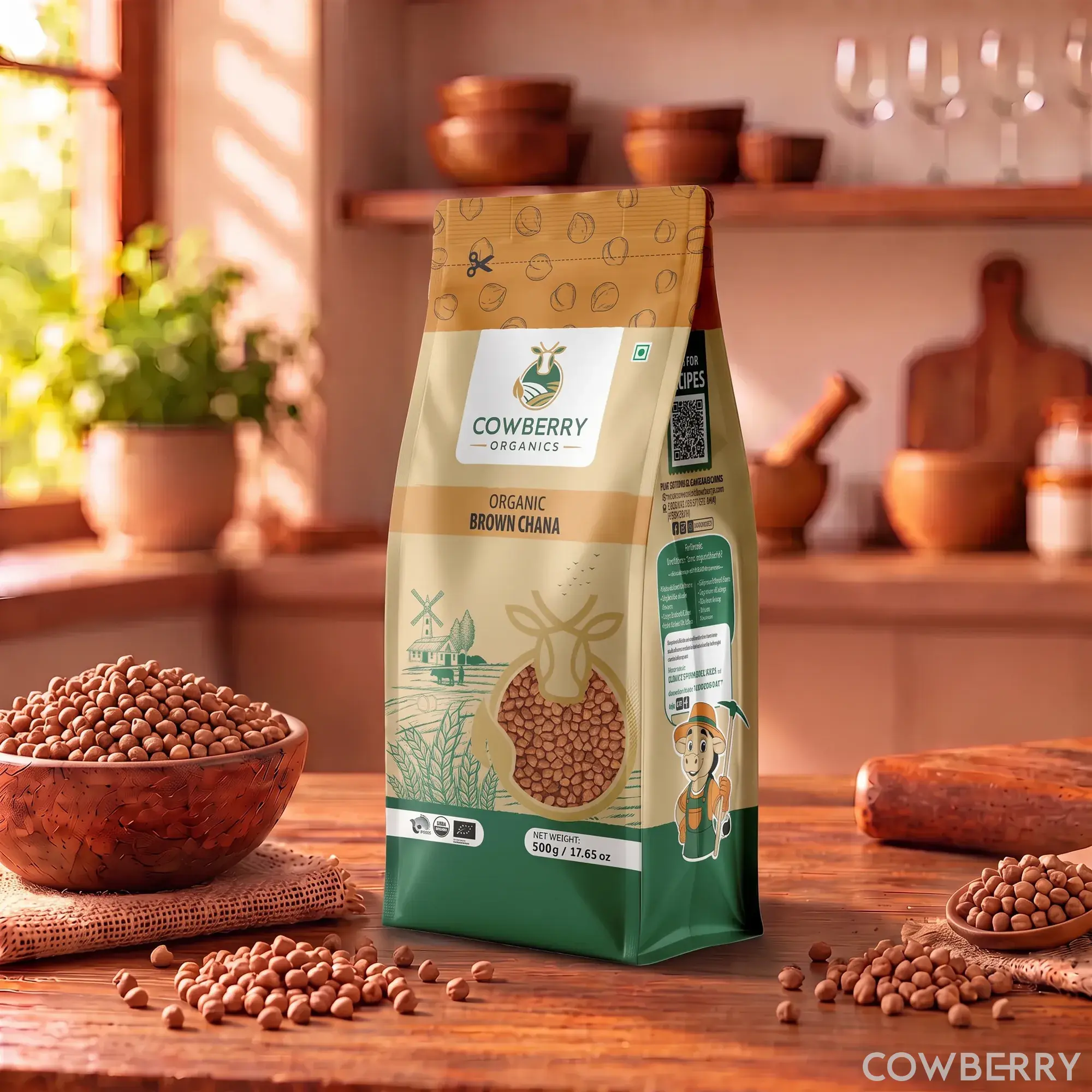
Shop this article
Keep reading
Green gram plant: crop, varieties and how it grows in India
Rajma vs lobia: difference, nutrition and which to choose
Rajma plant: how rajma is grown in India (it is not a tree)