by COWBERRY

7 minute read
Is rajma good for diabetes? GI, carbs and portion guide

Is rajma good for diabetes? Yes, when a measured portion stands in for a share of the plate's rice or roti, not when it is piled on as an extra. Cooked rajma beans average a GI of 45 in India tests (low), with 16.6 g of fibre per 100 g (IFCT 2017), and a 2009 meta-analysis found pulses brought down fasting blood glucose, in people with diabetes and without.
Short answer: is rajma good for diabetes?
Rajma suits a diabetes plate when three things hold: the portion is measured, the dal replaces a share of rice or roti, and it arrives fully cooked rather than as an add-on. The advantages are real but modest: a low tested GI, plenty of fibre and a good share of protein. When 41 controlled trials were pooled in 2009, pulses eaten by themselves pulled down fasting blood glucose and fasting insulin, and pulses placed inside low-GI or high-fibre diets shifted longer-term markers of blood sugar control in the same direction. None of that makes rajma a medicine, and the carbohydrate in it still counts toward your meal total.
Rajma glycemic index and carbs: the numbers
Below are the per-100 g figures for raw rajma as listed in IFCT 2017. For diabetes, carbohydrate, fibre and GI are the three numbers to read together.
GI: 45, the mean of two India tests
Two India-tested entries cover cooked kidney beans in the GI database kept by the University of Sydney: a 1981 test of boiled rajmah scored 19, and a 1991 test of beans left to soak half a day, held moist a further day and steamed scored 70. The mean of the two, 45, sits in the low band, which runs 55 and below, while the high band starts at 70 (University of Sydney categories), so the steamed test alone sits at the high-band line. For context, eleven tests of plain boiled kidney beans outside India span 9 to 51 with a mean of 30. Every value is for beans cooked and eaten as food; the GI of a rajma curry or a plate of rajma chawal depends on the recipe around the beans.
Carbohydrate, fibre and protein
Raw rajma carries 48.6 g of carbohydrate, 16.6 g of fibre and 19.9 g of protein per 100 g, with 300 kcal (IFCT 2017). The fibre is the number to watch: the dietary guidelines note that fibre delays the absorption of carbohydrate and fat from food and adds to how filling the meal feels (Dietary Guidelines for Indians, 2024). For every nutrient in one place, see the rajma protein per 100 g page.
| Nutrient | Rajma (red kidney beans), raw |
|---|---|
| Energy (kcal) | 300 |
| Protein (g) | 20 |
| Fat (g) | 1.8 |
| Carbohydrates (g) | 49 |
| Dietary fibre (g) | 17 |
| Iron (mg) | 6.1 |
| Calcium (mg) | 126 |
| Magnesium (mg) | 173 |
| Potassium (mg) | 1324 |
| Sodium (mg) | 10 |
| Zinc (mg) | 2.7 |
| Folate (mcg) | 316 |
| Glycemic index (GI) | 45 |
Per 100 g raw, edible portion. Composition: IFCT 2017 (ICMR-NIN). GI: University of Sydney GI database. — means not reported. These are average values for the food; the label on a pack gives the values for that product.
What the research says about pulses and blood sugar
Sievenpiper and colleagues pooled 41 controlled trials of non-oil-seed pulses, run in people with and without diabetes, in a 2009 meta-analysis. Diets built on pulses alone (11 trials) lowered fasting blood glucose and fasting insulin; pulses eaten inside low-GI diets (19 trials) lowered HbA1c or fructosamine; and pulses inside high-fibre diets (11 trials) lowered fasting blood glucose and glycated proteins. How far each marker moved varied widely between trials, and the studies fed lentils, chickpeas and beans as a family rather than rajma alone. A 2014 review of pulses ends at the same place: the fibre and the low GI are what the authors credit with helping people with diabetes hold blood glucose and insulin steady.
How much rajma per meal: katori and serving guide
Portion first, then pairing. A katori of rajma cooked from 30 g of dry beans lands near 90 kcal and 14.6 g of carbohydrate; a fuller serving cooked from 50 g dry lands near 150 kcal and 24.3 g of carbohydrate, with 10 g of protein and 8.3 g of fibre. Keep the 30 g katori for a dal beside a meal and the 50 g serving for the days rajma is the centre of the plate.
How much in a day
The Dietary Guidelines for Indians put 85 g of pulses on the adult daily plate, spread over the day as dal or whole legumes. That is a general adult figure, not a diabetic one; how you split pulses across meals is for your dietitian to set, and rajma eaten in place of some rice or roti adds less carbohydrate than rajma on top of it.
Pairing rajma
Rajma with a smaller rice portion is the classic. A rajma chawal plate built from 50 g of rajma and 75 g of raw rice brings the rice's carbohydrate on top of the rajma's 24.3 g, so trim the rice before you trim the rajma. Rajma curry with a roti or two, or boiled rajma tossed through a salad, works the same way. Have tea at least an hour away from the meal: tea close to meals lowers iron absorption from plant foods. More ideas are on the rajma recipe roundup, and rajma glycemic index explains the GI in more detail.
Better and worse ways to eat rajma with diabetes
How rajma lands on the plate decides more than the beans themselves.
Better
- Rajma curry with a plain roti and a dry vegetable, in the portion your plan allows.
- Boiled rajma in a salad with cucumber, onion and tomato; the beans bring the fibre, not the dressing.
- A rajma khichdi that leans on rajma and vegetables and keeps the rice share small.
Worse
- Rajma plus a full rice plate. The dal then adds carbohydrate instead of replacing it.
- Curries finished with a lot of ghee or butter. The extra fat adds calories.
- Fried rajma snacks and sweetened rajma sweets turn a fibrous dal into a calorie-dense bite.
The rajma beans hub has the full numbers behind these choices.
Talk to your doctor or dietitian
Living with diabetes means balancing medication, glucose monitoring and a food plan made for one person, and a new staple dal sits across all three. If you are on insulin or tablets that bring blood glucose down, the carbohydrate you swap in can nudge readings either way, so hold your portions steady while rajma joins the menu and show your meter to the doctor at the next visit. Portion sizes, meal timing and the rest of the plate are your dietitian's call. Change what you eat only after you talk to your doctor or dietitian.
FAQs
Is rajma good for diabetes?
Yes, when a measured portion swaps in for a share of the plate's rice or roti rather than being piled on top. Rajma averages a GI of 45 (low) over two India tests and brings 16.6 g of fibre per 100 g, and a 2009 meta-analysis found pulses lowered fasting blood glucose and insulin in people with and without diabetes. The carbohydrate still counts, so ask your dietitian how much fits your plan.
How much protein in rajma?
Raw rajma gives 19.9 g of protein per 100 g (IFCT 2017). A katori of rajma cooked from 30 g of dry beans gives about 6 g of protein, and a 50 g dry serving gives about 10 g. Pair it with a cereal: ICMR-NIN says cereals, millets and pulses complement each other to provide good quality protein.
Which rajma is good for health?
Any whole rajma you cook well and eat regularly; the variety matters less than cooking and portion. The numbers above are IFCT 2017's for red rajma; no separate figures are given for each type. Soak overnight and cook the beans fully, because kidney beans carry lectins, anti-nutritional factors that can cause intestinal disorders (He 2018). See the types of rajma guide.
Can kidney beans cause gas?
They can: pulse galacto-oligosaccharides reach the lower gut without being digested in the small intestine, and their fermentation there lets off gas, though how far this explains the gas has recently been questioned (Thompson 2019). Most people adapt within a few weeks when intake is maintained. Soak the beans overnight and cook them fully, and begin with a small katori.
What is rajma?
Rajma is red kidney beans, the dried seeds of the common bean plant (Phaseolus vulgaris). In Indian kitchens it is cooked as a spiced curry, most famously with rice as rajma chawal. Per 100 g, raw rajma gives about 300 kcal, 19.9 g of protein and 16.6 g of fibre (IFCT 2017).
References
- Indian Food Composition Tables (IFCT) 2017, ICMR-National Institute of Nutrition
- Dietary Guidelines for Indians, ICMR-National Institute of Nutrition
- University of Sydney glycemic index database (GI search)
- University of Sydney: about the glycemic index
- Sievenpiper JL, Kendall CW, Esfahani A, et al. Effect of non-oil-seed pulses on glycaemic control: a systematic review and meta-analysis of randomised controlled experimental trials in people with and without diabetes. Diabetologia, 2009
- Mudryj AN, Yu N, Aukema HM. Nutritional and health benefits of pulses. Appl Physiol Nutr Metab, 2014
- Thompson HJ. Improving human dietary choices through understanding of the tolerance and toxicity of pulse crop constituents. Curr Opin Food Sci, 2019
- He S, Simpson BK et al. Phaseolus vulgaris lectins: a systematic review of characteristics and health implications. Crit Rev Food Sci Nutr, 2018
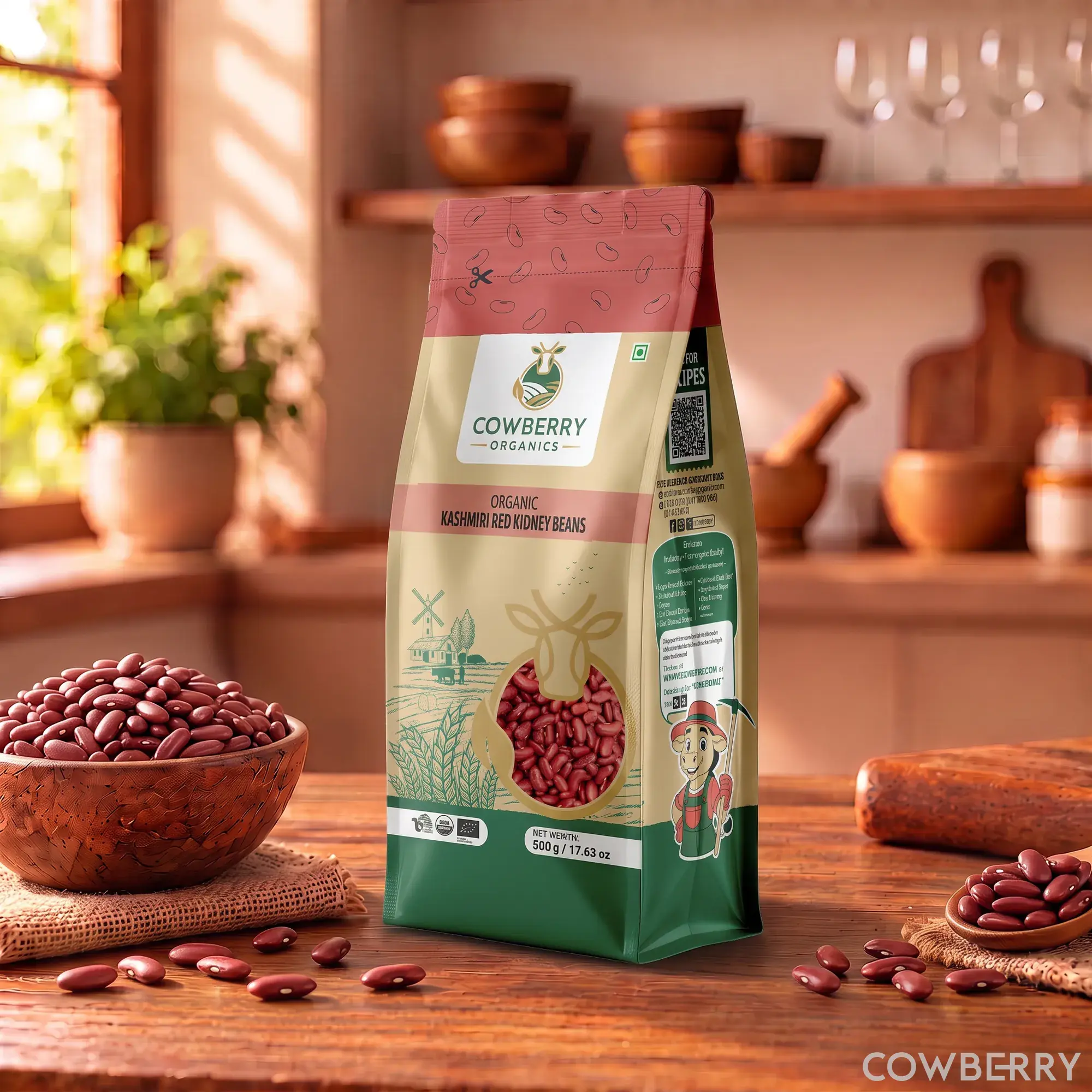
Shop this article
Keep reading
Green gram plant: crop, varieties and how it grows in India
Rajma vs lobia: difference, nutrition and which to choose
Rajma plant: how rajma is grown in India (it is not a tree)