by COWBERRY

4 minute read
Sabut moong in English: green gram names in Indian languages

Sabut moong in English is green gram: the whole seed of Vigna radiata, sold with its green skin on, unlike the split moong dal. Every name IFCT 2017 lists for sabut moong is here, from English to Sanskrit, with the names people confuse with it sorted out. The full green gram story starts on the hub.
Sabut moong in English: the quick answer
Sabut moong in English is green gram, and the sabut moong meaning in English is whole green gram: IFCT 2017 records the seed as 'Green gram, whole' under food code B011. Sabut means whole in Hindi, and moong is the bean's Hindi name, so sabut moong is simply the whole seed with its green skin on. IFCT 2017 lists a local name for it in thirteen languages, from Mung in Hindi to Mudra in Sanskrit, and the table below carries each one.
| Language | Name (romanised) |
|---|---|
| English | Green gram, whole |
| Hindi | Mung, Moong |
| Marathi | Mun |
| Gujarati | Mug |
| Punjabi | Sabut moong dal |
| Bengali | Moog |
| Odia | Muga |
| Assamese | Gota mogu mah |
| Kannada | Hesare kalu |
| Telugu | Pesalu |
| Tamil | Pasipayir |
| Malayalam | Cheru Pararu |
| Urdu | Moong |
| Sanskrit | Mudra |
| Botanical name | Vigna radiata |
Source: IFCT 2017 (ICMR-NIN) local-names list. — means no name recorded in the source.
Hindi ‘Moong’: spelling variant of the IFCT 2017 name ‘Mung’.
Green gram in English: the botanical name and the menu words
IFCT 2017's English entry is 'Green gram, whole', and the botanical name is Vigna radiata. In English-language science writing the bean is called mung bean, as in a 2019 Nutrients review, and grocery labels abroad often say mung bean or moong bean for the same seed. In the Punjabi column IFCT 2017 lists 'Sabut moong dal' for the whole bean, even though dal usually means the split form. The whole-versus-split choice is laid out on green gram vs moong dal.
Green gram meaning in Kannada, Telugu, Tamil and Malayalam
In the south, green gram goes by four names: Hesare kalu in Kannada, Pesalu in Telugu, Pasipayir in Tamil and Cheru Pararu in Malayalam. The north and the west speak the m-row: Mung in Hindi, Mun in Marathi, Mug in Gujarati, Moog in Bengali and Muga in Odia, with Gota mogu mah in Assamese. Urdu lists Moong, and Sanskrit Mudra. Mung, Mun, Mug, Moog and Muga sound close to each other. Every spelling here is exactly as IFCT 2017 gives it for Green gram, whole.
Names people confuse with sabut moong
Three names trip people up. Moong dal: the same seed split and husked, listed separately in IFCT 2017 as 'Green gram, dal', with its own Hindi name, Mug dal, and its Kannada name, Hesara bele. Black gram: a different bean entirely, the black-skinned urad, where green gram is green. Moong sprouts: the same seed germinated, not a different bean at all; green moong and green gram are one thing, moong being the Hindi word and gram the English one from IFCT. The whole-versus-split difference is on green gram vs moong dal, and the sprouting method on how to sprout moong.
Where the name ends and the bean begins
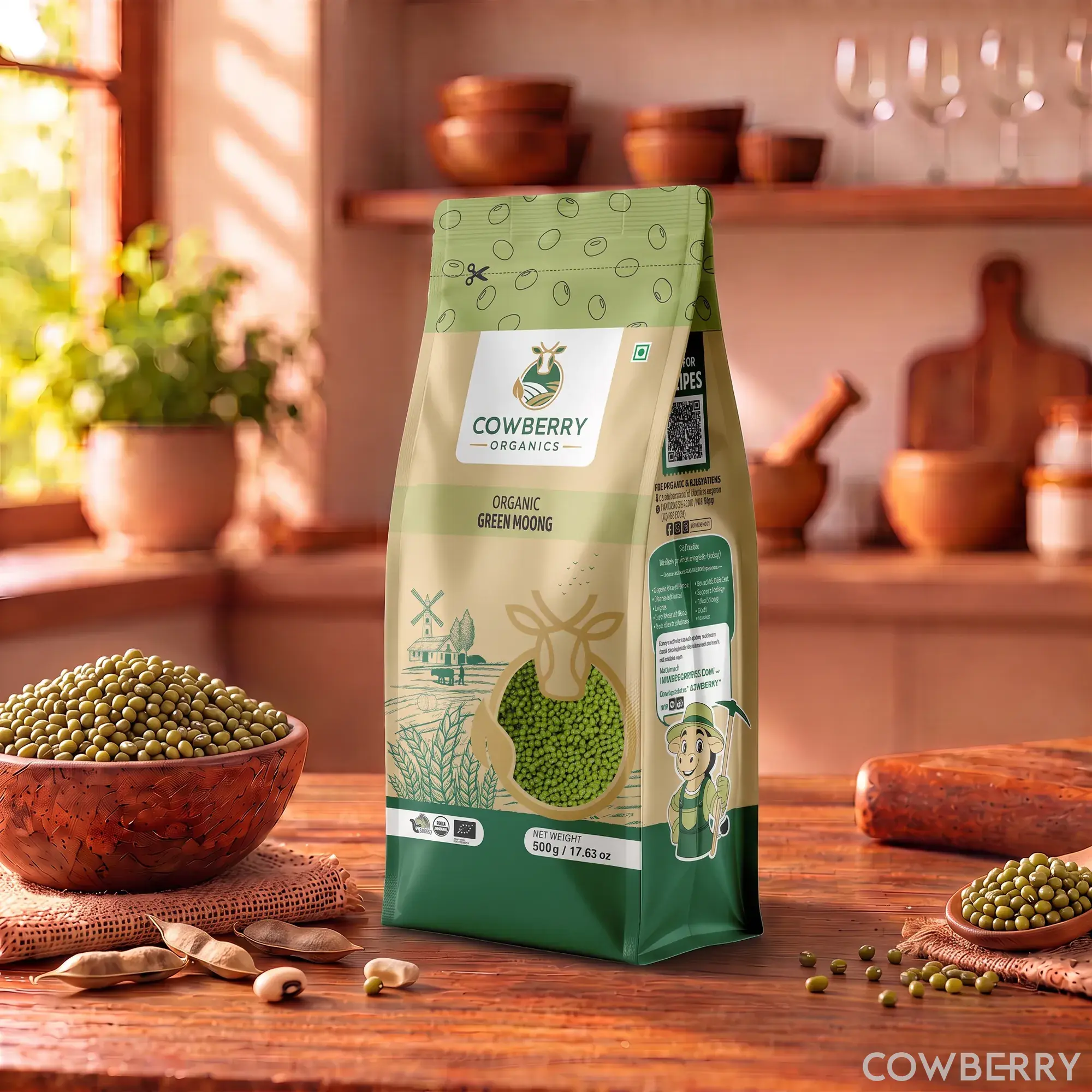
Whatever the language, the bean behind the name is the same: whole green gram grown in Rajasthan and Central India with cow-based, chemical-free farming and picked at peak maturity, which is how COWBERRY's Organic Green Moong is grown. Cook it whole as sabut moong dal, grind it soaked for pesarattu, or sprout it; whatever the kitchen calls it, the name on the pack is the one this page unpacked. Everything else about the bean is on the green gram hub.
FAQs
What is sabut moong?
Sabut moong is whole green gram, the entire seed of Vigna radiata with its green skin on. In English IFCT 2017 lists it as 'Green gram, whole'. It is the same bean as moong dal, only unsplit; soaked it cooks into sabut moong dal, and sprouted it becomes moong sprouts.
What is green gram in Hindi?
Green gram is mung in Hindi; the everyday word for the bean is moong, and sabut moong means whole moong. IFCT 2017 lists 'Mung' in its Hindi column, and 'Moong' in the Urdu column.
Which is green gram?
Green gram is the small, oval green bean sold whole as sabut moong; split and husked it becomes moong dal, and sprouted it becomes moong sprouts. In the shop, look for the small whole beans with green skins; the yellow split ones beside them are the same bean in dal form.
What is sabut moong dal?
Sabut moong dal is the curry cooked from whole green gram, the sabut moong bean simmered in its skin, not the yellow moong dal. The Punjabi column in IFCT 2017 even lists 'Sabut moong dal' as its name for the whole bean.
Difference between green gram and black gram?
They are different beans. Green gram is Vigna radiata, the green bean behind moong dal and sprouts. Black gram is Phaseolus mungo in the IFCT list, the black-skinned bean sold as urad and split into urad dal. Both belong to the pulses, which supply protein and fibre (a 2014 review).
References
- Indian Food Composition Tables (IFCT) 2017, ICMR-National Institute of Nutrition
- Mudryj AN, Yu N, Aukema HM. Nutritional and health benefits of pulses. Appl Physiol Nutr Metab, 2014
- Hou D, Yousaf L, Xue Y et al. Mung bean (Vigna radiata L.): bioactive polyphenols, polysaccharides, peptides, and health benefits. Nutrients, 2019
Shop this article
Keep reading
Green gram plant: crop, varieties and how it grows in India
Rajma vs lobia: difference, nutrition and which to choose
Rajma plant: how rajma is grown in India (it is not a tree)