by COWBERRY

10 minute read
Bay leaf (tej patta): names, nutrition, benefits and how to cook it

Bay leaf is the dried aromatic leaf that seasons dal, pulao, biryani and curries, then leaves the pot before the food is served. This hub separates the two leaves behind the name, prints the one nutrition record that exists, walks through the one human trial behind the benefit claims, and covers cooking, tea, storage and buying.
What is bay leaf?
Bay leaf is the dried leaf of Laurus nobilis, the Mediterranean bay tree, and the USDA FoodData Central record files it under the name 'Spices, bay leaf'. In the kitchen it is a pot spice: cooks add one or two whole leaves to a simmering dish and remove them before serving, because the leaf is not meant to be eaten and stays tough even after long cooking. In India the name trail forks. Tej patta is the Hindi name for bay leaf. In India, the pack labelled tej patta usually holds Cinnamomum tamala, the Indian bay leaf from a different tree, while the food tables record only the European Laurus nobilis. The tree has travelled far beyond the Mediterranean: a 2022 review in the journal Plants calls Laurus nobilis an aromatic medicinal plant, widely cultivated across many parts of the world. Which leaf is which, and what the two names cover, is untangled in the tej patta vs bay leaf comparison, and the language trail runs through tej patta in English.
Bay leaf names in Indian languages
The recorded names are fewer than the internet suggests. The USDA record prints the English name 'Spices, bay leaf' and the scientific name Laurus nobilis, and no Indian-language names; IFCT 2017 carries no bay leaf entry at all, so it prints no Hindi, Marathi, Bengali or other regional names for the leaf either. The table below shows exactly what is recorded: Tej patta as the Hindi name, per the Wikipedia article on Cinnamomum tamala, and a dash in every row where no name is on record. Empty rows stay empty on this page; no name is invented to fill them.
| Language | Name (romanised) |
|---|---|
| English | Spices, bay leaf |
| Hindi | Tej patta |
| Marathi | — |
| Gujarati | — |
| Punjabi | — |
| Bengali | — |
| Odia | — |
| Assamese | — |
| Kannada | — |
| Telugu | — |
| Tamil | — |
| Malayalam | — |
| Urdu | — |
| Sanskrit | — |
| Botanical name | Laurus nobilis |
Source: USDA FoodData Central record 170917 (English and scientific name only; no Indian-language names in source). — means no name recorded in the source.
Hindi ‘Tej patta’: Wikipedia: Cinnamomum tamala.
Bay leaf nutrition per 100 g
One nutrition record exists for bay leaf, and it belongs to the European leaf. The USDA FoodData Central entry for 'Spices, bay leaf', Laurus nobilis, prints 313 kcal of energy, 7.61 g of protein, 8.36 g of fat, 75.0 g of carbohydrate, 26.3 g of fibre, 43.0 mg of iron and 834 mg of calcium per 100 g. IFCT 2017 adds nothing: it has no bay leaf entry, and the tej patta sold in India, Cinnamomum tamala, shows up in neither database, so Laurus nobilis is the only leaf the numbers below can describe. The second thing to read into the table is scale: no dish cooks 100 g of leaf, and once the leaf has flavoured the pot it is lifted out again, so the mineral column mostly stays in the jar. The dedicated bay leaf nutrition facts 100g page holds the complete table and the arithmetic of a single leaf. Beside two spices that do get eaten the contrast shows: fresh curry leaves print 7.41 g of protein and 16.83 g of fibre per 100 g, cloves 34.52 g of fibre and 567 mg of calcium, and the leaf-to-leaf comparison is on curry leaves vs bay leaf.
| Nutrient | Bay leaf, dried | Curry leaves, fresh | Cloves |
|---|---|---|---|
| Energy (kcal) | 313 | 64 | 187 |
| Protein (g) | 7.6 | 7.4 | 5.9 |
| Fat (g) | 8.4 | 1.1 | 8.4 |
| Carbohydrates (g) | 75 | 4.5 | 19 |
| Dietary fibre (g) | 26 | 17 | 35 |
| Iron (mg) | 43 | 8.7 | 9.4 |
| Calcium (mg) | 834 | 659 | 567 |
| Magnesium (mg) | 120 | 182 | 334 |
| Potassium (mg) | 529 | 584 | 1434 |
| Sodium (mg) | 23 | 19 | 183 |
| Zinc (mg) | 3.7 | 1.2 | 1.1 |
| Folate (mcg) | 180 | 117 | 33 |
| Vitamin C (mg) | 46 | 6 | — |
Per 100 g raw, edible portion. Composition: USDA FoodData Central (SR Legacy), FDC ID 170917, NDB 2004; IFCT 2017 (ICMR-NIN). — means not reported. These are average values for the food; the label on a pack gives the values for that product.
Benefits of bay leaf
The trial: numbers and limits
The benefit claims made for bay leaf lead back to a single source: a 2009 study in the Journal of Clinical Biochemistry and Nutrition, testing the ground leaf in capsules. Its forty volunteers, all adults with type 2 diabetes, swallowed 1, 2 or 3 g daily for a month, against a placebo group, and the results are the numbers those lists quote: total cholesterol finished 20 to 24 percent lower, LDL cholesterol 32 to 40 percent lower and fasting glucose 21 to 26 percent lower in the leaf groups after the thirty days; the placebo group showed nothing comparable. The same paper reported HDL and triglyceride figures for only some of its groups, so neither is claimed here.
The limits matter as much as the results. Forty volunteers is a small group, a month is a short window, and nothing follows the effect into a sixth month. The capsules held Laurus nobilis, the European leaf, so the Indian tej patta, Cinnamomum tamala, sat outside the trial, and the gram amounts were chosen by the researchers, not offered as a dose for anyone to copy. The full walkthrough, numbers and cautions included, is on the is bay leaf good for diabetes page.
Traditional use
Beyond the trial sits a long kitchen tradition. Spices have filled both culinary and medicinal roles for centuries, as a 2014 review in the International Journal of Molecular Sciences puts it, and an older paper in the Asia Pacific Journal of Clinical Nutrition, from 2008, records the effort to give India's traditional spice uses a science-based footing, much of it still at the laboratory and animal stage. For the claims the trial does not support, and the cautions that go with them, see the tej patta benefits page; the same story is told in Hinglish on bay leaf khane ke fayde.
Side effects, and who should limit it
Cooked in food, bay leaf amounts to an aroma and nothing more, and the real cautions concern misuse, not the leaf itself. No published daily amount exists for bay leaf; the 1, 2 and 3 g capsule amounts in the 2009 trial were research amounts, never a dose offered to anyone. Swallowing grams of the powder is not the same act as cooking a leaf in dal, and no leaf replaces a medicine that a doctor has prescribed. Keep the leaf in the pot, mention any supplement you add to the doctor, and do not let a spice take the place of prescribed diabetes or cholesterol medicines, the very two markers the trial measured. For most eaters the leaf simply leaves the dish before it reaches the plate, and that is the whole safety story. Talk to your doctor or dietitian first if a spice or supplement is meant to stand in for a medicine.
How to cook with bay leaf
The method is one rule: whole leaf in at the start, whole leaf out before serving. The leaf goes into the hot oil or the simmering liquid of dal, pulao, biryani, curries, soups and stews, releases its aroma while the dish cooks, and is lifted out when the food is done. That aroma is the leaf's essential oil, and the 2022 review in Plants, the journal's piece on Laurus nobilis, centres it on the compound 1,8-cineole; the same review notes the oil shifts with environmental conditions, location, season and the drying method, which is why two harvests rarely smell identical. In practice one or two leaves season a family-sized pot, and the flavour it leaves behind is the point, not the leaf itself. Dish-by-dish timing, when to add and when to remove, and the Indian dishes that lean on the leaf are on the how to use bay leaf in cooking page.
Bay leaf tea and water
Steeped in hot water, the leaf makes a mild herbal tea; a leaf simmered in a cup, or soaked in water overnight, is the usual method. What a cup delivers has not been measured: no study has put bay leaf tea itself to the test, and the trial behind the claims used 1, 2 or 3 g of ground leaf pressed into capsules, never a steeped cup. Enjoyed as a flavoured drink the tea asks nothing of the evidence; as medicine it asks too much, because nothing shows a brewed cup moving the numbers the capsule trial moved. For the pot the leaf is a seasoning; for the cup it is the same leaf steeped in hot water, and the overnight soak is simply a longer, colder steep. Neither version is a measured dose of anything, and neither needs to be. The cup and soak methods, step by step, are on the how to make bay leaf tea page.
How to store bay leaf
Whole dried bay leaves are a pantry item, and what keeps them is dryness and a seal. The leaf's value is its volatile oil, and the 2022 review in the journal Plants records that the oil's composition depends on environmental conditions and the drying method, so the practical rule follows: an airtight jar, away from moisture, heat and direct light, keeps the aroma in. There is no printed shelf life for bay leaf in IFCT 2017 or the USDA record, so this page will not quote one; a leaf that has lost its smell has lost its point, and that is the honest test. Whole leaves bought from a sealed pack last longest; once the pack is open, the jar takes over the pack's job.
Buying guide: what to look for
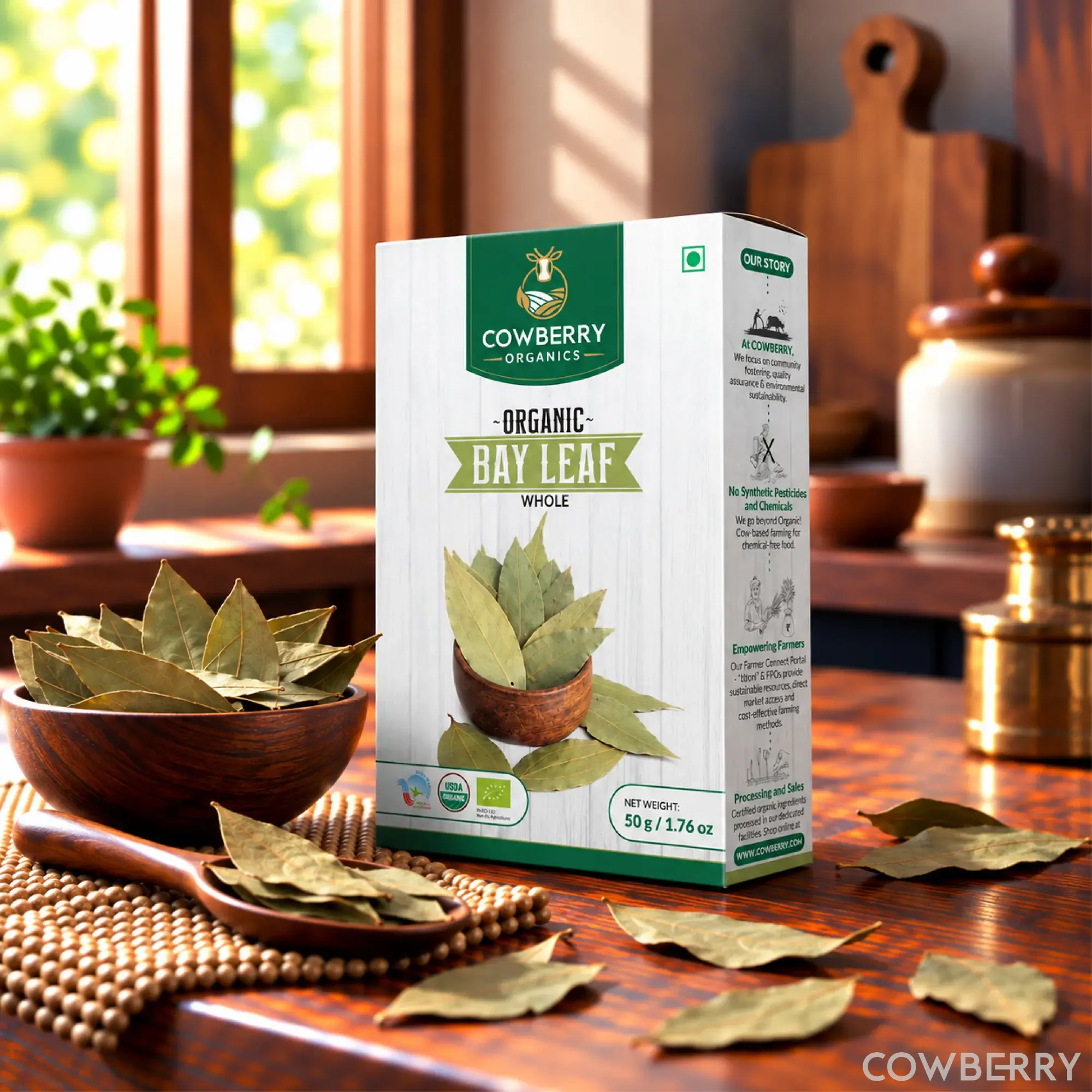
The Dietary Guidelines for Indians give the buying rule: since powdered spices are more likely to be adulterated, the whole leaf is the safer form, and the guideline's own words are 'whole spices, uniform in color, size and shape'. Bay leaf is sold whole, so the rule applies directly. COWBERRY's organic bay leaf is packed as whole leaves organically grown in West Bengal, naturally dried and gently cleaned in a 50 g pack, and the product is India Organic, USDA & EU certified. Buy whole leaves, keep them sealed and dry, and let the aroma do the talking.
FAQs
What is bay leaf?
A dried leaf used whole as a pot seasoning. The Mediterranean bay tree, Laurus nobilis, supplies the leaf the food tables record as 'Spices, bay leaf', added to dal, soups and curries for aroma and lifted out before serving; in Indian kitchens the Hindi name tej patta covers both that leaf and the similar Indian leaf, Cinnamomum tamala.
Is tej patta and bay leaf same?
Both names do the same job in the kitchen, but on the tree they are different leaves. The food tables' bay leaf comes from Laurus nobilis, the Mediterranean tree, while the pack sold as tej patta in India usually comes from Cinnamomum tamala, a different tree with a similar dried leaf. Both go into the pot whole and come out before serving.
Difference between tej patta and curry patta?
Different trees, different jobs. The bay leaf, tej patta, flavours the pot and is removed before serving, because the leaf does not soften even after long cooking. Curry patta is a different leaf that is eaten with the dish; the two share a name ending but little else in the kitchen.
Does tej patta expire?
No expiry is printed for the dried leaf in IFCT 2017 or the USDA record, so this page will not invent one. What fades is the aroma: the leaf's essential oil is the whole point, so a sealed jar in a cool, dry place is what keeps it useful. If the leaves still smell sharp when the jar opens, the oil is still doing its job; a leaf with no smell left has lost its job.
Does bay leaf help in weight loss?
No human trial puts bay leaf behind weight loss. The leaf enters the pot whole and leaves before serving, so it lends aroma without adding meaningful energy; what moves the scales is the whole plate, and one leaf in the dal is not it.
Which bay leaf is good for cooking?
The whole dried leaf, not the powder: the Dietary Guidelines for Indians warn that powdered spices are more likely to be adulterated, and bay leaf is sold whole for exactly that reason. The powdered form is precisely what the guideline's warning points at, so the whole leaf is the cooking form. Any whole leaf with a clear aroma works in the pot, and it is lifted out before serving.
References
- USDA FoodData Central
- Indian Food Composition Tables (IFCT) 2017, ICMR-National Institute of Nutrition
- Khan A, Zaman G, Anderson RA. Bay leaves improve glucose and lipid profile of people with type 2 diabetes. J Clin Biochem Nutr, 2009
- Paparella A, Nawade B, Shaltiel-Harpaz L et al. A Review of the Botany, Volatile Composition, Biochemical and Molecular Aspects, and Traditional Uses of Laurus nobilis. Plants (Basel), 2022
- Opara EI, Chohan M. Culinary herbs and spices: their bioactive properties, the contribution of polyphenols and the challenges in deducing their true health benefits. Int J Mol Sci, 2014
- Krishnaswamy K. Traditional Indian spices and their health significance. Asia Pac J Clin Nutr, 2008
- Dietary Guidelines for Indians, ICMR-National Institute of Nutrition
Shop this article
Keep reading
Coriander water benefits: what dhania water actually does
Peanuts in Hindi (moongfali): groundnut names in Indian languages
Coriander vs cilantro: are they the same herb?