by COWBERRY

10 minute read
Coriander seeds (dhania): names, nutrition, benefits and uses

Coriander seeds are the dried seed of the coriander plant, Coriandrum sativum, sold whole or ground; IFCT 2017 measures the whole seed at 269 kcal, 10.66 g of protein and 44.81 g of fibre per 100 g. One plant feeds three kitchen staples: the whole seeds, the powder and the fresh leaves. Names, nutrition, benefits, uses, storage and buying for all three follow.
What is coriander?
Coriander is one plant, Coriandrum sativum, and a 2015 Fitoterapia review by Laribi and colleagues places it in the Apiaceae family, valued for nutrition as much as for medicine. The same review records a wide range of traditional medicinal uses and sets out what chemists have found so far: each oil, from the seed and from the herb, has been studied for its chemical composition and for activities reported to include antimicrobial and antioxidant effects, most of that work done in the laboratory.
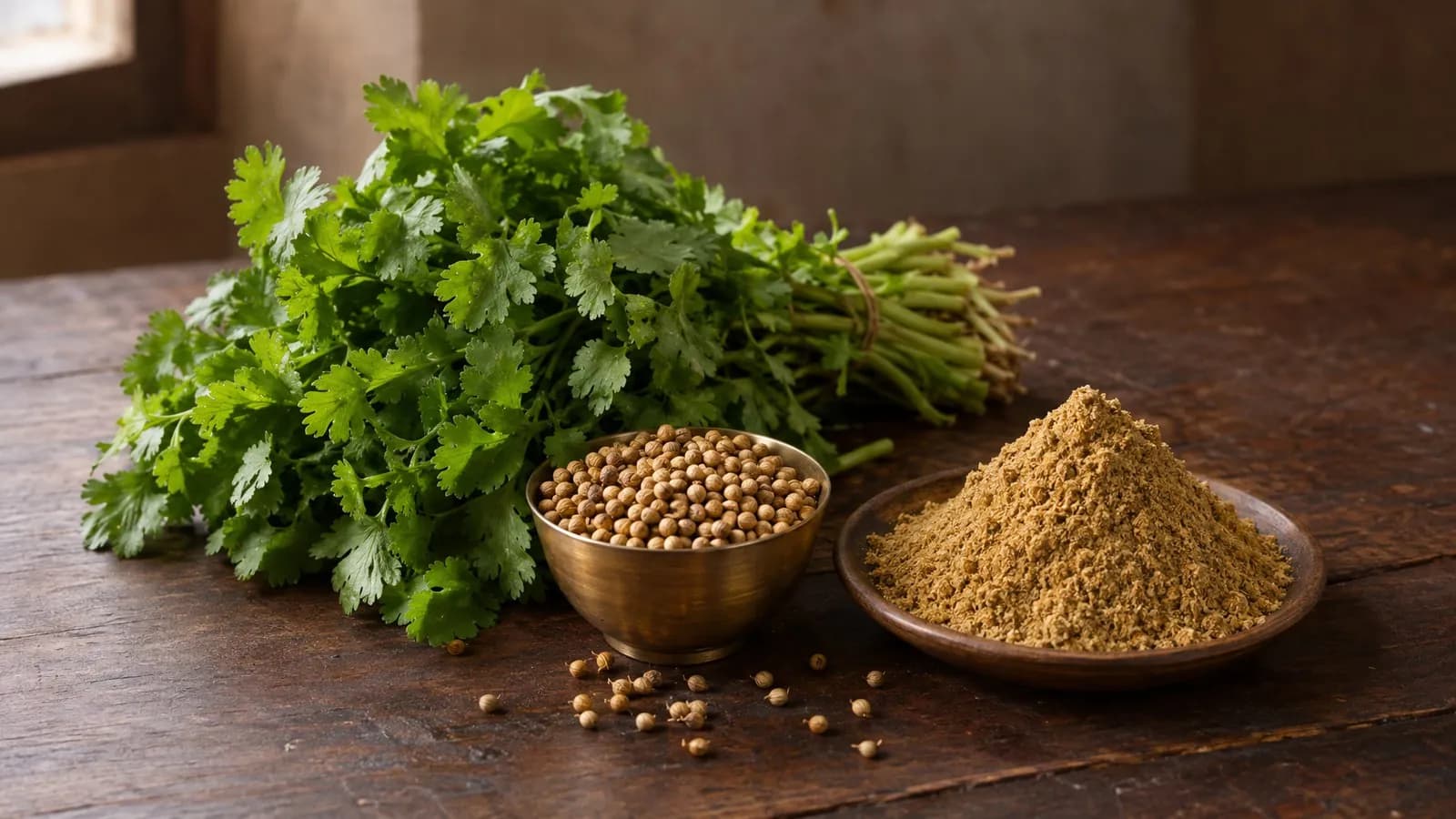
The plant supplies three kitchen staples from one sowing: the whole dried seeds, the ground powder, and the fresh green leaves. In Hindi all three answer to dhania, while American English uses cilantro for the leaf; the coriander vs cilantro page sorts the two words out. IFCT 2017 carries a full composition entry for the seeds, and the Dietary Guidelines for Indians give spices and herbs a place on the daily plate, with coriander (dhania) named in that group.
Coriander names in Indian languages
IFCT 2017 prints coriander seeds under their English name with regional names in 13 Indian languages, all gathered in the table below: dhania in Hindi and Punjabi, dhaniya in Urdu, dhane in Marathi, sukha dhana in Gujarati, dhone in Bengali, dhania in Odia, dhoniya in Assamese, kothamalli vidhai in Tamil, kothambari in Kannada, dhaniyalu in Telugu, kothambalari in Malayalam and dhanyaka in Sanskrit. Hara dhania is Hindi for the fresh green leaves, and ask by any of these names at an Indian market and the same round seed comes home. Whatever the language, the botanical name holds: Coriandrum sativum.
The ground spice has no separate Indian-language list: the USDA FoodData Central record for coriander powder is labelled only in English, as coriander seed, the dried seed spice, and Indian kitchens usually just say dhania powder or dhaniya powder. The dhaniya powder in english page walks through every name and every confusion.
| Language | Name (romanised) |
|---|---|
| English | Coriander seeds |
| Hindi | Dhania |
| Marathi | Dhane |
| Gujarati | Sukha dhana |
| Punjabi | Dhania |
| Bengali | Dhone |
| Odia | Dhania |
| Assamese | Dhoniya |
| Kannada | Kothambari |
| Telugu | Dhaniyalu |
| Tamil | Kothamalli vidhai |
| Malayalam | Kothambalari |
| Urdu | Dhaniya |
| Sanskrit | Dhanyaka |
| Botanical name | Coriandrum sativum |
Source: IFCT 2017 (ICMR-NIN) local-names list. — means no name recorded in the source.
Coriander seeds nutrition per 100 g
The table below holds the printed numbers for the two forms Indian kitchens keep, per 100 g of the dry spice. IFCT 2017 measures coriander seeds at 269 kcal, 10.66 g of protein, 17.47 g of fat and 12.98 g of carbohydrate, with 44.81 g of fibre, 17.64 mg of iron, 718 mg of calcium, 343 mg of magnesium and 1473 mg of potassium. Nearly half the seed's weight is fibre. USDA FoodData Central prints for the ground spice 298 kcal, 12.4 g of protein, 17.8 g of fat and 55.0 g of carbohydrate, with 41.9 g of fibre, 16.3 mg of iron, 709 mg of calcium and 21.0 mg of vitamin C, a value the whole-seed numbers lack. Pack labels can differ a little; the figures on this page stay with the two published sets above.
A 100 g portion is not how anyone cooks, though. One level teaspoon of the spice weighs about 5 g, which shrinks the numbers to about 13 kcal and 2.2 g of fibre for the seeds and about 15 kcal and 2.1 g of fibre for the powder. Neither form carries a published glycemic index figure. The full read, teaspoon by teaspoon, is on the coriander nutrition facts 100g page.
| Nutrient | Coriander seeds | Coriander powder |
|---|---|---|
| Energy (kcal) | 269 | 298 |
| Protein (g) | 11 | 12 |
| Fat (g) | 17 | 18 |
| Carbohydrates (g) | 13 | 55 |
| Dietary fibre (g) | 45 | 42 |
| Iron (mg) | 18 | 16 |
| Calcium (mg) | 718 | 709 |
| Magnesium (mg) | 343 | 330 |
| Potassium (mg) | 1473 | 1270 |
| Sodium (mg) | 34 | 35 |
| Zinc (mg) | 3.9 | 4.7 |
| Folate (mcg) | 22 | 0 |
| Vitamin C (mg) | — | 21 |
Per 100 g raw, edible portion. Composition: IFCT 2017 (ICMR-NIN); USDA FoodData Central (SR Legacy), FDC ID 170922, NDB 2013. — means not reported. These are average values for the food; the label on a pack gives the values for that product.
Benefits of coriander
The honest version of coriander benefits has three parts. Traditional use comes first: Krishnaswamy, writing in the Asia Pacific Journal of Clinical Nutrition in 2008, notes India's worldwide standing for spices and medicinal plants, and records that today's biomedical work is aimed at giving science-based evidence to the traditional uses.
Laboratory chemistry comes next, already covered above: seed and herb oils with antimicrobial and antioxidant activity shown in test settings. The newest is polyphenol research. Writing in Molecules in 2023, Scandar and colleagues work through polyphenol-rich coriander extracts and their record as protective agents in inflammation-linked conditions, which leads the authors to put coriander extract forward as a functional food candidate for obesity, metabolic syndrome and diabetes. That work is preclinical, resting on laboratory and animal studies, and the same review records that a polyphenol profile depends on the plant part and the way the extract is prepared; what holds for an extract has not been shown for a teaspoon in people.
The kitchen reality is the third part. Opara and Chohan, writing in the International Journal of Molecular Sciences in 2014, explain that culinary doses of a spice are tiny and arrive inside a dish, so pinning a true health benefit to the spoon is something the science has not yet done. The nutrient-by-nutrient reading is on the coriander benefits page, the Hindi summary on the dhania khane ke fayde page, the soaked-seed drink on the coriander water benefits page, and the weight question on the coriander for weight loss page.
Side effects: who should limit coriander
None of the sources reviewed for this page records harm from coriander eaten in kitchen amounts; an absence of reports is not itself a promise of safety, and the published work runs to laboratory and animal studies rather than long safety trials in people. What the research does not yet cover is worth one more line: the 2015 Fitoterapia review records that no report is available on how coriander works in reactive airway diseases such as asthma, so nothing on this page reads as medicine.
Two practical cautions follow. Extracts and capsules are not the spice: those polyphenol findings come from extracts made in particular ways, at amounts no teaspoon reaches, and the research reviewed here includes no human trial of a coriander supplement. And if you are on regular medicines or manage a long-term condition, let your doctor or dietitian decide what a spice should and should not do in your plan. The fuller side-effects section lives on the coriander benefits and side effects page.
How to cook with coriander: seeds, powder and leaves
The three forms cook differently, and between them they cover most Indian cooking:
- Whole seeds. Temper them in hot oil when a dal or sabzi starts, or dry-roast and grind them for a blend such as sambar powder, where coriander seeds carry the mix.
- Powder. Stir a teaspoon into a curry or dal as it finishes cooking; the heat does the work, and one teaspoon adds about 15 kcal.
- Fresh leaves. Scatter them over a finished dal or over a bowl of rasam, or blend them into a chutney.
The seeds come from a plant that grows easily in a pot at home: sowing to first leaves takes about a month, and the dhania how to grow page has the whole method.
How to store coriander
Each form wants a different keeping method. Fresh leaves belong in the fridge: wrap the dry bunch loosely in paper and use it soon, since no source prints a keeping time for cut herbs. Leaves frozen soon after buying keep for cooking, where their flavour matters more than their crunch.
Dry spice is the easy part. Whole seeds keep for many months inside a sealed jar on a cool shelf, away from the hob; the jar is the whole trick, because air and light dull the aroma. Powder fades faster than whole seeds, since grinding opens up the surface, so keep the quantity to what a few months of cooking will finish. The full method, temperatures included, is on the how to store coriander page.
Coriander recipes to start with
The site's own recipes put the seed to work. The sambar powder recipe is the best first project: it roasts 109 g of ingredients, coriander seeds the key ingredient at 40 g, in about 27 minutes of hands-on work plus a cooling wait, and the batch fills about 15 level tablespoons, roughly 21 kcal each. One heaped tablespoon seasons a pot of sambar made with 100 g (about half a cup) of toor dal, stirred in about five minutes before the tamarind; kept in a dry, airtight jar, the blend keeps its aroma for months. The same blend seasons potato and mixed-vegetable curries, and a spoonful roasted in oil starts a poriyal-style stir-fry; mixed with warm ghee it makes a quick podi over rice.
For the fresh leaf, the rasam recipe finishes with coriander scattered over the bowl at the end. Start with those two and the seeds, powder and leaves all have a job.
How to buy coriander seeds: seeds or powder?
The Dietary Guidelines for Indians give the shopping rule in one line: powdered spices are the likelier form to be adulterated, so prefer whole, uniform seeds and always pick a certified pack. That points to buying whole coriander seeds and grinding what a week or two of cooking needs, since the seed's volatile oils stay sealed inside until the grinder opens them.
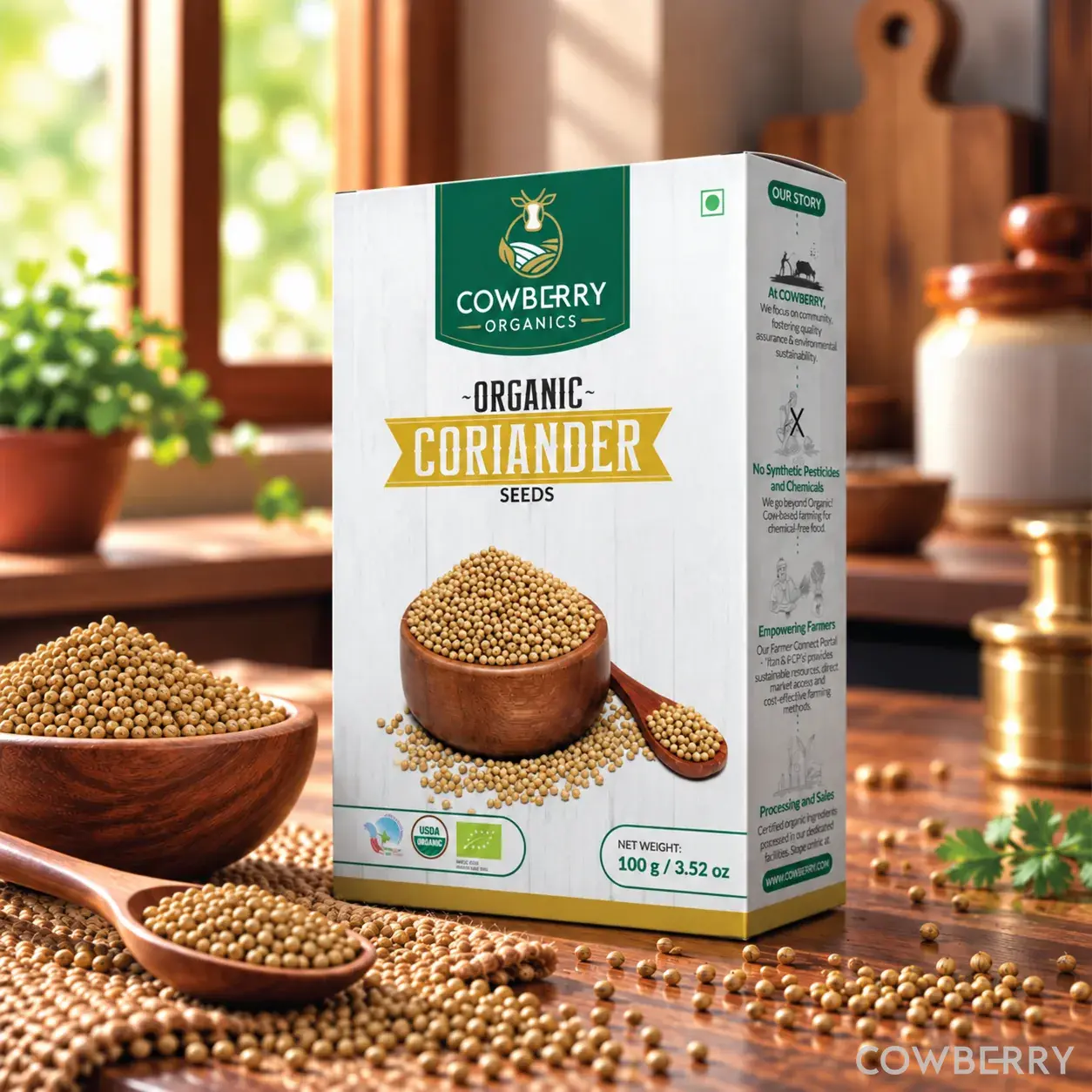
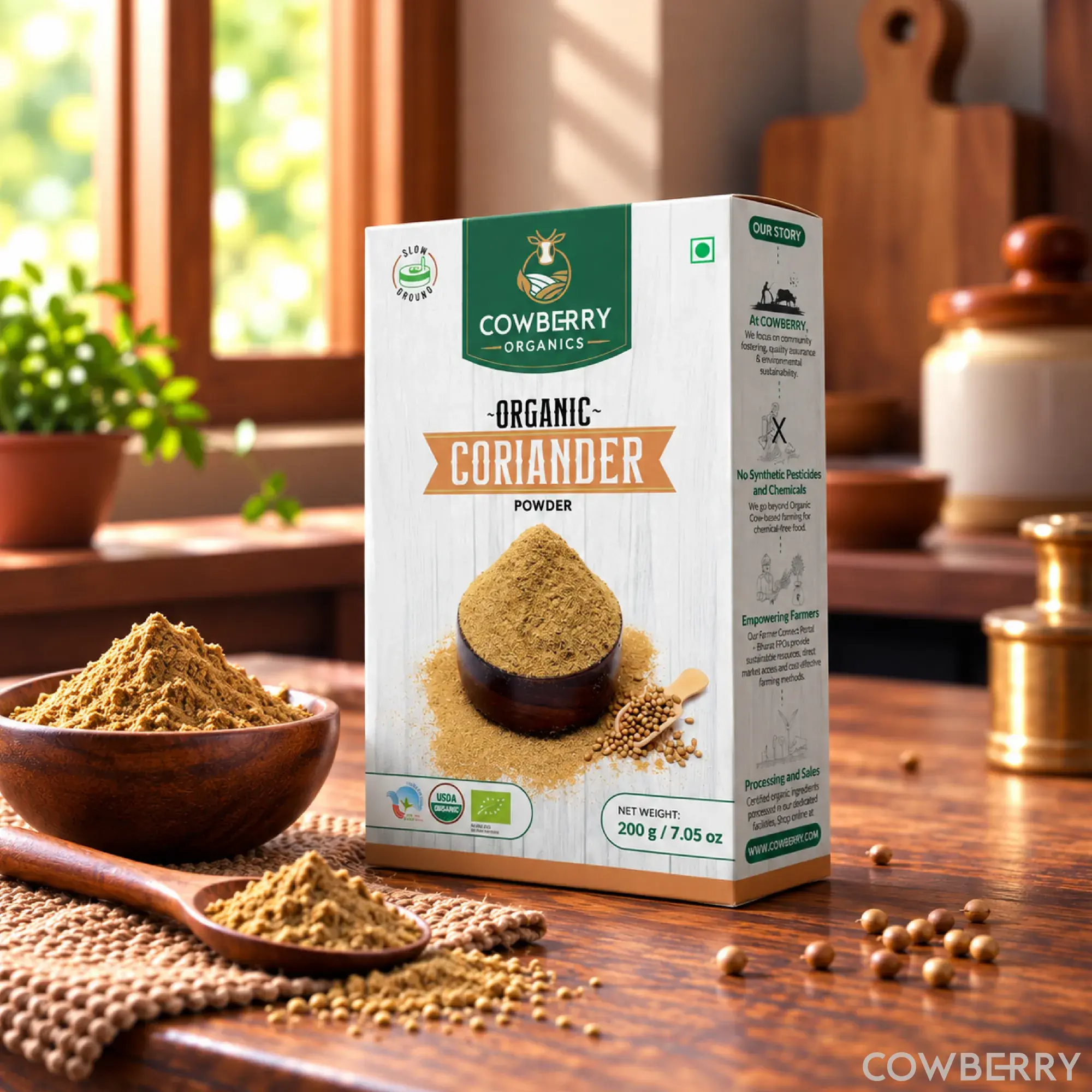
COWBERRY's organic coriander seeds come from Rajasthan and Madhya Pradesh, grown with natural cow-based farming, and the organic coriander powder is ground from those same seeds, dried and freshly ground with nothing added. Both packs carry the certification India Organic, USDA & EU certified, so the certified-pack part of the rule is easy to keep; for any organic spice, look for the mark on the pack before paying.
FAQs
Is coriander a herb or shrub?
A herb, not a shrub. One plant, Coriandrum sativum, supplies two kitchen products: the fresh leaf, eaten as a herb, and the dried seed, kept as a spice. Hindi makes no fuss about the split: dhania covers the leaf, the seed and the powder.
What is dhania in English?
Coriander. Dhania is the Hindi name for the spice that IFCT 2017 prints, and in English the parts carry plain names: coriander seeds for the whole seed, coriander powder once ground, and fresh coriander for the leaf. One plant, one English word, with the context saying which part is meant.
Difference between coriander and cilantro?
Two words for one plant, Coriandrum sativum, and the difference is which English is being spoken. Indian and British recipes call the whole plant coriander, leaves and all, while American recipes reserve cilantro for the fresh leaf and say coriander for the dried seed. The full side-by-side is on the coriander vs cilantro page.
How coriander seeds are made?
By drying. The plant flowers and sets seed a couple of months after sowing, the seed heads are left to dry, and the round seeds are rubbed off and cleaned; those dried seeds are the coriander seeds of the spice rack, sold whole or ground into powder. Nothing is added, and nothing is removed.
Does coriander have iron?
Yes. The printed figure is 17.64 mg of iron per 100 g for the whole seeds (IFCT 2017) and 16.3 mg for the ground spice (USDA FoodData Central), so a 5 g teaspoon of seeds carries about 0.9 mg. Because it is plant iron, the Dietary Guidelines for Indians pair it with the chutney trick: coriander-and-green-chilli chutney eaten with a meal improves how much iron the body takes up from plant foods.
How coriander grows?
From seed, not from a cutting. Coriander is sown as the split round seed, comes up in about a week to ten days in damp soil, and is ready for its first leaf cut around a month later; left to flower, the plant makes its seed from about two months. The step-by-step pot method is on the how to grow coriander page.
References
- Indian Food Composition Tables (IFCT) 2017, ICMR-National Institute of Nutrition
- USDA FoodData Central
- Dietary Guidelines for Indians, ICMR-National Institute of Nutrition
- Laribi B, Kouki K, M'Hamdi M et al. Coriander (Coriandrum sativum L.) and its bioactive constituents. Fitoterapia, 2015
- Scandar S, Zadra C, Marcotullio MC. Coriander (Coriandrum sativum) Polyphenols and Their Nutraceutical Value against Obesity and Metabolic Syndrome. Molecules, 2023
- Opara EI, Chohan M. Culinary herbs and spices: their bioactive properties, the contribution of polyphenols and the challenges in deducing their true health benefits. Int J Mol Sci, 2014
- Krishnaswamy K. Traditional Indian spices and their health significance. Asia Pac J Clin Nutr, 2008
Shop this article
Keep reading
Coriander water benefits: what dhania water actually does
Peanuts in Hindi (moongfali): groundnut names in Indian languages
Coriander vs cilantro: are they the same herb?