by COWBERRY

9 minute read
10 benefits of coriander (and its side effects)

Coriander benefits are modest and real: 17.6 mg of iron and 44.8 g of fibre per 100 g of seeds (IFCT 2017), about 15 kcal in a teaspoon of powder, and traditional uses with lab findings still early. Ten follow, each with its nutrient, then the side effects, how much per day, and the ways to eat it. The coriander seeds hub covers names and storage.
Coriander benefits on the plate: flavour, fibre and minerals
1. Flavour that costs about 15 kcal a teaspoon
The benefit Indian kitchens bank on every day is the simplest: coriander makes plain food worth eating, at almost no energy cost. One teaspoon (5 g) of powder works out to about 15 kcal and the same spoon of whole seeds to about 13 kcal, from 298 kcal and 269 kcal per 100 g respectively. That is the spice's real job on the plate, and the honest frame around it comes from Opara and Chohan, writing in 2014 in the International Journal of Molecular Sciences: people eat herbs and spices in small quantities and combined with other foods, which leaves their true health benefit unclear. Coriander uses, in short, are culinary first, and the flavour is the benefit.
2. Fibre in every teaspoon
Whole coriander seeds hold 44.8 g of total dietary fibre per 100 g (IFCT 2017) and the ground spice 41.9 g (USDA FoodData Central). Read by the spoon, a teaspoon of seeds gives about 2.2 g of fibre and a teaspoon of powder about 2.1 g. The Dietary Guidelines for Indians state what dietary fibre does in a meal: it slows carbohydrate and fat absorption and lifts how filling the meal feels. A teaspoon of dhania is a small share of a meal's fibre, but it is a real share, and it arrives with the flavour, not at its expense.
3. Iron, with the coriander chutney trick
Iron is 17.6 mg per 100 g of coriander seeds (IFCT 2017) and 16.3 mg in the ground spice (USDA); a 5 g teaspoon of seeds gives about 0.9 mg. For the rest of the meal's iron, the Dietary Guidelines for Indians point to chutneys made with coriander and green chillies, which they say improve iron absorption from plant foods when consumed as part of a regular meal. The same guidelines ask that tea, which binds dietary iron, stay at least an hour clear of the meal before, during or soon after.
4. A little calcium, potassium and magnesium
Per 100 g, coriander seeds carry 718 mg of calcium, 1473 mg of potassium and 343 mg of magnesium (IFCT 2017). Per the teaspoon that kitchens actually use, those become about 36 mg of calcium, 74 mg of potassium and 17 mg of magnesium. That is a modest top-up rather than a meal's worth: dhania adds a little of several minerals to every plate it touches, .
Coriander benefits in the research: what is and is not shown
5. Essential oils and polyphenols, studied in the lab
A 2015 review in Fitoterapia (Laribi and colleagues) sets out what the plant contains: coriander belongs to the Apiaceae family and has nutritional as well as medicinal properties, and its seed and herb essential oils have been investigated for their chemical composition and for biological activities including antimicrobial and antioxidant activity, among others. Those findings come mostly from laboratory work. The same review records that the plant has a wide range of traditional medicinal uses.
6. Polyphenols against obesity and metabolic syndrome: researchers are studying
A 2023 review in Molecules (Scandar and colleagues) works through coriander extracts that are rich in polyphenols and gathers the evidence on those polyphenols as protective agents against some inflammation-related diseases; from those bioactivities the authors see coriander extract as a candidate functional food against obesity, metabolic syndrome and diabetes. The evidence behind it is preclinical, and the review itself notes that an extract's polyphenol profile changes with the plant part and the extraction method. In plain terms: researchers are studying it, and the abstract reports no result in people.
7. The honest bottom line of spice research
In a 2014 piece in the International Journal of Molecular Sciences, Opara and Chohan spell out why spice research rarely translates to a plate: preparative and digestive processes, bioavailability and interactions between foods can all change what the bioactive compounds do, and with spices eaten in small amounts and in combination with other foods, their true health benefit is hard to pin down. That is why this page gives fibre and iron per teaspoon rather than promises: the amounts a kitchen uses are real, and the lab findings are not yet human findings.
Traditional uses, and what coriander does not do
8. Traditional uses, and the evidence being built
A 2008 review of traditional Indian spices (Krishnaswamy, Asia Pacific Journal of Clinical Nutrition) notes that India is recognized the world over for spices and medicinal plants, and that current biomedical efforts are aimed at providing science-based evidence for the traditional uses. Coriander's own traditional medicinal uses are wide-ranging, as the 2015 Fitoterapia review records. For kitchen amounts, the benefits this page can stand behind are what the sections above give: flavour, fibre and minerals; the rest is still being worked out.
9. A trace of vitamin C in the powder
The USDA record for the ground spice prints 21 mg of vitamin C per 100 g, which shrinks to about 1 mg in a teaspoon; IFCT 2017 reports no vitamin C value for the whole seeds. Either way it is a trace, worth knowing and not worth counting on.
10. What coriander does not do
The 2015 review notes that no report is available on coriander's effectiveness in reactive airway diseases such as asthma and bronchiolitis, and in the research reviewed here, no human trial shows the spice lowering blood sugar, blood fats or body weight. The numbers this page quotes belong to the seed's nutrients, not to effects in people; a promise that goes further is not backed by the research reviewed here. Coriander is food, and it is best read as food.
Side effects of coriander and who should limit it
Herbs and spices have been used for both culinary and medicinal purposes for centuries, as Opara and Chohan note in their 2014 paper in the International Journal of Molecular Sciences. The review abstracts read here describe mostly laboratory-level work and mention no harms from the spice eaten as food; that is an absence of reports rather than a promise of safety, and this page sets no safety limits beyond what the sources say.
Two cautions are worth keeping. First, capsules and extracts are not the spice: the polyphenol findings come from extracts prepared in particular ways, not from a spoonful in a curry, and the research reviewed here includes no human trial of a coriander supplement. Second, medicines and conditions change the ground rules; if you take medicines regularly or live with a chronic condition, speak with your doctor or dietitian before putting spices or supplements in place of the care they have prescribed. The weight-loss question has its own honest answer on the is coriander good for weight loss page, and the soaked-seed drink is covered on the coriander water benefits page.
How much coriander per day
There is no health dose of coriander, and no honest page gives one. The printed guidance covers spices as a group: the suggested balanced diets in the Dietary Guidelines for Indians, worked out for an elderly man and an elderly woman, each include 10 g of spices a day. A teaspoon (5 g) of coriander powder is half of that 10 g spice figure. What one serving gives, restated: a teaspoon of seeds, about 13 kcal, 2.2 g of fibre and 0.9 mg of iron; a teaspoon of powder, about 15 kcal, 2.1 g of fibre and 0.8 mg of iron. If a medical condition or a medicine list is in the picture, settle any food changes with your doctor or dietitian first; coriander is a seasoning, not a plan.
How to eat coriander: tadka, powder and leaves
Each form of the plant cooks its own way, and between them they cover most Indian meals:
- Whole seeds. Temper a pinch in hot oil at the start of a dal, or dry-roast and grind them into a blend.
- Sambar powder: this home-made blend is coriander-heavy, with 40 g of seeds in a batch that makes about 15 tablespoons.
- Powder. Stir a teaspoon into a curry base or a dal near the end of cooking, where its warm note sits best.
- Fresh leaves. Go on last, over dal or in a chutney, or blended with green chillies as the guidelines' iron-absorption trick.
The per-teaspoon arithmetic for every number above is on the coriander nutrition per 100 g page, and the coriander seeds hub rounds up names, storage and buying.
FAQs
What is dhaniya good for?
For flavour first, at almost no energy cost, and for a little nutrition on the side. A teaspoon of powder adds about 15 kcal and 2.1 g of fibre, and the seeds hold 17.6 mg of iron per 100 g (IFCT 2017). Its traditional uses are wide-ranging, but the research reviewed here shows no human result beyond the nutrients; the rest is laboratory research.
Can you use coriander in soup?
Yes. Stir a teaspoon of coriander powder into a soup near the end of cooking, or drop a few whole seeds into a simmering broth; both add the warm, citrusy note. A teaspoon adds about 15 kcal and 2.1 g of fibre. Fresh leaves scattered on top work best just before serving.
Does coriander have iron?
Yes. Whole coriander seeds have 17.6 mg of iron per 100 g (IFCT 2017) and the ground spice 16.3 mg (USDA), so a 5 g teaspoon of seeds gives about 0.9 mg and a teaspoon of powder about 0.8 mg. Eaten as a coriander-and-green-chilli chutney with a meal, it also helps the body absorb iron from the plant foods on the plate, per the Dietary Guidelines for Indians.
Is coriander a herb?
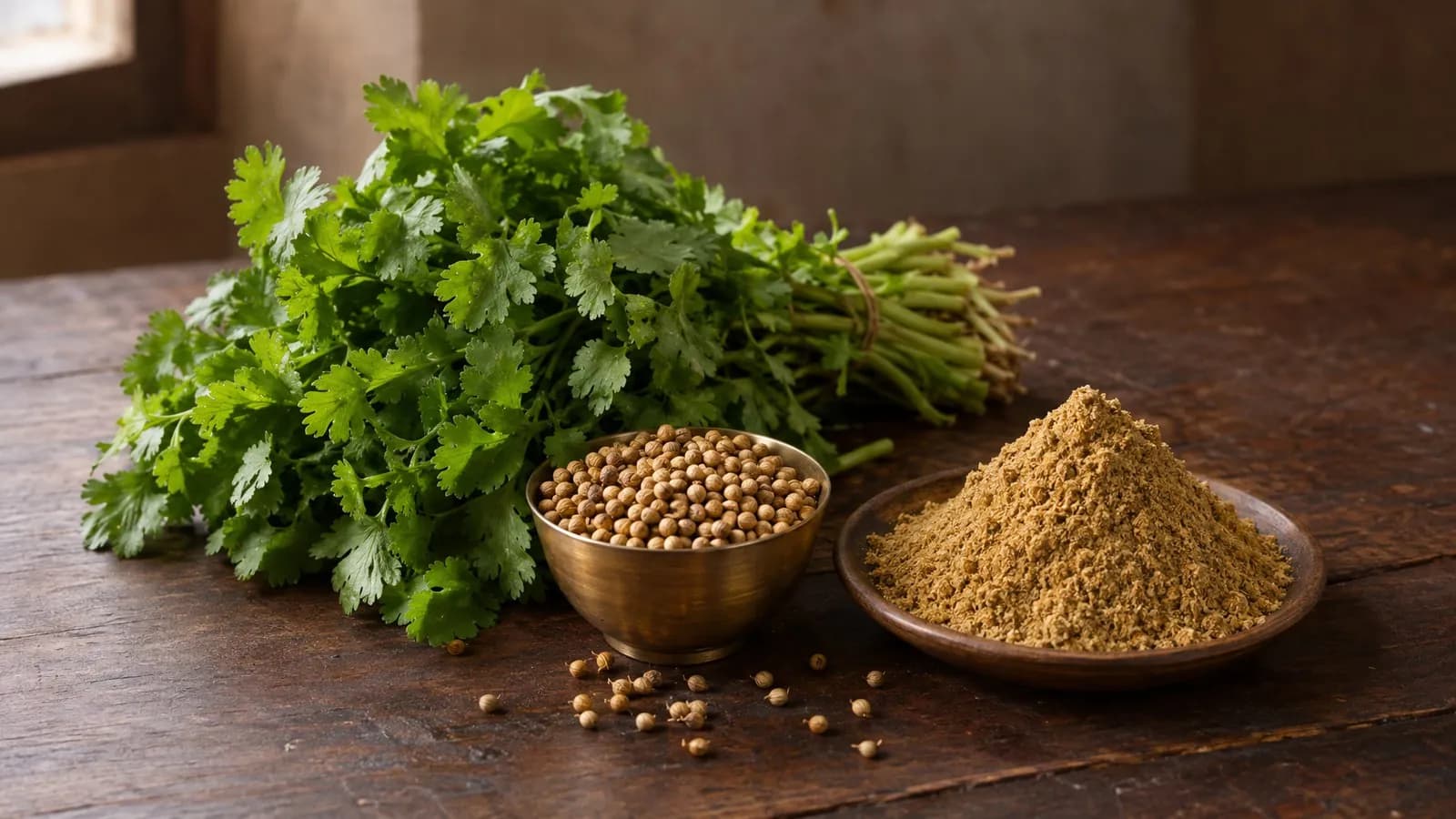
Yes. The plant Coriandrum sativum gives two kitchen products: the fresh leaf, used as a herb, and the dried seed, used as a spice. Both parts come from one plant, which is why the name coriander covers the leaf, the seed and the ground powder.
Is dhania coriander?
Yes. Dhania is the Hindi name IFCT 2017 prints for coriander seeds, and dhaniya is a spelling of the same word. The leaves, the whole seeds and the powder are one plant, Coriandrum sativum. The page on coriander names in Indian languages carries the full list.
What is coriander powder?
The whole dried coriander seed, ground fine; the same dhania as your masala box, opened up for quick cooking. The USDA FoodData Central record for the ground spice prints 298 kcal, 55 g of carbohydrate and 16.3 mg of iron per 100 g. Blends such as sambar powder are built coriander-heavy.
References
- Indian Food Composition Tables (IFCT) 2017, ICMR-National Institute of Nutrition
- Dietary Guidelines for Indians, ICMR-National Institute of Nutrition
- USDA FoodData Central
- Laribi B, Kouki K, M'Hamdi M et al. Coriander (Coriandrum sativum L.) and its bioactive constituents. Fitoterapia, 2015
- Scandar S, Zadra C, Marcotullio MC. Coriander (Coriandrum sativum) Polyphenols and Their Nutraceutical Value against Obesity and Metabolic Syndrome. Molecules, 2023
- Opara EI, Chohan M. Culinary herbs and spices: their bioactive properties, the contribution of polyphenols and the challenges in deducing their true health benefits. Int J Mol Sci, 2014
- Krishnaswamy K. Traditional Indian spices and their health significance. Asia Pac J Clin Nutr, 2008
Shop this article
Keep reading
Coriander water benefits: what dhania water actually does
Peanuts in Hindi (moongfali): groundnut names in Indian languages
Coriander vs cilantro: are they the same herb?