by COWBERRY

6 minute read
Coriander nutrition facts 100g: calories, protein and iron

Coriander nutrition facts 100g, from IFCT 2017 for the whole seeds: 269 kcal, 10.7 g protein, 17.5 g fat, 13 g carbohydrates, 44.8 g fibre and 17.6 mg iron. The USDA FoodData Central record for the ground spice lists 298 kcal and 12.4 g protein. Below: the table, a teaspoon's share, and coriander against cumin and fenugreek; the coriander seeds hub covers names and cooking.
Coriander nutrition facts 100g: the full table
The table below sets coriander nutrition facts 100g side by side for the two forms Indian kitchens keep: whole seeds and ground powder. The seed figures come from IFCT 2017, the Indian Food Composition Tables of ICMR-National Institute of Nutrition. IFCT 2017 has no separate entry for the ground spice, so the powder column uses the USDA FoodData Central record for coriander seed, the dried seed spice, which is what coriander powder is.
Two reading notes. These are raw, dry weights, not cooked ones, and a spice is never eaten 100 g at a time; the per-teaspoon section does the shrinking for you. Also, pack labels can differ from these values; every number on this page follows IFCT 2017 or the USDA record above.
| Nutrient | Coriander seeds | Coriander powder |
|---|---|---|
| Energy (kcal) | 269 | 298 |
| Protein (g) | 11 | 12 |
| Fat (g) | 17 | 18 |
| Carbohydrates (g) | 13 | 55 |
| Dietary fibre (g) | 45 | 42 |
| Iron (mg) | 18 | 16 |
| Calcium (mg) | 718 | 709 |
| Magnesium (mg) | 343 | 330 |
| Potassium (mg) | 1473 | 1270 |
| Sodium (mg) | 34 | 35 |
| Zinc (mg) | 3.9 | 4.7 |
| Folate (mcg) | 22 | 0 |
| Vitamin C (mg) | — | 21 |
Per 100 g raw, edible portion. Composition: IFCT 2017 (ICMR-NIN); USDA FoodData Central (SR Legacy), FDC ID 170922, NDB 2013. — means not reported. These are average values for the food; the label on a pack gives the values for that product.
Coriander calories per teaspoon, and the other per-serving numbers
Nobody cooks with 100 g of a spice. Indian kitchens work in teaspoons, and one teaspoon of coriander, seeds or powder, weighs about 5 g. From the values above, a teaspoon breaks down like this:
| Per teaspoon (5 g) | Seeds | Powder |
|---|---|---|
| Energy | 13 kcal | 15 kcal |
| Protein | 0.5 g | 0.6 g |
| Fibre | 2.2 g | 2.1 g |
| Iron | 0.9 mg | 0.8 mg |
| Calcium | 36 mg | 35 mg |
In a real dish the amounts stay small: a tadka takes a pinch of whole seeds, and a curry pot is seasoned by the teaspoon. The sambar powder recipe on this site builds a whole blend on 40 g of coriander seeds, and a level tablespoon of the finished powder comes to about 21 kcal.
Coriander protein and fibre, against cumin and fenugreek
Two common spice-rack neighbours put coriander's numbers in context. Cumin seeds (IFCT 2017) list 13.9 g of protein and 30.4 g of fibre per 100 g. Fenugreek seeds list 25.4 g of protein and 47.6 g of fibre. Coriander seeds sit at 10.7 g of protein and 44.8 g of fibre, so the ranking changes nutrient by nutrient.
For protein, coriander comes third of the three: cumin carries about 30 percent more, and fenugreek more than double. For fibre, coriander beats cumin by about 48 percent but still sits below fenugreek, which edges it by about 6 percent. All three are spices, so per teaspoon the differences stay small; what changes is the role. Fenugreek and cumin are the ones to lean on for protein and fibre, while coriander's own claim is the everyday curry note at 15 kcal a teaspoon.
Coriander glycemic index
No glycemic index figure is on record for coriander: IFCT 2017 lists no GI value for coriander seeds, and the USDA record for the ground spice carries none either. A GI figure quoted for dhania online comes from neither of those records.
In practice the gap matters little. A teaspoon of whole seeds carries about 0.6 g of carbohydrate and a teaspoon of powder about 2.8 g, small numbers beside the carbohydrate in the dal, roti or rice they season. Spices are eaten by the spoonful, not by the plate, and coriander's nutrition question is really about its minerals and fibre, covered next.
Dhania nutritional value: iron, calcium and the other micronutrients
The dhania nutritional value story is mostly mineral. Per 100 g, whole seeds hold 17.6 mg of iron, 718 mg of calcium, 343 mg of magnesium and 1473 mg of potassium (IFCT 2017); the ground spice lists 16.3 mg of iron, 709 mg of calcium, 330 mg of magnesium and 1270 mg of potassium (USDA FoodData Central). Sodium is low in both, at 34.4 mg and 35 mg, and zinc stands at 3.9 mg and 4.7 mg. Seeds add 22.1 mcg of folate per 100 g.
One more difference between the forms: the USDA record lists 21 mg of vitamin C per 100 g of powder, while IFCT 2017 lists no vitamin C value for the whole seeds. Because coriander's iron is plant iron, the Dietary Guidelines for Indians suggest vitamin C foods or a coriander-and-green-chilli chutney in the same meal to improve how much the body absorbs. Whole seeds or powder, the micronutrients come along with the flavour, which is how a spice earns its place on the plate.
How coriander nutrition fits a day of eating
The Dietary Guidelines for Indians list spices and herbs among the food groups of the daily plate, with coriander (dhania) among them, and on that plate dhania is a seasoning, not a course. Its job is to carry flavour across the dal, sabzi and curry, bringing its 15 kcal teaspoon, its 2.2 g of fibre and its minerals along. For the honest read on whether coriander helps with weight loss, the coriander for weight loss page has the research picture. What each nutrient does is the coriander benefits page, and names, storage and buying live on the coriander seeds hub.
FAQs
Does coriander have iron?
Yes, the seeds are the iron-rich part: 17.6 mg per 100 g in IFCT 2017, and 16.3 mg in the USDA record for the ground spice. A 5 g teaspoon of whole seeds carries about 0.9 mg, a teaspoon of powder about 0.8 mg. Because it is plant iron, the Dietary Guidelines for Indians suggest vitamin C foods or a coriander-and-green-chilli chutney in the same meal to help the body absorb it.
What is the nutritional value of coriander?
Per 100 g, whole coriander seeds give 269 kcal, 10.7 g of protein, 17.5 g of fat, 13 g of carbohydrates and 44.8 g of fibre (IFCT 2017), with 17.6 mg of iron and 718 mg of calcium. The ground spice lists 298 kcal, 12.4 g of protein, 55 g of carbohydrates, 41.9 g of fibre and 16.3 mg of iron per 100 g (USDA FoodData Central).
How many calories in one teaspoon of coriander powder?
About 15 kcal. Coriander powder lists 298 kcal per 100 g (USDA FoodData Central), and a level teaspoon holds about 5 g, which comes to 15 kcal. Whole seeds run a little lower: 269 kcal per 100 g (IFCT 2017), or about 13 kcal a teaspoon. Water adds nothing, so the figure is the same however you cook the powder.
Which coriander powder is best?
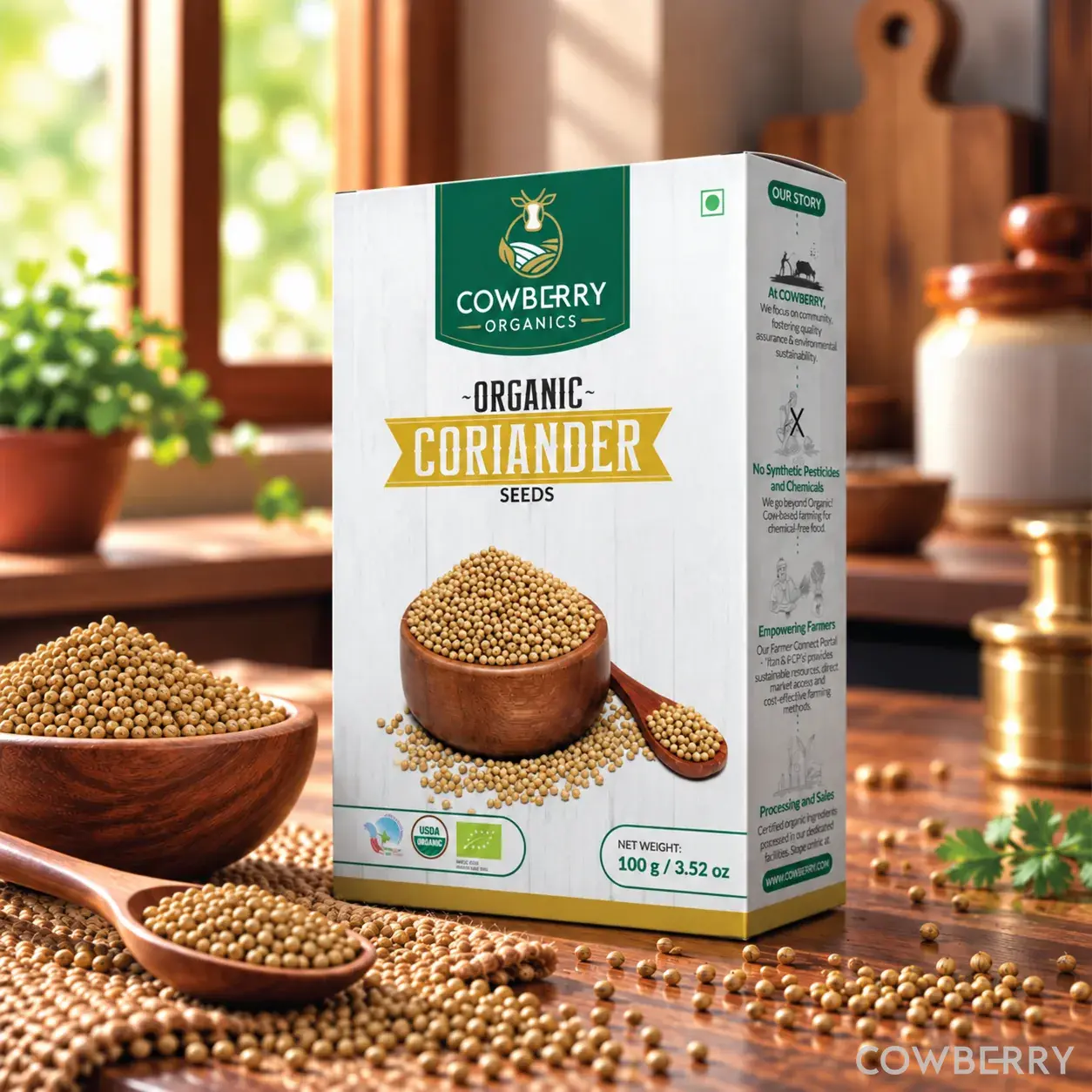
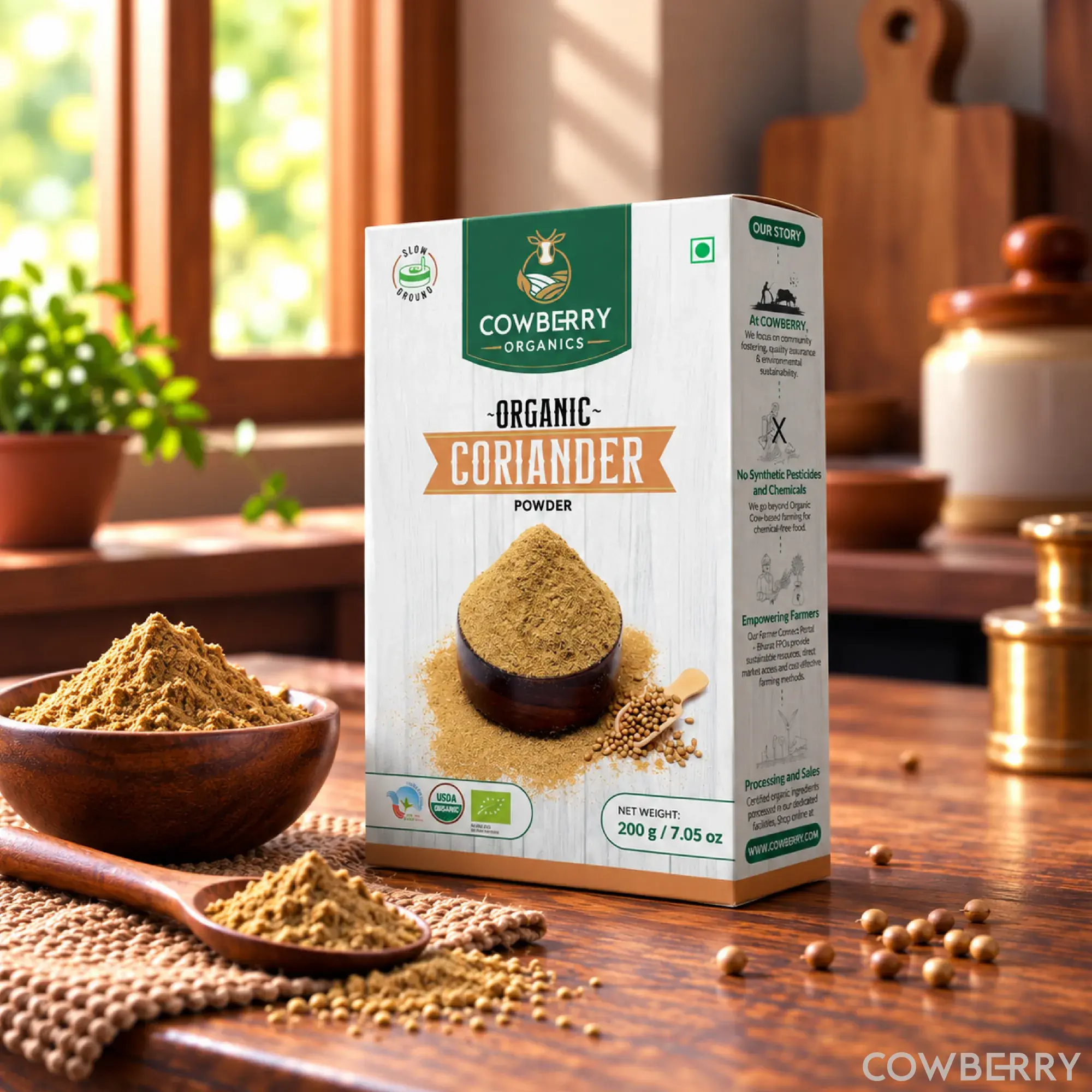
Look for powder ground from whole coriander seeds with nothing added. COWBERRY's coriander powder is made from seeds grown in Rajasthan and Madhya Pradesh, dried and freshly ground, with no artificial colours, fillers or preservatives. Keep it in an airtight jar in a cool, dry cupboard, and use it within a few months while the aroma lasts.
Does coriander have protein?
Some, but a spice is not a protein source. Whole seeds hold 10.7 g of protein per 100 g (IFCT 2017) and the powder 12.4 g (USDA), yet a 5 g teaspoon delivers only about 0.5 g of seeds or 0.6 g of powder. The protein on an Indian plate comes from the dal, milk, egg or meat; dhania adds flavour and a little fibre.
Does coriander have carbs?
Yes, and the two forms differ a lot. Whole seeds list 13 g of carbohydrates per 100 g (IFCT 2017), while the ground spice lists 55 g per 100 g (USDA FoodData Central). By the teaspoon the amounts stay tiny: about 0.6 g from seeds and 2.8 g from powder. Neither form has a published glycemic index.
References
Shop this article
Keep reading
Coriander water benefits: what dhania water actually does
Peanuts in Hindi (moongfali): groundnut names in Indian languages
Coriander vs cilantro: are they the same herb?