by COWBERRY

7 minute read
Chana dal for babies: when to start and how to serve

Chana dal for babies starts after six months, when complementary feeding begins: cook the split dal very soft, mash it, and begin with the small amount ICMR-NIN sample menus print, about 5 g of dry dal. The split gram is the same chickpea, husked, so it cooks soft. When to start, how much to give and how to serve it follow; the chana dal guide covers it.
Short answer
In short: after six months, cooked and mashed chana dal is fine for most babies, and the ICMR-NIN dietary guidelines include it in their sample menus for infants from that age. Cook the dal until completely soft, mash or puree it, and start small: the 5 g the menus print for babies aged 6 to 12 months, while the menus for children over one year print chana at 15 g. Add nothing. Complementary foods need no added sugar or salt, and the NHS says the same for salt: do not add any to your baby's food. Expect a little gas at first, and offer the dal on its own before mixing it into other foods.
When can a baby start eating chana dal?
The WHO says complementary foods should start at six months of age, and infants can take purees, mashes and semi-solid foods right from that point. The ICMR-NIN dietary guidelines give the same rule in Guideline 4: start feeding homemade semi-solid complementary foods to the infant soon after six months of age, beginning with a thin but not watery porridge such as dal gruel. Chana dal fits both: pressure cooked and mashed, it is smooth enough for a six-month-old. The guidelines also ask that each new food be introduced one at a time, and fed regularly for 4–5 consecutive days, so a baby's reaction to chana dal is easy to judge. By twelve months, most children can share the family's food types, the WHO notes, and well-cooked dal can then join the family meal.
How much chana dal can a baby eat?
The amounts in the ICMR-NIN sample menus are small: they print chana dal at 5 g in a feed, alongside 10 g of cereal, in the menus for infants aged 6–8 months and 9–12 months, and chana at 15 g in the menus for children over one year. These are dry, uncooked weights, and they are a starting point, not a target. A 5 g portion of dry chana dal carries about 16 kcal and 1.1 g of protein, with 0.3 mg of iron; 15 g of chana dal, the chana amount printed for children over one, carries about 49 kcal, 3.2 g of protein and 0.9 mg of iron. Small numbers, but in a day of mixed cereals and pulses they add to the protein a baby needs. Serve the dal as part of a meal that also has cereal, since cereals and pulses eaten together give good quality protein. Adult portions and what the dal itself contains are on the chana dal hub page.
How to cook and serve it safely
Start with dry split chana dal from a clean pack. Rinse it, then soak it in room-temperature water for an hour before cooking; the chana dal soak guide has the full routine, and soaking softens the dal so it cooks faster and more evenly. Pressure cook it with enough water until a grain crushes easily between your fingers; the ICMR-NIN dietary guidelines describe boiling and pressure cooking as the best preparation for the nutritional quality of pulses, because anti-nutritional factors in them are destroyed in the process. Mash the cooked dal with the back of a spoon or run it through a small blender, and thin it with a little of its own cooking water for a younger baby; the WHO notes six-month-olds can manage purees, mashes and semi-solid foods. Serve it with clean hands and clean utensils. As the baby grows, stir the mashed dal into chana dal khichdi and other mixed meals.
Chana dal and gas in babies
A common worry with chana dal for babies is gas. Pulses carry galacto-oligosaccharides such as raffinose and stachyose that the small intestine cannot digest, so gut bacteria ferment them and release gas, which is normal, though whether these sugars are the main cause of pulse flatulence has been questioned. A report on regular pulse intake notes that most people who feel flatulence at first adapt within a few weeks. For a baby, keep the first servings small and regular, and watch how the tummy responds. The one-at-a-time rule helps here too, the ICMR-NIN guidelines ask that a new food be continued for 4–5 consecutive days so its effect is clear. If the gas is painful or the baby's stools change, pause the dal and talk to your paediatrician.
What not to do
Salt stays out: the NHS says to leave salt out of your baby's food and its cooking water, and the ICMR-NIN guidelines ask that salt be limited in complementary food preparations. Sugar stays out too: your baby does not need sugar, the NHS notes, and the ICMR-NIN rule bans added sugar outright for children under 2 years. Honey is not a substitute: the NHS says honey should not be given before 12 months because of the risk of infant botulism. Skip the hard and round forms. The WHO asks that foods in a form that may cause choking, whole grapes or raw carrots among them, stay off the baby's plate, and the NHS keeps whole nuts off the table until 5 years, so serve the dal only cooked soft and mashed. Cook a separate, unseasoned batch for the baby instead of serving from the adult pot.
Talk to your doctor or dietitian
Every baby is different, and food allergy, reflux or slow weight gain in the family changes the picture. If you are unsure when to start chana dal, or how much to give, talk to your doctor or dietitian: ask when to introduce chana dal to your baby, what portion to begin with, and how to watch for signs that the dal does not suit your child. Follow their advice for your baby, and keep the first weeks simple: one new food, small amounts, nothing added.
FAQs
When can babies eat chana dal?
From about six months, once complementary feeding begins: cook the split dal until fully soft, mash or puree it and thin it with cooking water. The WHO notes that from six months infants can manage purees, mashes and semi-solid foods, and the ICMR-NIN sample menus for 6 to 12 months include chana dal at 5 g in a feed. Introduce it on its own, one new food at a time.
What is bengal gram?
Bengal gram is the English name for chickpea (Cicer arietinum). Chana dal is the split and husked inner part of the brown desi chickpea, the Bengal gram with its skin removed, which is why it cooks soft enough for a baby and has a mild, nutty taste. Whole Bengal gram is sold as kala chana. IFCT 2017 lists the dal under the name Bengal gram, dal.
Can chana dal cause gas?
Yes. Like other pulses, it carries galacto-oligosaccharides such as raffinose and stachyose, which the small intestine cannot digest; they are fermented in the large intestine with the release of gas. Small, regular servings let most people adapt within a few weeks. For a baby, start with tiny amounts, watch the tummy, and pause if the gas is painful.
Does chana dal have protein?
Yes, and plenty of it: 21.55 g of protein in every 100 g of dry chana dal, per IFCT 2017, with 46.7 g of carbohydrate alongside. For a baby the amounts scale down: a 5 g portion has about 1.1 g of protein, and 15 g, the chana amount printed for children over one, about 3.2 g of protein. Serve it with cereal so the two proteins complement each other.
Can babies eat chana dal khichdi?
Yes, from about six months, when the dal in it is well cooked and mashed and the khichdi carries no salt or added sugar. Khichdi is a natural first mixed meal because it combines the dal with rice, and cereals and pulses together give good quality protein. Watch for gas after the first servings. A plain home version is the chana dal khichdi on the recipe pages.
Should I soak chana dal before cooking it for my baby?
Yes. Soak the dal in room-temperature water for an hour before cooking, which softens it so it cooks evenly; thirty minutes is enough if you are short on time, and soaking overnight in cool water works too. Soaking also cuts some of the compounds that interfere with nutrient use, and cooking removes far more. The full routine, including the quick hot soak, is in the chana dal soak guide.
References
- Indian Food Composition Tables (IFCT) 2017, ICMR-National Institute of Nutrition
- Dietary Guidelines for Indians, ICMR-National Institute of Nutrition
- WHO: complementary feeding (health topic)
- NHS: Foods to avoid giving babies and young children
- Thompson HJ. Improving human dietary choices through understanding of the tolerance and toxicity of pulse crop constituents. Curr Opin Food Sci, 2019
- Shi L, Arntfield SD, Nickerson M. Changes in levels of phytic acid, lectins and oxalates during soaking and cooking of Canadian pulses. Food Res Int, 2018
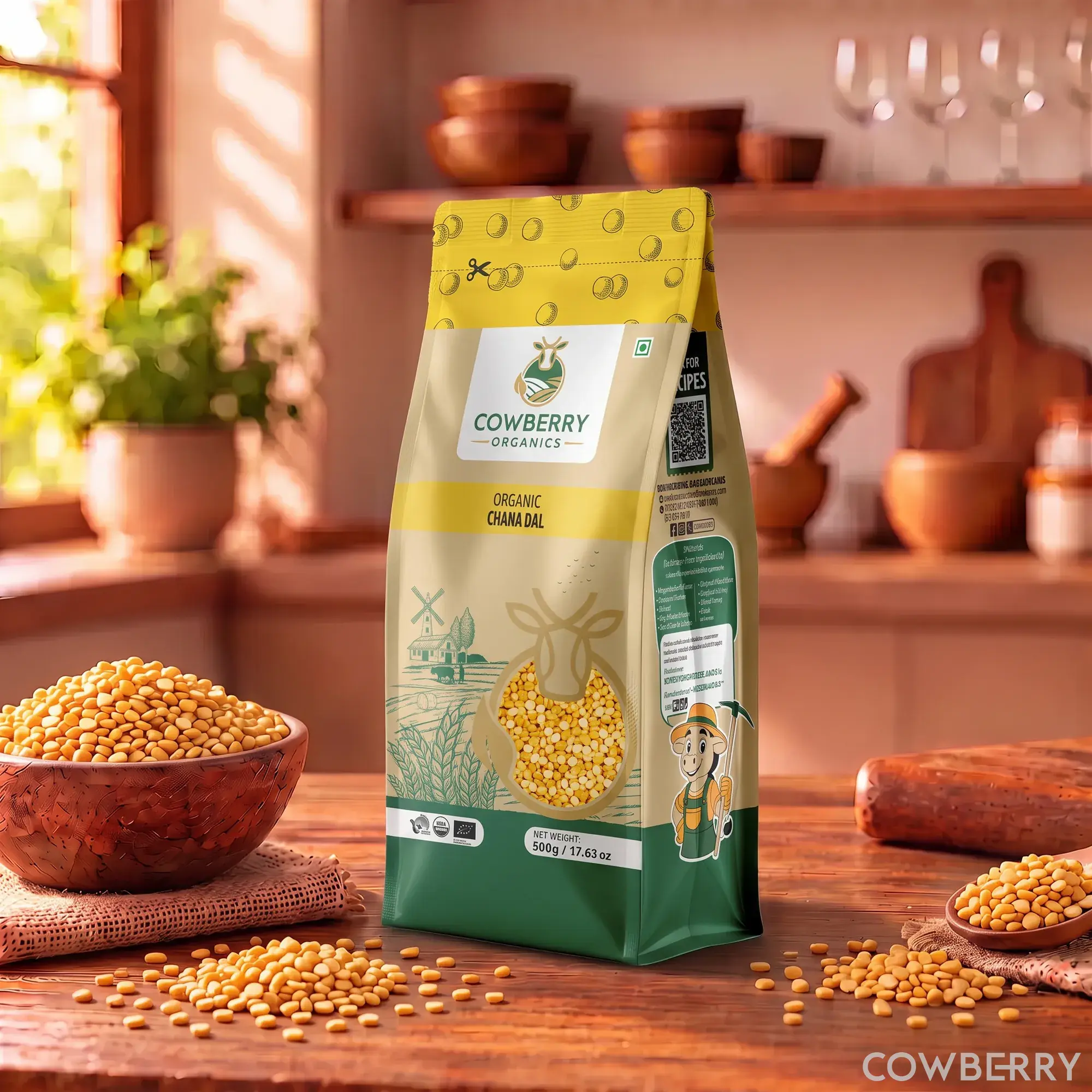
Shop this article
Keep reading
Green gram plant: crop, varieties and how it grows in India
Rajma vs lobia: difference, nutrition and which to choose
Rajma plant: how rajma is grown in India (it is not a tree)