by COWBERRY

11 minute read
What Is Brown Sugar? Types, How It Is Made, Nutrition and Uses

What is brown sugar? It is sugar crystals that keep part of the cane's molasses, which is where the colour, the soft texture and the caramel taste come from; per 100 g that sugar is 380 kcal and 98.1 g of carbohydrate (USDA FoodData Central). Demerara is one type of it. This guide covers the types, the names, the making, the nutrition, the uses and the buying checks.
What is brown sugar?
Brown sugar is sugar with molasses kept in. Make white sugar and you refine the cane sugar until the molasses is gone; make brown sugar and part of that molasses stays with the crystals, bringing the brown colour, the moist feel and the gentle caramel taste. The types differ in crystal size and in how much molasses each holds: demerara has coarse golden crystals, muscovado is usually the dark one with the deepest molasses taste, and light brown sugar is the milder member that stands in for demerara measure for measure. All of them carry the same numbers on this site, because one USDA entry, 'Sugars, brown', stands for the family — the figures do not state which type was measured. What the types share matters more than what divides them: the same 380 kcal per 100 g, the same counting rules, the same caramel family of flavours.
One neighbour deserves a careful word. Jaggery (gur) is not brown sugar: jaggery is the whole cane juice boiled down, while brown sugar is refined crystals holding on to molasses. The brown sugar vs jaggery page puts the two side by side.
What brown sugar is called: the names in English and in India
In English, the entry behind these figures is 'Sugars, brown', straight from USDA FoodData Central. IFCT 2017 has no brown sugar entry, and the USDA figures carry no Indian-language names for it, so the table below shows dashes everywhere except English — this page does not invent the blanks. For anyone searching brown sugar in English: the name is the same word, brown sugar. On Indian shop shelves the packs say 'brown sugar' in English, and demerara and muscovado appear under their own type names.
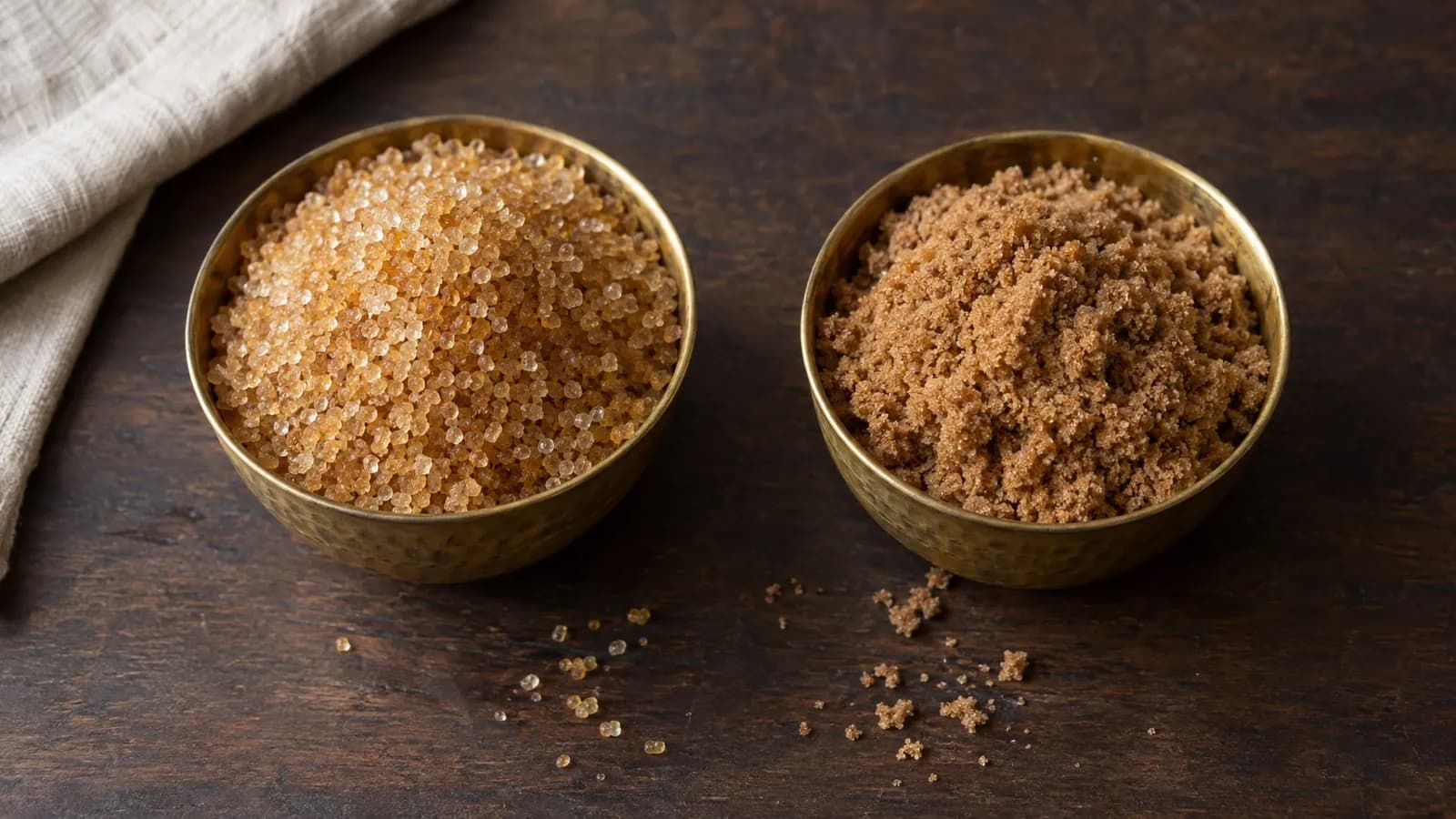
Demerara deserves a definition of its own, since demerara sugar meaning is a common search: demerara is brown sugar with coarse golden crystals, a member of the raw-sugar family, and it shares brown sugar's composition numbers. The name game with the other cane sweeteners — raw sugar, turbinado, muscovado — is sorted on the raw sugar vs brown sugar page.
| Language | Name (romanised) |
|---|---|
| English | Sugars, brown |
| Hindi | — |
| Marathi | — |
| Gujarati | — |
| Punjabi | — |
| Bengali | — |
| Odia | — |
| Assamese | — |
| Kannada | — |
| Telugu | — |
| Tamil | — |
| Malayalam | — |
| Urdu | — |
| Sanskrit | — |
| Botanical name | — |
Source: USDA FoodData Central record 168833 (English and scientific name only; no Indian-language names in source). — means no name recorded in the source.
How brown sugar is made
The short version: cane sugar is refined into white crystals, and brown sugar keeps part of the molasses instead of refining it all away. COWBERRY describes its brown sugar as made from organically grown Maharashtra sugarcane and minimally processed, without artificial colouring and without unnecessary refining, so the natural molasses it carries stays in place. That molasses is what the brown colour, the moist texture and the caramel taste come from.
What brown sugar is not: it is not jaggery, the whole boiled-down cane juice, and it is not a different food from raw sugar's family, since raw and brown share one composition entry. The brown sugar uses page shows the sugar at work in the kitchen; how it measures against the refined version is on the brown sugar vs white sugar page.
Brown sugar nutrition per 100 g
Per 100 g, brown sugar holds 380 kcal, 98.1 g of carbohydrate, 0.12 g of protein, no fat and no fibre, with 0.71 mg of iron, 83 mg of calcium and 133 mg of potassium from the molasses. White sugar runs 387 kcal and 100 g of carbohydrate with almost nothing in the mineral column, and jaggery brings more minerals but is still 84.87 g of carbohydrate per 100 g. The glycemic index of brown sugar is 71, from one small test in China with six participants whose reference the database does not list; white sugar averages 70 over 25 tests, and both sit in the high band, which starts at 70. The 2021 international GI tables show how far apart one food's GI values can run: whole-grain and whole-meal cereals showed wide variation in GI values, presumably because manufacturing methods differ.
The table below carries the three foods side by side. Per level teaspoon (5 g), the energy is 19 kcal and the carbohydrate 4.9 g, so a spoon is the honest serving for counting; a full 100 g only turns up in a batch of baking. The full per-teaspoon arithmetic lives on the brown sugar nutritional value per 100g page, and the GI story of all three sweeteners is on the white sugar glycemic index page.
| Nutrient | Brown sugar (USDA) | White sugar (USDA) | Jaggery (IFCT 2017) |
|---|---|---|---|
| Energy (kcal) | 380 | 387 | 354 |
| Protein (g) | 0.1 | 0 | 1.9 |
| Fat (g) | 0 | 0 | 0.2 |
| Carbohydrates (g) | 98 | 100 | 85 |
| Dietary fibre (g) | 0 | 0 | — |
| Iron (mg) | 0.7 | 0.1 | 4.6 |
| Calcium (mg) | 83 | 1 | 107 |
| Magnesium (mg) | 9 | 0 | 115 |
| Potassium (mg) | 133 | 2 | 488 |
| Sodium (mg) | 28 | 1 | 25 |
| Zinc (mg) | 0 | 0 | 0.5 |
| Folate (mcg) | 1 | 0 | 14 |
| Vitamin C (mg) | 0 | 0 | — |
| Glycemic index (GI) | 71 | 70 | — |
Per 100 g raw, edible portion. Composition: USDA FoodData Central (SR Legacy), FDC ID 168833, NDB 19334; USDA FoodData Central (SR Legacy), FDC ID 169655, NDB 19335; IFCT 2017 (ICMR-NIN). GI: University of Sydney GI database. — means not reported. These are average values for the food; the label on a pack gives the values for that product.
Brown sugar benefits
The honest list is short. Brown sugar adds a caramel taste and a moister crumb to baking, and its molasses leaves behind 83 mg of calcium, 0.71 mg of iron and 133 mg of potassium per 100 g — real, but a teaspoon's share is 4.2 mg of calcium and 0.04 mg of iron, nothing a diet notices. The kitchen reasons are the honest ones to buy it for: the caramel depth and the moisture it holds in cookies and cakes, all named in COWBERRY's product description. Beyond that, it is sugar: 98.1 g of carbohydrate per 100 g, counted the same as white sugar in every guideline. Each benefit and its number, plus the side effects, are on the brown sugar benefits page.
Side effects and who should limit brown sugar
The cautions are the cautions of sugar, and they are about amount. The ICMR-NIN dietary guidelines say that regular consumption of foods high in fat and sugar causes overweight and obesity, and such foods, they note, are energy dense and poor in vitamins, minerals and fibre; the WHO guideline reports higher rates of dental caries when free-sugar intake passes 10 percent of energy than when it stays below, and suggests a further cut below 5 percent of energy. Children get the strictest line: added sugar must be totally avoided below the age of two, brown or white.
Blood sugar follows the same logic: GI 71 for brown sugar and 70 for white sugar leave no room between the two, on a scale where 55 and below is low and 70 and above is high. For someone with diabetes the measured-spoon question is worked through on the brown sugar for diabetes page. For most households the useful limit is the spoon itself: the guidelines suggest adults avoid sugar or keep sugar to 20 to 25 g per day — four to five level teaspoons, and the 2000 kcal plate note says sugar must be restricted to 25-30 g a day, with cereals reduced to adjust the total calories. The same spoon logic applies to every member of the family, jaggery included, since ICMR-NIN counts all added sugars on one line.
How to use brown sugar in the kitchen
Wherever white sugar goes, brown sugar goes too, measure for measure — a level teaspoon of either is 5 g. Chai is where its caramel shows most: the brown sugar tea recipe sweetens each cup with two teaspoons (10 g) of demerara, the sugar going in with the leaves so it dissolves as the brew boils, and unlike jaggery it does not split the milk. Baking swaps it for white sugar one for one by weight, for a moister, deeper-coloured bake; kheer and halwa take it stirred in off the heat. For tea, two teaspoons a cup is the recipe's measure, with a little more only to taste.
For measures, syrup and the mistakes to avoid, open the brown sugar uses page; and when the jar is finished, the brown sugar substitute page covers what stands in for it in a cup or a batter.
How to store brown sugar
Brown sugar wants a closed jar. Kept in an airtight container somewhere cool and dry, it stays soft; left open to the air, it dries and hardens into a block. A hardened batch is not spoiled — it still melts into hot chai or a simmering syrup, and a dry, sealed jar keeps the next bag soft. The one kitchen habit that matters: close the jar after every spoon.
Brown sugar recipes
The one recipe this site builds around demerara is brown sugar tea, an everyday cup of chai where the sugar goes into the pot with the leaves: two teaspoons a cup, about 38 kcal and 9.8 g of carbohydrate from the sugar, two cups in about ten minutes. Beside it, white-sugar chai is purely sweet and jaggery chai carries a faint smoky, earthy edge, while brown sugar tea sits in the middle with a clean caramel taste; unlike jaggery, it does not split the milk.
Beyond tea, brown sugar slots into any sweet recipe the household already makes: cookies, cakes, custards, kheer and halwa, measure for measure in place of white sugar, with a moister crumb as the bonus. For the baking swaps, see the brown sugar substitute page.
Buying brown sugar: what to check
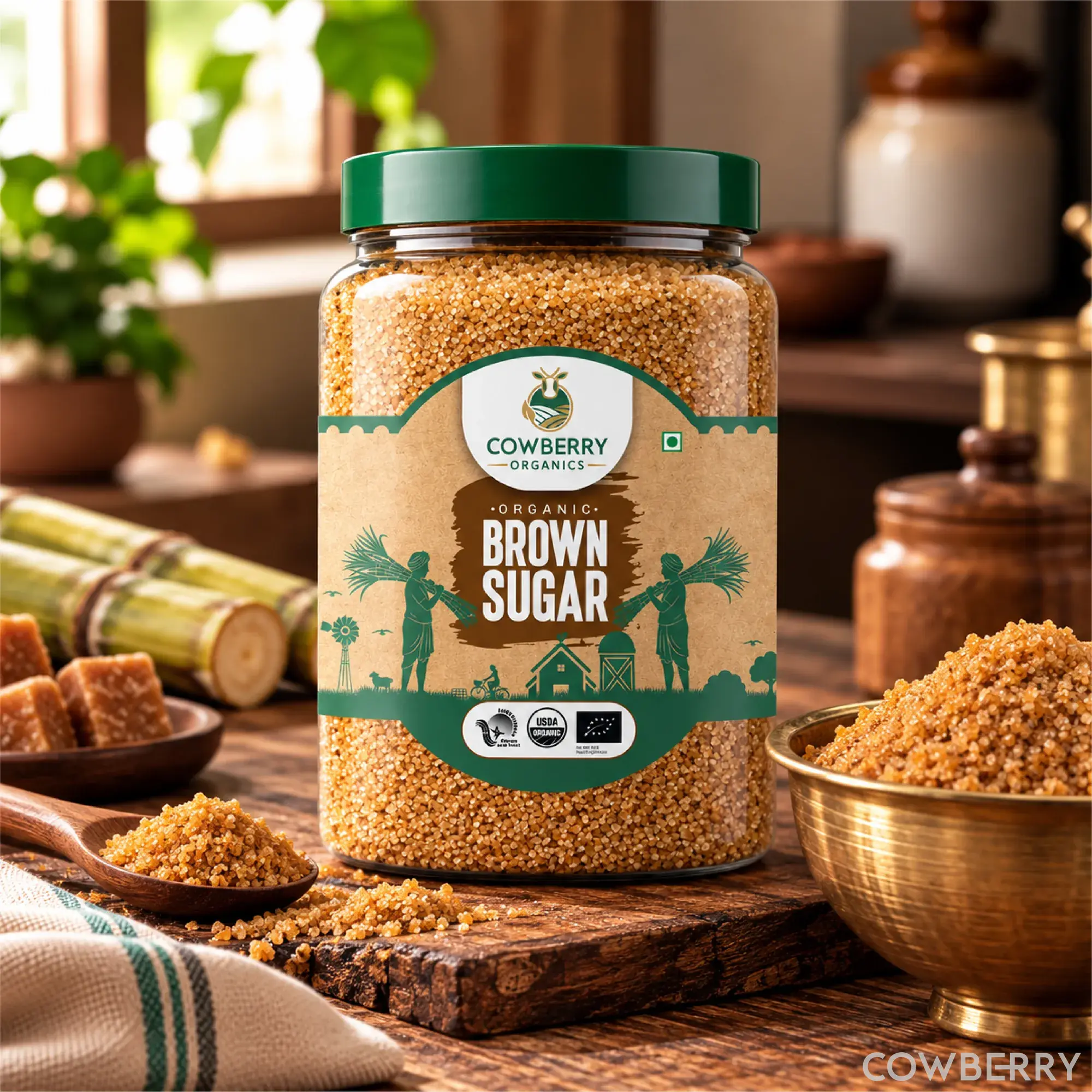
Read the pack for two things: the type and the farming. The type matters for the dish — demerara for crunch in biscuits, the finer brown sugar for cakes — and the pack states it. On the farming side, an organic pack carries a certification mark, and for COWBERRY's brown sugar that line reads India Organic, USDA & EU certified, on sugarcane grown organically in Maharashtra and minimally processed without artificial colouring or unnecessary refining, so the sugar keeps its natural molasses.
Buying in amounts the household finishes also helps: an open bag dries out sooner, and a dry, airtight jar in a cool place keeps the sugar soft. For everyday amounts, one to two teaspoons in chai and the same weight as white sugar in baking are the working measures.
FAQs
What is brown sugar?
Sugar crystals with part of the cane's molasses kept in; the molasses gives the brown colour, the moist texture and the caramel taste. Per 100 g it is 380 kcal and 98.1 g of carbohydrate. Demerara is one type of it, with coarse golden crystals. Light and dark brown sugar differ in how much molasses they carry, which is where the colour scale comes from.
What is brown sugar called in India?
It is sold as brown sugar, the English name on the pack; the USDA entry behind its numbers gives no Hindi, Marathi or other Indian-language name for it, and none is invented here. Demerara and muscovado keep their own type names on Indian shelves. So the answer to the name question is short: in India it is called what it is, brown sugar.
Does demerara sugar have another name?
Demerara sits in the raw-sugar family, where turbinado is its close relation; both take brown sugar's composition numbers, since USDA lists no separate entries for them. Its own name is the one on the pack: demerara sugar.
Is demerara sugar the same as brown sugar?
In the numbers, yes: one USDA entry, 'Sugars, brown', stands for the whole family, so demerara and brown sugar share 380 kcal and 98.1 g of carbohydrate per 100 g. What separates them is the crystal: demerara's coarse golden grains crunch a little more than the fine, moist brown sugar bakers pack into a spoon. Nutritionally, the two are twins.
How is brown sugar made?
Cane sugar is refined into white crystals; brown sugar keeps part of the molasses rather than refining it all away. COWBERRY makes its brown sugar from organically grown Maharashtra sugarcane, minimally processed with no artificial colouring and no unnecessary refining, which is how the natural molasses, the colour and the caramel taste stay. That is the whole of the method the product page describes: keep the molasses, skip the extras.
Does demerara sugar go off?
Dry sugar kept closed does not spoil like fresh food. What it does is harden: left open to the air, brown sugar dries into a block. An airtight jar in a cool, dry place prevents that, and a hardened batch still dissolves in hot chai or a simmering syrup. What it never needs is refrigeration; a kitchen shelf does.
References
- USDA FoodData Central (SR Legacy): Sugars, brown, FDC ID 168833
- USDA FoodData Central (SR Legacy): Sugars, granulated, FDC ID 169655
- Indian Food Composition Tables (IFCT) 2017, ICMR-National Institute of Nutrition
- Dietary Guidelines for Indians, ICMR-National Institute of Nutrition
- University of Sydney glycemic index database (GI search)
- University of Sydney: about the glycemic index
- Atkinson FS, Brand-Miller JC et al. International tables of glycemic index and glycemic load values 2021: a systematic review. Am J Clin Nutr, 2021
- WHO guideline: sugars intake for adults and children (2015)
Shop this article
Keep reading
Raw Sugar vs Brown Sugar: Is Demerara the Same Thing?
Does honey contain sugar? Carbs per 100g and the WHO sugar limit
Date Jaggery (Khejur Gur in English): Types, Forms and How to Use It