by COWBERRY

6 minute read
Brown Sugar Uses: Baking, Tea, Sweets and Everyday Cooking

Brown sugar uses in an Indian kitchen run from chai to cookies: measure it like white sugar (1 tsp = 5 g), dissolve it in hot drinks, swap it 1:1 for white sugar in baking and cook it into kheer and halwa. The brown sugar guide explains the sugar itself.
Short answer: how to use brown sugar
Use it exactly where you use white sugar, measure for measure, and keep two habits. First, measure by weight or level spoon: a teaspoon of brown sugar is 5 g and a tablespoon 15 g, the same as white sugar. Second, let heat do the dissolving, in hot chai, a simmering syrup or a warm bake, because the crystals need a moment in liquid. In baking, swap it 1:1 for white sugar by weight, and expect a caramel colour and a softer, moister bake. The sugar's own story, its types and nutrition, is on the brown sugar guide.
Brown sugar in tea and coffee
Chai is where brown sugar's molasses shows: it sweetens with a caramel note where white sugar is simply sweet. Stir one level teaspoon (5 g) into a hot cup and let it dissolve, adding more to taste; demerara's larger crystals take a few extra swirls. The full chai method is in the brown sugar tea recipe.
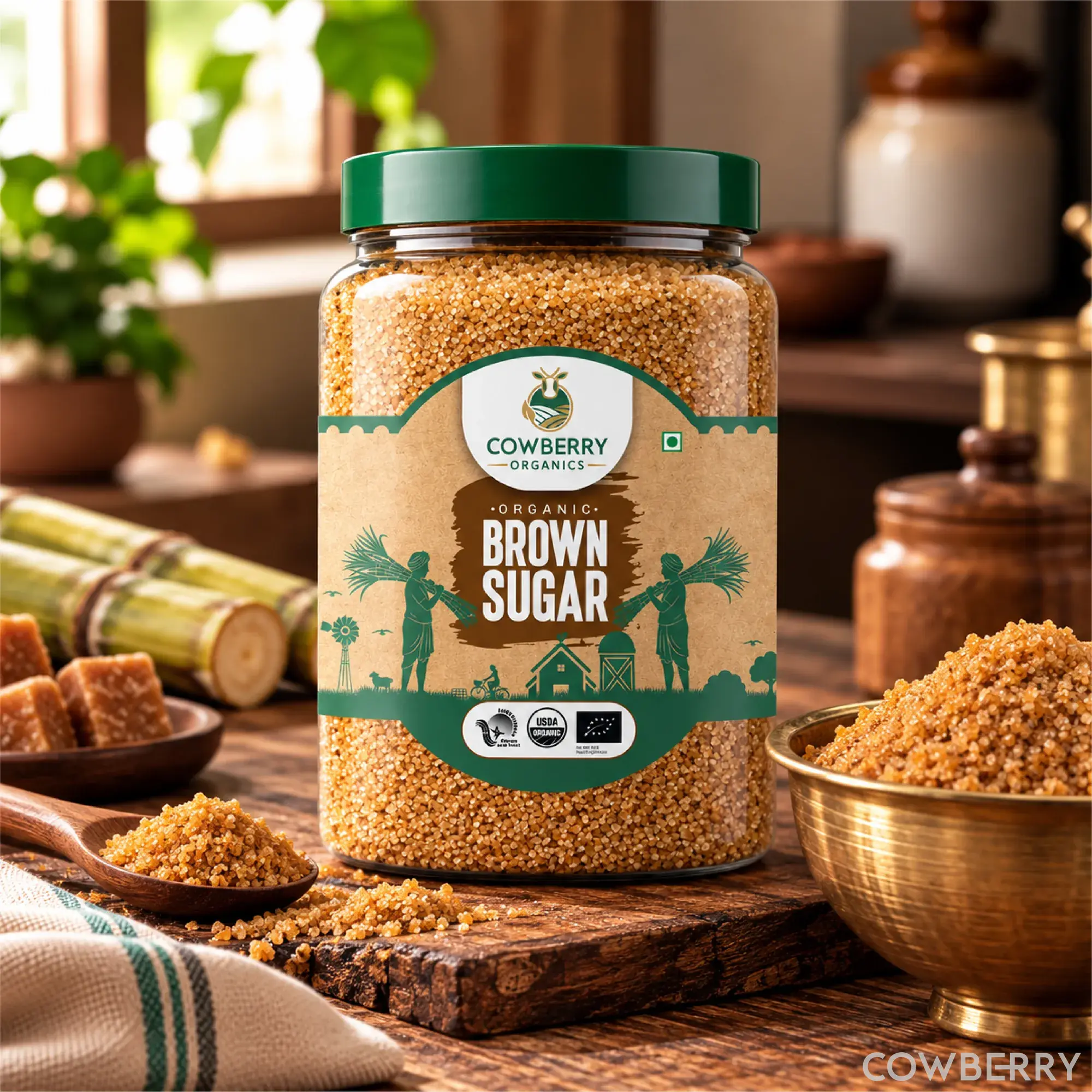
Coffee takes the same teaspoon, 5 g, stirred in while hot. For iced drinks the crystals dissolve slowly, so either stir longer or use the syrup from the next section. COWBERRY's Organic Brown Sugar keeps the molasses that gives the caramel taste, from organically grown Maharashtra cane.
Brown sugar in baking: cookies, cakes and simple syrup
In baking, brown sugar swaps for white sugar one for one by weight; where a recipe names grams, use the same grams. Brown sugar is commonly used in baking because it adds moisture and a rich caramel flavour to cookies, cakes and desserts, so the bake comes out moister and deeper in colour. When a recipe says packed brown sugar, press the sugar firmly into the spoon or cup so it holds its shape, because brown sugar is moister than white and settles with gaps.
Simple syrup: heat 100 g of brown sugar with 100 ml of water in a small pan until the sugar melts, cool it and bottle it; a tablespoon of the syrup sweetens a glass of nimbu pani or iced tea. Demerara works in the same syrup, so demerara sugar for simple syrup is a standard move.
Brown sugar in sweets and everyday cooking
Kheer and phirni: stir the brown sugar in after the rice is cooked and the pan is off the heat, so it melts into the warm milk without catching on the bottom. Halwa: add it at the end, to taste; the caramel note suits gajar and suji halwa. Nimbu pani and shikanji: dissolve one tablespoon (15 g) per glass in a spoon of warm water first, then top up with cold water and lemon. For the spoon amounts in context, the nutrition side is on brown sugar's nutrition per 100 g.
Swapping brown sugar for white sugar or jaggery
The table beside this section shows why the swaps are interchangeable: per 100 g, brown sugar gives 380 kcal and 98.1 g of carbohydrate against white sugar's 387 kcal and 100 g. A level teaspoon of either is 5 g, 19 kcal from brown sugar against 19.4 kcal from white, so switching one for the other changes the taste, not the arithmetic.
For jaggery powder, the swap is the same measure: one level teaspoon of jaggery powder is taken as 5 g here, so it stands in teaspoon for teaspoon, with a deeper caramel taste. Honey is the one to weigh differently: a teaspoon of honey is 7 g. If a dish calls for brown sugar and only honey is on the shelf, the full swap ratios are on the brown sugar substitute page.
| Nutrient | Brown sugar (USDA) | White sugar (USDA) |
|---|---|---|
| Energy (kcal) | 380 | 387 |
| Protein (g) | 0.1 | 0 |
| Fat (g) | 0 | 0 |
| Carbohydrates (g) | 98 | 100 |
| Dietary fibre (g) | 0 | 0 |
| Iron (mg) | 0.7 | 0.1 |
| Calcium (mg) | 83 | 1 |
| Magnesium (mg) | 9 | 0 |
| Potassium (mg) | 133 | 2 |
| Sodium (mg) | 28 | 1 |
| Zinc (mg) | 0 | 0 |
| Folate (mcg) | 1 | 0 |
| Vitamin C (mg) | 0 | 0 |
| Glycemic index (GI) | 71 | 70 |
Per 100 g raw, edible portion. Composition: USDA FoodData Central (SR Legacy), FDC ID 168833, NDB 19334; USDA FoodData Central (SR Legacy), FDC ID 169655, NDB 19335. GI: University of Sydney GI database. — means not reported. These are average values for the food; the label on a pack gives the values for that product.
Common mistakes, and a time-and-quantity table
- Calling it the healthy option. Brown sugar is still sugar: 98.1 g of carbohydrate per 100 g. It sweetens, it does not upgrade.
- Heaping the spoon. Level it off; a heaped teaspoon can carry far more than the 5 g you counted.
- Dropping crystals into cold drinks. They sit at the bottom; dissolve them in warm water first, or use syrup.
- Letting it dry out. Keep it in an airtight jar and it stays soft longer; left open, it hardens.
- Weighing by eye in baking. Brown sugar packs, so a scoop that looks like a little can be a lot; use the gram weight the recipe names.
| Use | Quantity |
|---|---|
| Chai or coffee | 1 tsp (5 g) per cup, stirred until dissolved |
| Nimbu pani or iced drinks | 1 tbsp (15 g) per glass, melted in a little warm water |
| Simple syrup | 100 g brown sugar to 100 ml water, simmered until the sugar melts |
| Baking | Same gram weight as white sugar |
| Kheer or halwa | 1 to 2 tbsp (15 to 30 g) to taste, stirred in off the heat |
| Storing | Airtight jar, cool dry place |
FAQs
How to use brown sugar?
Use it wherever you use white sugar, measure for measure: a level teaspoon of either is 5 g. It dissolves in hot tea and coffee, bakes into cookies and cakes at the same weight as white sugar, makes a simple syrup with equal grams of sugar and water, and stirs into kheer and halwa off the heat. Start with one teaspoon and taste.
What is brown sugar used for?
Chai and coffee, baking, syrups and sweets are its main uses. The molasses it keeps gives tea and cakes a caramel taste, and bakers value the moisture it adds to cookies and cakes. In an Indian kitchen it also sweetens kheer, halwa and nimbu pani; any recipe that takes white sugar can take brown sugar at the same weight.
Can brown sugar be used in coffee?
Yes. Stir one level teaspoon (5 g) into hot coffee and it dissolves like white sugar, leaving a mild caramel note from the molasses. In iced coffee the crystals dissolve slowly, so stir longer or use a spoon of brown-sugar syrup instead.
Can brown sugar be used instead of white sugar?
Yes, one for one by weight. A teaspoon of each weighs 5 g, and the calories are nearly identical, 19 kcal for brown sugar against 19.4 kcal for white. The bake or drink picks up a caramel colour and taste; nothing else changes.
Can you use demerara sugar for simple syrup?
Yes. Demerara is a brown sugar, so it melts into a golden, caramel-tasting syrup. Heat 100 g of demerara with 100 ml of water until the sugar melts, then cool and bottle it; a tablespoon sweetens iced tea or nimbu pani.
How to store brown sugar?
Store brown sugar in a closed, airtight jar kept somewhere cool and dry, away from the stove, to prevent it from hardening. A dry, hardened batch still works in chai or syrup, where it melts anyway.
References
Shop this article
Keep reading
Raw Sugar vs Brown Sugar: Is Demerara the Same Thing?
Does honey contain sugar? Carbs per 100g and the WHO sugar limit
Date Jaggery (Khejur Gur in English): Types, Forms and How to Use It