by COWBERRY

9 minute read
Brown Sugar vs Jaggery: Which Is Healthier and How They Differ

Brown sugar vs jaggery in one line: both come from sugarcane, but jaggery keeps more of the cane juice, and its printed values show more minerals. Per 100 g, brown sugar carries 380 kcal and jaggery 354 kcal, so the calorie difference is small. The brown sugar guide explains demerara and its types; this page puts the two sweeteners side by side.
Verdict in three lines
Jaggery is the more mineral-rich of the two. Per 100 g it holds 4.63 mg of iron against brown sugar's 0.71 mg, 107 mg of calcium against 83 mg, 488 mg of potassium against 133 mg, and 115 mg of magnesium against 9 mg.
Both are sugar. Brown sugar is 98.1 g of carbohydrate per 100 g and jaggery 84.9 g, with 380 kcal against 354 kcal. Neither is a health food, and for someone with diabetes neither one is a free food.
Use less of either. The real saving is in the spoon, not the swap: any saving comes from using less of either.
For the numbers, the table just below puts jaggery and brown sugar side by side per 100 g; for how much is too much, the glycemic index section gives the daily line; and for a particular person, the last section says which for whom. The jaggery hub covers gur on its own, with its regional names, how it is made and how it keeps.
Jaggery vs brown sugar: side by side per 100 g
The table reads IFCT 2017's entry for jaggery against USDA FoodData Central's entry for brown sugar. Read down the mineral rows and the gap is plain: jaggery carries about 6.5 times the iron of brown sugar, about 12.8 times the magnesium, about 3.7 times the potassium and about 1.3 times the calcium, plus 1.85 g of protein per 100 g to brown sugar's 0.12 g. On the energy line the two are close, jaggery at 354 kcal and brown sugar at 380 kcal, a small gap that follows from jaggery's lower carbohydrate share, 84.9 g against 98.1 g. Jaggery's fibre is not reported in IFCT 2017; brown sugar has none.
At spoon scale, one level teaspoon (5 g) of jaggery powder comes to about 18 kcal and the same spoon of brown sugar to about 19 kcal, while a 15 g tablespoon of jaggery carries about 53 kcal, 0.69 mg of iron and 16.1 mg of calcium. The teaspoon-by-teaspoon arithmetic for demerara continues on the brown sugar nutritional value per 100g page.
| Nutrient | Brown sugar (demerara) | Jaggery (cane) |
|---|---|---|
| Energy (kcal) | 380 | 354 |
| Protein (g) | 0.1 | 1.9 |
| Fat (g) | 0 | 0.2 |
| Carbohydrates (g) | 98 | 85 |
| Dietary fibre (g) | 0 | — |
| Iron (mg) | 0.7 | 4.6 |
| Calcium (mg) | 83 | 107 |
| Magnesium (mg) | 9 | 115 |
| Potassium (mg) | 133 | 488 |
| Sodium (mg) | 28 | 25 |
| Zinc (mg) | 0 | 0.5 |
| Folate (mcg) | 1 | 14 |
| Vitamin C (mg) | 0 | — |
| Glycemic index (GI) | 71 | — |
Per 100 g raw, edible portion. Composition: USDA FoodData Central (SR Legacy), FDC ID 168833, NDB 19334; IFCT 2017 (ICMR-NIN). GI: University of Sydney GI database. — means not reported. These are average values for the food; the label on a pack gives the values for that product.
Gur vs brown sugar: how each is made
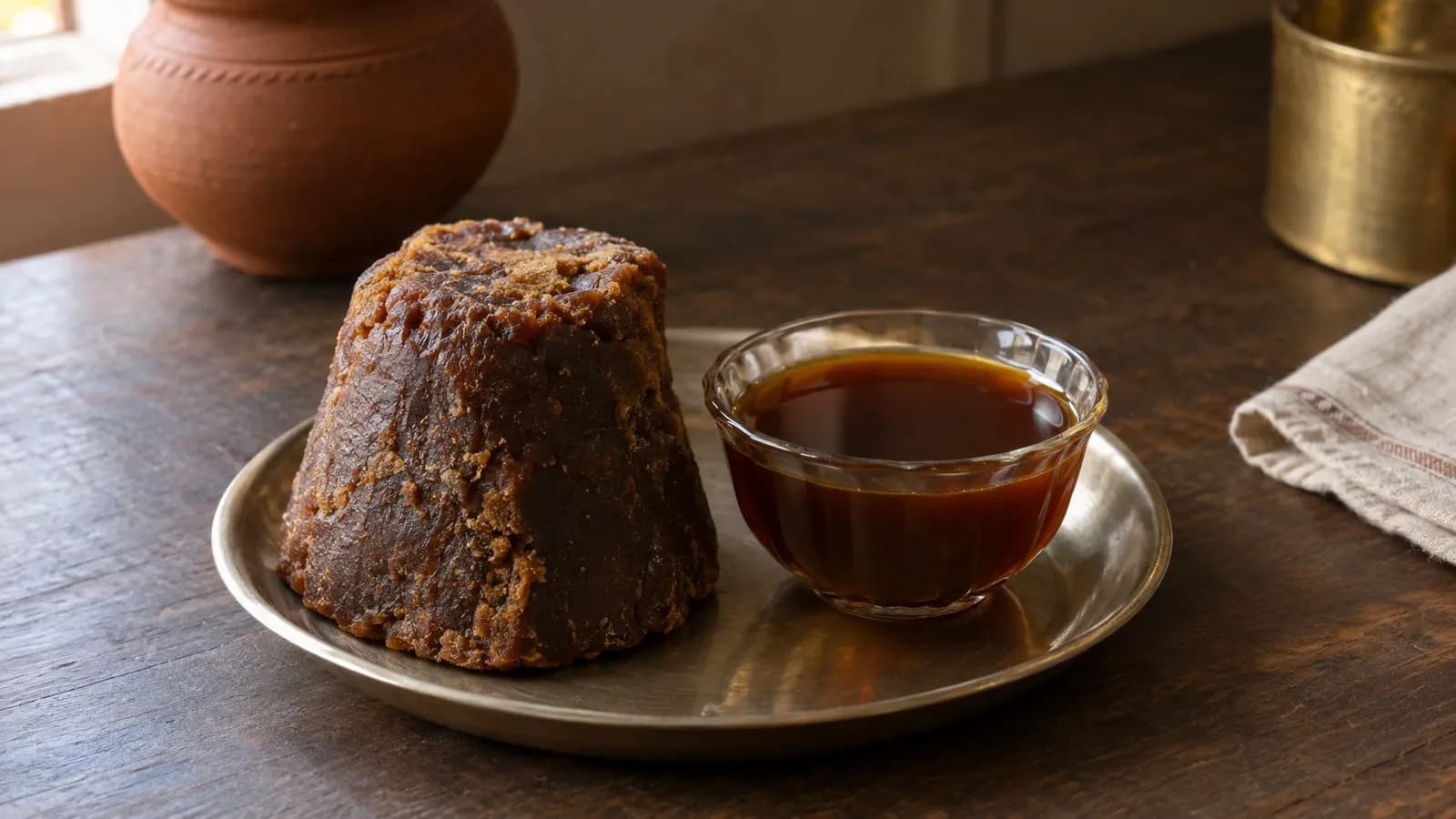
Jaggery. Gur is non-centrifugal sugar: sugarcane juice is boiled, concentrated and clarified, then set into blocks or milled to powder, without the step that spins the molasses away from the crystals. For solid jaggery the juice is taken to a striking point of 118-120 °C; jaggery powder is heated to 120-122 °C, cooled, scraped and sieved, then dried to 1-2 percent moisture (Rao and Singh, Sugar Tech 2022). The same review calls jaggery a nutraceutical for its amino acids, antioxidants, phenolics and minerals such as calcium, phosphorus and iron, notes it has been known for about 3000 years as an essential part of rural diets in many countries, and describes it as a healthier dietary substitute for white sugar on the strength of those nutrients.
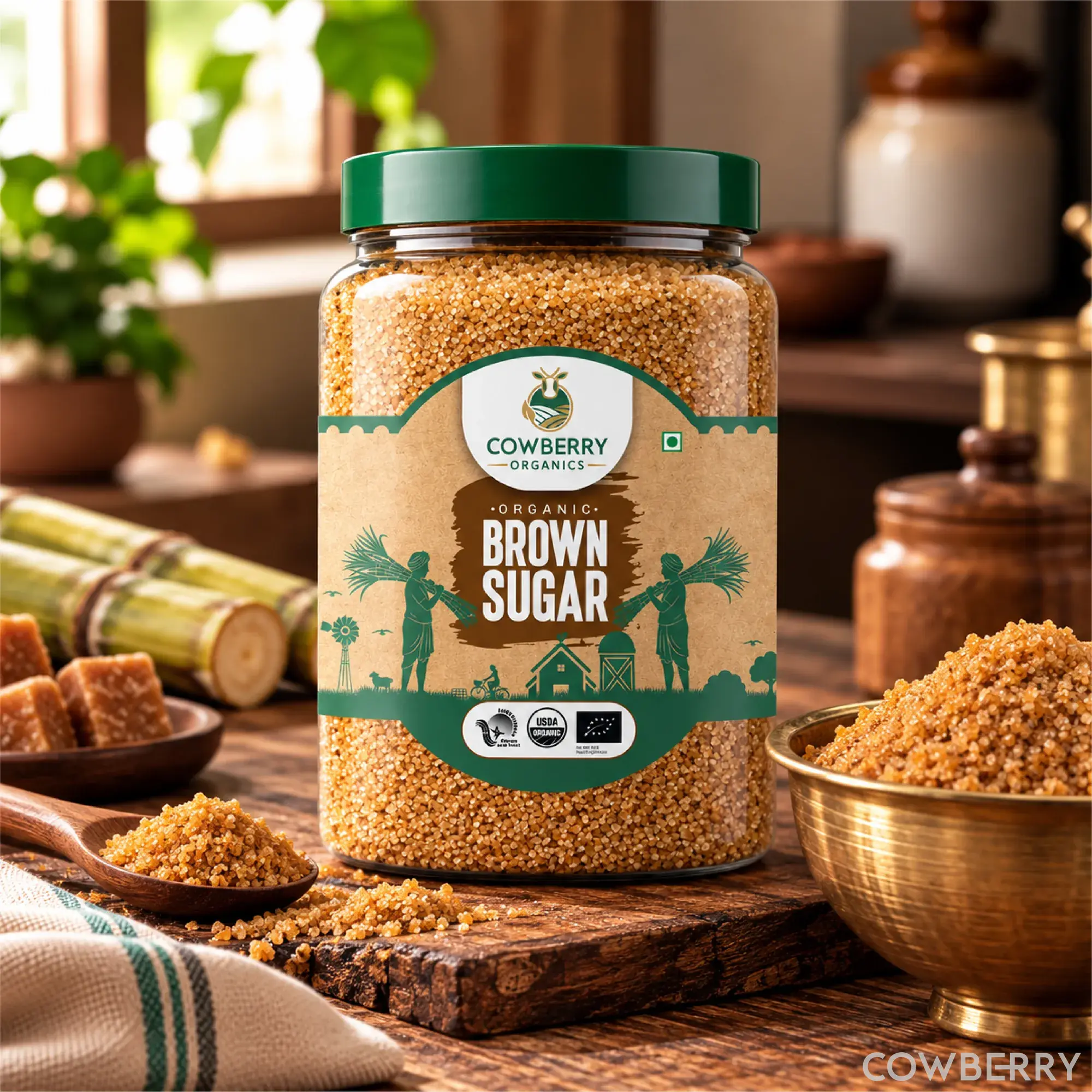
Brown sugar. The USDA entry behind these numbers is 'Sugars, brown', with the type not stated, so the page says only this much: brown sugar is sugar that keeps its molasses. For its brown sugar, COWBERRY names organically grown Maharashtra sugarcane, minimal processing, no artificial colouring and no unnecessary refining, all so the natural molasses remains. Jaggery is not brown sugar dried or crushed: one is sugar crystals that hold on to molasses, the other is boiled-down cane juice. More on the types is in the brown sugar guide.
Glycemic index: brown sugar 71, jaggery untested
The glycemic index question has a one-sided answer. The University of Sydney GI database holds a single brown-sugar entry, a sugar tested in China with six participants, and prints GI 71 for it; that number rests on one small test, and the database gives no reference for it. For jaggery the same database has no entry at all, so no GI is printed for gur anywhere on this page, and none is guessed. The nearest tested food is unrefined cane sugar (panela), at GI 69 in one Italian study, but panela is a different product, so that number is not borrowed for jaggery.
In the University of Sydney's classes, 55 and below is the low band and 70 and above the high, so the tested brown sugar sits at the start of the high band. The WHO lists sugars added by the cook or the maker among free sugars and recommends that free sugars stay under 10 percent of daily energy, and a further reduction toward 5 percent is suggested. ICMR-NIN's plate for a 2000 kcal diet says sugar must be restricted to 25-30 g a day, and five level teaspoons of either sweetener already make 25 g. The full reading for gur is on the jaggery calories page.
Brown sugar vs jaggery powder in the kitchen
Colour and flavour. Brown sugar brings a gentle caramel taste with a warm colour; jaggery's caramel is the stronger of the two. That is the practical rule for swapping: brown sugar suits tea, cookies and cakes where a mild caramel note is welcome, while jaggery suits chai, kheer, laddu and chikki, where its deeper taste is the point.
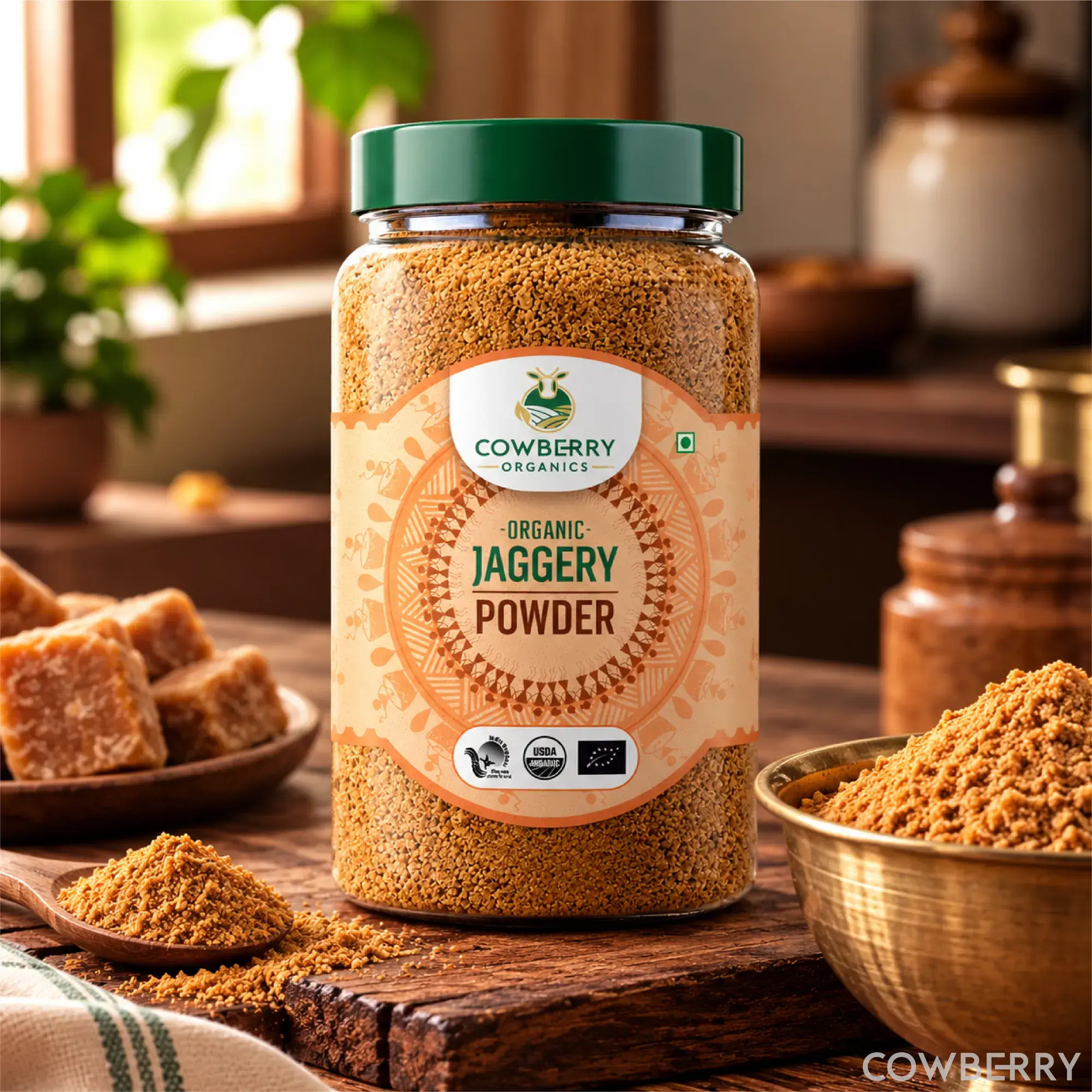
Storage. Brown sugar wants an airtight jar kept cool and dry or it hardens; jaggery powder wants the same, or it clumps. Jaggery powder is dried to a low moisture content when it is made, which is what gives it better storability.
Substitution. Swap brown sugar and jaggery powder weight for weight, then taste and adjust, so the dish ends up using less sweetener rather than the same measure of a different one. For tea, the brown sugar tea recipe builds on demerara, and the jaggery tea recipe shows gur done properly in a cup.
Cost and where each fits
Of the two, jaggery is usually the cheaper buy, though the sums are too small to decide a household's choice.
What decides is use. Brown sugar fits where the dish wants mild caramel and a soft, moist crumb: cakes, cookies, custards and tea. Jaggery fits where its stronger molasses taste belongs: chai, kheer and payasam, laddu and chikki, puran poli and tamarind chutney. Both keep in a dry jar, and both reward being used in smaller amounts than the recipe asks for.
Which for whom
- Someone with diabetes: neither one is a free food. Gur's minerals do not change the fact that it is mostly sugar, and its GI is untested rather than favourable; the single brown-sugar test puts that one at the start of the high band. Where a small amount fits the meal plan, taste decides, and where it does not, use neither. Talk to your doctor or dietitian before bringing either back. The numbers for demerara alone are on the brown sugar vs white sugar page.
- Weight loss: the calorie gap is small either way. A 2012 review of 30 trials and 38 cohort studies in the BMJ found that cutting sugars went with an average loss of 0.8 kg in adults eating freely, while adding them was linked to a comparable 0.75 kg gain; the saving comes from using less, not from switching.
- Low iron: a 15 g tablespoon of jaggery gives 0.69 mg of iron, a small amount, not a remedy. Eat iron-rich foods and follow any prescription instead.
- Children: ICMR-NIN allows no added sugar, jaggery included, below the age of two; after that the WHO ceiling on free sugars covers children too, so the goal is less of either.
- Cooking and baking: brown sugar for mild caramel and a moist crumb; jaggery for a stronger, deeper sweetness.
- Pregnancy: both draw from the same small sugar allowance, and the iron in jaggery is a trace, not a supplement. If you have gestational diabetes, clear it with your doctor or dietitian first.
- Anyone buying gur: read the pack to learn how it was made; the wider list of what jaggery does and does not do is on the jaggery guide.
FAQs
Difference between brown sugar and jaggery?
Brown sugar is sugar crystals that keep some molasses; jaggery is non-centrifugal sugar, the whole cane juice boiled down without spinning the molasses away. The numbers follow: jaggery has 4.63 mg of iron and 107 mg of calcium per 100 g against 0.71 mg and 83 mg, and 354 kcal against 380 kcal.
Is brown sugar and jaggery same?
No. Both start from sugarcane juice, but jaggery is the boiled-down cane juice itself, while brown sugar is crystals that hold on to some molasses. Jaggery is also made without the centrifuging step, which is what the term non-centrifugal sugar means.
Difference between jaggery powder and brown sugar?
Jaggery powder is solid jaggery milled to a fine, dry powder: the boiled mass is cooled, then scraped, sieved and dried to 1-2 percent moisture, and Rao and Singh link that low moisture to better storability. Brown sugar is soft, moist crystals with a gentle caramel taste. A level teaspoon (5 g) of either is the same weight.
Does brown sugar and jaggery taste the same?
No, though both taste of caramel. COWBERRY describes its brown sugar as a gentle caramel sweetness and its jaggery powder as a rich caramel sweetness, and the difference in a cup is just that: jaggery is deeper and stronger, brown sugar softer. Which one suits the dish is a matter of taste.
Is brown sugar jaggery?
No. Jaggery is cane juice boiled and concentrated whole, while brown sugar is sugar crystals with molasses kept in. The name jaggery itself comes from the Portuguese jagara, meaning coarse brown sugar.
Can brown sugar be used in tea?
Yes. Brown sugar dissolves easily in hot tea and brings a mild caramel note instead of plain sweetness, which suits chai. The brown sugar tea recipe on this site is built on demerara sugar, so start there for amounts and method.
References
- Indian Food Composition Tables (IFCT) 2017, ICMR-National Institute of Nutrition
- USDA FoodData Central (SR Legacy): Sugars, brown, FDC ID 168833
- University of Sydney glycemic index database (GI search)
- University of Sydney: about the glycemic index
- WHO guideline: sugars intake for adults and children (2015)
- Dietary Guidelines for Indians, ICMR-National Institute of Nutrition
- Rao GP, Singh P. Value addition and fortification in non-centrifugal sugar (jaggery): a potential source of functional and nutraceutical foods. Sugar Tech, 2022
- Te Morenga L, Mallard S, Mann J. Dietary sugars and body weight: systematic review and meta-analyses of randomised controlled trials and cohort studies. BMJ, 2012
Shop this article
Keep reading
Raw Sugar vs Brown Sugar: Is Demerara the Same Thing?
Does honey contain sugar? Carbs per 100g and the WHO sugar limit
Date Jaggery (Khejur Gur in English): Types, Forms and How to Use It