by COWBERRY

8 minute read
Brown Sugar Benefits and Side Effects: Is It Healthier Than White?

Brown sugar benefits are real but small: a caramel taste, a moister bake, and traces of calcium, iron and potassium that white sugar lacks — not a health upgrade, since the calories and the carbohydrate barely move. This page lists each benefit with its number, then the side effects, the daily amount and the ways to use it. What the sugar itself is, the brown sugar guide covers.
Brown sugar benefits, one at a time
Four benefits, honestly sized. None of them turns brown sugar into a health food, and each one has a number attached.
Calcium from the molasses
Per 100 g, brown sugar carries 83 mg of calcium where white sugar has 1 mg; that is the molasses showing. Scaled to a level teaspoon (5 g), the share is 4.2 mg, so the calcium is a curiosity more than a contribution.
Iron and potassium, in traces
The same pattern holds for iron, 0.71 mg per 100 g against white sugar's 0.05 mg, and potassium, 133 mg against 2 mg. A teaspoon's iron works out to 0.04 mg. Eaten for iron, these numbers do nothing; eaten for the caramel taste, they come along free.
Energy as simple carbohydrate
Brown sugar is 98.1 g of carbohydrate per 100 g and 380 kcal, almost all of it sugar, so a spoon in chai supplies energy as simple carbohydrate — and next to nothing else, at 0.12 g of protein, and no fat or fibre per 100 g.
Demerara sugar benefits in the kitchen: caramel and moisture
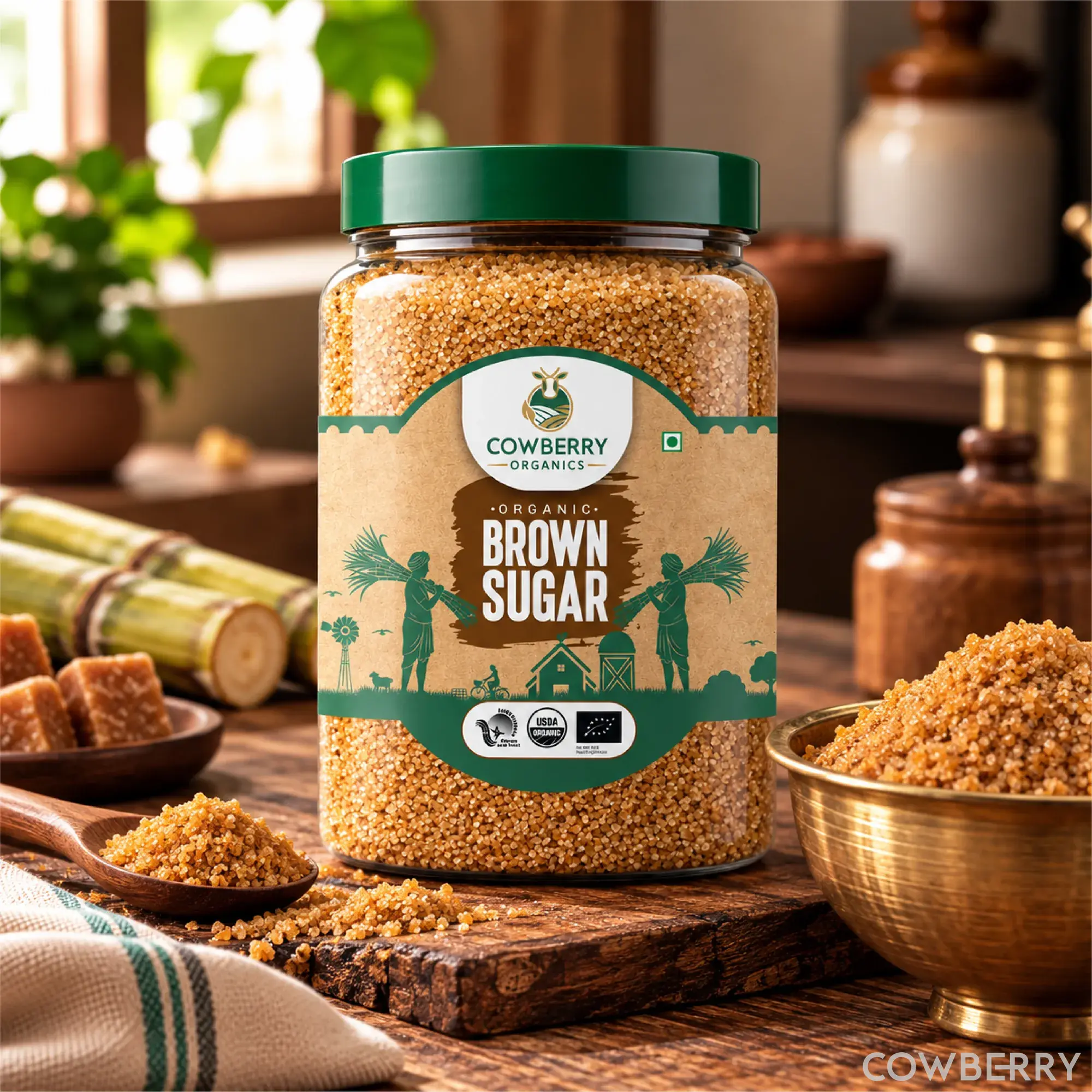
What demerara and the other brown sugars actually win on is the bake. COWBERRY's product page names what its brown sugar brings to a bake — moisture and a rich, caramel-like flavour, across cookies, cakes and desserts — and its description ties the taste to the natural molasses content that minimal processing keeps, noting that fully refined white sugar cannot offer that caramel depth.
Is brown sugar good for health? An honest reading
Set against white sugar, brown sugar is the same food in a darker coat. Energy is 380 kcal per 100 g against 387 kcal, a 7 kcal gap on paper; carbohydrate is 98.1 g against 100 g, and the mineral differences are milligrams, 0.71 mg of iron against 0.05 mg and 83 mg of calcium against 1 mg. The ICMR-NIN dietary guidelines group sugar added in the factory and sugar added at the table as one thing — their added-sugar list names table sugar, jaggery and honey side by side — and they state the plain fact that refined extracted sugars have no vitamins or minerals.
The same guidelines add that sugar contributes energy and little else: calories are healthy only when accompanied by vitamins, minerals and fibre, which is the part brown sugar's molasses traces do not fix. So the honest answer to the question is that brown sugar is a source of energy with a nice taste, and the health question turns on how much of any sugar goes into the day. The brown sugar guide walks through the types and how the molasses stays in.
Side effects of brown sugar and who should limit it
There is no special brown-sugar side effect; the side effects belong to sugar in general, and they arrive through the amount. The ICMR-NIN dietary guidelines describe foods high in fat and sugar as energy dense and short on vitamins, minerals and fibre, and say their regular consumption causes overweight and obesity while pushing aside foods that carry protein and fibre. Brown sugar, at 98.1 g of carbohydrate per 100 g, is that kind of food when the spoon overflows.
- Weight. Every extra teaspoon is another 19 kcal with no fibre or protein attached. In a 2012 BMJ review of 30 randomised trials and 38 cohort studies (Te Morenga and colleagues), in trials of adults eating freely, reduced sugar intake was associated with 0.80 kg lower body weight and increased intake with 0.75 kg higher, while swapping sugars for other carbohydrates at the same energy showed no change.
- Blood sugar. Its GI of 71, from one small Chinese test of six people whose reference the database does not list, sits beside white sugar's 70 at the start of the high band — the University of Sydney scale marks low as 55 and below and high as 70 and above — so the two sugars sit in the same band. Atkinson and colleagues note that whole-grain and whole-meal cereals turned in GI values spread wide apart, differences they put down, presumably, to how the foods were manufactured. The detail is on the brown sugar for diabetes page.
- Teeth. The WHO sugars guideline reports more dental caries when free sugars rise past 10 percent of energy than when they sit below it.
- Children. The guidelines are blunt: added sugar must be totally avoided for children below two years, brown or white, and the WHO ceiling on free sugars covers children after that too.
- Displacing food. Sugar adds energy without the vitamins, minerals and fibre that meals deliver; a child or adult who fills up on sweetened drinks and sweets eats less of the dal, vegetables and fruit that carry them.
None of this is about the colour. It is the dose, and the dose is the spoon. Anyone counting teaspoons as part of a diabetic meal plan should settle the amount with a doctor or dietitian.
How much brown sugar per day
The ICMR-NIN dietary guidelines give adults two numbers. Their weight-control line suggests avoiding sugar or holding it to 20 to 25 g a day, and the note under their 2000 kcal plate restricts sugar to 25-30 g a day. Five level teaspoons of brown sugar make 25 g and about 95 kcal, so a little in tea can already be the whole day's allowance.
The WHO guideline measures the same thing as a share of energy: hold free sugars — the sugars a cook or a manufacturer adds, plus the sugars in honey and syrups — under 10 percent of a day's energy, and a cut below 5 percent is suggested as a further step. Brown sugar is a free sugar on that definition, exactly like white sugar, jaggery and honey. The working habit that follows: decide the teaspoons for the day first, then spend them where the caramel taste shows, not hidden in batter.
How to eat brown sugar: chai, baking and the swaps
Chai is the everyday use. The brown sugar tea recipe on this site builds each cup on demerara — two teaspoons (10 g), working out to roughly 38 kcal and 9.8 g of carbohydrate per cup, added with the leaves at the start — and brown sugar, unlike jaggery, does not split the milk. In baking, brown sugar can stand in for white sugar in many recipes and brings the moist crumb and caramel colour that cookies and cakes want.
The full list of measures, syrups and common mistakes is on the brown sugar uses page; when the jar is empty, the brown sugar substitute page works through jaggery powder, white sugar and honey as stand-ins. For the per-100 g table behind every number above, see brown sugar nutritional value per 100g. And the honest side-by-side with the refined version is the brown sugar vs white sugar page.
FAQs
Is brown sugar good for health?
Not more than white sugar is. Brown sugar gives 380 kcal with 98.1 g of carbohydrate per 100 g against white sugar's 387 kcal and 100 g, and its minerals, 0.71 mg of iron and 83 mg of calcium, are traces. The ICMR-NIN guidelines note that refined extracted sugars have no vitamins or minerals, so the day's sugar total, not the colour, decides.
Is demerara sugar healthy?
Demerara is one kind of brown sugar, and it carries the same numbers: 380 kcal per 100 g, 98.1 g of carbohydrate, traces of minerals. Healthy is the wrong frame: it is a sweetener, and it belongs inside the same 20 to 25 g a day that ICMR-NIN suggests for adults. Its edge over other sugars is the caramel taste, nothing measured.
Why brown sugar is healthy?
It is not, in the sense the question hopes. The molasses leaves 0.71 mg of iron and 83 mg of calcium per 100 g, which is more than white sugar's 0.05 mg and 1 mg, but a teaspoon's share is 0.04 mg of iron and 4.2 mg of calcium, nothing that changes a diet. What brown sugar genuinely offers is flavour.
Which brown sugar is good for health?
No type is. The USDA entry for brown sugar does not state the type it measured, and no published figure ranks demerara, muscovado or light brown sugar on health; nothing here shows one is better for health. Choose the one the dish wants, and keep the amount the same.
Is brown sugar actually healthy?
Actually, it is sugar that kept its molasses. Per 100 g, its 98.1 g of carbohydrate sits just under white sugar's 100 g, and its 380 kcal run 7 below white sugar's 387 kcal. The molasses minerals are real but tiny, and the guidelines' added-sugar list names table sugar, jaggery and honey side by side. Small amounts, occasionally, is the whole story.
References
- USDA FoodData Central (SR Legacy): Sugars, brown, FDC ID 168833
- USDA FoodData Central (SR Legacy): Sugars, granulated, FDC ID 169655
- Dietary Guidelines for Indians, ICMR-National Institute of Nutrition
- University of Sydney glycemic index database (GI search)
- University of Sydney: about the glycemic index
- Atkinson FS, Brand-Miller JC et al. International tables of glycemic index and glycemic load values 2021: a systematic review. Am J Clin Nutr, 2021
- Te Morenga L, Mallard S, Mann J. Dietary sugars and body weight: systematic review and meta-analyses of randomised controlled trials and cohort studies. BMJ, 2012
- WHO guideline: sugars intake for adults and children (2015)
Shop this article
Keep reading
Raw Sugar vs Brown Sugar: Is Demerara the Same Thing?
Does honey contain sugar? Carbs per 100g and the WHO sugar limit
Date Jaggery (Khejur Gur in English): Types, Forms and How to Use It