by COWBERRY

7 minute read
Black rice vs white rice: nutrition, GI, taste and which to choose

Black rice vs white rice: one keeps the dark bran, one is polished — and the gap is smaller than the colour promises. Black rice wins on fibre, 4.2 g against 2.81 g per 100 g, and on minerals, while its tested GI of 91 sits above the India-tested sona masoori figure of 72. The black rice hub covers the dark grain; the two meet here.
Verdict in three lines
Black rice is the unpolished whole grain: 4.2 g of fibre per 100 g against white rice's 2.81 g, 113 mg of magnesium against 19.3 mg, and anthocyanins among its listed components. White rice, in the common sona masoori form, is the polished everyday grain that cooks in 12-15 minutes into soft, fluffy grains.
On energy the two nearly tie: 370 kcal per 100 g for black rice, 357 kcal for white. On GI the tested numbers surprise: plain cooked black rice averages 91 across three tests, none in India, above the India-tested sona masoori figure of 72. Both sit in the high band; neither is a low-GI rice.
Which to pick is a portion and pairing question more than a colour one. The black rice guide gives the dark grain's names and kitchen life; the numbers for the swap follow below.
Black rice vs white rice nutrition: side by side per 100 g
Black rice numbers come from the USDA food database; the white-rice column is the Indian Food Composition Tables' entry for raw milled rice (there is no sona masoori-specific row). The table shows the values as each source lists them.
Fibre is the honest headline: 4.2 g against 2.81 g, about one-and-a-half times. Minerals widen the gap further: magnesium 113 mg against 19.3 mg, potassium 256 mg against 108 mg, iron 1.12 mg against 0.65 mg, zinc 1.72 mg against 1.21 mg, calcium 14 mg against 7.49 mg.
On protein and carbohydrate the two are close: 7.57 g of protein and 77.2 g of carbohydrate in black rice, 7.94 g and 78.24 g in white, so white rice's protein edge is small. Fat is 3.44 g against 0.52 g, both small next to the ghee or oil the meal itself adds. A katori of cooked black rice (about 40 g raw) carries about 148 kcal, 31 g of carbohydrate and 1.7 g of fibre; the same katori of white rice carries about 143 kcal, 31 g of carbohydrate and 1.1 g of fibre. The full per-100 g detail for the dark grain is on black rice nutrition per 100g.
| Nutrient | Black rice, raw | White rice (sona masoori), raw |
|---|---|---|
| Energy (kcal) | 370 | 357 |
| Protein (g) | 7.6 | 7.9 |
| Fat (g) | 3.4 | 0.5 |
| Carbohydrates (g) | 77 | 78 |
| Dietary fibre (g) | 4.2 | 2.8 |
| Iron (mg) | 1.1 | 0.7 |
| Calcium (mg) | 14 | 7.5 |
| Magnesium (mg) | 113 | 19 |
| Potassium (mg) | 256 | 108 |
| Sodium (mg) | 0 | 2.3 |
| Zinc (mg) | 1.7 | 1.2 |
| Folate (mcg) | — | 9.3 |
| Glycemic index (GI) | 91 | 72 |
Per 100 g raw, edible portion. Composition: USDA FoodData Central (Foundation), FDC ID 2710825, NDB 100349; IFCT 2017 (ICMR-NIN). GI: University of Sydney GI database. — means not reported. These are average values for the food; the label on a pack gives the values for that product.
Glycemic index: 91 against 72, read carefully
The India-tested white-rice figure is solid: sona masoori recorded a GI of 72 in a 2012 Chennai study of 23 healthy volunteers, cooked in a rice cooker for 35 minutes — high on the University of Sydney scale, where 55 or below counts as low and 70 or above counts as high.
The black-rice average is assembled from thinner, foreign evidence: an Indonesian black Adan rice at 64, and a Chinese waxy black rice steamed 30 and 60 minutes at 100 and 109 — a mean of 91, with no Indian test on record. The spread, 64 to 109, shows how much variety and cooking moved the results, the same point a 2023 Foods review makes for rice generally.
Read both figures as band markers, not verdicts. Neither number decides how your plate behaves, and 72 is not "better" than 91 in any useful sense — both are high. For India-tested rice, basmati at 50 sits in the low band and brown rice at 58 in the medium band; low GI rice in India covers them.
Taste and cooking
COWBERRY describes its black rice as earthy and mildly nutty. White sona masoori is soft, light and fluffy with a gentle aroma, the neutral base every dal, sambar and rasam knows.
Cooking differs on effort, not just time. Sona masoori cooks in 12-15 minutes. Black rice has no single set time — the pack says cooking time varies with the variety — so the method is: rinse well, use one cup of rice to two cups of water (the pack's 1:2 instruction) and simmer until every grain is tender through the middle; judge by doneness, not the clock.
For the plate: white rice stays the daily grain for dal-chawal, curd rice and biryani. Black rice can go into desserts such as kheer and rice pudding. The darker family argument sits on red rice vs black rice.
Storage and where each fits
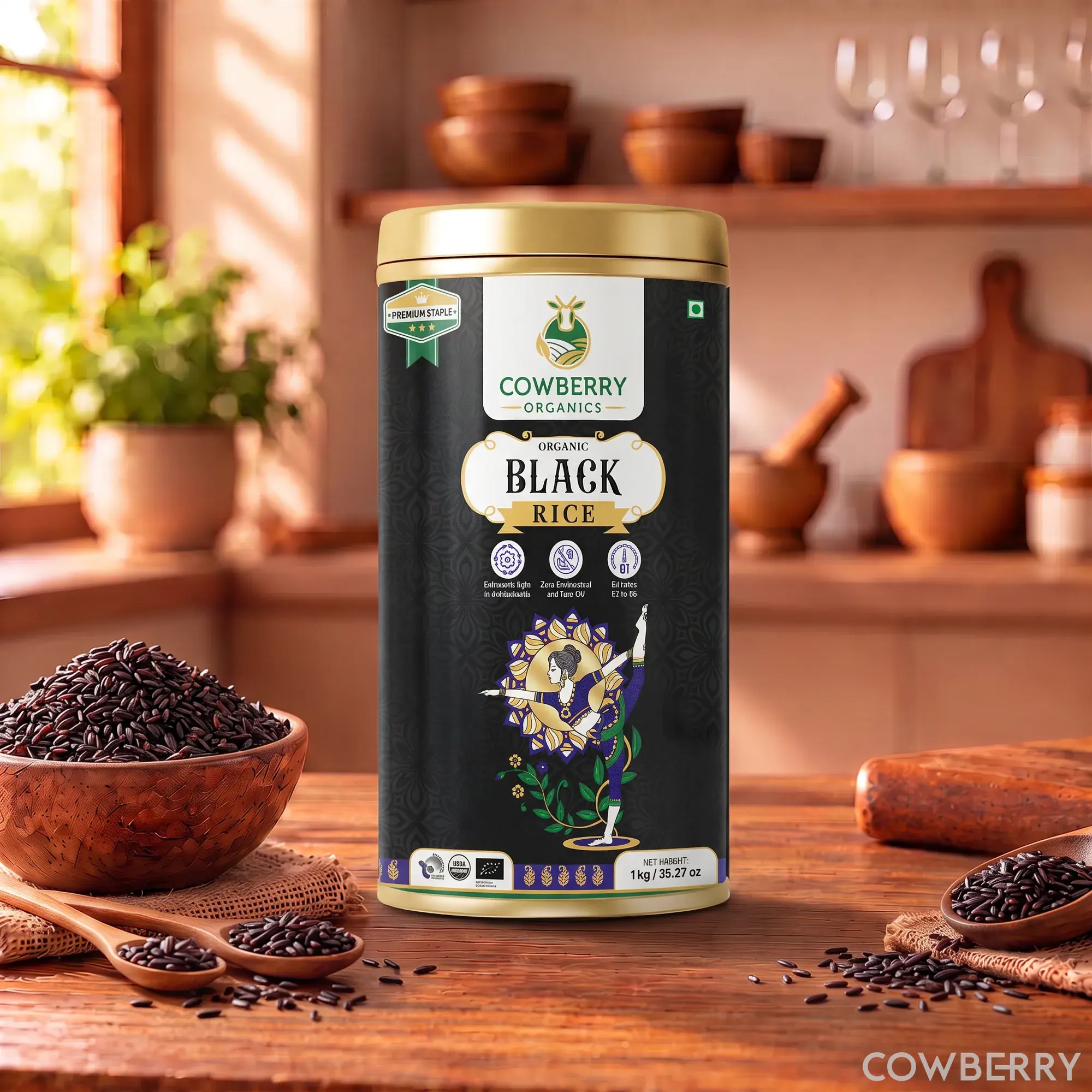
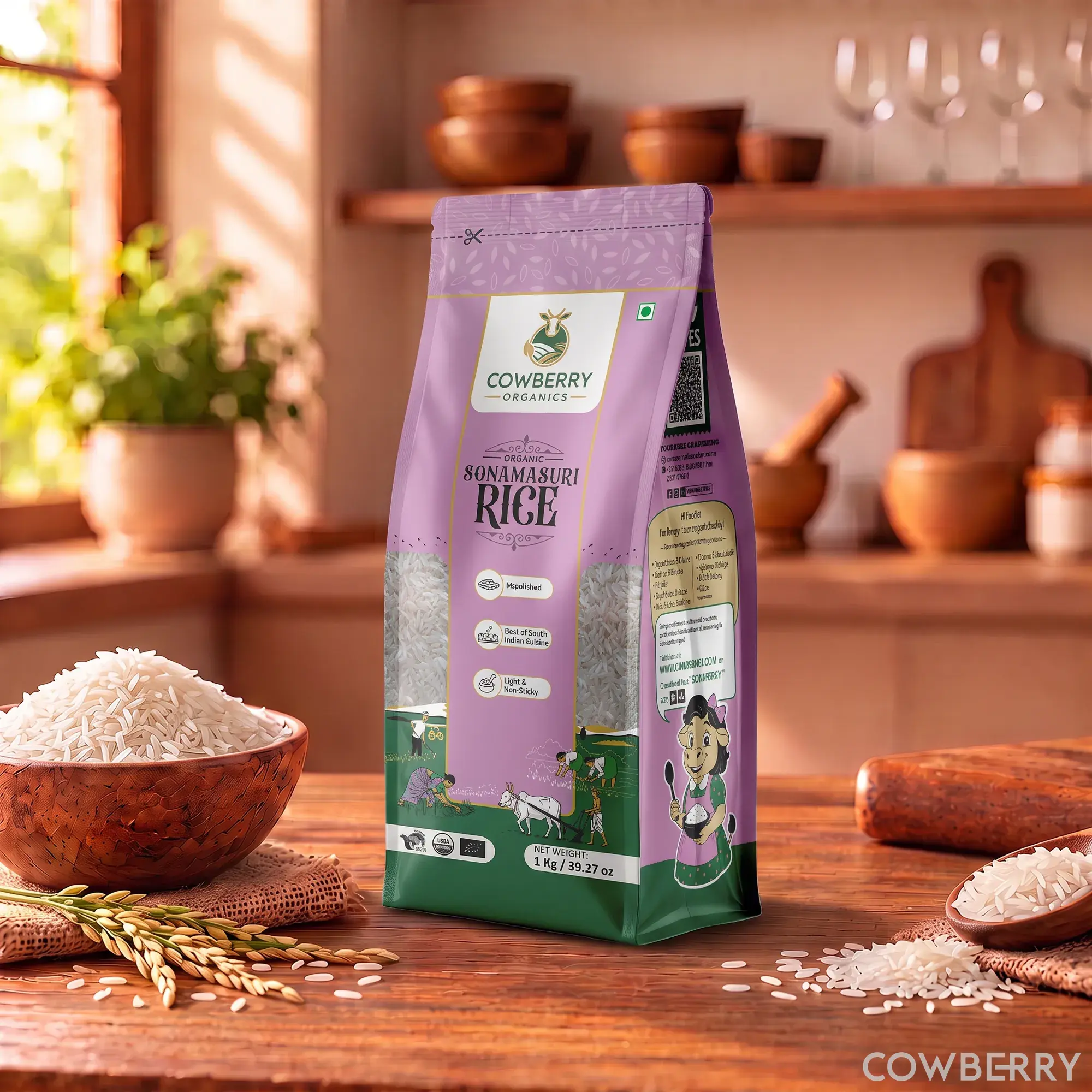
White rice is the everyday grain in many Indian homes. Black rice is a specialty grain from Manipur and the broader Northeast belt, and COWBERRY's comes in a 1 kg pack. COWBERRY's sonamasuri is grown in Andhra Pradesh, Telangana and Karnataka.
Both grains belong in an airtight container in a cool, dry place. How each grain lines up among the wider shelves is on types of rice in India.
Which for whom
- Everyday meals: white sona masoori — quick, soft and familiar. The everyday grain is sona masoori rice.
- Managing diabetes: neither is low-GI. In a 2022 meta-analysis, white rice intake was associated with a higher type 2 diabetes risk when the highest and lowest intakes were compared, and black rice's tested average of 91 is no lower on paper. Talk to your doctor or dietitian about either grain and the portion. Black rice for diabetes has the numbers.
- Watching weight: katoris nearly tie — about 148 kcal for black rice, 143 kcal for white — and a 2023 review of pigmented rice in general associated longer-term intake with a small drop in weight, 0.23 kg across three trials, while asking for more high-quality trials.
- Gluten-sensitive homes: both are naturally gluten-free.
- Children's meals: COWBERRY describes its sonamasuri as soft and easy to cook, suitable for children's meals.
FAQs
What is the difference between black rice and white rice?
The bran. Black rice is sold unpolished, with its dark outer layer; white rice is milled and polished to remove the bran. That is behind part of the table: black rice carries 4.2 g of fibre and 113 mg of magnesium per 100 g, white rice 2.81 g and 19.3 mg.
Is black rice good for diabetics?
Black rice is not a low-GI rice: across the three GI tests of plain cooked black rice, the average lands at 91, the high band, and a katori (40 g raw) carries about 31 g of carbohydrate. If you have diabetes, talk to your doctor or dietitian about the grain and the portion.
Does black rice taste good?
COWBERRY describes its black rice as earthy and mildly nutty, and it can go into desserts like rice pudding. Taste is personal, and the product's own description calls it a grain with a unique colour, flavour and texture. If the earthiness is too much on its own, mix it with white rice at first.
Why is black rice black?
Black rice is rich in anthocyanins, a pigment also found in blueberries, and anthocyanins are listed among black rice's components in a 2019 Food Chemistry review, alongside dietary fibre, minerals and phenolic compounds.
Does black rice have protein?
Yes, 7.57 g per 100 g, a whisker below white rice's 7.94 g. Both are cereals, and the Dietary Guidelines for Indians note that pairing cereals with pulses improves the protein quality of a meal.
Can black rice be eaten daily?
It is a cooked cereal like other rice: a katori (40 g raw) gives about 148 kcal and 31 g of carbohydrate. How often it suits you depends on your whole diet; for blood sugar or weight concerns, talk to your doctor or dietitian.
References
- Indian Food Composition Tables (IFCT) 2017, ICMR-National Institute of Nutrition
- USDA FoodData Central
- University of Sydney glycemic index database (GI search)
- University of Sydney: about the glycemic index
- Shobana S, Kokila A, Lakshmipriya N, et al. Glycaemic index of three Indian rice varieties. Int J Food Sci Nutr, 2012
- Yu J, Balaji B et al. White rice, brown rice and the risk of type 2 diabetes: a systematic review and meta-analysis. BMJ Open, 2022
- Ngo TV, Kunyanee K et al. Insights into recent updates on factors and technologies that modulate the glycemic index of rice and its products. Foods, 2023
- Mendoza-Sarmiento D, Mistades EV, Hill AM. Effect of Pigmented Rice Consumption on Cardiometabolic Risk Factors: A Systematic Review of Randomized Controlled Trials. Curr Nutr Rep, 2023
- Ito VC, Lacerda LG. Black rice (Oryza sativa L.): A review of its historical aspects, chemical composition, nutritional and functional properties, and applications and processing technologies. Food Chem, 2019
- Dietary Guidelines for Indians, ICMR-National Institute of Nutrition
Shop this article
Keep reading
Red rice vs brown rice: the fibre, GI and honest verdict
Red rice vs black rice: nutrition, glycemic index and which to choose
Red rice nutrition per 100g: calories, protein, fibre and GI