by COWBERRY

10 minute read
Sona masoori rice: meaning, nutrition, benefits and how to cook it

Sona masoori rice is a light, medium-grain white rice, the grain behind everyday dal-chawal, curd rice, dosa and idli; COWBERRY lists it as light and non-sticky, soft and aromatic, with a 12 to 15 minute cook. Its names, nutrition, tested GI, benefits, cooking, storage, recipes and buying notes follow.
What is sona masoori rice?
Sona masoori is a medium-grain white rice that comes milled in two forms: raw, and steam — the parboiled kind, also called boiled. The name gets spelled sona masoori, sona masuri or sonamasuri; all three are one rice, and the one entry the University of Sydney GI database holds for it names the grain plain white rice, Sona Masuri variety. Its botanical name is Oryza sativa. A medium grain sits between the long rices and the short ones on the shelf, and the pack's own feature list names medium size grain among its qualities.
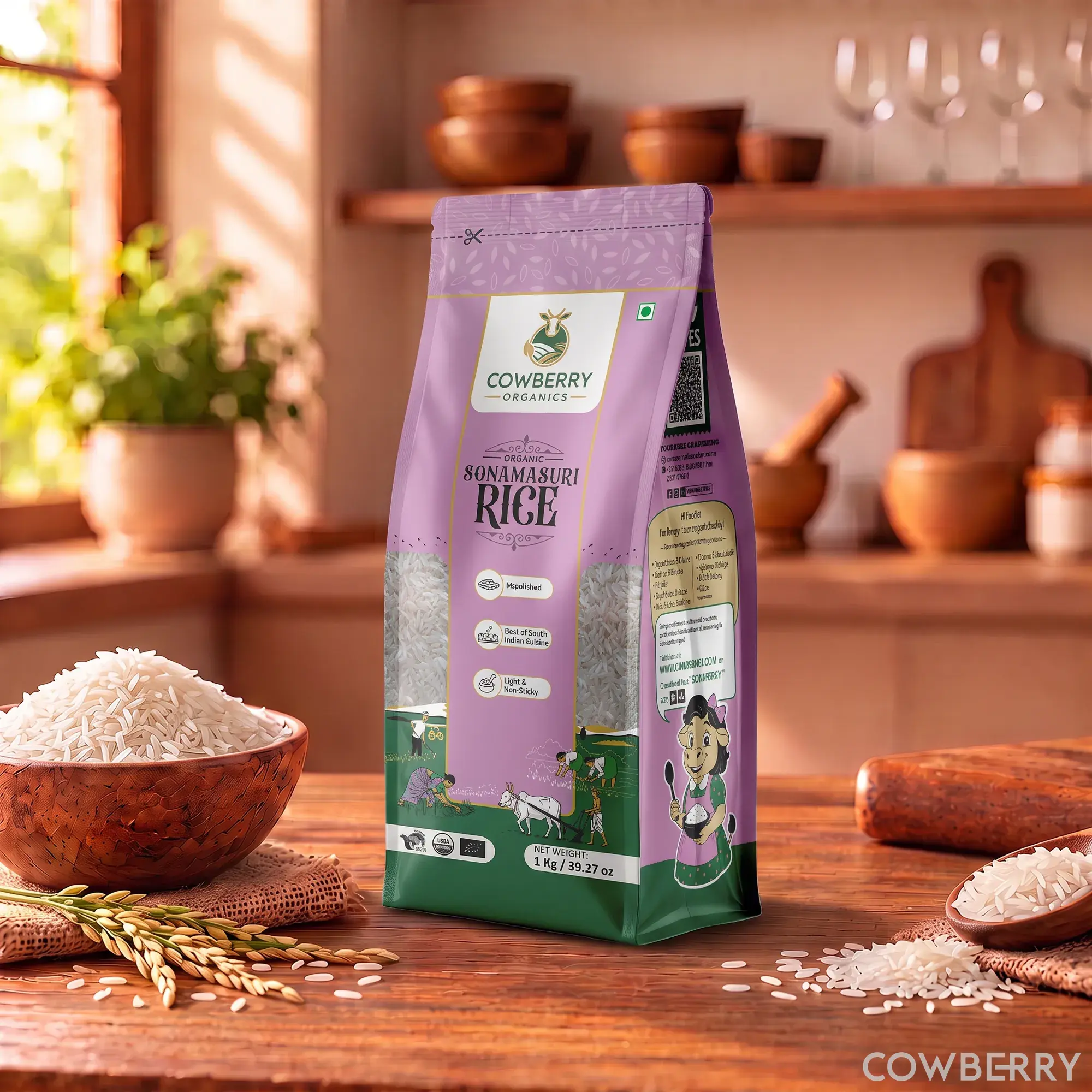
COWBERRY lists sona masoori as light and non-sticky, soft and aromatic; the pack's features add slender and fluffy, quick and easy to cook, medium size grain and made from quality rice. The two forms, and what each does in the pot, are compared on the sona masoori raw vs steam page.
Sona masoori rice names in Indian languages
IFCT 2017 prints ten local names for the grain: Hindi's Chawal, Telugu's Biyyam, Tamil's Arisi, Kannada's Akki, Marathi's Tondool, Gujarati's Choka, Punjabi's Chaul, Bengali's Chowl, Odia's Chaula and Assamese Milat khunda chaul. The table below holds that list in full, with the botanical name on top.
Ten languages, one grain — the names all hang off the same pooled listing the composition figures come from, so the English name printed is the generic rice, raw, milled. On the shelf the spelling varies — sona masoori, sona masuri or sonamasuri — but all three name one grain.
| Language | Name (romanised) |
|---|---|
| English | Rice, raw, milled |
| Hindi | Chawal |
| Marathi | Tondool |
| Gujarati | Choka |
| Punjabi | Chaul |
| Bengali | Chowl |
| Odia | Chaula |
| Assamese | Milat khunda chaul |
| Kannada | Akki |
| Telugu | Biyyam |
| Tamil | Arisi |
| Malayalam | — |
| Urdu | — |
| Sanskrit | — |
| Botanical name | Oryza sativa |
Source: IFCT 2017 (ICMR-NIN) local-names list. — means no name recorded in the source.
Sona masoori rice nutrition per 100 g
The numbers come from the listing sona masoori falls under in IFCT 2017 — rice, raw, milled, since the tables print no separate line for the variety: 357 kcal, 7.94 g of protein, 0.52 g of fat, 78.24 g of carbohydrate and 2.81 g of fibre per 100 g. Beside it in the same table sit brown rice and whole wheat, and the pattern shows plainly: of the three, this polished grain carries the least fibre and protein and the most carbohydrate.
On minerals, the same table shows the pattern for itself: iron 0.65 mg, zinc 1.21 mg, magnesium 19.30 mg, potassium 108 mg, calcium 7.49 mg, sodium 2.34 mg and folate 9.32 mcg per 100 g, with vitamin C not reported — a modest list, not a mineral food's. A katori of cooked rice starts from 40 g of the raw grain — about 143 kcal and 31.3 g of carbohydrate — and a 200 g cup of dry rice is five katoris. The per-katori arithmetic, the micronutrient detail and the tested GI are on the sona masoori rice nutrition page.
| Nutrient | Sona masoori (raw, milled) | Brown rice | Whole wheat |
|---|---|---|---|
| Energy (kcal) | 357 | 354 | 322 |
| Protein (g) | 7.9 | 9.2 | 11 |
| Fat (g) | 0.5 | 1.2 | 1.5 |
| Carbohydrates (g) | 78 | 75 | 65 |
| Dietary fibre (g) | 2.8 | 4.4 | 11 |
| Iron (mg) | 0.7 | 1 | 4 |
| Calcium (mg) | 7.5 | 11 | 39 |
| Magnesium (mg) | 19 | 94 | 125 |
| Potassium (mg) | 108 | 199 | 366 |
| Sodium (mg) | 2.3 | 3.6 | 2.5 |
| Zinc (mg) | 1.2 | 1.7 | 2.9 |
| Folate (mcg) | 9.3 | 12 | 30 |
| Glycemic index (GI) | 72 | 58 | 47 |
Per 100 g raw, edible portion. Composition: IFCT 2017 (ICMR-NIN). GI: University of Sydney GI database. — means not reported. These are average values for the food; the label on a pack gives the values for that product.
Sona masoori rice benefits
A white rice's honest benefit list stays short, and each item rests on a printed figure or a product fact. It is naturally gluten-free: on its coeliac disease page the NHS names wheat, barley and rye as the three gluten cereals, and rice carries none of them, so the grain sits easy on a gluten-free plate. Fat is 0.52 g and sodium 2.34 mg per 100 g, the grain is light and non-sticky, and COWBERRY's product page names children and elderly family members among those it suits.
The everyday advantages are practical rather than clinical: a 12 to 15 minute cook, a clean flavour that takes on dal, rasam, sambar and curd, and soft, separate grains that suit tiffin boxes and simple meals. What the grain is not is a fibre food: its 2.81 g per 100 g sits below brown rice's 4.43 g and far below whole wheat's 11.23 g, so the whole-grain share of the day has to come from other foods on the plate. The plate, not the grain, carries the day's fibre. Each benefit, with the nutrient and the source behind it, is on the sona masoori rice benefits page.
Side effects: who should limit sona masoori rice
There is no separate side-effect list for sona masoori; the limits that matter are the ones every white rice carries. First, the glycemic index: the variety's single tested entry reads 72 — the Shobana 2012 study cooked the white rice for 35 minutes in a rice cooker, in India, on 23 subjects — and on the University of Sydney scale, 70 and above is the high band, with low at 55 and below. A big bowl lifts blood glucose more than a measured katori with dal and sabzi does; one katori carries 31.3 g of carbohydrate and two carry 62.6 g.
On the research side, a 2022 meta-analysis in BMJ Open pooled eight cohort studies: at the extremes of intake, heavier eating of white rice was associated with higher diabetes risk, the association steepening beyond roughly 300 g a day at 13 percent per added 158 g a day serving, while brown rice intake pointed the opposite way. A 2015 study adds one kitchen habit: rice cooled for a full day at 4 °C and reheated brought a gentler glucose response in fifteen healthy adults, with resistant starch climbing from 0.64 to 1.65 g per 100 g. Both tested white rice in general, not this variety.
Second, the pattern of eating: a week of white rice alone misses the whole-grain share the guidelines set — at least half of daily cereals as whole grains and minimally polished — so the grain belongs in a rotation with brown rice, millets and whole wheat. With diabetes, take the portion question to the clinic — the full numbers are on the is sona masoori rice good for diabetes page — and talk to your doctor or dietitian before changing your staple grain.
How to cook and use sona masoori rice
The everyday pot is simple. Rinse the rice once or twice — the guidelines want grains washed well rather than again and again, because over-washing lifts out minerals and vitamins — then cook one cup of rice in twice its volume of water, the 1:2 ratio. Covered on a low flame, the 12 to 15 minutes COWBERRY lists is enough, with five minutes of resting under the lid before you fluff it with a fork. The pressure cooker keeps the same ratio and finishes sooner, and the test of doneness is the same everywhere: a grain that squeezes soft all through.
A 200 g cup of dry rice cooks into about five katoris, each katori counting 40 g of raw grain. The steam form may want a splash more water. For whistle counts, full steps and cooker settings, see how to cook sona masoori rice.
How to store sona masoori rice
Dry rice is the easy one: keep it in an airtight container in a cool, dry place, which COWBERRY's page for the grain says holds its freshness, aroma and texture. Bought dry and kept sealed, rice stores well for many months.
For cooked rice the fridge rule applies: cool it and refrigerate within one to two hours of the pot leaving the flame, then eat it within two days. Freezing cooled leftovers promptly keeps them longer still, and the same government guidance walks through chilling, freezing and defrosting in detail for any leftovers.
Sona masoori rice recipes
Six recipes here are built on sona masoori, one for each job the grain does. Dosa and idli turn the rice, with urad dal, into a fermented batter; curd rice mashes the cooked grains with curd under a mustard tempering; ven pongal pressure-cooks the rice with moong dal into a soft breakfast porridge; coconut rice folds cooled grains with grated coconut; and puliyogare coats them in tamarind gojju.
The two batters share one rhythm: soak the rice and dal for 4 to 6 hours, grind, then ferment for 8 to 10 hours. After that the idli recipe steams the batter in moulds for 12 to 15 minutes into sixteen soft idlis, and the dosa recipe spreads it thin into eight crisp ones. The cooked-grain recipes start from the pot: one cup of rice simmers 12 to 15 minutes into four servings of curd rice, and the rest dress the cooked grain — moong dal porridge, grated coconut, tamarind gojju. Each recipe lists its own quantities, timings and steps.
How to buy sona masoori rice
Check the bag first: it says raw or steam (sometimes boiled), and the two forms suit different jobs. For organic rice, look for a certification mark on the pack; under the FSSAI advertising rules, the word natural is a defined claim — a single food with nothing added and only minimal processing — not a certification. COWBERRY's Organic Sonamasuri Rice is India Organic, USDA & EU certified, grown organically in Andhra Pradesh with cow-based farming, with no additives or preservatives. Buy a size you will finish while the grain is still fresh, keep it in the airtight container above, and let the sona masoori raw vs steam page settle which form to pick.
FAQs
What is sona masoori rice?
Sona masoori is a medium-grain white rice, sold raw and steam, and the grain behind everyday dal-chawal, curd rice, dosa and idli. COWBERRY lists it as light and non-sticky, and describes the grain as soft and aromatic; the pack's features add slender and fluffy, quick and easy to cook. Its botanical name is Oryza sativa, and its one tested glycemic index is 72.
What does sona masoori rice taste like?
Soft and aromatic, as COWBERRY describes the grain, with light, fluffy grains, a clean flavour and a gentle natural aroma. Under dal, sambar, rasam or curd it stays a plain base, so the curry leads the plate.
What is sona masoori rice used for?
Everyday rice dishes, mostly: dal-chawal, curd rice, lemon rice, pongal, coconut rice and puliyogare, plus dosa and idli batters. The product page adds biryani and rice pudding to the list, and cooled, day-old grains suit fried rice. Six recipes on this site are built on it.
Where is sona masoori rice grown?
COWBERRY's Organic Sonamasuri Rice is grown organically in Andhra Pradesh with cow-based farming. The one GI test behind its figure of 72 was run in India on healthy volunteers in the Shobana 2012 study.
Can sona masoori rice be used for idli?
Yes — the idli recipe on this site is built on it. Soak the rice and urad dal separately for 4 to 6 hours, grind both, mix with salt and ferment for 8 to 10 hours, then steam the batter in moulds for 12 to 15 minutes. Sixteen soft idlis come out, ready for chutney and sambar.
Can sona masoori rice be used for dosa?
Yes — it is the rice half of the batter in the dosa recipe on this site. Soak the rice and urad dal for 4 to 6 hours, grind, mix with salt and ferment for 8 to 10 hours; the risen batter makes eight thin, crisp dosas.
Is sona masoori rice good?
As an everyday rice, yes: light, non-sticky and quick to cook, with 0.52 g of fat and 2.34 mg of sodium per 100 g. Its single tested GI, 72, sits in the high band, so it earns a counted katori with dal and sabzi rather than free helpings.
Is sona masoori rice good for babies?
It can be, once solids begin: COWBERRY's product page names children among those the soft, light grain suits. The ICMR-NIN guidelines advise beginning semi-solid complementary foods soon after six months while breastfeeding continues, and your paediatrician decides which food comes first.
References
- Indian Food Composition Tables (IFCT) 2017, ICMR-National Institute of Nutrition
- Dietary Guidelines for Indians, ICMR-National Institute of Nutrition
- University of Sydney glycemic index database (GI search)
- University of Sydney: about the glycemic index
- Shobana S, Kokila A, Lakshmipriya N, et al. Glycaemic index of three Indian rice varieties. Int J Food Sci Nutr, 2012
- Yu J, Balaji B et al. White rice, brown rice and the risk of type 2 diabetes: a systematic review and meta-analysis. BMJ Open, 2022
- Sonia S, Witjaksono F, Ridwan R. Effect of cooling of cooked white rice on resistant starch content and glycemic response. Asia Pac J Clin Nutr, 2015
- NHS: coeliac disease
- UK Food Standards Agency: How to chill, freeze and defrost food safely
- FSSAI Food Safety and Standards (Advertising and Claims) Regulations 2018, compendium (PDF)
Shop this article
Keep reading
Red rice vs brown rice: the fibre, GI and honest verdict
Red rice vs black rice: nutrition, glycemic index and which to choose
Red rice nutrition per 100g: calories, protein, fibre and GI