by COWBERRY

7 minute read
Tej patta vs bay leaf: the difference between them and uses

Difference between tej patta and bay leaf: in the kitchen there is none, because tej patta is the Hindi name for bay leaf and both words buy the same whole dried leaf for the same pot. In botany the difference is real: the Indian tej patta is Cinnamomum tamala, the European bay leaf is Laurus nobilis. The comparison is below; the bay leaf hub covers the leaf itself.
The short answer: one leaf in the kitchen, two trees in botany
The difference between tej patta and bay leaf is mostly a question of which book you open. In the kitchen the two names point to the same thing: the whole dried leaf added to dal, pulao, biryani and curries for its aroma and lifted out before serving. In botany they point to two trees.
| Bay leaf | Tej patta | |
|---|---|---|
| English name | Bay leaf; the USDA FoodData Central record writes it 'Spices, bay leaf' | Tej patta is the Hindi name; no other Indian-language name is recorded |
| Botanical name | Laurus nobilis | Cinnamomum tamala |
| Food-table record | USDA FoodData Central FDC 170917, with a full per-100 g profile; IFCT 2017 has no entry | No record in IFCT 2017 or in the USDA tables |
| Growing | Widely cultivated in many world regions (a 2022 review) | The leaf Indian kitchens buy; COWBERRY's is grown in West Bengal |
The name split matters because the nutrition numbers people quote for bay leaf belong to the European leaf only; the Indian leaf has no recorded profile, so no honest page can put two sets of numbers side by side. The bay leaf hub covers the rest of the cluster.
Taste and cooking: the same job in the pot
Cooked, the two are interchangeable, and Indian kitchens use them as one spice. One or two whole leaves go into the hot oil with the other whole spices, or into the simmering liquid, and come out before serving; the leaf stays tough even after a long cooking, which is why it is not eaten.
The aroma is the point. The 2022 review of Laurus nobilis describes the leaf's essential oil, built around the compound 1,8-cineole, and notes that the oil's composition shifts with environmental conditions, location, season and drying method. That matters more in the pot than the name on the label: leaves from different harvests can carry different aromas. Under either name, the leaf gives the same quiet herbal background note that rounds out dal, rice and meat dishes without standing in front of the other spices.
For the pot-side method, see how to use bay leaf in cooking.
The numbers: only the European leaf is on the books
The numbers people quote for bay leaf come from one place: the USDA FoodData Central record FDC 170917 for 'Spices, bay leaf', Laurus nobilis, per 100 g. It is the only bay leaf profile either food table carries. IFCT 2017, the Indian food tables, has no bay leaf entry at all, and Cinnamomum tamala, the Indian leaf, has no record in either source.
| Nutrient | Bay leaf (Laurus nobilis), raw |
|---|---|
| Energy (kcal) | 313 |
| Protein (g) | 7.6 |
| Fat (g) | 8.4 |
| Carbohydrates (g) | 75 |
| Dietary fibre (g) | 26 |
| Iron (mg) | 43 |
| Calcium (mg) | 834 |
| Magnesium (mg) | 120 |
| Potassium (mg) | 529 |
| Sodium (mg) | 23 |
| Zinc (mg) | 3.7 |
| Folate (mcg) | 180 |
| Vitamin C (mg) | 46 |
Per 100 g raw, edible portion. Composition: USDA FoodData Central (SR Legacy), FDC ID 170917, NDB 2004. — means not reported. These are average values for the food; the label on a pack gives the values for that product.
Three honest readings of that table
First, 313 kcal, 75.0 g of carbohydrate and 26.3 g of fibre describe 100 g of dried leaf, and no recipe uses 100 g; cooks add one or two whole leaves and remove them before serving. Second, the minerals are large for a leaf, 43.0 mg of iron and 834 mg of calcium per 100 g, but again they describe the spice jar, not the plate. Third, the table cannot compare the two leaves, because only one of them is recorded; there is no glycemic index published for bay leaf, and no nutrition entry for tej patta to set beside it. The full per-100 g breakdown lives on the bay leaf nutrition facts 100g page.
Cost and where each fits in the kitchen
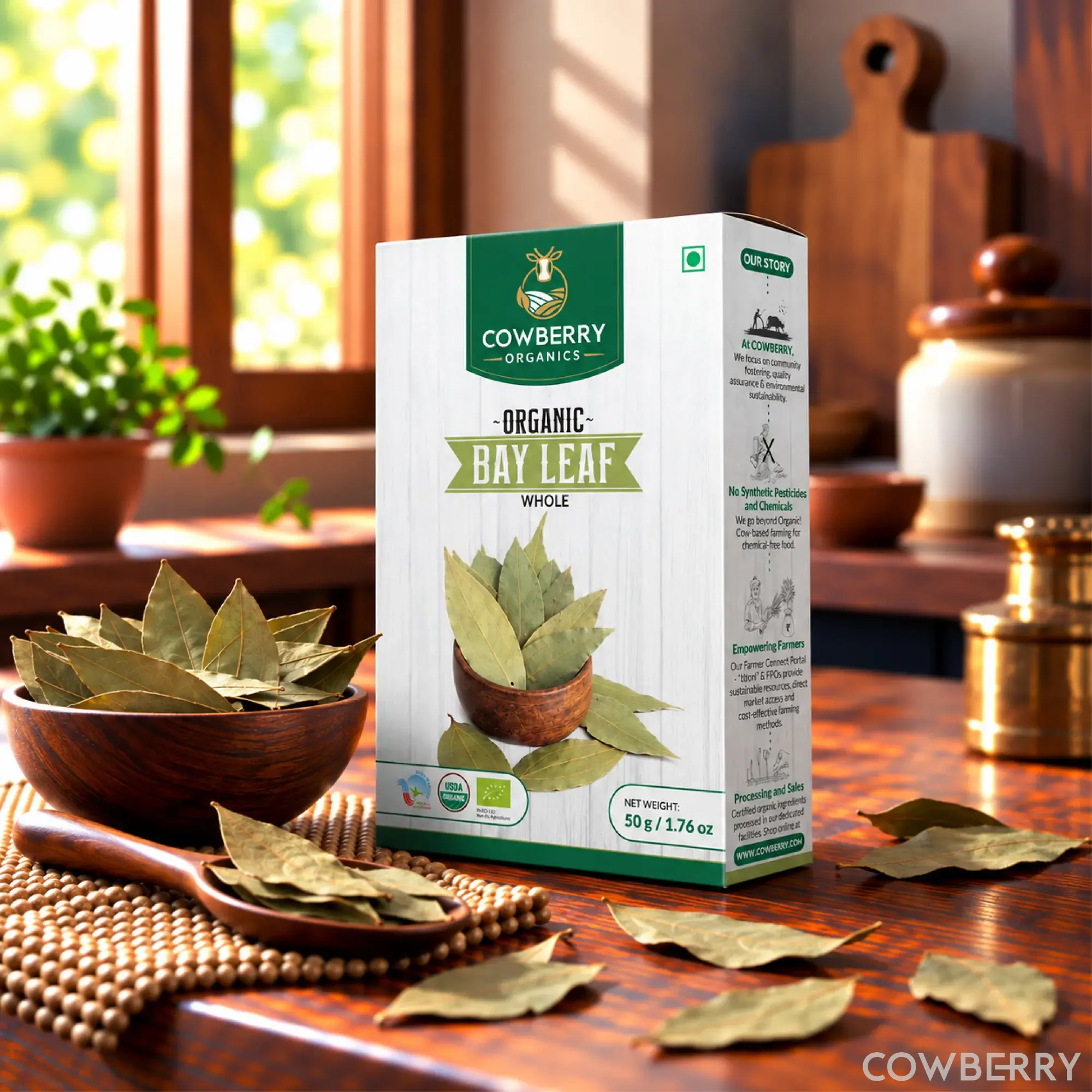
This page compares the leaves, not price tags. No single price applies across India's spice shops, and both leaves are everyday whole spices sold in small packs. COWBERRY's organic bay leaf, grown in West Bengal, comes in a 50 g pack of whole dried leaves.
What costs the cook more than the leaf is a pack that has gone stale. Buy whole leaves and check for even colour and unbroken leaves; whole spices are the harder ones to adulterate, as the Dietary Guidelines for Indians point out, and a cool, dry, airtight jar keeps the aroma.
Which one for whom
For the cook, the decision is simple: buy whatever the shop sells under whichever name, because the job in the pot is the same. For the recipe reader, the name follows the language: English recipes say bay leaf, Hindi recipes say tej patta, and the swap is free. For the label reader, the pack carries what the names do not, origin and pack size; COWBERRY's leaf is organically grown in West Bengal, naturally dried and gently cleaned.
For the reader who wants the full name trail, the tej patta in English page carries every name with its source. For curry-leaf cooks, tej patta's most common mix-up is with curry patta, a different leaf from a different plant; that comparison has its own page at kadi patta vs tej patta.
FAQs
Is tej patta and bay leaf same?
Same leaf on the spice shelf, two names on paper. Tej patta is the Hindi name for bay leaf, and in the pot they are used identically: whole, for aroma, removed before serving. In botany the split is real, because the Indian tej patta is the leaf of Cinnamomum tamala while the European bay leaf is Laurus nobilis.
Is bay leaf and tej patta same?
Yes, in the kitchen. Bay leaf is the English name and tej patta the Hindi one, and either word buys the same whole dried leaf in India. Only the food tables split them: the recorded profile belongs to the European bay leaf, Laurus nobilis, and the Indian leaf, Cinnamomum tamala, has no recorded profile.
What is tej patta?
Tej patta is the Hindi name for bay leaf, the whole dried leaf cooked in dal, pulao, biryani and curries for its aroma and removed before serving. Botanically it is the leaf of the Indian tree Cinnamomum tamala, while the European bay leaf is Laurus nobilis; in the kitchen the two are interchangeable.
What is the difference between tej patta and curry patta?
Tej patta and curry patta are two different leaves. Curry patta, the curry leaf, is the small green leaf fried in the tempering and eaten with the dish; tej patta is the large dried bay leaf, cooked whole for its aroma and lifted out before serving. The full comparison is on the kadi patta vs tej patta page.
Can I use bay leaf instead of tej patta?
Yes, freely. Tej patta is the Hindi name for bay leaf, so an English-recipe bay leaf and a Hindi-recipe tej patta do the same job in the pot: whole leaf in at the start, out before serving. The only difference is on paper, in the botanical names.
What is bay leaf?
Bay leaf is the dried aromatic leaf used whole in cooking, added to dal, rice, soups and curries for its aroma and removed before serving because it stays tough. The food tables record it as 'Spices, bay leaf', the leaf of Laurus nobilis; in India the same leaf is called tej patta.
References
- USDA FoodData Central
- Indian Food Composition Tables (IFCT) 2017, ICMR-National Institute of Nutrition
- Paparella A, Nawade B, Shaltiel-Harpaz L et al. A Review of the Botany, Volatile Composition, Biochemical and Molecular Aspects, and Traditional Uses of Laurus nobilis. Plants (Basel), 2022
- Dietary Guidelines for Indians, ICMR-National Institute of Nutrition
Shop this article
Keep reading
Coriander water benefits: what dhania water actually does
Peanuts in Hindi (moongfali): groundnut names in Indian languages
Coriander vs cilantro: are they the same herb?