by COWBERRY

7 minute read
Bay leaf nutrition facts 100g: calories, fibre and what one leaf adds

Bay leaf nutrition facts 100g come from one place: the USDA FoodData Central record for 'Spices, bay leaf', which prints 313 kcal, 75.0 g of carbohydrate and 26.3 g of fibre per 100 g. The Indian tej patta has no published record, and the leaf is lifted out before serving, so the table needs a reality check. The bay leaf hub covers the leaf itself.
Bay leaf nutrition facts per 100 g: the table
The table prints the full USDA FoodData Central record for the dried European bay leaf, Laurus nobilis: 313 kcal of energy, 7.61 g of protein, 8.36 g of fat, 75.0 g of carbohydrate and 26.3 g of dietary fibre, with 43.0 mg of iron and 834 mg of calcium per 100 g. IFCT 2017, the Indian food tables, carries no bay leaf entry, and the Indian tej patta, Cinnamomum tamala, appears in neither source, so every number on this page belongs to Laurus nobilis alone.
Two things to keep in mind as you read it. First, these are values for the dried leaf as it sits in the spice jar, not for a serving: no recipe cooks 100 g of bay leaf, and the leaf is removed before the food is eaten. Second, the numbers belong to the leaf the West calls bay leaf; the Indian pack labelled tej patta has no published profile, so its numbers cannot honestly be quoted.
| Nutrient | Bay leaf, dried | Curry leaves, fresh | Cloves |
|---|---|---|---|
| Energy (kcal) | 313 | 64 | 187 |
| Protein (g) | 7.6 | 7.4 | 5.9 |
| Fat (g) | 8.4 | 1.1 | 8.4 |
| Carbohydrates (g) | 75 | 4.5 | 19 |
| Dietary fibre (g) | 26 | 17 | 35 |
| Iron (mg) | 43 | 8.7 | 9.4 |
| Calcium (mg) | 834 | 659 | 567 |
| Magnesium (mg) | 120 | 182 | 334 |
| Potassium (mg) | 529 | 584 | 1434 |
| Sodium (mg) | 23 | 19 | 183 |
| Zinc (mg) | 3.7 | 1.2 | 1.1 |
| Folate (mcg) | 180 | 117 | 33 |
| Vitamin C (mg) | 46 | 6 | — |
Per 100 g raw, edible portion. Composition: USDA FoodData Central (SR Legacy), FDC ID 170917, NDB 2004; IFCT 2017 (ICMR-NIN). — means not reported. These are average values for the food; the label on a pack gives the values for that product.
Bay leaf calories in a real pot, not a 100 g jar
Bay leaf calories exist on paper and barely on the plate. The 313 kcal in the table describe 100 g of dried leaf, a spice-jar amount no dish ever sees. The working measure is the trial's own: 1 g of ground leaf carries about 3 kcal, and the trial's top amount, 3 g, comes to about 9 kcal. A whole leaf cooked in the pot and lifted out adds aroma to the dish, not energy worth counting.
The reason is plain. The leaf flavours the oil and the liquid and then comes out again; what dissolves into the food is a small share of the leaf's volatile compounds, not its carbohydrate or minerals. So when a food log asks for the calories of the bay leaf in the dal, the honest entry is effectively zero, and the honest number for the leaf itself is about 3 kcal for the trial's smallest daily amount.
Bay leaf nutrition against curry leaves and cloves
Set the leaf beside two spices that do get eaten and the picture sharpens. Protein is 7.61 g per 100 g, about level with fresh curry leaves at 7.41 g and above cloves at 5.86 g. Fibre is 26.3 g per 100 g, above the curry leaf's 16.83 g but below cloves at 34.52 g. Iron, at 43.0 mg per 100 g, runs far ahead of the 8.67 mg in curry leaves and the 9.41 mg in cloves, and calcium at 834 mg leads the same pair, at 659 mg and 567 mg.
The comparison carries one honest limit: the bay leaf row is USDA's dried Laurus nobilis while the curry leaf and clove rows are IFCT 2017, and one of the three is normally lifted out of the pot before anyone eats. The minerals that win on paper mostly leave with the leaf.
Tej patta nutritional value per 100g: what is not recorded
The phrase tej patta nutritional value per 100g deserves a straight answer: no such figure is published. The Indian tej patta, Cinnamomum tamala, has no entry in USDA FoodData Central and none in IFCT 2017, and this page will not invent one. Every number quoted above belongs to the European bay leaf, Laurus nobilis, and applies to the Indian leaf only in the loose sense that both are dried aromatic leaves used whole in the pot.
The same gap shows up in the glycemic index. No glycemic index is published for bay leaf, the European leaf included, and without one there is no glycemic load to quote; the leaf is a seasoning removed before serving, not a carbohydrate food. Any page that prints a GI figure for tej patta has no published source for it. The botanical and naming split is set out on the difference between tej patta and bay leaf page.
Minerals, vitamins and the essential oil: what reaches the plate
The minerals in the table are striking for a leaf: 43.0 mg of iron, 834 mg of calcium, 120 mg of magnesium, 529 mg of potassium and 3.7 mg of zinc per 100 g, with 180 mcg of folate and 46.5 mg of vitamin C. Sodium is low at 23 mg per 100 g. Read honestly, though, these are spice-jar numbers: the leaf's job in the pot is to give aroma, and the leaf is lifted out, so almost none of this mineral column reaches the eater.
What does move into the dish is the essential oil. A 2022 review in the journal Plants names 1,8-cineole as the compound at the centre of the leaf's essential oil, and adds that the oil's composition depends on environmental conditions, location, season and the drying method used; that is why the same spice can smell different from one harvest to the next. The aroma is the nutrition story of the leaf: a whole pot seasoned for a few kcal at most.
How to read these numbers, and where the leaf fits
Summed up: the leaf is nutritionally real but nutritionally beside the point. Per 100 g it is fibre-rich at 26.3 g and mineral-dense, yet what actually cooks is one or two leaves in a pot, removed before serving, so the honest per-serving number is about 3 kcal for the trial's 1 g of ground leaf. What the leaf reliably adds is aroma; in food it is not a dose of anything.
For the cooking method and the one rule, whole leaf in and whole leaf out, see how to use bay leaf in cooking. The trial behind the numbers people quote is explained on the is bay leaf good for diabetes page, and what each of these numbers means for health is on the tej patta benefits page. The bay leaf hub collects the whole cluster.
FAQs
Do bay leaves have any nutritional value?
Yes, on paper: the USDA record for the dried European leaf prints 313 kcal, 7.61 g of protein, 26.3 g of fibre, 43.0 mg of iron and 834 mg of calcium per 100 g. In practice the leaf is added whole for aroma and removed before serving, so almost none of that reaches the plate; the trial's 1 g of ground leaf holds about 3 kcal.
Does bay leaf have calories?
Yes: 313 kcal per 100 g of dried leaf, from the USDA record. What cooks, though, is one or two leaves in a pot, removed before serving, so the calories that end up in the dish are effectively none. The trial's smallest daily amount, 1 g of ground leaf, is about 3 kcal, and 3 g comes to about 9 kcal.
Does tej patta helps in weight loss?
No human study shows bay leaf helping with weight loss, and this page will not stretch the numbers to say otherwise. The leaf seasons the pot for about 3 kcal a gram and is lifted out before serving, so it neither adds nor takes away meaningful energy. Weight loss comes from the whole plate, not from any single leaf.
Is bay leaf good for diabetes?
A single 2009 study, the one trial behind the claims, gave forty people with type 2 diabetes ground bay leaf capsules for 30 days; in the bay leaf groups, fasting glucose and cholesterol readings fell, while the placebo group showed no significant changes. It is one short study of a powder, not the leaf in food; the full reading is on the is bay leaf good for diabetes page.
What is bay leaf?
The dried aromatic leaf of Laurus nobilis, sold whole and added to dal, pulao, soups and curries for its aroma, then lifted out before serving. The USDA tables record it as 'Spices, bay leaf'; in India the same leaf is tej patta. The name trail is on the tej patta in English page.
References
- USDA FoodData Central
- Indian Food Composition Tables (IFCT) 2017, ICMR-National Institute of Nutrition
- Paparella A, Nawade B, Shaltiel-Harpaz L et al. A Review of the Botany, Volatile Composition, Biochemical and Molecular Aspects, and Traditional Uses of Laurus nobilis. Plants (Basel), 2022
- Khan A, Zaman G, Anderson RA. Bay leaves improve glucose and lipid profile of people with type 2 diabetes. J Clin Biochem Nutr, 2009
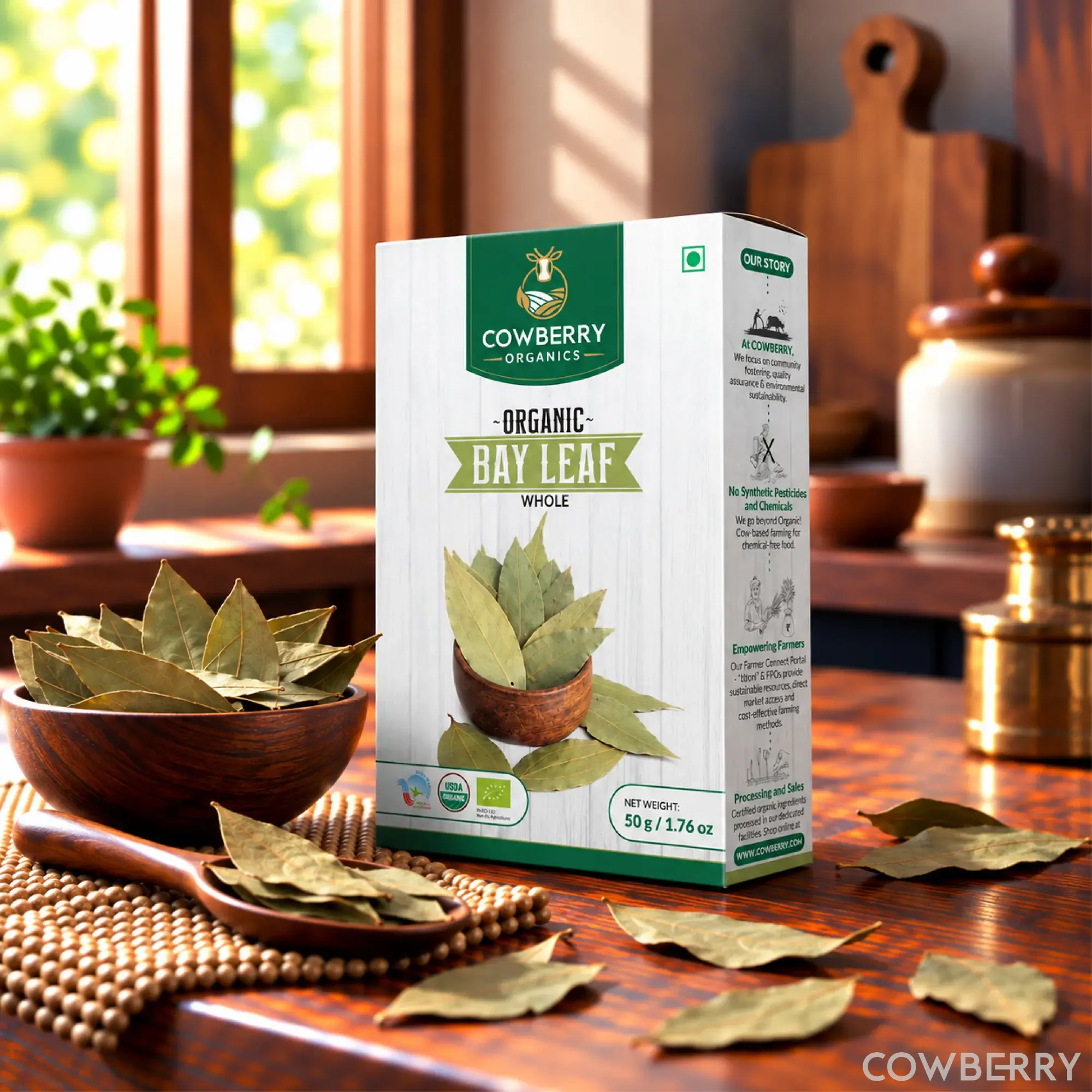
Shop this article
Keep reading
Coriander water benefits: what dhania water actually does
Peanuts in Hindi (moongfali): groundnut names in Indian languages
Coriander vs cilantro: are they the same herb?