by COWBERRY

10 minute read
Ajwain (carom seeds): names, nutrition, benefits and how to use it

Ajwain is the seed behind a spice note every Indian kitchen knows: the one that makes a dal tadka, a paratha and a glass of ajwain water smell like home. This hub collects every ajwain page on this site — names, nutrition, benefits, side effects, uses, recipes and buying. Start at the names table below or jump to what you need.
What is ajwain?
Carom seeds ajwain, ajwain seeds, omum — the jar may say any of them, and the seed inside is one: Trachyspermum ammi, a small seed spice with a strong, pungent character. IFCT 2017, the Indian Food Composition Tables, files the seed under food code G029 as Omum, and a 2014 review in Phytotherapy Research records the plant's traditional therapeutic uses. In the kitchen the seed is older than any paper: whole seeds crackle into tempering oil, get kneaded into paratha and thepla doughs, and steep into the drink called ajwain water. The seed's strong aroma is the whole story: a pinch in pakora batter, a few seeds in khichdi, a spoonful in mathri dough — the dishes change, the small measure stays.
The same seed answers to thirteen Indian-language names, from ajwan in Hindi to vamu in Telugu, and the table below prints all of them with the language each belongs to. Shops often spell a few of them differently — ova in Marathi, vaamu in Telugu, omam in Tamil — and each variant gets a footnote on the names page. Which name is which, plus those variants, is on the ajwain in english and hindi page.
| Language | Name (romanised) |
|---|---|
| English | Omum |
| Hindi | Ajwan |
| Marathi | Onva |
| Gujarati | Ajmo |
| Punjabi | Ajwain |
| Bengali | Joan |
| Odia | Juani |
| Assamese | Ajwain |
| Kannada | Oma |
| Telugu | Vamu |
| Tamil | Omum |
| Malayalam | Ayamothakam |
| Urdu | Ajwain |
| Sanskrit | Ajamoda |
| Botanical name | Trachyspermum ammi |
Source: IFCT 2017 (ICMR-NIN) local-names list. — means no name recorded in the source.
Ajwain nutrition per 100 g
The printed numbers come from IFCT 2017, per 100 g of ajwain: 358 kcal of energy, 15.89 g of protein, 21.11 g of fat, 24.53 g of carbohydrates and 20.58 g of dietary fibre, with calcium 1034 mg, iron 13.65 mg, zinc 5.67 mg and folate 51.79 mcg. No GI figure is printed for ajwain, and this page repeats none. A 2014 Food Chemistry analysis of aromatic spices read ajwain's zinc as 84.95 micrograms per gram, with arsenic, cadmium and lead reading very low across the spices it tested.
Per 100 g reads large because the seed is eaten by the pinch. A teaspoon (5 g), the measure for a cup of ajwain water, comes to about 18 kcal, 1 g of fibre, 52 mg of calcium and 0.7 mg of iron. The table below prints the full set of figures, and the page that sets them beside cumin seeds and coriander seeds, ratios included, is carom seeds nutritional value per 100g.
| Nutrient | Ajwain (carom) |
|---|---|
| Energy (kcal) | 358 |
| Protein (g) | 16 |
| Fat (g) | 21 |
| Carbohydrates (g) | 25 |
| Dietary fibre (g) | 21 |
| Iron (mg) | 14 |
| Calcium (mg) | 1034 |
| Magnesium (mg) | 273 |
| Potassium (mg) | 1692 |
| Sodium (mg) | 29 |
| Zinc (mg) | 5.7 |
| Folate (mcg) | 52 |
Per 100 g raw, edible portion. Composition: IFCT 2017 (ICMR-NIN). — means not reported. These are average values for the food; the label on a pack gives the values for that product.
Ajwain benefits: what the research actually shows
Two records stand behind ajwain's reputation, and neither is a human trial. The traditional record is old: a 2008 Asia Pacific Journal of Clinical Nutrition review records that biomedical work on Indian spices is focused on their scientific merits, seeking science-based backing for the traditional uses. The laboratory record is younger: a 2014 Phytotherapy Research review reports that previous studies credited the plant — through its constituents thymol and carvacrol — with anti-inflammatory, antioxidant and immunological effects, and that effects such as antifungal, antibacterial, antiparasitic and antilipidemic have been described for it. That evidence lives in laboratory and animal studies; no trial in people appears in the review, so the claims stay on the research bench.
The reason the human record stays thin is spelled out in a 2014 review by Opara and Chohan: herbs and spices are eaten by the pinch, mixed into other foods, which keeps a true health benefit hard to establish. Between the two sits the nutrition: the per-100 g numbers in the section above are composition facts, not benefit claims, and the benefits page keeps those two kinds of statements apart. The careful, study-by-study reading is on the ajwain benefits page, and the same points in Hindi are on ajwain khane ke fayde.
Side effects, and who should limit ajwain
No published study we could find lists side effects of ajwain in people, so there is no official list to print. The practical caution is the flavour itself: ajwain is strongly flavoured, and more than a recipe's pinch is likely to taste harsh, which is why every amount on this page is small. The doctor rule still applies in two places. Pregnant or nursing women and people on regular medicines should ask their doctor or dietitian before making ajwain a daily habit, and anyone whose stomach complaints keep returning should see a doctor rather than reach for a spice jar, because no study tests ajwain against those complaints.
In practice the pinch already keeps things modest: a quarter teaspoon for a whole dal is a trace amount, and a teaspoon only ever goes into a cup of water. Keep it that small and the caution list stays short; push the amount up and the harsh taste acts as its own brake.
Ajwain vs jeera and other seeds
Three jars sit side by side on many Indian shelves, and they are not interchangeable. Jeera is cumin, Cuminum cyminum, the earthy workhorse of the tadka; ajwain is carom, the pungent pinch seed; saunf is fennel, the sweet seed chewed after meals. IFCT 2017 records the Hindi pair as jira and ajwan, and the Tamil pair as jeerakam and omum, so the names never meet. In cooking, jeera can stand in for ajwain in a savoury dish, pinch for pinch, while saunf's sweetness belongs where sweetness fits; the full swap table is on what is a substitute for carom seeds.
The plant mix-ups are easier to clear: ajwain is the seed of one plant, Trachyspermum ammi, while oregano and thyme are separate plants with no entry in ajwain's IFCT 2017 name list. A recipe that calls for oregano means oregano; a recipe that calls for carom means ajwain.
How to use ajwain in cooking
Ajwain works in three kitchen jobs, all of them small. Tempering: a quarter teaspoon covers the dal or curry pot for four — the seeds go into hot oil or ghee with the other whole spices and crackle for a few seconds before the onions. Doughs: whole seeds knead into paratha and thepla dough, a pinch for a stuffed paratha. Water: a teaspoon (5 g) per cup, simmered for three to five minutes or soaked for eight hours overnight and strained. The quantities and the mistakes to avoid are on the how to use carom seeds page; both water methods, step by step, are on how to make carom seeds water.
Two habits keep the flavour where it belongs. Keep whole seeds rather than powder, because the ICMR-NIN Dietary Guidelines prefer whole spices, uniform in colour, size and shape, as powdered spices are more likely to be adulterated. And use ajwain only where the recipe asks for it — the seeds do not swap for jeera, as the section above explains.
Ajwain recipes to start with
Two recipes on this site put the seeds in food rather than water. Ajwain roti kneads a teaspoon of seeds into whole-wheat dough for eight soft rotis, cooked on a tawa in about 35 minutes; a serving of two rotis adds up to 231 kcal, about 116 kcal a roti. Ajwain laddu folds two teaspoons of seeds into roasted atta, ghee and jaggery for a batch of fifteen laddus, each about 35 g and 172 kcal, rolled in half an hour of work and kept for about a month in an airtight jar. The laddu recipe's own note ties the batch to a home tradition: many families roll ajwain laddus when a baby arrives and keep them for the new mother; through the rest of the year the same laddus are an everyday sweet. Both recipes measure the seeds in teaspoons because a little is the whole point. If the seeds are new to your kitchen, either recipe is a gentle place to begin, since both carry ajwain's aroma without asking for more than a teaspoon.
How to store and buy ajwain
Whole ajwain seeds keep for months when they stay dry: an airtight jar in a cool, dark cupboard, a dry spoon every time, and the jar away from the stove's heat and steam. A cup of made ajwain water is a different thing — it keeps for up to two days refrigerated, no longer.
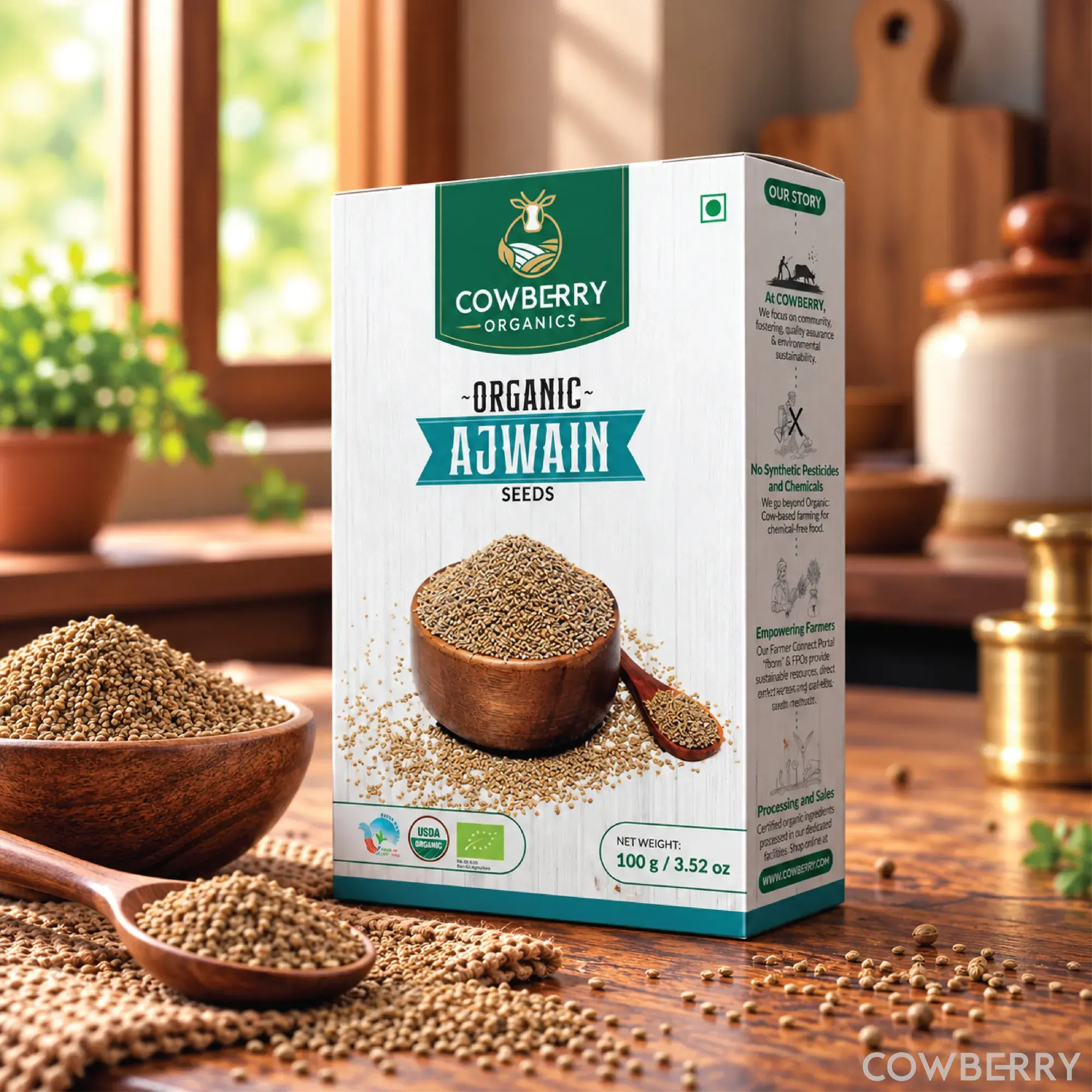
When buying, choose whole seeds over powder, for the same adulteration reason the dietary guidelines give in the cooking section above; the same guidelines advise buying certified products. COWBERRY's ajwain seeds come from Madhya Pradesh and Rajasthan, where the crop is grown with cow-based farming and the arid climate and mineral-rich soil suit it, and the seeds are cleaned, minimally processed and packed whole in 100 g and 250 g packs; the organic ajwain seeds are India Organic, USDA & EU certified. The names and nutrition tables sit at the top of this page, the benefits are linked above, and the recipe pages show the seed at work; each linked page goes deeper into its one topic than this overview can.
FAQs
What is ajwain?
Ajwain is a seed spice: the fruit of Trachyspermum ammi, sold as carom seeds, and the pinch ingredient behind tempering, paratha dough and ajwain water. IFCT 2017 files it as Omum under food code G029. The tables at the top of this page print its names and per-100 g numbers; the seed's story is spread across the pages linked above.
Is ajwain and carom seeds same?
Yes. Ajwain and carom seeds are two names for one seed, Trachyspermum ammi; IFCT 2017 records the food as Omum and adds the Hindi name ajwan. Shops may write ajwain, carom, ajowan or omum on the jar, and all four labels hold the same spice.
What is ajwain called in english?
Carom seeds, and sometimes ajowan. IFCT 2017 lists the food under the English name omum, and the botanical name behind all three spellings is Trachyspermum ammi — one seed, three English words. The full names table is above.
Is ajwain hot in nature?
Hot and cold belong to traditional food classification, and no composition table records either label for ajwain. What is printed about the seed's character is its flavour: strongly aromatic and pungent, which is why recipes measure it by the pinch. A pungent taste is a taste, not a temperature.
Is carom seeds good for health?
As a kitchen spice, yes — it seasons food with almost nothing added: a teaspoon carries about 18 kcal. As a medicine, the record is honest: laboratory studies on thymol and carvacrol exist, but no human trial shows an effect from eating the seed. Enjoy it as food, and see the benefits page linked above for the study-by-study detail.
Difference between ajwain and jeera?
Ajwain is carom seeds and jeera is cumin: different plants, different jars, different jobs. In the pan, jeera's savoury base tempers almost any dal, while ajwain's pungency is reserved for parathas, puris and mathri. Check the label before you buy, because the two seeds do different jobs in the same pan.
Where to buy carom seeds?
Spice shops and grocers that keep whole spices usually sell ajwain under one name or another; look for ajwain or carom seeds on the label. For organic whole seeds, COWBERRY sells organic ajwain seeds from Madhya Pradesh and Rajasthan in 100 g and 250 g packs, cleaned, minimally processed and India Organic, USDA & EU certified.
References
- Indian Food Composition Tables (IFCT) 2017, ICMR-National Institute of Nutrition
- Dietary Guidelines for Indians, ICMR-National Institute of Nutrition
- Alavinezhad A, Boskabady MH. Antiinflammatory, antioxidant, and immunological effects of Carum copticum L. and some of its constituents. Phytother Res, 2014
- Khan N, Choi JY, Nho EY et al. Determination of minor and trace elements in aromatic spices by micro-wave assisted digestion and inductively coupled plasma-mass spectrometry. Food Chem, 2014
- Opara EI, Chohan M. Culinary herbs and spices: their bioactive properties, the contribution of polyphenols and the challenges in deducing their true health benefits. Int J Mol Sci, 2014
- Krishnaswamy K. Traditional Indian spices and their health significance. Asia Pac J Clin Nutr, 2008
Shop this article
Keep reading
Coriander water benefits: what dhania water actually does
Peanuts in Hindi (moongfali): groundnut names in Indian languages
Coriander vs cilantro: are they the same herb?