by COWBERRY

6 minute read
How to use carom seeds: daily dose and easy ways to eat ajwain

How to use carom seeds: drop a quarter teaspoon into hot oil for a tempering, knead a few seeds into paratha or roti dough, simmer a teaspoon in a cup of water for ajwain water, or fold them into the ajwain laddu. Each way is written out below with its quantities and its mistakes; the ajwain hub covers the seed's names and nutrition.
Short answer: how to use carom seeds
Handle ajwain as a pinch spice: whole seeds, small amounts, and in every use below the seeds meet heat or water. In tempering they go into hot oil at the very start; in dough they are kneaded straight into the flour; in water they are simmered or soaked overnight; in a laddu they season the sweet. One quarter teaspoon seasons a dal or curry for four people, and a teaspoon makes a cup of ajwain water. The seed is strongly flavoured, so it plays a supporting role: you notice it, and it never takes over the dish.
Ajwain how to use: tempering, dals and curries
Tempering (tadka) is where ajwain does its main work. Heat a tablespoon of oil or ghee in a small pan, add a quarter teaspoon of ajwain seeds and let them crackle for a few seconds over a medium flame, then pour the tempering over a cooked dal or add your curry base to the pan. The seeds go in first, with any other whole spices and before the onions, because whole seeds need hot oil to release their smell. For a simpler dal, skip the full tadka and crackle a pinch of ajwain in a teaspoon of hot oil or ghee, then pour it over the dal just before serving. If a recipe measures differently, follow the recipe; a quarter teaspoon is the everyday amount for four servings.
How to use carom seeds in rotis, parathas and sweets
For flatbreads, knead whole seeds into the dough. Ajwain's strong flavour stands up to whole-wheat atta, and the seeds stay whole in the bread. The full method, with dough ratios and cooking times, is in the ajwain roti recipe, and a pinch of ajwain in the dough does the same for a stuffed paratha.
On the sweet side, the ajwain laddu recipe turns the seeds into a sweet. For the drink form of the seed, the how to make carom seeds water page has both the boiled tea and the overnight soak.
How much carom seeds per day
No guideline prints a daily amount for carom seeds, and no study we could find sets one, so there is no dose to follow. What the guidelines do say is qualitative: the ICMR-NIN dietary guidelines recommend, for older adults, well-cooked soft food with less salt and moderate amounts of spices, and the 2014 International Journal of Molecular Sciences review of culinary spices cautions that these foods are normally eaten in small quantities and alongside other foods, so their true benefit stays unclear. In the kitchen the working amounts are a quarter teaspoon per dal for four and a teaspoon per cup of water. A teaspoon (5 g) of the seeds gives about 18 kcal, about 1 g of fibre, 52 mg of calcium and 0.7 mg of iron (IFCT 2017 per 100 g: 358 kcal, 20.58 g fibre, 1034 mg calcium, 13.65 mg iron). For the seed's names, nutrition and benefits, see the ajwain hub.
Quantity table for everyday use
These are kitchen measures, not a dose; no guideline prints one.
| Use | Quantity |
|---|---|
| Tempering a dal or curry for four | A quarter teaspoon, into hot oil at the start |
| Ajwain water, one cup | One teaspoon of seeds in 240 ml water |
| Paratha or roti dough | A pinch to half a teaspoon per four flatbreads, or the amount the recipe states |
| Laddu | The amount the recipe states |
| Dry storage | Airtight jar, cool and dry place, away from the stove |
The pinch-to-half-teaspoon range for dough is a working span, not a limit; ajwain is pungent, so start low and add more only after the first batch.
Common mistakes and how to store ajwain
- Using too much. Ajwain is sharp and pungent, and half a teaspoon too many can spoil a dish. Add less than you think; you can always temper a second pinch.
- Adding it late. Whole seeds dropped into a finished dish stay hard. They belong in hot oil at the start of the tempering, or kneaded into dough before cooking.
- Reaching for the wrong jar. Ajwain and jeera are different seeds; the ajwain in English and Hindi page sets their names side by side, so check the label rather than guessing.
- Buying powder. The ICMR-NIN dietary guidelines prefer whole spices, uniform in colour, size and shape, because powdered ones are more likely to be adulterated; buy whole seeds and grind a pinch yourself only if a recipe needs powder.
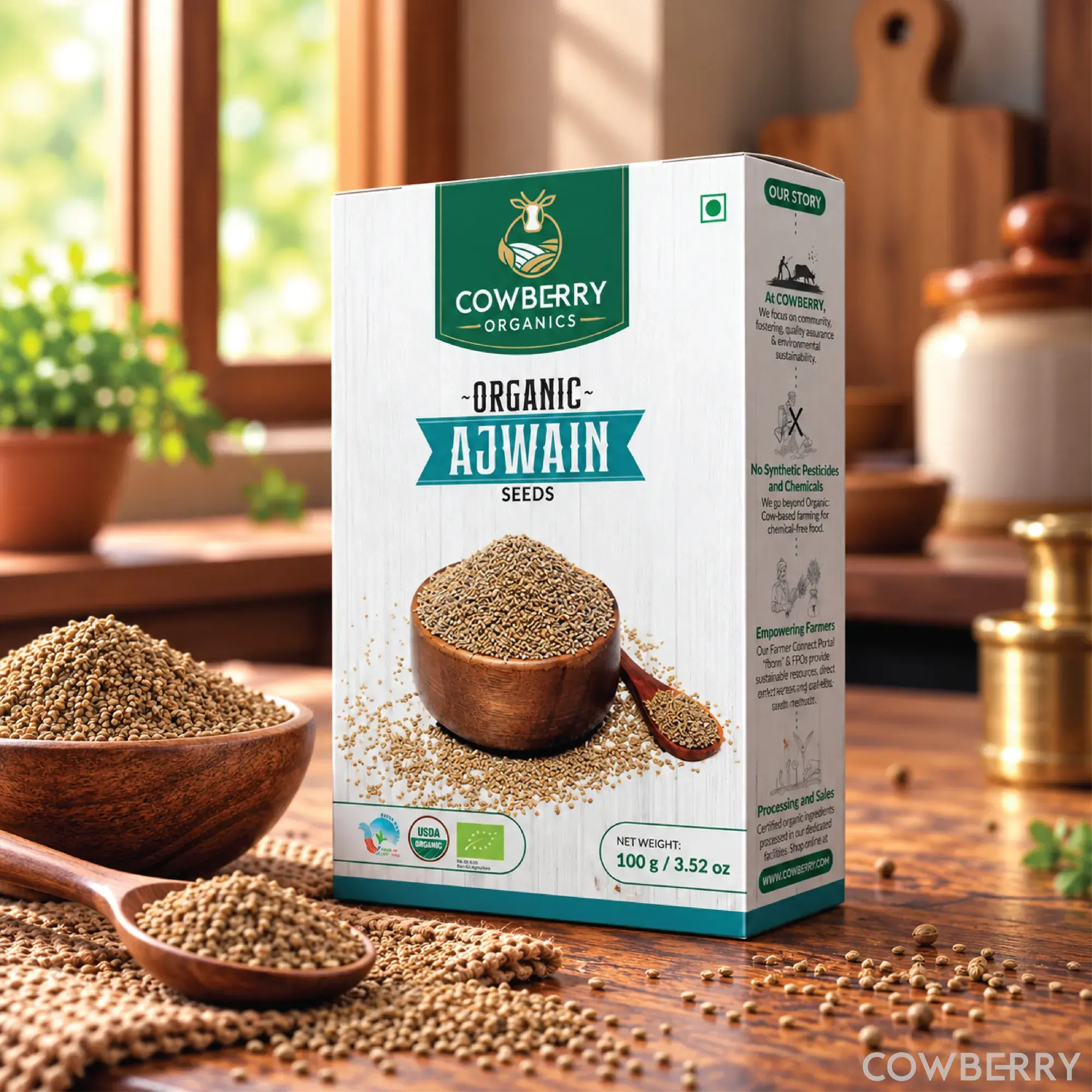
Store whole ajwain in a sealed jar somewhere cool and dry, out of the light; kept dry, it lasts for many months. COWBERRY's organic ajwain seeds come cleaned and whole from Madhya Pradesh and Rajasthan.
FAQs
How much carom seeds per day?
There is no daily dose of carom seeds in any guideline or study we could find. In the kitchen, a quarter teaspoon tempers a dal for four and a teaspoon makes a cup of ajwain water. A teaspoon (5 g) gives about 18 kcal, about 1 g of fibre and 52 mg of calcium. For older adults, the ICMR-NIN guidelines suggest moderate amounts of spices; for everyone else, no number is on record, so stay with the pinch amounts above.
Why ajwain is used?
Ajwain is used for flavour: it is the seed that gives temperings, parathas, dals and curries their sharp, pungent note, and it makes the drink called ajwain water. Its traditional therapeutic uses are on record in the 2014 Phytotherapy Research review, backed so far by work in the laboratory rather than human trials, so in the kitchen it stays a spice rather than a medicine.
Difference between ajwain and jeera?
They are two different seeds. Jeera is cumin, Cuminum cyminum, and ajwain is carom, Trachyspermum ammi, the botanical names IFCT 2017 records. The same source lists jeera's Hindi name as jira and ajwain's as ajwan; in Tamil they are jeerakam and omum, and in Telugu jeelakarra and vamu. Both go into tempering, but a dish that asks for jeera needs cumin, not ajwain.
Does ajwain helps in digestion?
No study we could find shows that ajwain improves digestion in people. The 2014 Phytotherapy Research review of the plant reports traditional uses and laboratory findings rather than human trials. Use it as a spice, and see a doctor for persistent digestive trouble.
Where to buy carom seeds?
Many grocers that keep spices sell ajwain, and it is easy to order online. If you want whole seeds grown in Madhya Pradesh and Rajasthan, cleaned and minimally processed, COWBERRY's organic ajwain seeds come in 100 g and 250 g packs. Look for whole, even seeds rather than powder, and keep the jar airtight.
References
- Indian Food Composition Tables (IFCT) 2017, ICMR-National Institute of Nutrition
- Dietary Guidelines for Indians, ICMR-National Institute of Nutrition
- Alavinezhad A, Boskabady MH. Antiinflammatory, antioxidant, and immunological effects of Carum copticum L. and some of its constituents. Phytother Res, 2014
- Opara EI, Chohan M. Culinary herbs and spices: their bioactive properties, the contribution of polyphenols and the challenges in deducing their true health benefits. Int J Mol Sci, 2014
Shop this article
Keep reading
Coriander water benefits: what dhania water actually does
Peanuts in Hindi (moongfali): groundnut names in Indian languages
Coriander vs cilantro: are they the same herb?