by COWBERRY

8 minute read
Ajwain benefits: uses of carom seeds and their side effects

Ajwain benefits rest on two separate things: a long traditional use and a body of earlier research on the seed's components, thymol and carvacrol. This page separates what the 2014 Phytotherapy Research review shows from what no study we found shows in people, then gives the nutrition, the side effects and the kitchen amounts. The ajwain hub covers names and cooking.
Ajwain benefits: what the record actually shows
Ajwain is the seed Trachyspermum ammi, sold in English as carom seeds and recorded as Omum in the Indian Food Composition Tables (IFCT 2017). The claims around it sit in two piles. The first is tradition: a 2014 review in Phytotherapy Research opens with the plant being used traditionally for its various therapeutic effects, and a 2008 review in the Asia Pacific Journal of Clinical Nutrition notes that current biomedical efforts on Indian spices are focused on their scientific merits, to provide science-based evidence for the traditional uses. The second pile is earlier research: the same 2014 review reports that previous studies have shown anti-inflammatory, antioxidant and immunological effects for the plant and its constituents, thymol and carvacrol.
Neither review's abstract describes a trial of ajwain in people, so this page claims no effect in humans and does not dress tradition up as proof. A 2014 review by Opara and Chohan points to one reason the human record may be thin: spices are usually consumed in small amounts, mixed into other foods, which makes their true health benefit hard to prove.
Carom seeds benefits, nutrient by nutrient
The nutrients below come from the IFCT 2017 composition of ajwain per 100 g, and each is followed by what a teaspoon actually delivers, because the seed is eaten by the pinch.
Fibre: 20.58 g per 100 g
Ajwain carries 20.58 g of dietary fibre per 100 g, which shrinks to about 1 g in a teaspoon (5 g). The ICMR-NIN Dietary Guidelines describe dietary fibre as delaying and retarding the absorption of carbohydrates and fats and increasing the satiety value, so the seed looks like a strong fibre source in the table; in practice a pinch-sized portion makes that fibre a footnote rather than a daily source. The full per-100 g table, with cumin and coriander seeds beside it, is on the carom seeds nutritional value per 100g page.
Calcium: 1034 mg per 100 g
The calcium figure is a large one: 1034 mg per 100 g, so a teaspoon carries about 52 mg. The same teaspoon holds 0.7 mg of iron, and the same table prints 13.65 mg of iron and 5.67 mg of zinc per 100 g, with folate at 51.79 mcg. A 2014 Food Chemistry study of aromatic spices recorded 84.95 micrograms of zinc per gram for ajwain, and reported arsenic, cadmium and lead at very low levels in the spices it tested.
What these nutrients do not say
Composition facts are not effect claims: no study we could find has tested what a pinch of ajwain does for iron, calcium or zinc status in people. The numbers above read best as a way to compare one seed with another, which is exactly how the nutrition page uses them.
Thymol and carvacrol: what earlier studies found
The 2014 review in Phytotherapy Research is the fullest record this page can point to on ajwain's chemistry, and it deserves a close reading for what it says and what it leaves out.
The components
The review states that the plant contains various components such as thymol and carvacrol, and the seed's smell and taste are strong and pungent.
Anti-inflammatory and antioxidant effects
The review reports that previous studies have shown potent anti-inflammatory and antioxidant effects for the plant and its constituents, and it reads those findings as giving the plant and its constituents therapeutic value in several inflammatory and immunological disorders as well as in oxidative stress conditions. The framing matters: the review's abstract describes no trial in people, and its wording is about previous studies, so this page repeats none of them as a claim about the pinch on your plate.
Antimicrobial effects
The same review records that different therapeutic effects such as antifungal, antibacterial, antiparasitic and antilipidemic were described for the plant. The word is described, not established, and the abstract does not say these were tested in people.
None of this is small print. The strongest sentence in the review — potent anti-inflammatory and antioxidant effects — is a statement about previous studies, and reading it as a promise about human health would go beyond the source. This page stays on the near side of that line.
Carom seeds side effects: what is known and what is not
No study we could find lists side effects of carom seeds in people, and the 2014 review's abstract reports no safety findings from people. What this page can say honestly: ajwain is a strongly flavoured seed, so more than the pinch a recipe calls for is likely to taste harsh; the kitchen amounts below keep it small. Ajwain is a spice, not a supplement, and there is no dose on record to stay under.
Two situations deserve a question to a professional rather than a guess. If you are pregnant, nursing or taking regular medicines, talk to your doctor or a dietitian before making ajwain a daily habit. And if gas, acidity or stomach trouble keeps coming back, see a doctor instead of reaching for a seed — no study we could find tests ajwain against those complaints, whatever the home habit says.
How much ajwain per day
No guideline prints a daily amount for ajwain, and no study sets one, so there is no dose on this page. The working kitchen amounts stand on their own: a quarter teaspoon seasons a dal or curry for four people, and a teaspoon (5 g) makes a cup of ajwain water. What a teaspoon adds is small — about 18 kcal, 0.8 g of protein, 1 g of fibre and 52 mg of calcium — and in a cup of strained water most of the seed stays behind in the strainer.
For older adults, the ICMR-NIN Dietary Guidelines recommend well-cooked, soft food preparations with less salt and moderate amounts of spices, a qualitative steer rather than a measure. Anyone on a medical diet should settle their own amounts with their doctor or a dietitian, and anyone pregnant or nursing should ask before making ajwain water a daily habit.
How to eat carom seeds
The everyday uses, with the full methods linked. Tempering: a quarter teaspoon goes into hot oil or ghee at the start of a dal or sabzi and crackles for a few seconds. Doughs: whole seeds are kneaded into paratha dough, a pinch for a stuffed paratha. Ajwain water: a teaspoon simmered in a cup of water for three to five minutes, or soaked overnight for eight hours and strained in the morning. The how to use carom seeds page has the quantities and the mistakes to avoid; the how to make carom seeds water page has both methods step by step.
For the seed in food, the ajwain roti recipe kneads a teaspoon of the seeds into eight soft rotis, and the ajwain laddu recipe folds two teaspoons into a batch of fifteen roasted atta laddus. On the seed's English and Hindi names, the ajwain in english and hindi page lists all of them, and the ajwain hub gathers the whole cluster.
FAQs
Is carom seeds good for health?
The honest answer is: as a flavour spice, yes; as a medicine, no study shows that. The seed's composition is real — 358 kcal, 15.89 g of protein and 20.58 g of fibre per 100 g — but a 2014 review notes that spices are eaten in small amounts with other foods, which makes a true health benefit hard to prove. Keep ajwain in the spice jar, not the medicine cabinet.
What is carom seeds?
Carom seeds are ajwain, the seed of Trachyspermum ammi, called omum in the IFCT 2017 food tables. It is the strongly flavoured seed that goes into tempering, paratha dough and ajwain water. What it is not is jeera — cumin is a different seed, and a recipe that says carom seeds means ajwain, not cumin.
Can ajwain be taken during pregnancy?
No study we could find tests ajwain in pregnancy, so there is no safety finding to lean on either way. The pinch amounts above are kitchen measures, not pregnancy advice. If you are pregnant and want ajwain water or seeds regularly, ask your doctor first.
Why ajwain is good for stomach?
What is on record for the stomach is home habit, not a finding: the 2014 Phytotherapy Research review lists the plant's traditional therapeutic uses, and its abstract describes no trial in people. No study we could find tests ajwain against stomach complaints. For a stomach that troubles you often, a doctor is the right first stop.
Difference between ajwain and jeera?
They are two seeds from two plants: ajwain is carom, Trachyspermum ammi, and jeera is cumin, Cuminum cyminum. IFCT 2017 records the Hindi names ajwan and jira for the pair, and in Tamil omum and jeerakam. They are not interchangeable in a recipe: use the seed the recipe names. A jar labelled jeera is cumin; only a jar labelled ajwain is ajwain.
References
- Indian Food Composition Tables (IFCT) 2017, ICMR-National Institute of Nutrition
- Dietary Guidelines for Indians, ICMR-National Institute of Nutrition
- Alavinezhad A, Boskabady MH. Antiinflammatory, antioxidant, and immunological effects of Carum copticum L. and some of its constituents. Phytother Res, 2014
- Khan N, Choi JY, Nho EY et al. Determination of minor and trace elements in aromatic spices by micro-wave assisted digestion and inductively coupled plasma-mass spectrometry. Food Chem, 2014
- Opara EI, Chohan M. Culinary herbs and spices: their bioactive properties, the contribution of polyphenols and the challenges in deducing their true health benefits. Int J Mol Sci, 2014
- Krishnaswamy K. Traditional Indian spices and their health significance. Asia Pac J Clin Nutr, 2008
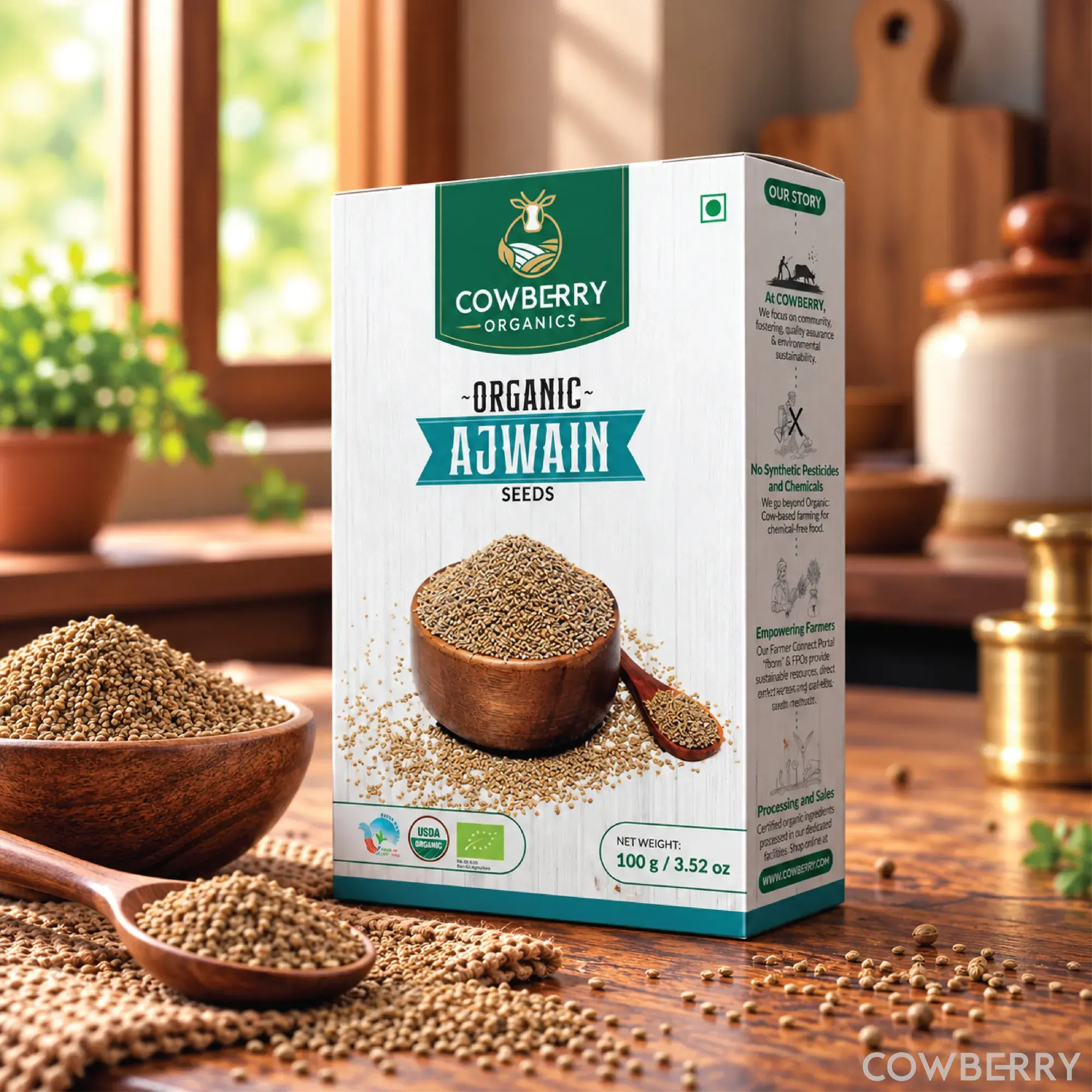
Shop this article
Keep reading
Coriander water benefits: what dhania water actually does
Peanuts in Hindi (moongfali): groundnut names in Indian languages
Coriander vs cilantro: are they the same herb?