by COWBERRY

8 minute read
Poha for babies: from what age, how to serve it and what to avoid

Poha for babies works from six months of age, when the World Health Organization recommends starting complementary foods: cooked to a soft, mashable texture and served without salt, sugar or honey. ICMR-NIN's sample complementary food menus for babies list rice flakes by name. The poha guide covers the grain itself, its types and its cooking.
Short answer: when can babies start poha?
WHO recommends that infants start receiving complementary foods at six months of age, in addition to breast milk. ICMR-NIN's Dietary Guidelines for Indians set the Indian table the same way: home-made semi-solid foods should begin soon after six months, opening with a thin, never watery porridge, and the guidelines name rice slurry among the first foods to try. Their sample complementary food menus go further and list rice flakes by name: 10 g, raw weight, in a mid-morning feed with 5 g of black gram dal, at six to eight months and again at nine to twelve; check the amount for your own baby with your paediatrician. Introduce it the way the guidelines introduce every new food: one at a time, kept up for four to five consecutive days while you watch how the child takes to it.
Poha texture by age: from mashed to finger food
WHO sets the texture steps: from six months babies can eat pureed, mashed and semi-solid foods, most can manage finger foods by eight months, and most eat family-style foods by twelve. ICMR-NIN adds a consistency test: a child's food should not flow in the plate but spread, and the consistency should rise from semi-solid to solid as the child grows. Poha follows that ladder. At six to eight months, cook thick poha until it is very soft and mash it smooth, alone or stirred into dal water or a vegetable puree. From around eight months, leave it as soft, moist clumps the baby can pick up. Near one year, an ordinary soft poha with small pieces of cooked vegetables works. One WHO warning applies here too: keep foods that may cause choking away from the bowl, so serve poha moist and soft, never as dry flakes.
What poha gives a baby: energy, protein and iron
Per 100 g of dry poha, IFCT 2017 lists 354 kcal, 7.4 g of protein, 76.8 g of carbohydrate, 1.1 g of fat, 3.5 g of fibre and 4.5 mg of iron. Read the numbers against what a baby needs: the suggested complementary food menus in ICMR-NIN's Dietary Guidelines provide about 230 kcal a day at six to eight months and 385 kcal a day at nine to twelve months, so a baby's poha serving is a small fraction of an adult plate. One caution on the minerals: a 2007 laboratory study from Mysore linked phytin phosphorus and dietary fibre in rice flakes with binding of iron and calcium, so the iron poha carries is only partly available; serve it with vegetables or fruit rich in vitamin C at the same meal, which ICMR-NIN says improves iron bioavailability.
| Nutrient | Rice flakes (poha) |
|---|---|
| Energy (kcal) | 354 |
| Protein (g) | 7.4 |
| Fat (g) | 1.1 |
| Carbohydrates (g) | 77 |
| Dietary fibre (g) | 3.5 |
| Iron (mg) | 4.5 |
| Calcium (mg) | 9.2 |
| Magnesium (mg) | 78 |
| Potassium (mg) | 148 |
| Sodium (mg) | 2.6 |
| Zinc (mg) | 1.5 |
| Folate (mcg) | 8.5 |
| Glycemic index (GI) | 59 |
Per 100 g raw, edible portion. Composition: IFCT 2017 (ICMR-NIN). GI: University of Sydney GI database. — means not reported. These are average values for the food; the label on a pack gives the values for that product.
How to make poha for a baby, step by step
Thick poha is the flake to use; it holds its shape through cooking, unlike the papery thin kind. Rinse the poha once under running water, let it drain, then cook it in just enough water to soften it fully, in a pan or a steamer, until a flake squashes easily between your fingers. Mash it with the back of a spoon, thin it with dal water, curd or a plain vegetable puree if it feels stiff, and cool it to lukewarm before feeding. Nothing sweet or salty goes into the pot, and the spoon and bowl are washed clean first; WHO asks that complementary foods be hygienically prepared and fed with clean hands and clean utensils. For exact quantities and timings, use the poha porridge recipe, and more family poha dishes sit in the poha recipes roundup. The poha guide covers the grain's names, types and cooking rules.
What to avoid: salt, sugar, honey and hard pieces
ICMR-NIN is direct: complementary foods need no sugar or salt added, and added sugar should be avoided completely below two years, jaggery and honey included. The NHS gives the reasons: babies should not eat much salt because it is not good for their kidneys, and honey is held off until the first birthday because it can occasionally carry bacteria that cause infant botulism. The NHS also advises against sugary foods and sweeteners for children of four and under, and against whole nuts below five years because of choking; groundnuts go into a baby's poha only crushed or ground, and if there is a history of food allergies in the family, the NHS says to talk to your doctor or health visitor before introducing any nut. A 2015 randomised trial in infants at high risk of peanut allergy, babies with severe eczema, egg allergy or both, found that early introduction of peanuts significantly decreased the development of the allergy; for a baby like that, when to start is a decision for your doctor. Dry poha flakes straight from the pack have no place in a baby's bowl either: flattened rice for babies should always arrive moist and soft.
Poha benefits for babies, and its limits
What poha offers a baby is practical rather than dramatic: it cooks in minutes, it is mild in taste and soft once cooked, and it supplies carbohydrate energy in a form a six-month-old can manage. Its limits matter more than its selling points. Plain poha carries a modest 3.5 g of fibre and 7.4 g of protein per 100 g, so a bowl of poha alone is not a meal; ICMR-NIN's minimum dietary diversity for infants asks for cereals, nuts and oilseeds, pulses or egg or meat, milk, and vegetables or fruit across the day. That is why every serving above pairs poha with dal water, curd or vegetables, and why the poha benefits page is worth a read for the adult plate.
Talk to your doctor or dietitian
Starting solids is a medical milestone as much as a kitchen one. Ask your paediatrician when to start poha if your baby was born early, is small for age, or has any feeding difficulty, and check before adding groundnuts if allergies run in the family. If poha brings on repeated vomiting, a rash or loose stools, stop it and show the doctor. Feeding plans differ child to child, and the ages and textures above are general guidance, not a prescription for one baby: talk to your doctor or dietitian, and to your paediatrician, before changing how you feed your child.
FAQs
Which poha is good for babies?
Thick poha. It keeps its shape when rinsed and cooked, so it mashes into a soft, grainy cereal instead of dissolving; thin poha turns pasty in water and suits sweets and cutlets better. Start a baby on plain white poha; red poha cooks the same way once the food is familiar.
How to make poha?
For a baby, rinse thick poha once, drain it, and cook it in a little water until a flake squashes easily between your fingers. Mash it smooth, loosen it with dal water, curd or vegetable puree, and cool it before feeding. No salt, sugar or honey. Full quantities and timings are in the poha porridge recipe.
What is poha made of?
Rice, rolled flat into flakes. Poha needs no boiling — a rinse and a short rest soften it; for a baby, cook it further in water until fully soft and mash it.
How much protein in poha?
IFCT 2017 lists 7.4 g of protein per 100 g of dry poha, so a 50 g dry plate carries about 3.7 g. A baby's plate is far smaller than an adult's, and poha protein is not complete on its own; dal, curd or milk eaten with it lifts the protein quality, the pairing ICMR-NIN advises for cereal-based meals.
Does flattened rice have fiber?
Yes, but not much: 3.5 g per 100 g of dry poha in IFCT 2017, and 1.7 g in a 50 g plate. Vegetables, dal and fruit bring more fibre to a baby's meal than poha does, which is one more reason to pair it rather than serve it alone.
How much calories in poha?
354 kcal per 100 g of dry poha (IFCT 2017), and 177 kcal for a 50 g plate. For scale, the suggested complementary food menus in ICMR-NIN's Dietary Guidelines provide 230 kcal a day at six to eight months; a baby's poha portion is a fraction of the adult plate, not the plate itself.
References
- Indian Food Composition Tables (IFCT) 2017, ICMR-National Institute of Nutrition
- Dietary Guidelines for Indians, ICMR-National Institute of Nutrition
- WHO: complementary feeding (health topic)
- NHS: Foods to avoid giving babies and young children
- Suma RC, Sheetal G, Jyothi LA et al. Influence of phytin phosphorous and dietary fibre on in vitro iron and calcium bioavailability from rice flakes. Int J Food Sci Nutr, 2007
- Du Toit G, Roberts G, Sayre PH, et al. Randomized trial of peanut consumption in infants at risk for peanut allergy. N Engl J Med, 2015
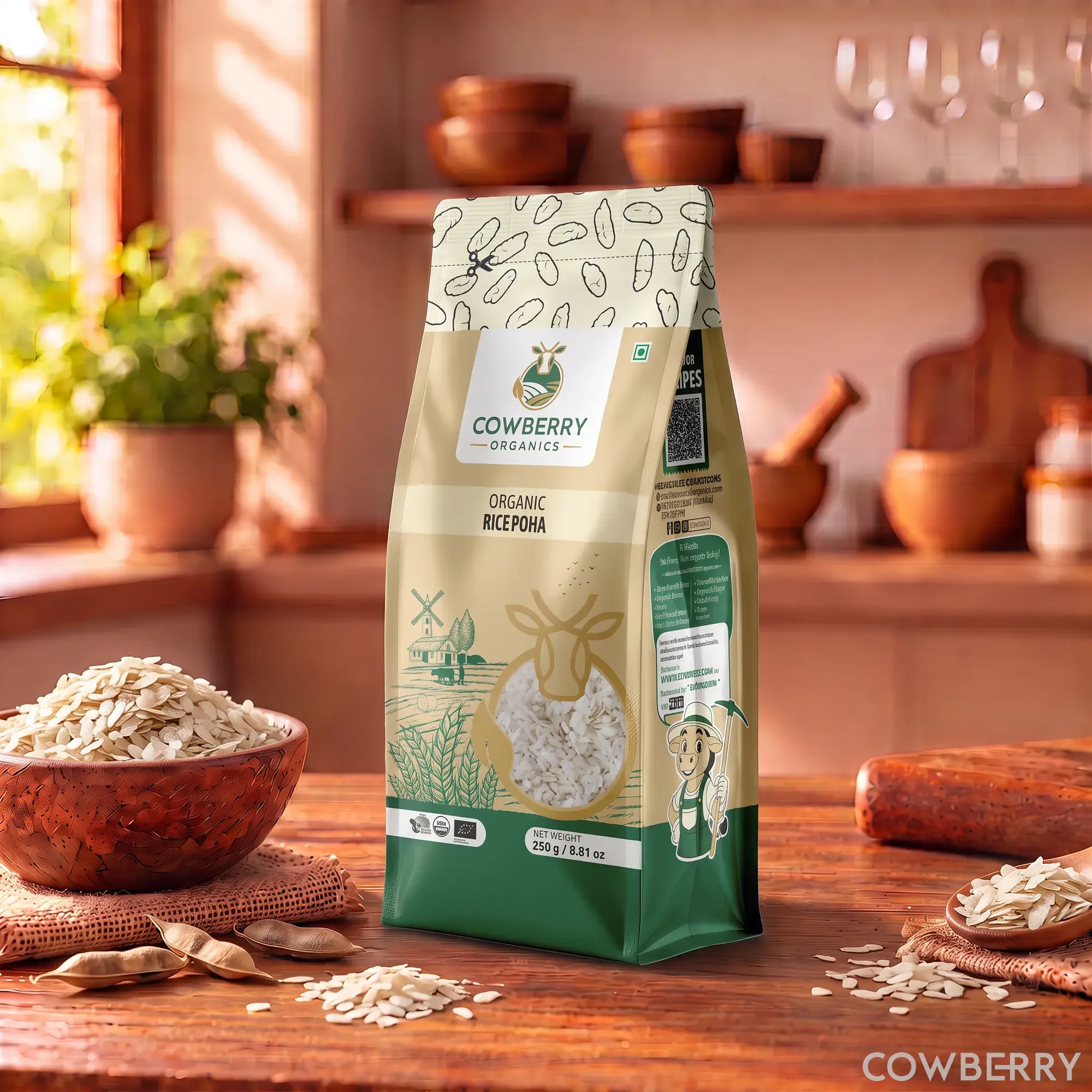
Shop this article
Keep reading
Red rice vs brown rice: the fibre, GI and honest verdict
Red rice vs black rice: nutrition, glycemic index and which to choose
Red rice nutrition per 100g: calories, protein, fibre and GI