by COWBERRY

11 minute read
10 benefits of mustard oil (and its side effects)

Mustard oil benefits start with its fats: a 2022 review in the Journal of Clinical Lipidology describes it as low in saturated fat, and ICMR-NIN's Dietary Guidelines for Indians list it among the vegetable oils that supply the omega-3 fat ALA. Its main concern is erucic acid. Below are ten benefits with sources, the side effects, how much to use and how to cook with it.
What is kachi ghani mustard oil? Kachi ghani meaning
Mustard oil is squeezed from mustard seed, the seed of Brassica species. It is sarson ka tel in Hindi and Urdu, shorsher tel in Bengali, sarhon da tel in Punjabi, rai nu tel in Gujarati, mohariche tel in Marathi, kadugu ennai in Tamil and aava nune in Telugu (names as listed in IFCT 2017). The 2022 review calls it one of the most popular cooking oils in Asia, particularly in India.
Kachi ghani meaning: kachi means raw and ghani is the traditional Indian oil press. ICMR-NIN's Dietary Guidelines for Indians use kachi ghani tel and cold-pressed oil as two names for one thing: oil obtained by mechanical pressing, without the application of heat. In the guidelines' account, a press leaves the oil's nature unchanged, and its antioxidants and phytonutrients are kept. How this differs from a refined oil is set out in cold pressed oil vs refined oil.
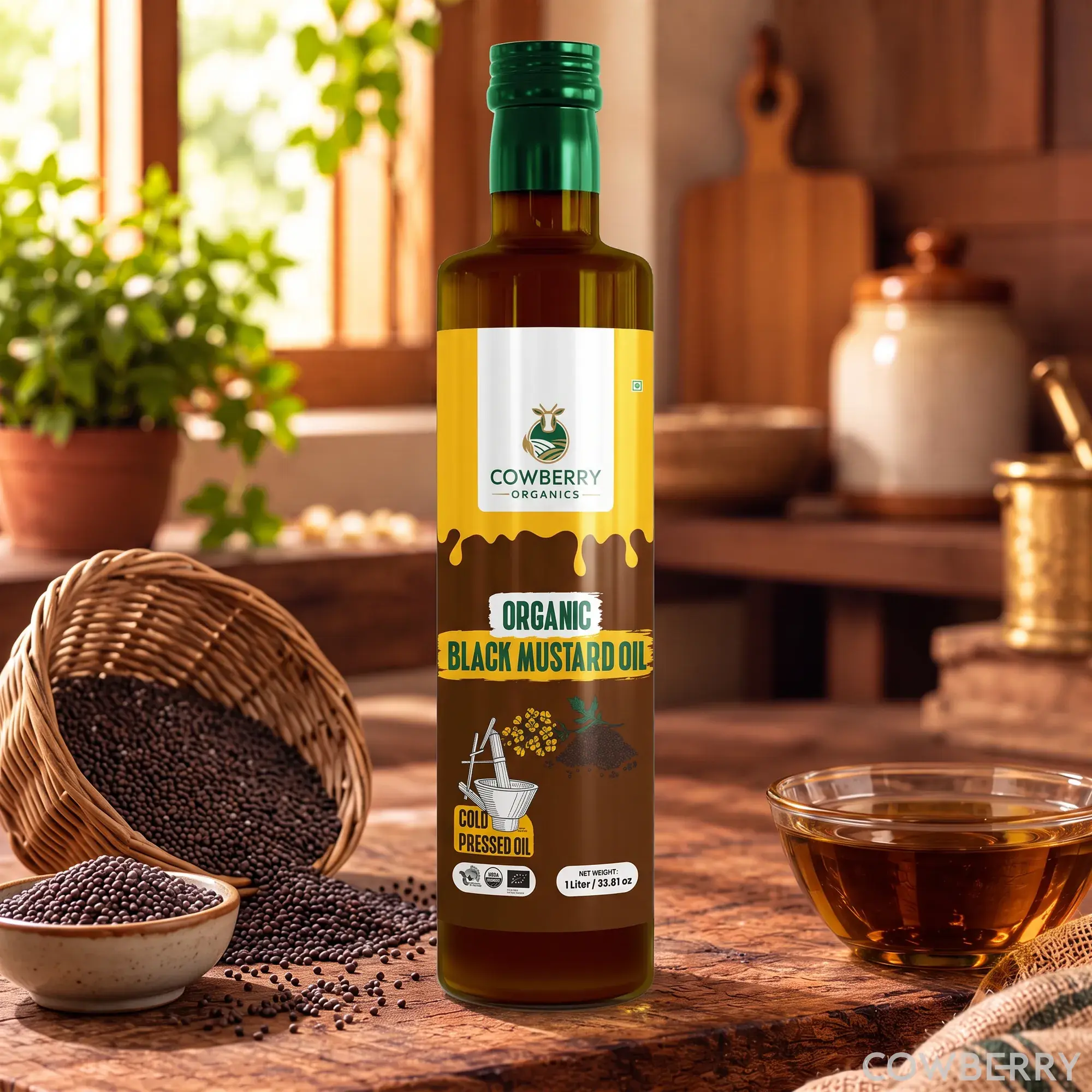
COWBERRY's cold-pressed mustard oil is pressed slowly, without heat or chemicals, from mustard seed grown in Rajasthan and Bengal, and its product facts say the oil keeps its deep colour and strong aroma. ICMR-NIN adds that refining removes odour, so a refined mustard oil has less of that smell.
Is mustard oil good for health? Benefits 1 to 5, the fats
Is mustard oil good for health? In moderate amounts it can have a place in a balanced diet. The first five mustard oil health benefits are about the kind of fat it carries.
1. Low in saturated fat
The 2022 review Mustard oil and cardiovascular health: why the controversy? describes mustard oil as a liquid oil that is low in saturated fat. That matters: WHO's 2023 guideline wants saturated fat held to 10% of the day's total energy for adults and children alike, and ICMR-NIN notes that saturated fats raise total and LDL cholesterol in the blood.
2. It contains monounsaturated fat
Monounsaturated fats are part of mustard oil's make-up; COWBERRY's product facts list them. In the WHO guideline, monounsaturated fat from plant sources is one of three things that can take the place of saturated fat. Polyunsaturated fat is another; the third is carbohydrate that comes with its own fibre, from whole grains, vegetables, fruits and pulses.
3. It supplies omega-3 (ALA)
Alpha-linolenic acid (ALA) is the plant form of omega-3 and one of the two essential fatty acids, which the body cannot make for itself. ICMR-NIN names mustard among the foods that provide it, and its table of vegetable oils that supply ALA lists mustard/rapeseed oil next to soyabean, canola and flaxseed oil. For vegetarian households the cooking oil is an easy place to get some.
4. Omega-6 and omega-3 together
In most oilseeds, the guidelines say, omega-6 is the major polyunsaturated fat, and they ask people to moderate the use of oils that are high in it. Rapeseed/mustard is on their short list of oilseeds that are good sources of both omega-6 and omega-3. Sunflower oil is not in the ALA table, which is the core of the mustard oil vs sunflower oil comparison.
5. Recommended by the Lipid Association of India
The review records that mustard oil is recommended as a heart-healthy oil by the Lipid Association of India, and that some health benefits have been reported for it in humans. It sets this against the opposite position taken by the US regulator, which is why its title speaks of a controversy. Read it as a reason to keep mustard oil among the oils you cook with, not as a promise about your heart.
Mustard oil health benefits 6 to 10: kachi ghani oil in the kitchen
6. No cholesterol, carbohydrate or sodium
USDA FoodData Central lists mustard oil at 884 kcal and 100 g fat per 100 g, with 0 g carbohydrate, 0 g protein and 0 mg sodium. With no carbohydrate it has no glycemic index, and it is naturally gluten-free. Cholesterol, ICMR-NIN points out, is found only in foods from animal sources, so a seed oil has none.
7. Kachi ghani oil keeps its antioxidants and its bite
Kachi ghani mustard oil benefits come from what is left alone. ICMR-NIN notes that refining takes out small amounts of minor components such as antioxidants and phytosterols, while in cold-pressed oil the antioxidants and phytonutrients are preserved. It adds that an oil owes much of its natural flavour to these components, which also help stop it going rancid. COWBERRY presses its oil without heat or chemicals to keep the natural pungency.
8. It helps you absorb fat-soluble vitamins
Fats promote the absorption of vitamins A, D, E and K, the guidelines say. That is the nutritional sense in cooking leafy greens with a little oil: the tadka on sarson ka saag or palak does more than add taste.
9. Strong flavour, so a little does a lot
Fat adds flavour and a feeling of fullness to a meal. Because mustard oil tastes assertive, one teaspoon in a tadka seasons a whole pot of dal or sabzi, which helps when you are trying to cook with less oil.
10. It suits tadka, frying and pickling
According to COWBERRY's product facts, the oil has a high smoke point and can take deep frying, sauteing and high-heat cooking. That matches kitchen practice: pakoras and fish are fried in it, whole spices are bloomed in it, and pickles are kept under a layer of it.
Mustard oil side effects: erucic acid and who should limit it
Mustard oil side effects come down to one fatty acid, the fact that kachi ghani oil is unrefined, and the calories every oil carries.
Erucic acid
Erucic acid is a typical constituent of mustard and rapeseed. A 2014 study in Food Chemistry explains the concern: food with a high erucic acid content is considered undesirable because it has been linked to myocardial lipidosis (fat building up in heart muscle) and heart lesions in laboratory rats, and several countries have restricted it in oils and fats. The study measured mustard oils and prepared mustards from Germany and Australia. Seven of the nine oils were above the permitted maximum, and the level varied widely from sample to sample. Its authors add that a careful choice of mustard cultivars could lower intake.
That concern is why the rules on mustard oil differ from country to country. The 2022 review reports that the rodent evidence prompted the US Food and Drug Administration to ban its use for cooking, while Australia, New Zealand and the European Union set upper limits instead. Its authors recommend a new FDA review of the safety limits for erucic acid, because 29 countries allow limited amounts and some health benefits have been reported in humans.
Unrefined oil keeps everything
ICMR-NIN is even-handed about cold-pressed oils: they keep their antioxidants, but like crude oil they can also carry undesirable compounds that refining would remove, allergens among them. A 2024 review of edible oil adulteration adds that mixing with lower-cost oils is widespread. Both are reasons to buy single-seed oil from a seller you trust.
Calories
Mustard oil is pure fat. A level teaspoon (5 g) gives about 44 kcal and a tablespoon (15 g) about 133 kcal, so a heavy hand adds up faster than it looks.
Who should go easy
- People with a mustard allergy: avoid the oil as well as the seed.
- Anyone who finds it too pungent: raw kachi ghani oil is sharp; heat it before cooking and keep raw use to a few drops.
- Anyone on a fat-restricted diet: the limit set by your doctor covers mustard oil too.
Heart disease or a diet prescribed for you changes the picture: talk to your doctor or dietitian about which oils suit you and in what amount.
How much mustard oil per day
There is no separate allowance for mustard oil. It comes out of your budget for visible fat, ICMR-NIN's name for the oil, ghee and butter that go into the pan or onto the plate. The Dietary Guidelines for Indians limit visible fat to 20 to 50 g per person a day, which is 4 to 10 teaspoons, depending on how much energy you need. For adults with a sedentary routine they give 20 g for women and 30 g for men.
That figure covers every fat in the day, so measure with a spoon instead of pouring from the bottle. One level teaspoon of mustard oil is about 44 kcal (from the USDA value of 884 kcal per 100 g).
Three habits from the same guidelines keep the amount honest:
- Choose sauteing, steaming, grilling or boiling more often than frying.
- Count ghee in the same budget: the guidelines' ceiling for ghee or butter is 1 to 2 teaspoons a day. Ghee vs oil explains when each makes sense, and 1 spoon ghee calories gives the numbers.
- Do not fry twice in the same oil. Oil used once for frying can be filtered and used up in a curry within a day or two.
Many households also keep a second oil and alternate between the two. If that oil is groundnut, the case for it is in cold pressed groundnut oil benefits.
How to use mustard oil: tadka, pickles, fish and saag
Heat it first
For cooked dishes, warm kachi ghani oil until it just begins to smoke and turns a shade lighter, then lower the flame and add the spices. This softens the raw sharpness. Do not leave it smoking on the flame.
Tadka
Mustard seeds, dried red chilli and panch phoron crackled in hot mustard oil are a common base for dals and sabzis in Bengal, Bihar and Odisha. Our dal tadka is tempered in ghee; make the final tadka in mustard oil for a sharper, more pungent dal. Punjabi chole can be cooked in mustard oil too.
Pickles
For mango, lime or chilli achaar, heat the oil until it smokes, let it cool completely, and pour enough over the pickle to cover it. The oil layer keeps air off the fruit.
Fish
In Bengali cooking, fish rubbed with turmeric and salt is often fried in mustard oil before it goes into a gravy such as shorshe maach or machher jhol.
Saag
Sarson ka saag is slow-cooked mustard greens finished with a tadka of garlic and chilli in mustard oil, ghee or both; if you use ghee, bilona ghee is the traditional kind.
Raw, in drops
A few drops of raw oil lift aloo chokha, baingan bharta, jhalmuri and sattu. Keep the bottle capped, somewhere cool and dry and out of direct sunlight. Hindi readers can find this guide as sarso ke tel ke fayde.
FAQs
Is mustard oil good for health?
Used in moderate amounts, it can be part of a healthy diet. Its case rests on two points: it is low in saturated fat, according to the 2022 review, and it gives some omega-3 ALA, according to ICMR-NIN. Like every oil it is pure fat, 884 kcal per 100 g, and it contains erucic acid, so the amount matters.
Does mustard oil increase cholesterol?
Mustard oil has no cholesterol of its own; ICMR-NIN notes that cholesterol is found only in animal-source foods. It is also low in saturated fat, the kind of fat the same guidelines link to higher total and LDL cholesterol. Total fat still counts. If your cholesterol is high, talk to your doctor or dietitian about oils.
Why is mustard oil banned in the US?
Because of erucic acid. The 2022 review explains that mustard oil contains a large proportion of erucic acid, a fatty acid associated with myocardial lipidosis in rodents, and that this evidence led the US FDA to ban it for cooking. Australia, New Zealand and the EU chose upper limits rather than a ban, and the review's authors recommend a new FDA review.
Can mustard oil be used for cooking?
Yes. It goes into tadka, frying, fish, saag and pickles, and COWBERRY's product facts describe it as suited to deep frying and sauteing. Warm kachi ghani oil until it just starts to smoke before adding spices. Where it is not permitted as a food oil, follow the label.
How to identify pure mustard oil?
Start with the label: one ingredient, and the words kachi ghani or cold-pressed. A 2024 review names cottonseed oil, mineral oil and lower-cost oils such as palm olein among the adulterants found in edible oils, and the detection methods it lists are laboratory ones, chromatography and spectroscopy, not kitchen tests, so the seller you buy from matters.
What is sarso ka tel in English?
Sarso ka tel is mustard oil in English, the oil pressed from mustard seed (Brassica species). IFCT 2017 lists it as shorsher tel in Bengali, sarhon da tel in Punjabi, rai nu tel in Gujarati, mohariche tel in Marathi, kadugu ennai in Tamil and aava nune in Telugu. Kachi ghani sarso ka tel means cold-pressed mustard oil.
Is mustard oil good for hair?
It is a traditional hair oil; COWBERRY's product facts note that mustard oil is commonly used for hair care. The studies cited on this page look at mustard oil as a food, not on the scalp, so we make no claim about hair growth or dandruff. It is a pungent oil: try a small patch of skin first.
References
- Poddar KH, Sikand G, Kalra D et al. Mustard oil and cardiovascular health: why the controversy? J Clin Lipidol, 2022
- Wendlinger C, Hammann S, Vetter W. Various concentrations of erucic acid in mustard oil and mustard. Food Chem, 2014
- Dietary Guidelines for Indians, ICMR-National Institute of Nutrition
- WHO guideline: saturated fatty acid and trans-fatty acid intake for adults and children (2023)
- Begum A, Jain BP. Adulteration in edible oil (mustard oil) and ghee; detection and their effects on human health. Int J Biochem Mol Biol, 2024
- USDA FoodData Central
- Indian Food Composition Tables (IFCT) 2017, ICMR-National Institute of Nutrition
Shop this article
Keep reading
Cold pressed oil benefits: why they survive processing better
Mustard oil vs refined oil: nutrition, cooking and which to choose
Mustard oil omega 3: nutrition, calories and fat per 100g