by COWBERRY

9 minute read
Mustard oil vs sunflower oil: fats, taste and which is better for you

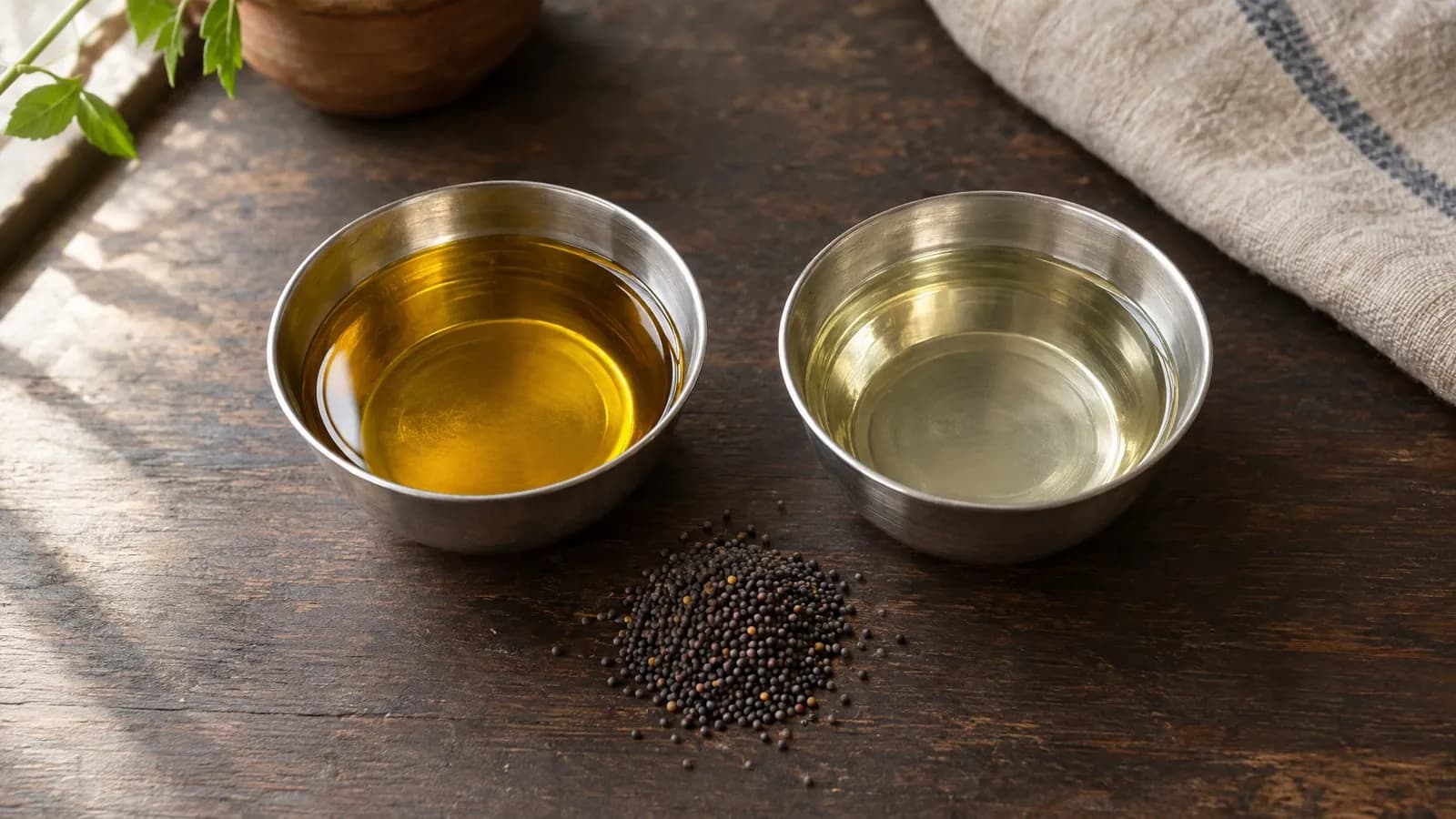
Mustard oil vs sunflower oil comes down to three things: omega-3, erucic acid and taste. Both are liquid oils from seeds, and both can stand in for saturated fat in cooking. Mustard oil adds the omega-3 fat ALA and a sharp flavour, and it carries erucic acid; sunflower oil is mild, and the sources used here raise no such concern about it. The details follow, each with its source.
Mustard oil vs sunflower oil: the verdict in three lines
- Fat: mustard oil is low in saturated fat, according to a 2022 Journal of Clinical Lipidology review, and the same paper puts sunflower oil on its list of healthier oils for heart-protective eating patterns to use instead of saturated fats. On this count neither oil is the problem; ghee, butter and vanaspati are what both replace.
- What sets them apart: omega-3. Mustard/rapeseed oil appears in ICMR-NIN's table of vegetable oils that give ALA, the plant omega-3; sunflower oil does not appear there. Mustard oil also contains a large proportion of erucic acid, the reason it is restricted in some countries.
- In the kitchen: mustard oil is pungent and shapes the dish; sunflower oil is mild and stays in the background. An Indian kitchen gains more from using each where it fits than from crowning one.
Whichever you pour, the amount matters more than the label. The full case for the first oil, with its cautions, is in mustard oil benefits.
Sunflower oil vs mustard oil, side by side
| Point | Mustard oil | Sunflower oil |
|---|---|---|
| Seed | Mustard (Brassica species) | Sunflower seed |
| How it is usually sold | Kachi ghani (cold-pressed) or refined | Widely sold refined |
| Saturated fat | Low, according to the 2022 review | Named in the same review among the oils that replace saturated fat |
| Omega-3 (ALA) | In ICMR-NIN's table of vegetable oils that supply ALA | Not in that table |
| Omega-6 | Rapeseed/mustard is a good source of both omega-6 and omega-3 (ICMR-NIN) | ICMR-NIN's general rule: in most oilseeds, omega-6 is the major polyunsaturated fat |
| Erucic acid | A large proportion (2022 review) | Not raised in the sources used here |
| Rules abroad | Banned for cooking by the US FDA; upper limits in Australia, New Zealand and the European Union | No restriction mentioned in the review |
| Taste | Pungent and sharp, mellower once heated | Mild, close to neutral |
| Figures in our reference table | 884 kcal and 100 g fat per 100 g (USDA) | Not in the table, so no figure is quoted |
Why are there no numbers for sunflower oil? This page quotes only the reference entries used across this site, and sunflower oil is not among them. For a fatty acid breakdown, ICMR-NIN's guidelines carry a chart, built on IFCT 2017 data, of twelve cooking fats that include sunflower, mustard and groundnut oil; it splits each into saturated, monounsaturated, omega-6 and omega-3 fat.
On erucic acid, a 2014 study in Food Chemistry measured nine mustard oils from Germany and Australia and found seven above the permitted maximum, with wide variation between samples. The authors see the choice of mustard cultivar as one way to bring intake down.
Nutrition: what the printed numbers say
Oil is fat and nothing else. Per 100 g, mustard oil's entry in USDA FoodData Central reads 884 kcal and 100 g of fat, with 0 g of protein or carbohydrate. Groundnut oil, the other oil in our reference table, comes to the same 884 kcal. The seed changes the kind of fat, not the calories: gram for gram, ICMR-NIN notes, fat carries more than twice the energy of protein or carbohydrate.
In spoon terms, a level teaspoon of mustard oil (5 g) is about 44 kcal and a tablespoon (15 g) about 133 kcal. Sunflower oil is not in our table, but at the 9 kcal that ICMR-NIN gives for every gram of fat, its spoon lands in the same range. Swapping one oil for the other will not change the calories in a dish; using less oil will.
So the comparison is about the type of fat. WHO's 2023 guideline makes replacing saturated fat with polyunsaturated fat a strong recommendation, and replacing it with monounsaturated fat from plant sources a conditional one. Both oils on this page sit on the right side of that swap. The table below gives USDA's figures for mustard oil, with groundnut oil beside it.
| Nutrient | Mustard oil | Groundnut oil |
|---|---|---|
| Energy (kcal) | 884 | 884 |
| Protein (g) | 0 | 0 |
| Fat (g) | 100 | 100 |
| Carbohydrates (g) | 0 | 0 |
| Dietary fibre (g) | 0 | 0 |
| Iron (mg) | 0 | 0 |
| Calcium (mg) | 0 | 0 |
| Magnesium (mg) | 0 | 0 |
| Potassium (mg) | 0 | 0 |
| Sodium (mg) | 0 | 0 |
| Zinc (mg) | 0 | 0 |
| Folate (mcg) | 0 | 0 |
| Vitamin C (mg) | 0 | 0 |
Per 100 g raw, edible portion. Composition: USDA FoodData Central (SR Legacy), FDC ID 172337, NDB 4583; USDA FoodData Central (SR Legacy), FDC ID 171410, NDB 4042. — means not reported. These are average values for the food; the label on a pack gives the values for that product.
Taste and cooking: refined oil vs mustard oil
Flavour. Kachi ghani mustard oil announces itself: a sharp aroma, a deep colour and a bite that mellows with heat. It is the taste of shorshe maach, sarson ka saag, Bihari chokha and North Indian pickles. Sunflower oil has very little taste of its own, and that is its use: it lets the masala, the batter or the cake speak.
Refined oil vs mustard oil. This common search compares a process with a seed. Sunflower oil is widely sold refined; mustard oil is sold both refined and kachi ghani. ICMR-NIN explains what refining does: it removes odour and extends shelf life, and it takes out small amounts of antioxidants and phytosterols, while the fatty acid composition stays as it was. The longer comparison is in cold pressed oil vs refined oil.
Heat. Cooks warm kachi ghani mustard oil until it just begins to smoke, then lower the flame, which softens the pungency. The smoke point of COWBERRY's mustard oil is high, its product facts say, and they list deep frying and sauteing among its uses. No source we cite puts a temperature on the smoke point of either oil, so this page gives no figure. What the guidelines do say applies to both: long exposure of oil to high heat and air can generate highly oxidised, potentially toxic products, so oil that has been used for frying should not be used for frying again.
Dishes. Reach for mustard oil for Punjabi chole, fish, saag, achaar and the tadka on dal. Reach for sunflower oil for pooris, cakes and shallow-fried snacks where the oil should not be tasted.
Cost and where each fits
We give no figures here, only the general pattern. As ICMR-NIN notes, refining extends shelf life, so refined sunflower oil is an economical, long-keeping choice for everyday cooking. Kachi ghani mustard oil is pressed without heat and sold unrefined, and a cold-pressed oil usually costs more than the refined oil of the same seed.
Where each fits:
- Mustard oil: pickles that must keep through the year, fish and greens, tadka, and the regional dishes that call for it. A little goes far because the flavour is strong.
- Sunflower oil: neutral frying, baking, and food cooked for people who dislike pungency.
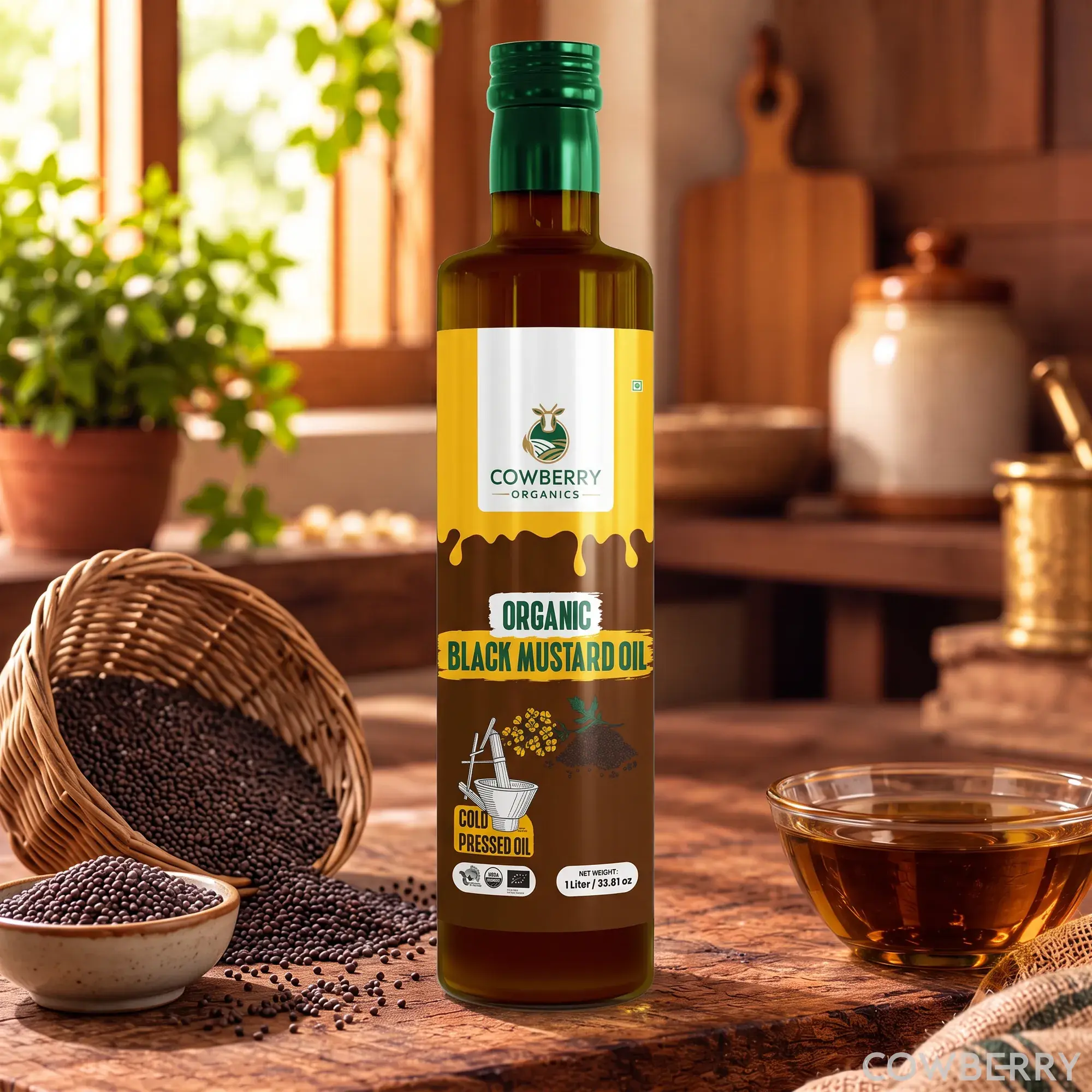
Both bottles keep best closed and out of the sun, somewhere cool and dry. COWBERRY's cold-pressed mustard oil is pressed from seed grown in Rajasthan and Bengal.
Which oil for whom
- You cook North or East Indian food: mustard oil, the oil many of those dishes are cooked in.
- You are vegetarian and eat little flax, walnut or soyabean: mustard oil helps, since ICMR-NIN counts it among the vegetable oils that provide ALA. The guidelines also name walnuts, flax seeds, chia seeds, soyabean, fenugreek seeds and leafy vegetables as omega-3 sources.
- You want an oil nobody will taste: sunflower oil.
- You live where mustard oil is not permitted as a food: follow the local rule. The 2022 review offers people who are used to mustard oil practical ways to bring in other oils such as canola, olive, sunflower and soyabean.
- You already rely on oils high in omega-6: ICMR-NIN asks for moderation in high omega-6 oils, so let mustard oil share the work.
- You have heart disease or a prescribed diet: talk to your doctor or dietitian, and let them decide the oil and the amount with you.
For the ghee side of the kitchen, read ghee vs oil and our guide to bilona ghee.
FAQs
Which is better, mustard oil or sunflower oil?
Neither wins outright. Both are liquid seed oils that replace saturated fat. Mustard oil supplies omega-3 ALA and a strong flavour but contains erucic acid, which is why some countries restrict it; sunflower oil is mild and carries no such restriction in the sources used here. Use each where it fits and keep the total amount of oil moderate.
Is mustard oil good for health?
It can be, in moderate amounts and as part of a balanced diet. The 2022 review finds it low in saturated fat and reports that the Lipid Association of India recommends it as heart-healthy; ICMR-NIN also counts it among the oils that supply ALA. The same review explains why the US FDA bans it for cooking: erucic acid. Amount and source both matter.
Difference between mustard oil and refined oil?
Mustard oil names the seed; refined names the process. The kachi ghani kind is pressed without heat and bottled unrefined. A refined oil has been through refining, which ICMR-NIN says removes odour, extends shelf life and takes out small amounts of antioxidants without changing the fatty acids. Mustard oil itself is sold both ways.
Is mustard oil good for diabetes and cholesterol?
Mustard oil has no carbohydrate, so it has no glycemic index, and no cholesterol, which ICMR-NIN notes is found only in animal-source foods. It is low in saturated fat. It is still pure fat at 884 kcal per 100 g, so the portion counts. If you have diabetes or high cholesterol, talk to your doctor or dietitian.
Can I mix mustard oil and sunflower oil?
Yes. Alternate them through the week, or give each the dishes it suits; the 2022 review itself suggests ways for mustard-oil households to work sunflower and other oils into their meals. What ICMR-NIN advises against is something else: topping up used frying oil with fresh oil and frying in it again.
How mustard oil is made?
It is pressed out of the seed by machine: ICMR-NIN describes crude vegetable oils, mustard among them, as extracted by mechanical expelling. In kachi ghani, or cold pressing, the expeller runs without the application of heat. Refined mustard oil then goes through the chemical refining that ICMR-NIN describes, which takes out unwanted compounds and the smell and lets the oil keep longer.
References
- Poddar KH, Sikand G, Kalra D et al. Mustard oil and cardiovascular health: why the controversy? J Clin Lipidol, 2022
- Dietary Guidelines for Indians, ICMR-National Institute of Nutrition
- WHO guideline: saturated fatty acid and trans-fatty acid intake for adults and children (2023)
- Wendlinger C, Hammann S, Vetter W. Various concentrations of erucic acid in mustard oil and mustard. Food Chem, 2014
- USDA FoodData Central
Shop this article
Keep reading
Cold pressed oil benefits: why they survive processing better
Mustard oil vs refined oil: nutrition, cooking and which to choose
Mustard oil omega 3: nutrition, calories and fat per 100g