by COWBERRY

15 minute read
10 benefits of moong dal (and its side effects)

Moong dal benefits come down to its numbers: 100 g of raw dal gives 23.88 g protein, 9.37 g fibre, 92.11 mcg folate and 1268 mg potassium, with a low glycemic index (GI) of 38. It is also a light, quick-cooking dal. Below are ten benefits with the nutrient behind each, the side effects and how much to eat, building on our moong dal guide.
Moong dal nutrition at a glance
Moong dal is green gram (Vigna radiata) with its skin milled off and the seed split in two; the whole bean is green, the dal inside is yellow. The table below puts the IFCT 2017 values for moong dal beside whole green moong and toor dal, the everyday dal of many Indian homes. Three things stand out. Moong dal has the most protein of the three at 23.88 g per 100 g, against 21.7 g in toor dal. It is very low in fat, 1.35 g. And its fibre, 9.37 g, is about the same as toor dal's 9.06 g but well under whole moong's 17.04 g, because much of a pulse's fibre sits in the skin that dehusking removes.
Per 100 g raw is not how anyone eats dal. A katori of cooked moong dal starts from about 30 g of raw dal, which gives 98 kcal, 7.2 g protein, 2.8 g fibre, 28 mcg folate and 380 mg potassium. Two katoris double that. The full micronutrient list and the cooked-versus-raw arithmetic are on the moong dal protein per 100 g page, and every name it goes by, from hesaru bele to pesara pappu, is on the moong dal in English and other Indian languages page.
| Nutrient | Moong dal (yellow, dehusked) | Whole green moong (sabut) | Toor dal |
|---|---|---|---|
| Energy (kcal) | 326 | 294 | 331 |
| Protein (g) | 24 | 23 | 22 |
| Fat (g) | 1.4 | 1.1 | 1.6 |
| Carbohydrates (g) | 53 | 46 | 55 |
| Dietary fibre (g) | 9.4 | 17 | 9.1 |
| Iron (mg) | 3.9 | 4.9 | 3.9 |
| Calcium (mg) | 43 | 92 | 72 |
| Magnesium (mg) | 155 | 198 | 119 |
| Potassium (mg) | 1268 | 1177 | 1395 |
| Sodium (mg) | 10 | 12 | 18 |
| Zinc (mg) | 2.5 | 2.7 | 2.6 |
| Folate (mcg) | 92 | 145 | 108 |
| Glycemic index (GI) | 38 | 38 | 20 |
Per 100 g raw, edible portion. Composition: IFCT 2017 (ICMR-NIN). GI: University of Sydney GI database. — means not reported. These are average values for the food; the label on a pack gives the values for that product.
Moong dal benefits 1 to 3: protein, fibre and a low GI
Numbers are per 100 g of raw dal from IFCT 2017 unless stated; the guidelines, reviews and studies named are listed under References.
1. Plant protein: 23.88 g per 100 g
Moong dal is roughly a quarter protein by weight, more than toor dal's 21.7 g and close to urad. Lysine is where pulses are strong and cereals weak; with methionine and cysteine, the sulphur amino acids, the strengths swap. That is why the Dietary Guidelines for Indians count a plate carrying both a pulse and a grain as better-quality protein than one built on either, which is the whole idea of khichdi and dal-chawal. A 2018 review reached the same picture for mung bean: judged by the amino-acid recommendations of the FAO and WHO it is a good protein source, deficient only in methionine and cysteine, the two sulphur amino acids (Yi-Shen et al.).
2. Fibre: 9.37 g per 100 g
A katori of cooked moong dal gives about 2.8 g of fibre. The Dietary Guidelines for Indians credit fibre with slowing how fast carbohydrates and fats are absorbed, making food more filling and adding bulk to the stool. A 2014 review of pulses adds that serum lipid profiles improve with pulse consumption (Mudryj et al.).
3. Low glycemic index: 38
Moong's GI is 38. The figure comes from a single India-tested entry for plain green gram in the University of Sydney database, which does not record whether the gram was whole or split. The University counts 55 or less as low and describes low-GI carbohydrates as the ones that produce smaller swings in blood glucose and insulin. Mudryj and colleagues, in the same 2014 review, credit the high fibre and low glycemic index of pulses with helping people with diabetes keep blood glucose and insulin at healthy levels. If you have diabetes, agree the portion with your doctor or dietitian.
Moong dal benefits 4 to 7: folate, potassium, iron, zinc and magnesium
4. Folate: 92.11 mcg per 100 g
Folate is the B vitamin the body needs to multiply and mature its red blood cells. The Dietary Guidelines for Indians note that more of it is required during pregnancy and count legumes among the good sources; a katori of moong dal gives about 28 mcg. The same guidelines call boiling in just enough water, with nothing drained away, the way to keep the folate in legumes, which is how khichdi and dal tadka are cooked anyway.
5. Potassium: 1268 mg per 100 g, sodium 10.14 mg
Moong dal pairs a lot of potassium with very little sodium. The Dietary Guidelines for Indians ask for sodium intake to be balanced with potassium, name beans and lentils among the good sources of potassium, and put the requirement at around 3800 mg a day when sodium is kept to the recommended level. A katori of dal gives about 380 mg, a tenth of that. If you are watching sodium, keep the salt light: the same guidelines note that most of the sodium in a diet comes from salt added in cooking or processing, not from the food itself.
6. Iron 3.93 mg and zinc 2.49 mg per 100 g
Moong dal gives 3.93 mg iron and 2.49 mg zinc per 100 g, useful amounts for a vegetarian, with one caveat: the Dietary Guidelines for Indians rate the availability of iron from plant foods as poor. They add that vitamin C-rich fruit such as guava, lemon or orange, or a coriander and green chilli chutney, eaten with the meal improves its absorption, and that tea binds iron and should stay at least an hour away from meals. Pressure cooking, they note, greatly reduces the phytic acid that hinders mineral absorption.
7. Magnesium: 155 mg per 100 g
Magnesium is one of the body's macro minerals. The Dietary Guidelines for Indians list it with iron, potassium and zinc among the important minerals that pulses contain, and the 2014 pulses review names it among the minerals pulses are a significant source of (Mudryj et al.). Moong dal's 155 mg per 100 g is more than toor dal's 119 mg; a katori gives about 47 mg.
Moong dal benefits 8 to 10: low fat, light cooking and polyphenols
8. Very low fat: 1.35 g per 100 g
With 1.35 g of fat and 326 kcal per 100 g raw, moong dal is protein and slow carbohydrate with almost no fat of its own; the fat in a dal dish is whatever you temper it with. That makes it easy to fit into a low-fat or a weight-management diet.
9. Light, soft and quick to cook
Moong is the dal many Indian kitchens give to elders and anyone unwell, and there is a reason beyond habit: dehusked and split, it cooks soft in minutes without the coarse skin of the whole bean. Pressure cooking also destroys the enzyme inhibitors in pulses and so raises their digestibility, the Dietary Guidelines for Indians note. Light is not the same as fully absorbed, though. A 2019 study in Indian children under two measured the true ileal digestibility of mung bean's indispensable amino acids at 65.2%, against 78.5% for rice and 87.4% for egg (Shivakumar et al.). Its authors point to adding milk or egg to such diets; at a vegetarian table the milk can be a bowl of curd beside the dal and rice.
10. Polyphenols and peptides
Beyond the nutrients in the table, mung bean carries bioactive compounds: polyphenols, polysaccharides and peptides. The 2019 review in Nutrients, which calls mung bean an important pulse eaten around the world and especially in Asian countries, identifies vitexin and isovitexin as its major polyphenols and traces the health benefits documented for the bean mainly to its bioactive compounds (Hou et al.). The 2018 review adds that a limited number of reports have found other bioactivities in mung bean proteins and peptides (Yi-Shen et al.). In a 2023 study, the content of polyphenol extract in mung bean germinated under the study's optimised conditions was 3.07 times higher than in the ungerminated bean (Li et al.). None of this says what a katori of dal will do for you: the 2014 pulses review itself asks for long-term randomized controlled trials to demonstrate the direct effects of pulses (Mudryj et al.).
Yellow moong dal benefits vs green (chilka) moong dal: which is best?
The three forms of moong on a shop shelf are whole green moong (sabut), split moong with the skin (chilka moong dal, green and yellow) and dehusked split moong (dhuli or yellow moong dal). The IFCT 2017 entry used on this page, 'green gram, dal', is the yellow dehusked dal, so every yellow moong dal benefit above is exactly what the numbers describe. Whole moong keeps the skin and with it 17.04 g fibre, 145 mcg folate and 4.89 mg iron per 100 g, at the cost of longer cooking and a heavier feel. Chilka moong dal sits between the two: the skin is on, so it keeps more of the fibre than yellow dal, but it is split, so it cooks in a pressure cooker in minutes and still tastes light. IFCT does not print a separate entry for it.
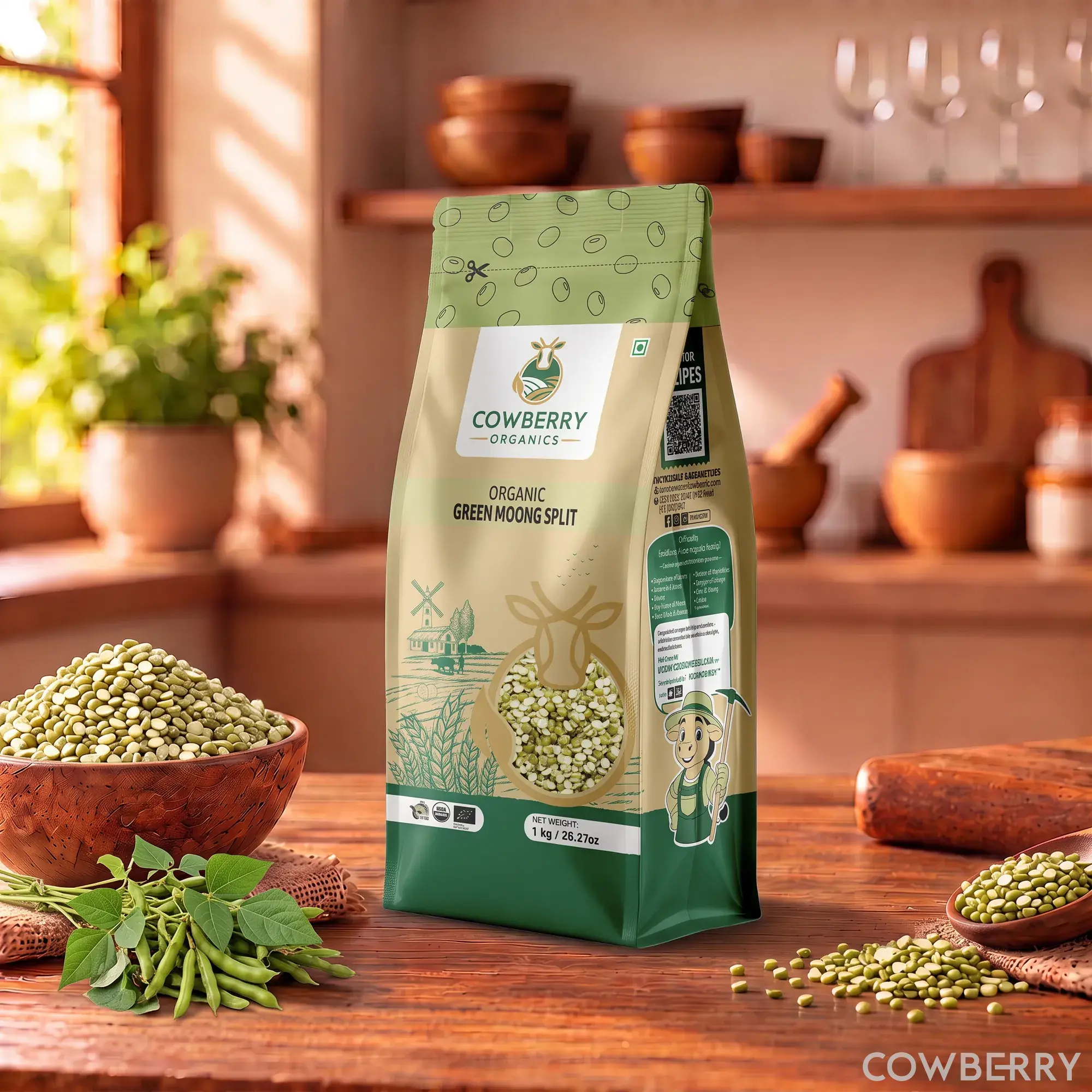
Which is best depends on the job. Yellow moong dal for a sick-day khichdi, a baby's first dal (after your paediatrician's advice), halwa and a smooth chilla batter. Chilka moong dal for everyday khichdi and dal when you want the fibre; that is what COWBERRY's green moong split is. Whole moong for sprouts and for a green moong curry. None of them needs polishing: an unpolished dal simply looks matte rather than shiny. How each form is made, stored and bought is covered in the moong dal guide.
Moong dal side effects: who should limit it
Eaten in normal portions, moong dal gives most people no trouble, which is why it is the dal of sick days and first foods. Its side effects come up in five situations.
- Gas and bloating. Pulses carry raffinose, stachyose and verbascose, sugars the small intestine has no enzyme to digest, so bacteria ferment them in the colon and release gas. That is the usual explanation, though a 2019 review of pulse tolerance by Thompson says it has recently been questioned, and how much gas people get varies. Soak the dal and pour that water away, then cook it fully soft; soaking and boiling both appear in the Dietary Guidelines for Indians as ways to improve how well pulses are digested. If dal is new to your plate, start with a small katori and keep it regular: Thompson also reports that for most people the gas subsides within a few weeks if they stay with pulses.
- High uric acid or gout. The body makes uric acid by breaking down purines, which pulses carry, but a 2019 review by Jakse and colleagues explains that most uric acid comes from the body's own purines and only a minor part from food. The review cites a 12-year study of 47,150 men who began without gout: eating more of the higher-purine plant foods, peas, beans and lentils among them, was not tied to gout, while more meat and seafood was (Choi et al.). The same review urges care with high-purine plant foods for anyone who already has gout or advanced kidney disease and finds the data on high uric acid thin, so ask your doctor or dietitian how much dal fits your levels and your medicines.
- Kidney disease on a potassium-restricted diet. The 1268 mg of potassium in 100 g of dal suits most people, but not someone whose kidneys cannot clear potassium. Anyone on a renal diet should ask their dietitian how much dal fits.
- Constipation. With 9.37 g fibre per 100 g, moong dal is an unlikely cause; the Dietary Guidelines for Indians note that fibre adds bulk to the stool. Keep the dal loose and drink enough water through the day.
- Allergy. Some people are allergic to a particular pulse; itching or swelling after eating dal needs a doctor, not a home remedy.
Raw dal also carries phytic acid, which hinders the absorption of iron and zinc. Pressure cooking reduces it to a great extent, and vitamin C in the same meal improves the absorption of the iron, which is what a squeeze of lemon on dal has always done.
How much moong dal per day
One to two katoris of cooked dal a day, made from 30 to 60 g of raw dal, fits a normal adult diet, counted as your pulse portion rather than added on top of other dals and paneer. For scale, 'My Plate for the Day' in the Dietary Guidelines for Indians (ICMR-NIN) sets a vegetarian's pulses for the day at 85 g by raw weight within a 2000 kcal diet, so two katoris of moong dal still leave room for another pulse. Those two katoris add up to 196 kcal and 14.3 g protein.
Rotate it. Different pulses have different nutrient profiles, which is why the same guidelines recommend a variety of them, so give toor, chana, urad and masoor their turn beside moong. For babies, the guidelines start complementary foods at six months with a thin but not watery dal gruel, thickened over the following days, and advise against watery dal ka pani; at about one year a child moves to the family diet. Start dal for a baby only after your paediatrician's advice. If you have diabetes, kidney disease or high uric acid, the portion is a conversation with your doctor or dietitian, not a rule from a website.
How to eat moong dal: benefits of moong dal khichdi, chilla and halwa
The benefits of moong dal khichdi are the benefits of moong dal plus rice: the dal's lysine covers what rice protein lacks, the rice's methionine covers what the dal lacks, and the ghee tempering carries the cumin and hing. It is an early solid food for many Indian babies and the meal many homes cook when someone is unwell. Our moong dal khichdi uses chilka moong split for a little more fibre.
For breakfast, a moong dal chilla turns soaked and ground dal into thin savoury pancakes with 11.9 g protein in two, with no flour and no fermenting. Plain moong dal tadka, cooked thin with turmeric and tempered with ghee, cumin and hing, is the everyday version; add spinach or bottle gourd for a vegetable dal. Sprouted whole moong goes into salads and chaat.
And yes, there is a dessert. Moong dal halwa roasts soaked, coarsely ground dal slowly in ghee, then cooks it with hot water, jaggery and saffron milk; the dal's protein is still there, but at about 404 kcal a serving (a sixth of the recipe) it is a sweet, not a health food, so eat it as one. If you read Hindi more easily, the same ground is covered in Hinglish under moong dal khane ke fayde.
FAQs
How much protein in 100 gm moong dal?
23.88 g per 100 g of raw moong dal (IFCT 2017), which rounds to 24 g, about a quarter of its weight. Dal takes up water as it cooks, so the katori on your plate, made from about 30 g of raw dal, carries about 7.2 g protein. Eat it with rice or roti: the amino acids of pulses and grains complement each other.
Can moong dal cause gas?
Yes, it can, like any pulse, and how much varies. Raffinose-family sugars escape digestion in the small intestine and are fermented in the colon, the usual explanation for pulse gas, though Thompson's 2019 review says it has recently been questioned. Soak the dal and pour the water off, cook it until fully soft, and start with a small katori; for most people who get gas, the review adds, it settles after a few weeks of regular pulses.
Which moong dal is best green or yellow?
Neither is better overall; they suit different jobs. Yellow (dehusked) moong dal is the light, quick one: sick-day khichdi, halwa, baby food. Green chilka moong dal keeps the skin, so it gives more fibre and a nuttier taste for everyday dal and khichdi. Whole green moong is for sprouts and curries. They are the same seed; only the skin and the splitting differ.
Does moong dal increase uric acid?
Food is the smaller source: moong dal has purines, as pulses do, but the body makes most of its uric acid from its own purines (Jakse et al.). A large 12-year study of men found no rise in gout among those eating more purine-rich plant foods (Choi et al.). For most healthy people a katori a day is an ordinary portion; with high uric acid or gout, decide the portion with your doctor or dietitian.
Is moong dal good for weight loss?
It fits a weight-loss diet well: 23.88 g protein and 9.37 g fibre per 100 g keep you full, fat is 1.35 g, and a katori of plain dal is about 98 kcal. What adds calories is the tempering and what it is eaten with. A moong dal chilla or a thin dal with salad is a filling meal for modest calories; talk to your doctor or dietitian before a big change in diet.
Can moong dal cause constipation?
It is unlikely to. Moong dal has 9.37 g fibre per 100 g, and the Dietary Guidelines for Indians describe fibre as adding bulk to the stool. If you do feel constipated after dal, look at how much water you drink through the day, keep the dal loose and add vegetables to the meal.
What is the difference between moong dal and toor dal?
Both are dehusked split pulses with similar energy, but moong dal (green gram) has more protein, 23.88 g against 21.7 g per 100 g, less sodium and a lighter, sweeter taste that cooks in minutes; toor dal (pigeon pea) has more folate, 108 mcg against 92.11 mcg, and the fuller flavour that sambar and dal fry are built on. Boiled whole pigeon peas, none tested in India, average a lower GI of 20 in the Sydney database.
References
- Indian Food Composition Tables (IFCT) 2017, ICMR-National Institute of Nutrition
- University of Sydney glycemic index database (GI search)
- University of Sydney: about the glycemic index
- Hou D, Yousaf L, Xue Y et al. Mung bean (Vigna radiata L.): bioactive polyphenols, polysaccharides, peptides, and health benefits. Nutrients, 2019
- Yi-Shen Z, Shuai S, FitzGerald R. Mung bean proteins and peptides: nutritional, functional and bioactive properties. Food Nutr Res, 2018
- Mudryj AN, Yu N, Aukema HM. Nutritional and health benefits of pulses. Appl Physiol Nutr Metab, 2014
- Li B, Shen X, Shen H et al. Effect of optimized germination technology on polyphenol content and hypoglycemic activity of mung bean. Front Nutr, 2023
- Shivakumar N, Kashyap S et al. Protein-quality evaluation of complementary foods in Indian children. Am J Clin Nutr, 2019
- Dietary Guidelines for Indians, ICMR-National Institute of Nutrition
- Thompson HJ. Improving human dietary choices through understanding of the tolerance and toxicity of pulse crop constituents. Curr Opin Food Sci, 2019
- Jakse B, Jakse B, Pajek M, Pajek J. Uric acid and plant-based nutrition. Nutrients, 2019
- Choi HK, Atkinson K, Karlson EW, Willett W, Curhan G. Purine-rich foods, dairy and protein intake, and the risk of gout in men. N Engl J Med, 2004
Shop this article
Keep reading
Green gram plant: crop, varieties and how it grows in India
Rajma vs lobia: difference, nutrition and which to choose
Rajma plant: how rajma is grown in India (it is not a tree)