by COWBERRY

7 minute read
Chickpeas (kabuli chana) for weight loss: calories, protein, portions

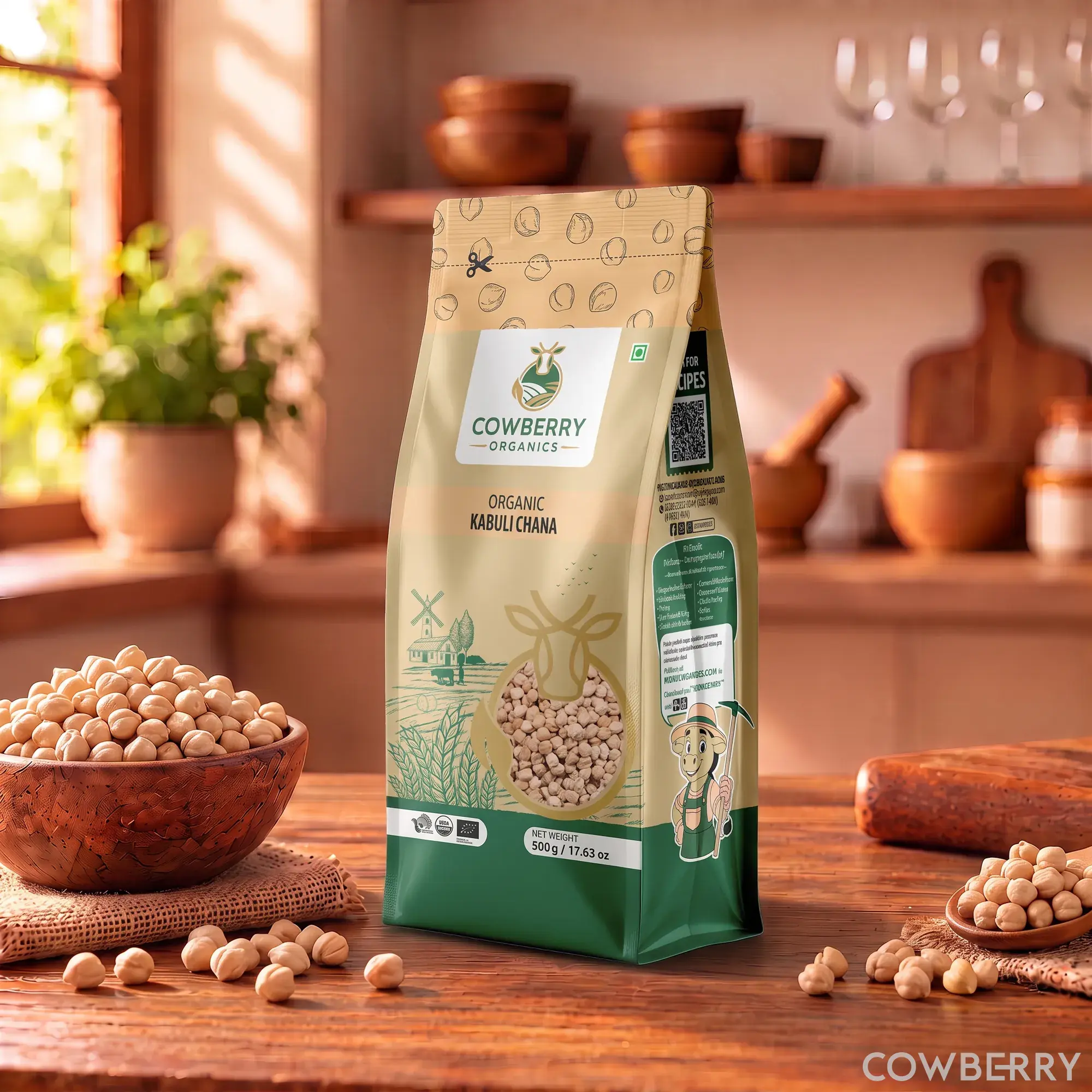
Chickpeas for weight loss come down to three numbers per 100 g of the dry grain: 378 kcal, 12.2 g of fibre and 20.5 g of protein. One cooked katori, from 30 g dry, is about 113 kcal, and a 2016 meta-analysis found diets containing pulses brought a modest weight loss even without calorie cutting. The grain's own story lives on the kabuli chana hub, and the detail follows below.
Short answer: is kabuli chana good for weight loss?
It can help, in one specific way: as a replacement for part of the rice, roti or fried snack, not as an addition. The ICMR-NIN guidelines link dietary fibre to the satiety value of a meal, and the trials point to a small effect: in a 2016 meta-analysis of 21 randomised controlled trials, diets containing pulses lost a little more weight than diets without them, even when the diets were not designed for weight loss. The catch is the calorie count: 378 kcal per 100 g dry means chana is a food to budget, not a free one.
Chickpeas for weight loss: calories, protein and fibre per 100 g
The table sets kabuli chana beside kala chana per 100 g raw, from the USDA FoodData Central record for the white type and IFCT 2017 for the dark one.
Calories
Kabuli chana carries 378 kcal per 100 g of the dry grain. A cooked katori, about 30 g dry, is roughly 113 kcal, a modest main-course portion and the number to remember when the second katori calls. Kala chana comes in lower at 287 kcal per 100 g.
Protein and fibre
The white type carries 20.5 g of protein and 12.2 g of fibre per 100 g. The ICMR-NIN dietary guidelines say dietary fibre delays the absorption of carbohydrates and fats and raises the satiety value of a meal, which is useful on a weight-loss plate. A 2012 review of chickpea nutrition adds that its protein is short only in the sulphur-containing amino acids, which cereals in the daily diet can complement.
| Nutrient | Kabuli chana | Kala chana |
|---|---|---|
| Energy (kcal) | 378 | 287 |
| Protein (g) | 20 | 19 |
| Fat (g) | 6 | 5.1 |
| Carbohydrates (g) | 63 | 40 |
| Dietary fibre (g) | 12 | 25 |
| Iron (mg) | 4.3 | 6.8 |
| Calcium (mg) | 57 | 150 |
| Magnesium (mg) | 79 | 160 |
| Potassium (mg) | 718 | 935 |
| Sodium (mg) | 24 | 27 |
| Zinc (mg) | 2.8 | 3.4 |
| Folate (mcg) | 557 | 233 |
| Vitamin C (mg) | 4 | — |
| Glycemic index (GI) | 23 | 23 |
Per 100 g raw, edible portion. Composition: USDA FoodData Central (SR Legacy), FDC ID 173756, NDB 16056; IFCT 2017 (ICMR-NIN). GI: University of Sydney GI database. — means not reported. These are average values for the food; the label on a pack gives the values for that product.
What the trials found: pulses and body weight
A 2016 systematic review and meta-analysis in the American Journal of Clinical Nutrition pooled 21 randomised controlled trials with 940 participants. Diets containing whole pulses, at a median intake of about 132 g a day, roughly one serving, showed an overall weight reduction of 0.34 kg compared with diets without a pulse, over a median duration of six weeks. The loss showed in matched weight-loss diets and in weight-maintaining diets alike, and six of the included trials also suggested that pulse consumption may reduce body fat percentage. The authors conclude that including pulses in a diet may be a beneficial weight-loss strategy because it leads to a modest weight-loss effect even when diets are not intended to be calorically restricted. The trials ran for three weeks or more, not for years, and the authors ask for future studies on long-term sustainability, so the finding supports pulses inside a weight-loss plan rather than promising weight loss from pulses alone.
How much kabuli chana a day for weight loss, and how to eat it
Start from the plate, not the bowl. The ICMR-NIN food pyramid for a balanced 2000 kcal diet allots 85 g of pulses and legumes a day, shared among every dal and pulse on the menu, so one katori of cooked chana, from about 30 g dry, fits when it replaces part of the cereal rather than joining a full thali. Two recipes that do the swap properly: a no-fry kabuli chana salad and Punjabi chole eaten with the bhatura skipped. The guidelines add that fats in a meal impart a feeling of fullness and delay the onset of hunger, so a teaspoon of oil in the tadka or dressing is not the enemy; the fried versions are, because frying adds a lot of oil to the dish.
Better and worse ways to eat chickpeas for weight loss
Better
- Boiled chana with lemon, onion, tomato and cucumber: the salad route.
- Chana khichdi, or a thin chole with one phulka instead of two.
- A handful of plain boiled chana as the evening snack that replaces fried namkeen.
Worse
- Roasted or deep-fried chana: oil adds calories fast.
- Kabuli chana laddu and other ghee-jaggery sweets: the pulse does not cancel the sugar.
- Hummus mopped up with a whole pack of pita: the dip is not the issue, the portions are.
Cooking, storage and buying all live on the kabuli chana hub page.
What to avoid
- Counting chana as free food. 378 kcal per 100 g dry; one katori is 113 kcal that must come out of somewhere.
- Eating chana as the whole diet. The guidelines' pyramid puts pulses at 85 g a day within a varied menu, not as the only food.
- Two helpings because it is healthy. The second katori doubles the 18.9 g of carbohydrate, and weight loss is still a calorie account.
- Frying as the default. A shallow-fried tikki carries the oil with the pulse.
Talk to your doctor or dietitian
Weight loss is a medical question whenever a health condition travels with it, and calorie targets, thyroid or blood sugar medication and pregnancy each change the plan. Take your weight goal and your usual plate to a dietitian and let them place the chana in your calorie count; if you are on medication or managing any condition, talk to your doctor or dietitian before the menu changes.
FAQs
Is chickpeas good for weight loss?
They can be, as a replacement for part of the rice, roti or fried snack rather than an extra. Per 100 g dry there are 378 kcal, 20.5 g of protein and 12.2 g of fibre, and a 2016 meta-analysis of 21 trials found diets with pulses lost a little more weight than diets without, even without calorie restriction. The ICMR-NIN guidelines tie the fibre to a meal's satiety value; the portion is still a calorie you must budget.
Does kabuli chana increase weight?
Only through the calories, like any food. A katori of cooked chana is about 113 kcal, which fits most calorie budgets; weight goes up when chana dishes carry a lot of oil or ghee, come with bhature, or sit on top of a full meal. In the 2016 meta-analysis, diets containing pulses lost slightly more weight than diets without them. The preparation decides the direction, not the pulse.
Does chickpeas have protein?
Yes: the USDA FoodData Central record for the dry seed reads 20.5 g per 100 g, and one cooked katori holds close to 6.2 g. The 2012 chickpea review in the British Journal of Nutrition notes that chickpea protein is short only in the sulphur-containing amino acids, which cereals in the daily diet can complement, so chana with roti or rice suits a calorie-controlled plate.
Why chickpeas cause bloating?
Chickpea bloating is usually put down to galacto-oligosaccharides; the small intestine cannot digest them, and their fermentation in the colon releases gas. The 2019 review of pulse tolerance adds that this explanation has recently been questioned, that how much gas someone gets varies from person to person, and that most people adapt if they keep eating pulses regularly.
Which chickpeas are high in protein?
Kabuli chana leads the whole chickpeas at 20.5 g of protein per 100 g, against 18.77 g for kala chana. On a weight-loss plate the differences are small; the fibre, 12.2 g per 100 g in kabuli chana, matters at least as much, because it is what keeps the meal satisfying.
Is roasted chana good for weight loss?
Roasted chana can be, if the pack keeps the oil and salt low, and the label tells you. Plain boiled chana, at about 113 kcal a cooked katori, is the version with nothing added. Either way it replaces a fried snack rather than joining it, and it counts towards the day's calories like any other food.
References
- USDA FoodData Central
- Indian Food Composition Tables (IFCT) 2017, ICMR-National Institute of Nutrition
- Kim SJ, de Souza RJ, Choo VL, et al. Effects of dietary pulse consumption on body weight: a systematic review and meta-analysis of randomized controlled trials. Am J Clin Nutr, 2016
- Dietary Guidelines for Indians, ICMR-National Institute of Nutrition
- Jukanti AK, Gaur PM, Gowda CL et al. Nutritional quality and health benefits of chickpea (Cicer arietinum L.): a review. Br J Nutr, 2012
- Thompson HJ. Improving human dietary choices through understanding of the tolerance and toxicity of pulse crop constituents. Curr Opin Food Sci, 2019
Shop this article
Keep reading
Green gram plant: crop, varieties and how it grows in India
Rajma vs lobia: difference, nutrition and which to choose
Rajma plant: how rajma is grown in India (it is not a tree)