by COWBERRY

7 minute read
Chickpeas for babies: when to start, how to cook and serve

Chickpeas for babies start from around six months, once complementary foods begin: cooked soft and mashed or pureed, they bring protein, iron and folate to a weaning plate. The WHO sets the age, an NHS page lists the foods to avoid, and your paediatrician sets the portion. The kabuli chana hub has the basics of the pulse itself.
Short answer: can babies eat chickpeas, and from when?
Yes, from around six months. The WHO recommends that infants start receiving complementary foods at 6 months of age in addition to breast milk, and that infants can eat pureed, mashed and semi-solid foods beginning at 6 months, which is exactly the form a pressure-cooked, mashed chickpea takes. Before six months the baby's needs are met by milk alone, so chana waits. What matters as much as the age is the texture and the salt: an NHS page on foods to avoid says not to add salt to your baby's food or cooking water, so the chana for the baby are cooked and mashed without it.
Chickpeas recipe for baby: how to cook and serve at each age
6 to 8 months: a smooth mash
Soak the kabuli chana 8 to 12 hours, or overnight, pressure cook until they squash between finger and thumb, then mash them smooth with the cooking water, a little at a time, into a paste with no lumps. The WHO's rule for this age is two to three complementary feeds a day of pureed, mashed and semi-solid foods. Mix it into a rice or moong base rather than serving it alone, and ask your paediatrician how much to offer and how fast to increase it.
8 to 12 months: soft pieces
By 8 months most infants can also eat finger foods, the WHO notes, so squashed halves of soft-cooked chana, skins slipped off, work as early finger practice. From 9 to 11 months the feeds rise to three to four times daily, and by 12 months most children can eat the same types of foods as the rest of the family, so the chana curry can be shared once the baby's portion is taken out before any salt goes in.
Choking: the rule that overrides everything
The WHO says to avoid foods in a form that may cause choking, such as whole grapes or raw carrots, and the NHS keeps whole nuts away from children under five for the same reason. A whole chana is small and round, so mash it, squash it or split it until the baby can chew. The baby eats sitting up, watched, and never with a handful of loose chana.
Why chickpeas for babies: protein, iron and folate
The numbers are per 100 g of dry chickpeas (USDA FoodData Central): 20.5 g of protein, 4.31 mg of iron, 557 mcg of folate and 12.2 g of fibre. A baby eats a spoonful or two at a time, so the point at this age is nutrient density, not quantity: the WHO's complementary-feeding definition of adequate foods is that they provide sufficient energy, protein and micronutrients to meet a growing child's nutritional needs. A 2012 review of chickpea finds every essential amino acid present in significant amounts bar the sulphur-containing ones, a gap that a cereal such as rice can fill through the day.
The fibre is high too, at 12.2 g per 100 g, so offer the mash in small amounts, well cooked and with the baby's usual milk or cereal meal, and let the paediatrician guide how much.
Gas in babies: why chickpeas cause it and how to keep it mild
The oligosaccharides in chickpeas are not digested in the small intestine; the colon ferments them and gas is the result, although a 2019 pulse-tolerance review says that explanation has recently been called into question. The same review adds that the amount differs from one person to the next, and that for most people who notice it the discomfort fades once pulses become a regular part of meals. The review offers no kitchen step that stops the gas, so for a baby the routine is simply the safe one: soak, discard the water, pressure cook until completely soft and mash, and ask the paediatrician if gas seems to trouble the child. The ICMR-NIN guidelines add that boiling and pressure cooking destroy the anti-nutritional factors in pulses and improve protein availability, which is the second reason the baby's chana are always fully cooked, never half-cooked.
Better and worse chickpea foods for babies and kids
Better
- Home-cooked chana mash mixed into rice, khichdi or a mild dal.
- Soft-cooked whole chana, squashed, for finger-food age.
- A smooth, salt-free hummus-style paste with the baby's usual bread or rice; the hummus recipe shows the method for the adult version.
- For older kids, the roundup of kabuli chana recipes has salads, tikki and khichdi they can grow into.
Worse
- Whole, firm chana for a baby who cannot chew: the choking rule.
- Shop-bought chana snacks, restaurant chole and anything salted: the NHS says babies should not eat much salt, as it is not good for their kidneys.
- Honey-sweetened anything before the age of one: the NHS explains that honey occasionally contains bacteria that can produce toxins in a baby's intestines, and says not to give honey until they are over 1 year old.
- Deep-fried tikki or bhature-chole for the under-fives as a habit: keep the fried part occasional.
Buying, soaking and storing the pulse are covered on the kabuli chana hub.
Talk to your doctor or dietitian
Weaning plans are individual, and the first months of solid food are when growth, digestion and any allergy questions are settled with the doctor who knows the child. The NHS asks families with a history of food allergies to talk to their GP or health visitor before introducing any type of nut; such a family can raise chana at the same visit, and anything unusual after a new food goes to the doctor rather than to guesswork. A paediatrician or dietitian can place chana in your baby's weaning plan, portion and all: talk to your doctor or dietitian before changing what the baby eats.
FAQs
Can chickpeas cause gas?
Yes. The sugars chickpeas carry, galacto-oligosaccharides, pass through the small intestine without being digested, and the colon turns them into gas. In a 2019 pulse-tolerance review, most people troubled by gas adapted when pulses stayed on their plate, and the amount differed between people. For a baby, cook the chana completely soft, mash it, and ask the paediatrician if the gas seems to bother the child.
Does chickpeas have protein?
Yes: 20.5 g of protein in every 100 g of the dry grain (USDA FoodData Central). A baby's portion is small, so the amount is small too; the WHO asks that complementary foods together provide sufficient energy, protein and micronutrients. Chickpea protein falls short only in the sulphur-containing amino acids, according to a 2012 review, and cereals in the daily diet can make up the difference, so serve the mash with rice or another cereal.
Can chickpeas be boiled without soaking?
They can, but unsoaked chana cook unevenly and take far longer, and the soak is also one of the household methods the ICMR-NIN guidelines list for improving the digestibility of legumes, which matters most when the eater is small. Our guide to soaking kabuli chana has the full method.
Is chickpeas good for diabetes?
That question is for the adults at the table; for a child with diabetes the rules are set by the child's doctor, not by a web page. For grown-ups, boiled chickpeas average a GI of 23 and the details are on the kabuli chana for diabetes page.
What is chickpeas?
Chickpeas are the round, cream-coloured seeds of Cicer arietinum, the pulse sold in India as kabuli chana and eaten as chole, salads and hummus. The USDA FoodData Central record calls them chickpeas, garbanzo beans, bengal gram. They are a pulse, not a grain, and their names in English and Hindi are on our chickpea names page.
References
- WHO: complementary feeding (health topic)
- NHS: Foods to avoid giving babies and young children
- USDA FoodData Central
- Dietary Guidelines for Indians, ICMR-National Institute of Nutrition
- Thompson HJ. Improving human dietary choices through understanding of the tolerance and toxicity of pulse crop constituents. Curr Opin Food Sci, 2019
- Jukanti AK, Gaur PM, Gowda CL et al. Nutritional quality and health benefits of chickpea (Cicer arietinum L.): a review. Br J Nutr, 2012
- University of Sydney glycemic index database (GI search)
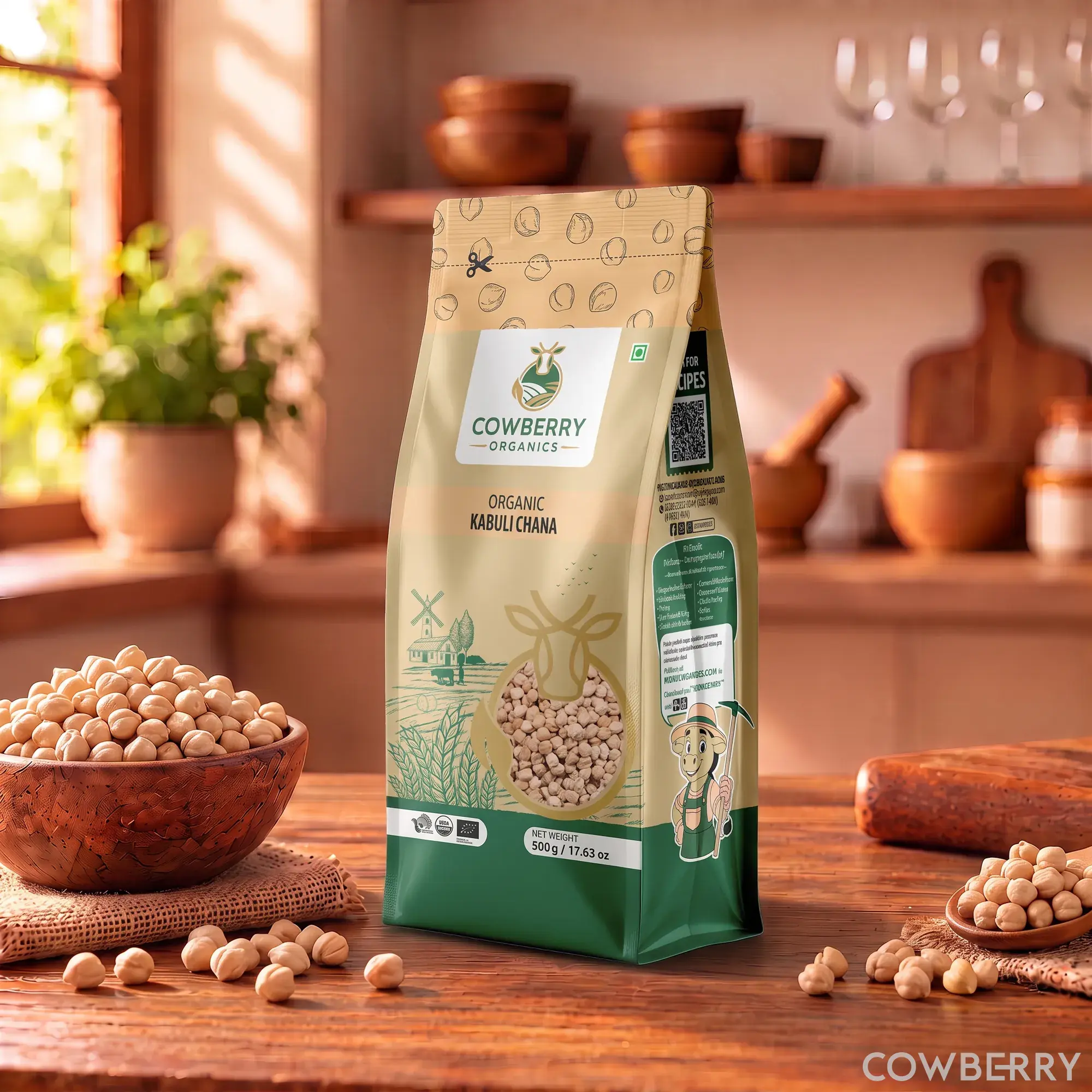
Shop this article
Keep reading
Green gram plant: crop, varieties and how it grows in India
Rajma vs lobia: difference, nutrition and which to choose
Rajma plant: how rajma is grown in India (it is not a tree)