by COWBERRY

6 minute read
Black pepper vs white pepper: taste, uses and which to choose

Black pepper vs white pepper in one line: both come from one species, Piper nigrum, and both are sold as whole peppercorns, but black pepper is the dark, wrinkled berry while white pepper is the pale kind used where dark specks would spoil the look of a dish. This black pepper guide compares their nutrition, taste, cost and kitchen roles.
Verdict in three lines
Same species, two forms. Both the black pepper and the white pepper records name the species Piper nigrum: black pepper is the dark, wrinkled berry, white pepper the pale peppercorn.
Black is the everyday one; white is for looks. White pepper's printed purpose is pale dishes, soups, creamy sauces and gravies where dark specks would show, and its taste is a sharper warmth with a more subtle aroma.
The nutrition gap is real on paper, tiny on the plate. White pepper's 296 kcal and 68.6 g of carbohydrate per 100 g sit above black pepper's 218 kcal and 36.22 g, but both come in pinches worth 2 or 3 kcal. The white pepper hub covers safed mirch on its own.
Black pepper vs white pepper: side by side per 100 g
The table puts the two records side by side: black pepper's numbers come from IFCT 2017 (food code G031) and white pepper's from the USDA FoodData Central record, because IFCT 2017 does not include white pepper.
Read down the table and white pepper looks the heavier spice: 296 kcal against 218 kcal, about 36 percent more energy, and 68.6 g of carbohydrate against 36.22 g, about 89 percent more. Black pepper answers back with 33.16 g of fibre against 26.2 g, about 27 percent more, and its minerals run far ahead: 405 mg of calcium against 265 mg, about 53 percent more, and 1487 mg of potassium against 73 mg, about 20 times. White pepper takes iron narrowly, 14.3 mg against 11.91 mg, about 20 percent more, and it alone reports 21 mg of vitamin C.
| Nutrient | Black pepper | White pepper |
|---|---|---|
| Energy (kcal) | 218 | 296 |
| Protein (g) | 10 | 10 |
| Fat (g) | 2.7 | 2.1 |
| Carbohydrates (g) | 36 | 69 |
| Dietary fibre (g) | 33 | 26 |
| Iron (mg) | 12 | 14 |
| Calcium (mg) | 405 | 265 |
| Magnesium (mg) | 196 | 90 |
| Potassium (mg) | 1487 | 73 |
| Sodium (mg) | 24 | 5 |
| Zinc (mg) | 1.2 | 1.1 |
| Folate (mcg) | 22 | 10 |
| Vitamin C (mg) | — | 21 |
Per 100 g raw, edible portion. Composition: IFCT 2017 (ICMR-NIN); USDA FoodData Central (SR Legacy), FDC ID 170933, NDB 2032. — means not reported. These are average values for the food; the label on a pack gives the values for that product.
Nutrition: what a pinch of either actually gives
A pinch weighs about a gram, and at that scale the gaps above nearly disappear. A 1 g pinch of black pepper carries about 2 kcal and about 0.12 mg of iron; the same pinch of white pepper carries about 3 kcal and about 0.14 mg of iron. Both are small against a day's meals, whichever column you started from.
That is also why a 2014 review of culinary spices reaches a modest conclusion: eaten in small quantities and in combination with other foods, it is unclear what a spice's true benefit is from a health perspective, so the two peppers earn their place in cooking rather than in a medicine cabinet. The black pepper nutrition page has the full read-down, and the black pepper hub links the rest of the cluster.
Taste and cooking
Taste first, in the words the sources print. Black pepper is brown, wrinkled and pungent, and a systematic review calls it a widely used spice that adds a flavour of its own to dishes while enhancing the taste of other ingredients. It is the everyday pepper of Indian cooking, kali mirch in Hindi. White pepper is described as a sharper warmth with a more subtle aroma, so the difference between kali mirch and white mirch is not only colour.
Cooking splits them by appearance more than anything else. Black pepper is the pepper of a rasam powder recipe and of the turmeric and black pepper pairing, while white pepper, or safed mirch, is the one for soups, creamy sauces, gravies, marinades, vegetable preparations and spice blends where dark specks would show. The safed mirch in english page lists white pepper's own names.
Cost and where each fits
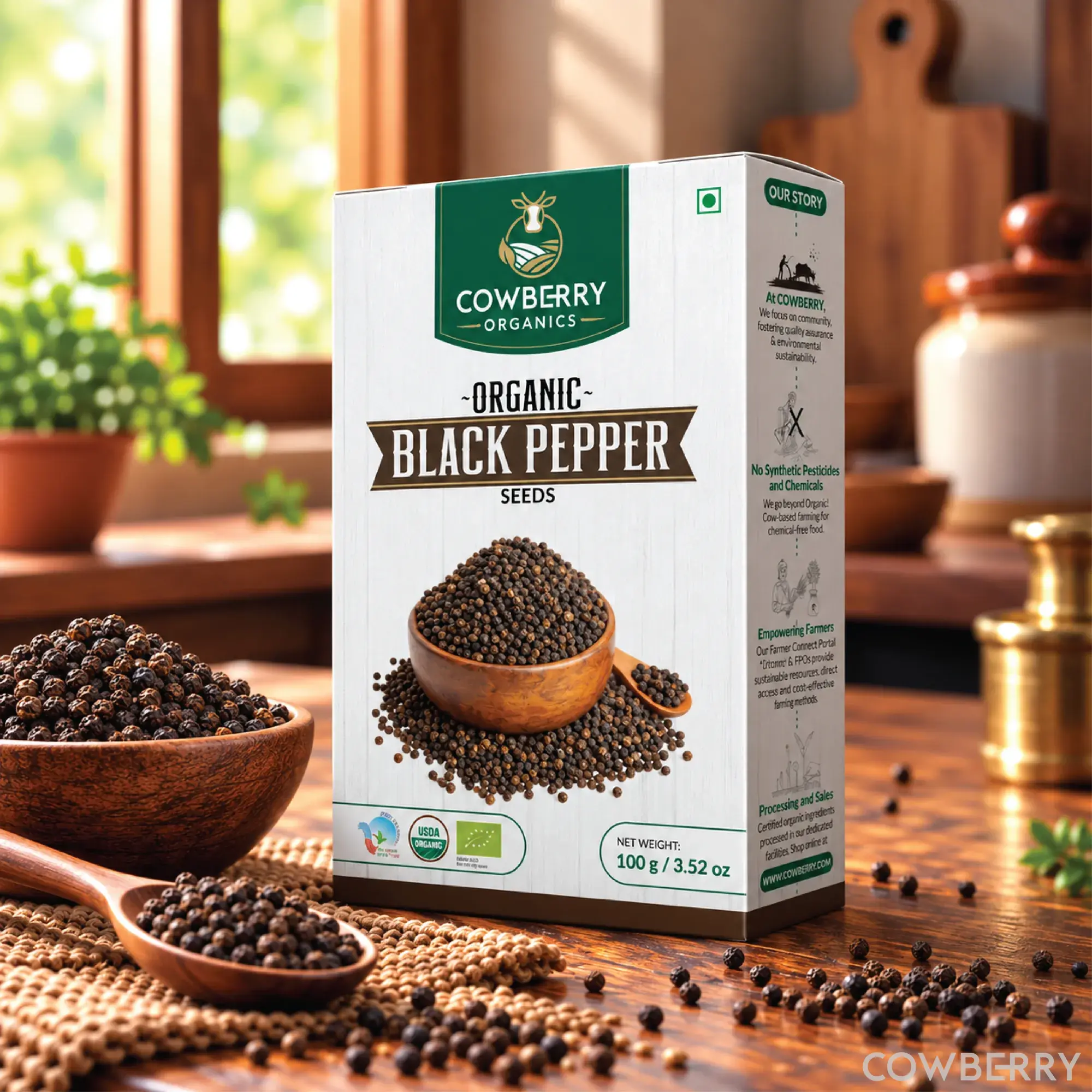
Black pepper is the working spice of Indian cooking: COWBERRY sells it whole in a 100 g pack. White pepper comes in a 50 g pack, a specialist jar for the occasional white soup or cream sauce. No prices here, because they move with each harvest, and the honest buying rule is simpler.
Black pepper earns its place in everyday cooking; white pepper earns it in the occasional pale dish. That is where each fits, and it is the same answer as the cost question: buy the one your cooking actually uses, whole rather than ground, and let the organic white pepper pack sit until a pale-sauce dinner calls for it.
Which for whom
Everyday Indian cooks: black pepper, the widely used form that the rasam powder recipe and the turmeric pairing are built on.
Pale-dish cooks: white pepper, whose job over black is staying speck-free in soups and cream sauces while adding a sharper warmth.
Anyone choosing by nutrition: neither wins at the pinch, because the per 100 g gaps above shrink to a gram or two of spice, so pick by taste and dish, not by the table.
Whichever you pick, buy whole peppercorns rather than powder, ICMR-NIN prefers whole, uniform spices and certified products, and keep the jar airtight, cool and dry. COWBERRY's organic black pepper is India Organic, USDA & EU certified, and the black pepper adulteration test page shows how to check a batch at home.
FAQs
Is white pepper and black pepper the same?
Same plant, different spice. The IFCT 2017 record for black pepper and the USDA record for white pepper both name the species Piper nigrum; black pepper is the dark, wrinkled berry, while white pepper is the pale peppercorn whose taste is a sharper warmth with a more subtle aroma.
Can white pepper be substituted for black pepper?
Yes, in pale dishes it is the whole point: white pepper stands in for black in soups, creamy sauces and gravies where dark specks would show, and it brings a sharper warmth and a more subtle aroma. In everyday Indian dishes there is no reason to swap, because black pepper is the form the recipes expect.
How is white pepper different from black?
By look, taste and the numbers. Black pepper is brown and wrinkled; white pepper is pale. White pepper's taste is a sharper warmth with a more subtle aroma, and per 100 g it is heavier on energy, 296 kcal against 218 kcal, while black pepper carries more fibre, calcium and potassium. At a pinch, none of that matters.
Which is stronger white pepper or black?
Nothing measures one against the other directly, so the honest answer is: white pepper is the one described with a sharper warmth, black pepper the one described as pungent. Try the same dish with each once and pick by taste.
Does white pepper have more nutrients than black pepper?
White pepper wins energy, carbohydrate, iron and vitamin C: 296 kcal against 218 kcal, 14.3 mg of iron against 11.91 mg, plus 21 mg of vitamin C that black pepper's record does not report; black pepper answers with more fibre, calcium and potassium. Eaten by the gram, the differences are trivial.
Is black pepper better for Indian cooking than white pepper?
Yes, because Indian recipes are written around it: the rasam powder recipe in COWBERRY's kitchen is built on black pepper, and it is the spice the food tables record under "Pepper, black". White pepper's role is appearance, pale soups and sauces, not replacing black in everyday dishes.
References
- Indian Food Composition Tables (IFCT) 2017, ICMR-National Institute of Nutrition
- Dietary Guidelines for Indians, ICMR-National Institute of Nutrition
- USDA FoodData Central
- Takooree H, Aumeeruddy MZ, Rengasamy KRR et al. A systematic review on black pepper (Piper nigrum L.): from folk uses to pharmacological applications. Crit Rev Food Sci Nutr, 2019
- Opara EI, Chohan M. Culinary herbs and spices: their bioactive properties, the contribution of polyphenols and the challenges in deducing their true health benefits. Int J Mol Sci, 2014
- FSSAI Eat Right India: DART (Detect Adulteration with Rapid Test), salt, spices and condiments tests
Shop this article
Keep reading
Coriander water benefits: what dhania water actually does
Peanuts in Hindi (moongfali): groundnut names in Indian languages
Coriander vs cilantro: are they the same herb?