by COWBERRY

5 minute read
Safed mirch in English, Hindi and Indian languages (white pepper)

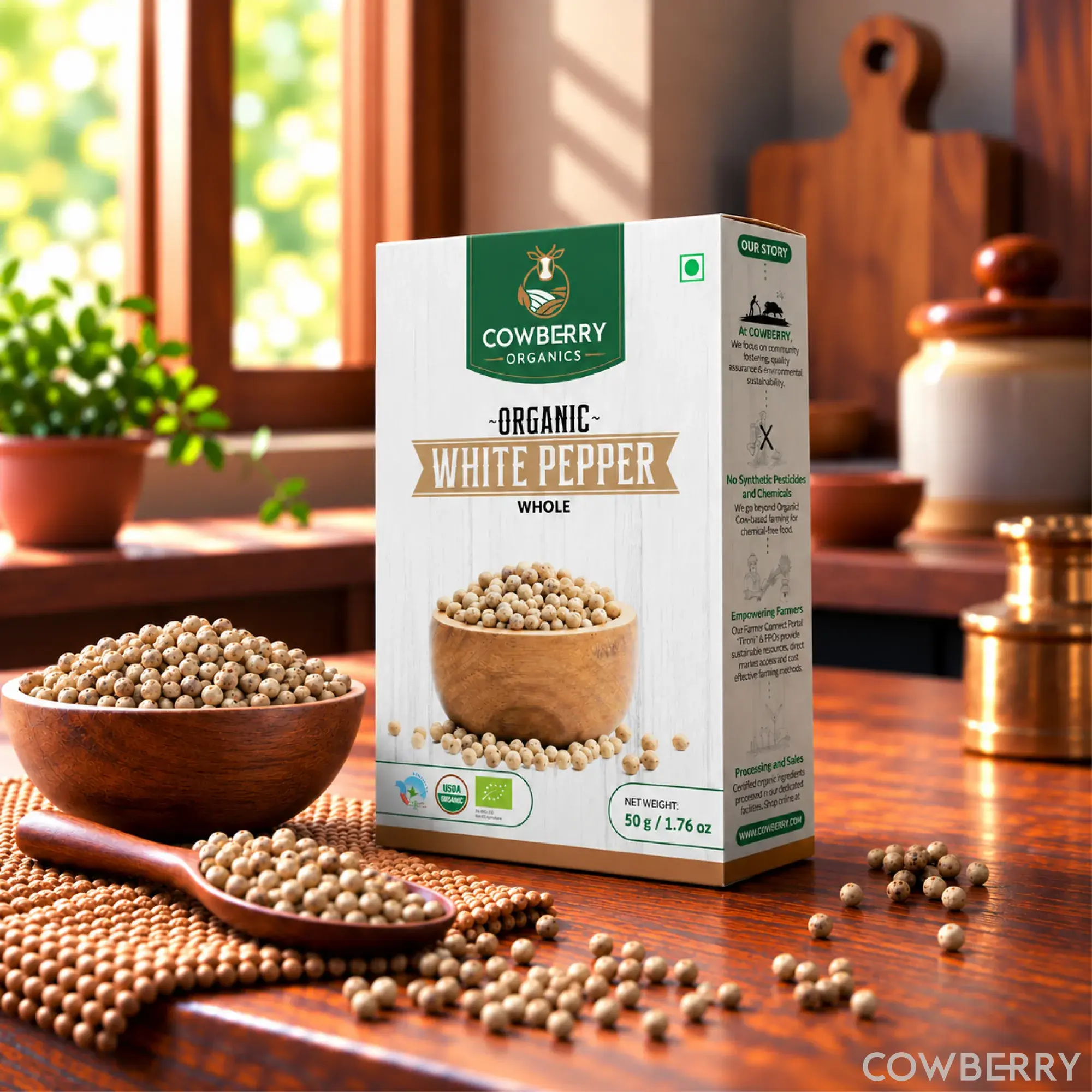
Safed mirch in English is white pepper, and safed mirch in Hindi is the name COWBERRY's product page prints for it. The spice is the pale peppercorn of Piper nigrum, the same vine that gives black pepper; USDA FoodData Central lists it as 'Spices, pepper, white'. Every name below comes with its source, and the full story is on the white pepper hub page.
Safed mirch in English, Hindi and Indian languages: quick answer
One line per language: English white pepper, Hindi safed mirch, and for the other Indian languages no separate name is recorded. The Hindi name is the one COWBERRY's white pepper page prints; the English label and the botanical name are what the USDA FoodData Central record for white pepper prints, and the table below shows those, with a dash where that record has no name.
| Language | Name (romanised) |
|---|---|
| English | Spices, pepper, white |
| Hindi | — |
| Marathi | — |
| Gujarati | — |
| Punjabi | — |
| Bengali | — |
| Odia | — |
| Assamese | — |
| Kannada | — |
| Telugu | — |
| Tamil | — |
| Malayalam | — |
| Urdu | — |
| Sanskrit | — |
| Botanical name | Piper nigrum |
Source: USDA FoodData Central record 170933 (English and scientific name only; no Indian-language names in source). — means no name recorded in the source.
Safed mirch in English and the botanical name
White pepper in English is white pepper, and safed mirch is not a second spice: the Hindi name sits beside the English one on COWBERRY's product page, 'Organic White Pepper (Safed Mirch)'. The formal English name in USDA FoodData Central is 'Spices, pepper, white', FDC ID 170933, and the botanical name is Piper nigrum. IFCT 2017 lists the same species for black pepper, so white pepper is not a different plant but the same seed, processed differently.
White pepper in Hindi, Gujarati and Indian languages
Hindi and Urdu
White pepper in Hindi is safed mirch, printed on COWBERRY's product page. For pepper itself, IFCT 2017 records Kalimirchi in Hindi and Kaali Mirch in Urdu, names that belong to black pepper, the same seed.
Gujarati, Marathi and Punjabi
White pepper in Gujarati has no separately recorded name; IFCT 2017's Gujarati name for pepper is Mari, with Mire in Marathi and Kalimirchi in Punjabi.
South and East India, and Sanskrit
IFCT 2017 records Kari menasu in Kannada, Mirayalu in Telugu, Milagu in Tamil and Kurumlaku in Malayalam for pepper, and in the east Golmarichi in Bengali, Golomarcho in Odia and Kola jaluk in Assamese, with Marich ushna, hapusha in Sanskrit. For white pepper itself, safed mirch is the only Indian name recorded.
Often confused with: safed mirch vs kali mirch
Kali mirch is black pepper and safed mirch is white pepper: COWBERRY pairs each Hindi name with its English one on the two product pages, and the USDA and IFCT records print one botanical name for both, Piper nigrum. What differs is processing and colour. COWBERRY's white pepper page describes the spice as processed differently from black pepper, which gives its pale appearance, with a sharper warmth and a more subtle aroma; it is chosen for light dishes where dark specks would show. The full side-by-side is on black pepper vs white pepper.
Where white pepper grows
White pepper is not grown separately from black pepper: it is the same Piper nigrum seed, and the two differ only after harvest. That makes white and black pepper one crop, not two. COWBERRY sources its white pepper from Karnataka, a region known for spice growing, where it is raised through traditional cow-based natural farming, and sells the peppercorns whole as organic white pepper.
How safed mirch is made and used
Safed mirch is sold whole and ground fresh, and COWBERRY's product page lists where it goes: soups, creamy sauces, gravies, marinades, vegetable preparations and spice blends, picked where pepper flavour is wanted without dark specks. Whole peppercorns keep their aroma and can be ground just before use, which is how the product page suggests using them. The white pepper hub page covers the spice's names, nutrition per 100 g and how to use it.
FAQs
What is safed mirch in English?
Safed mirch in English is white pepper, and both names are printed together on COWBERRY's product page as 'Organic White Pepper (Safed Mirch)'. USDA FoodData Central lists the same spice under the formal English name 'Spices, pepper, white', FDC ID 170933, with the botanical name Piper nigrum.
What is white pepper in Hindi?
White pepper in Hindi is safed mirch, the name printed on COWBERRY's white pepper page. No other Indian language has a recorded name for white pepper; the Indian pepper names IFCT 2017 prints (Kalimirchi in Hindi, Kaali Mirch in Urdu) belong to black pepper, the same Piper nigrum seed.
Difference between kali mirch and safed mirch?
Kali mirch is black pepper and safed mirch is white pepper, the seed of one vine, Piper nigrum. White pepper is processed differently from black pepper, which gives it its pale colour; COWBERRY describes its warmth as sharper, with a more subtle aroma. The side-by-side comparison is on black pepper vs white pepper.
How white pepper is made?
White pepper comes from the same Piper nigrum seed as black pepper, processed differently, and COWBERRY's product page prints that this different processing gives the spice its characteristic pale appearance. Whole peppercorns are kept unground so each cook can grind them fresh when a dish needs them. Beyond that, neither COWBERRY's product page nor the USDA record describes the method.
Is white pepper spicy?
Yes. COWBERRY's product page describes white pepper as having a sharp, warm, peppery flavour with a subtle earthy aroma and lingering heat, and calls its heat balanced. Compared with black pepper, its warmth is sharper while the aroma is more subtle. Its pale colour also makes it useful in soups and white gravies where dark specks would show.
Does white pepper have any health benefits?
No benefit of white pepper in people is established, and a 2014 review in the International Journal of Molecular Sciences explains why: spices are eaten in small amounts, usually with other foods, so their true health benefit is hard to pin down. What the spice does hold, per 100 g (USDA FoodData Central), is 26.2 g fibre, 14.3 mg iron, 265 mg calcium and 21 mg vitamin C.
References
Shop this article
Keep reading
Coriander water benefits: what dhania water actually does
Peanuts in Hindi (moongfali): groundnut names in Indian languages
Coriander vs cilantro: are they the same herb?