by COWBERRY

11 minute read
White pepper (safed mirch): names, nutrition and how to use it

White pepper is the pale peppercorn of Piper nigrum, the one vine behind both white and black pepper; processed differently, it is sold whole and ground fresh to white pepper powder, and in Hindi it is safed mirch. This page covers its names, its USDA nutrition per 100 g, what is and is not shown about its benefits, and how to use, store and buy it.
What is white pepper?
White pepper is not a different plant from black pepper. Both are the seed of Piper nigrum, the one vine; what separates the two is processing after harvest, which turns one dark and wrinkled and leaves the other pale. COWBERRY's product page puts that plainly: white pepper is processed differently from black pepper, and that different processing gives the spice its characteristic pale appearance. Neither that page nor the USDA record describes the steps in between.
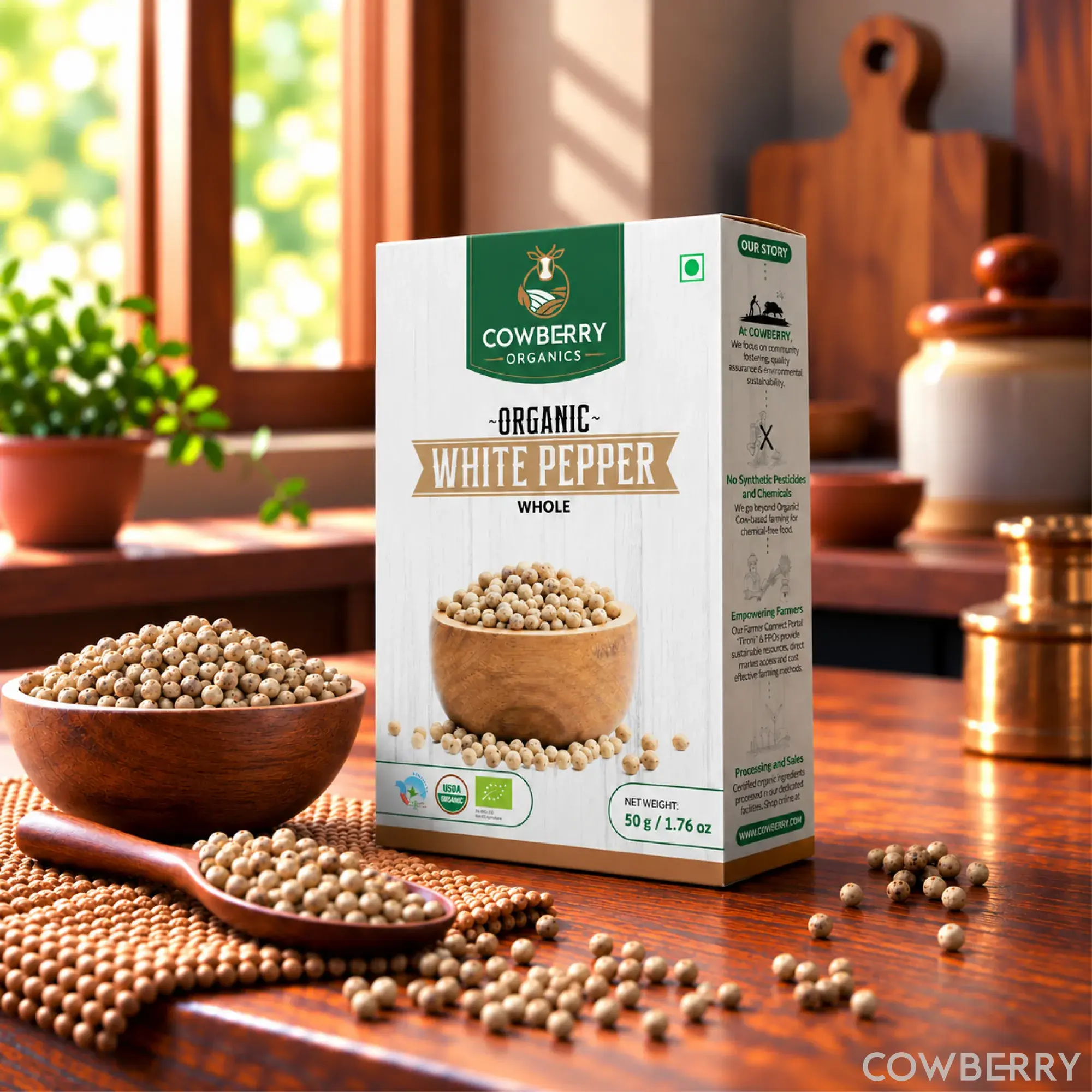
Its taste is its own too: a sharper warmth than black pepper, a more subtle aroma, heat described as balanced, with a lingering finish. Cooks choose it for dishes where pepper flavour should come without dark specks: soups and creamy sauces, gravies and marinades, vegetable preparations and spice blends. It is sold whole, in a 50 g pack, ready to be ground to white pepper powder when a dish asks.
Safed mirch: white pepper names in India
In Hindi the spice is safed mirch, the name COWBERRY's product page prints beside the English one as 'Organic White Pepper (Safed Mirch)'; ground, it is safed mirch powder. The formal English name is 'Spices, pepper, white', the label on USDA FoodData Central record FDC 170933; botanists know the vine as Piper nigrum.
The table below follows that USDA record, which prints no Indian-language names for white pepper, so most rows show a dash. IFCT 2017 does record pepper names in 13 Indian languages, but those belong to black pepper, the same seed; the full list, language by language, is on the safed mirch in english page. Ask "safed mirch kya hai" or "white pepper kya hai" and the answer is the same: this one spice.
| Language | Name (romanised) |
|---|---|
| English | Spices, pepper, white |
| Hindi | — |
| Marathi | — |
| Gujarati | — |
| Punjabi | — |
| Bengali | — |
| Odia | — |
| Assamese | — |
| Kannada | — |
| Telugu | — |
| Tamil | — |
| Malayalam | — |
| Urdu | — |
| Sanskrit | — |
| Botanical name | Piper nigrum |
Source: USDA FoodData Central record 170933 (English and scientific name only; no Indian-language names in source). — means no name recorded in the source.
White pepper nutrition per 100 g
Every figure below comes from USDA FoodData Central, which carries white pepper as record FDC 170933; IFCT 2017 has no white pepper entry. Per 100 g, the record measures 296 kcal, 10.4 g protein, 2.12 g fat and 68.6 g carbohydrate, with 26.2 g of fibre. On the mineral and vitamin side: 14.3 mg iron, 265 mg calcium, 90 mg magnesium, 73 mg potassium, 5 mg sodium and 1.13 mg zinc, plus 10 mcg folate and 21 mg vitamin C. Neither the USDA record nor IFCT 2017 reports a glycemic index for white pepper.
Those numbers are large on paper because the table is built on 100 g of a dry spice, and on a plate the spice is eaten a pinch at a time. A pinch weighs about 1 g and works out to about 3 kcal and 0.14 mg of iron. The vitamin C figure is a small footnote: white pepper's USDA record prints one and black pepper's IFCT 2017 entry does not, which matters less than the taste. For how this column stacks up against black pepper's numbers, the full read-down is on the black pepper vs white pepper page.
| Nutrient | White pepper |
|---|---|
| Energy (kcal) | 296 |
| Protein (g) | 10 |
| Fat (g) | 2.1 |
| Carbohydrates (g) | 69 |
| Dietary fibre (g) | 26 |
| Iron (mg) | 14 |
| Calcium (mg) | 265 |
| Magnesium (mg) | 90 |
| Potassium (mg) | 73 |
| Sodium (mg) | 5 |
| Zinc (mg) | 1.1 |
| Folate (mcg) | 10 |
| Vitamin C (mg) | 21 |
Per 100 g raw, edible portion. Composition: USDA FoodData Central (SR Legacy), FDC ID 170933, NDB 2032. — means not reported. These are average values for the food; the label on a pack gives the values for that product.
Benefits of white pepper
Start with the honest answer: none of the cited studies establishes a health benefit of white pepper in people. Opara and Chohan, writing in the International Journal of Molecular Sciences in 2014, explain why culinary spices in general are hard to judge: people eat them in tiny quantities and almost always mixed into other foods, so what they truly do for health stays an open question.
The spice is not empty on paper. Per 100 g, USDA FoodData Central shows 26.2 g of fibre, 14.3 mg of iron, 265 mg of calcium and 21 mg of vitamin C; those describe the spice, not a benefit a pinch can deliver. India's standing in spices is documented: a 2008 piece in the Asia Pacific Journal of Clinical Nutrition opens by noting India is recognised worldwide for its spices and medicinal plants. That is about traditional use; for white pepper itself, none of the cited studies establishes an effect, so no figure or dose is offered here. Season the food, and let a doctor or dietitian guide the diet.
Side effects: who should limit white pepper
At the pinch-sized amounts cooks use, no established concern is recorded for white pepper. Whole peppercorns are a kitchen ingredient, not a supplement, and no limit for healthy adults is established. One kitchen caution stands in for a health one: because the warmth is sharper than black pepper's, a dish meant to be mild wants less of it.
The usual care line still applies. Anyone with a medical condition, and anyone on medicines, should talk to their doctor before any spice or supplement stands in for medical care, and before changing a diet plan the doctor has set. For everyone else, the practical limit is flavour: white pepper's warmth is described as sharp but balanced, so a light hand keeps a dish pleasant.
How to cook and use white pepper
Whole or ground? COWBERRY keeps its organic white pepper whole for a reason: whole peppercorns hold their natural essential oils, and the product page suggests grinding them fresh whenever a dish needs them. A pepper mill or a clean spice grinder makes white pepper powder in seconds, and grinding only what the recipe needs keeps the rest of the jar aromatic; for a coarse sprinkle, a few peppercorns crushed under a flat pan work too.
Where it goes, from the product page: gravies and marinades, creamy sauces and soups, vegetable preparations and spice blends, chosen where dark specks would show. That covers a clear soup, a white gravy, a cream sauce, a light marinade: any dish that wants clean pepper warmth without black flecks. In Indian cooking it suits the pale gravies and cream-based dishes, where black pepper would dot the sauce.
Season lightly and taste before adding more, since the warmth is described as sharp but balanced. A 1 g pinch carries about 3 kcal and 0.14 mg of iron, so the spice seasons without moving a meal's numbers.
How to store white pepper
White pepper wants what any dry spice wants: a closed jar, a cool dry spot, and no steam, sunlight or wet spoon near it. Kept that way, whole peppercorns stay good for many months; that is the point of buying the whole form, and a ready powder fades sooner.
Grind fresh and a little at a time, then close the jar right after. If you grind a batch ahead, keep the powder in the same kind of closed jar and finish it quickly. The tell that pepper has gone past its best is the aroma: peppercorns that have lost their sharp, warm smell have gone stale. They will not spoil the way fresh food does, but flat pepper has little left to give a dish. Keep the jar away from the shelf above the stove, where heat and steam gather.
White pepper recipes: where the cooking ideas live
COWBERRY's recipe collection has no white-pepper recipe of its own, so the cooking ideas come from the pages that do exist. The dish list sits on the product page: from soups and creamy sauces to gravies, marinades, vegetables and spice blends. The safed mirch in english page carries a section on how safed mirch is made and used.
The everyday pattern is simple: in a pale soup, cream sauce or white gravy, white pepper can stand in for black pepper so the dish stays speck-free, while in the spiced brown dishes of everyday Indian cooking, black pepper remains the form recipes expect. Start with a small pinch, taste, and grind only what the pot needs. For a first try, grind a pinch into a clear soup or a cream sauce and taste before adding more; the same pinch lifts a white gravy without leaving dark dots.
How to buy white pepper: what to look for
The Dietary Guidelines for Indians (ICMR-NIN) state the shopping rule plainly: the powder is the form of spice more likely to be adulterated, so whole spices of uniform colour, size and shape are preferred, and the guideline says always buy certified products. For white pepper that means buying whole peppercorns and grinding them at home.
COWBERRY's organic white pepper follows that advice: white peppercorns sourced from Karnataka, organically grown through traditional cow-based natural farming, and kept whole in a 50 g pack. For any organic spice, an organic pack should carry a certification mark, so check for the mark before you buy. Whole peppercorns also let you see exactly what you are buying, which a powder never does.
FAQs
What is white pepper used for?
White pepper is used where a dish needs pepper flavour without dark specks: soups and creamy sauces above all, then gravies, marinades, vegetables and spice blends, the dish list COWBERRY's product page prints. The peppercorns are sold whole and ground fresh when a dish needs them, and with heat described as balanced, season by the pinch, not the spoon.
Does white pepper have any health benefits?
No benefit of white pepper in people is established in the cited studies. A 2014 paper in the International Journal of Molecular Sciences gives the reason for spices generally: so little goes onto a plate, and usually inside other foods, that what they truly add to health is hard to show. What white pepper does hold is a food-facts list per 100 g: 26.2 g fibre, 265 mg calcium, 21 mg vitamin C and 14.3 mg iron (USDA FoodData Central).
Is white pepper good for diabetes?
None of the cited studies shows white pepper doing anything for diabetes, and no glycemic index is reported for it. The honest reading of a 2014 spice review is that small culinary amounts make any true benefit hard to establish. Per 100 g, USDA lists 68.6 g carbohydrate and 26.2 g fibre. If you are on diabetes medicines, talk to your doctor before letting any spice or supplement into your routine.
Is safed mirch good for eyes?
No. None of the cited studies shows that eating safed mirch helps eyes in people. White pepper's nutrition record lists 21 mg of vitamin C per 100 g, but no human evidence ties the spice to eyesight. Season food with it for taste; for an eye problem, see an eye doctor rather than reaching for a spice.
Is white pepper good for weight loss?
No. None of the cited studies shows white pepper helping with weight loss, and for spices generally a 2014 review notes that small quantities eaten with other foods make any true benefit hard to pin down. What is known is the food fact: a 1 g pinch carries about 3 kcal. Use it to make lighter dishes taste good; it is not a weight-loss aid.
Difference between kali mirch and safed mirch?
Kali mirch is black pepper, safed mirch is white pepper: two forms of one seed, Piper nigrum, separated by processing. The dark, wrinkled kali mirch is the everyday pepper of Indian cooking; the pale safed mirch is picked where dark specks would show, with the sharper warmth and the subtler aroma of the two. The full side-by-side lives on black pepper vs white pepper.
Can white pepper go bad?
Not quickly, and it fades rather than spoils. Kept whole in a closed jar, cool and dry, white pepper stays good for many months; ground powder fades sooner. The tell is the aroma: peppercorns that have lost their sharp, warm smell have gone stale, so grind fresh and keep the jar shut.
Can white pepper activate turmeric?
Piperine, the compound a 2013 treatise on black pepper credits with boosting nutrient absorption, comes from Piper nigrum, the vine behind both black and white pepper. That enhancer role comes from cell-culture and animal studies, not from cooking studies, so a kitchen pinch is not shown to change how turmeric acts. See turmeric for what is actually known about turmeric.
References
- USDA FoodData Central
- Indian Food Composition Tables (IFCT) 2017, ICMR-National Institute of Nutrition
- Dietary Guidelines for Indians, ICMR-National Institute of Nutrition
- Opara EI, Chohan M. Culinary herbs and spices: their bioactive properties, the contribution of polyphenols and the challenges in deducing their true health benefits. Int J Mol Sci, 2014
- Krishnaswamy K. Traditional Indian spices and their health significance. Asia Pac J Clin Nutr, 2008
- Butt MS, Pasha I, Sultan MT et al. Black pepper and health claims: a comprehensive treatise. Crit Rev Food Sci Nutr, 2013
Shop this article
Keep reading
Coriander water benefits: what dhania water actually does
Peanuts in Hindi (moongfali): groundnut names in Indian languages
Coriander vs cilantro: are they the same herb?