by COWBERRY

10 minute read
Black pepper (kali mirch): names, nutrition, benefits and uses

Black pepper is the dried berry of the Piper nigrum vine, the pungent everyday spice that Indian kitchens know as kali mirch. This page gathers the whole story in one place: the names used across India, the per-100 g nutrition, what the evidence does and does not show, and how to cook, store and buy it.
What is black pepper?
Black pepper is the dried berry of the Piper nigrum vine, sold whole as peppercorns or ground as black pepper powder. FSSAI's home-test manual for spices describes the dried berry as brown with a wrinkled surface, a characteristic smell and a pungent taste. In the food tables the entry reads 'Pepper, black', the English name, with Piper nigrum as the botanical name.
A 2019 systematic review counts India ahead of every other country in traditional reports of the spice, for human and veterinary medicine alike, and places the spice among the world's everyday seasonings. One vine produces two spices: white pepper is the same berry in a pale form, saved for dishes where dark specks would show. The side-by-side comparison lives on the black pepper vs white pepper page.
Kali mirch: black pepper names in Indian languages
Kali mirch is the everyday Hindi name; IFCT 2017 prints it as Kalimirchi, and the two spellings are one word. The same tables record the spice's name in 13 Indian languages, from Gujarati Mari and Marathi Mire in the west to Tamil Milagu and Malayalam Kurumlaku in the south, with two Sanskrit names, Marich ushna and hapusha. Hindi and Punjabi share Kalimirchi, and Urdu writes Kaali Mirch, a third spelling of the same word. Packs may also carry trade names such as Tellicherry or Malabar for the same berry. The complete list sits in the table below.
The kali mirch in english page walks through the names region by region and covers the look-alikes people confuse with the spice.
| Language | Name (romanised) |
|---|---|
| English | Pepper, black |
| Hindi | Kalimirchi, Kali mirch |
| Marathi | Mire |
| Gujarati | Mari |
| Punjabi | Kalimirchi |
| Bengali | Golmarichi |
| Odia | Golomarcho |
| Assamese | Kola jaluk |
| Kannada | Kari menasu |
| Telugu | Mirayalu, Miriyalu |
| Tamil | Milagu |
| Malayalam | Kurumlaku |
| Urdu | Kaali Mirch |
| Sanskrit | Marich ushna, hapusha |
| Botanical name | Piper nigrum |
Source: IFCT 2017 (ICMR-NIN) local-names list. — means no name recorded in the source.
Hindi ‘Kali mirch’: spelling variant of the IFCT 2017 name ‘Kalimirchi’. Telugu ‘Miriyalu’: spelling variant of the IFCT 2017 name ‘Mirayalu’.
Black pepper nutrition per 100 g
The table below is the IFCT 2017 record for raw black pepper: 218 kcal, 10.12 g protein, 2.74 g fat, 36.22 g carbohydrate and 33.16 g total fibre per 100 g. The mineral column is the surprise for a spice: 11.91 mg iron, 405 mg calcium and 1487 mg potassium, against just 24.08 mg sodium. Further down the record sit 196 mg of magnesium, 1.24 mg of zinc and 21.89 mcg of folate; vitamin C carries no figure.
Read those numbers with a kitchen eye. Nobody cooks with 100 g of peppercorns; that is about 33 level teaspoons, a jar that lasts a home kitchen for months. A level teaspoon of ground pepper (3 g) carries about 6.5 kcal and 12 mg of calcium, and it seasons a whole pot. The per-teaspoon and per-tablespoon workings, and the comparison against white pepper and cumin, sit on the nutrition page, kali mirch nutritional value per 100g.
| Nutrient | Black pepper |
|---|---|
| Energy (kcal) | 218 |
| Protein (g) | 10 |
| Fat (g) | 2.7 |
| Carbohydrates (g) | 36 |
| Dietary fibre (g) | 33 |
| Iron (mg) | 12 |
| Calcium (mg) | 405 |
| Magnesium (mg) | 196 |
| Potassium (mg) | 1487 |
| Sodium (mg) | 24 |
| Zinc (mg) | 1.2 |
| Folate (mcg) | 22 |
Per 100 g raw, edible portion. Composition: IFCT 2017 (ICMR-NIN). — means not reported. These are average values for the food; the label on a pack gives the values for that product.
Black pepper benefits: the honest picture
Pepper sits on ICMR-NIN's list of antioxidant-rich spices, the ones the Dietary Guidelines would count within a balanced diet. The 2013 treatise by Butt and colleagues credits the spice, with piperine as its active ingredient, with antioxidant and antimicrobial potential. The same paper is careful about where the evidence lives: the findings are proven in animal modelling, and it calls for controlled trials in human subjects.
The 2019 systematic review compiled sixty studies in vitro, twenty-one in vivo and a single clinical trial, so the human side of the evidence is one trial deep. Its traditional-use record is the richer one: reports of the spice, mostly in menstrual and ear-nose-throat complaints in people, and gastrointestinal ones in livestock. Separately, the 2013 review records piperine's boost to the absorption of nutrients, a laboratory finding the kitchen's turmeric-and-pepper habit echoes. A 2014 review of culinary spices adds the last word: eaten in small quantities and mixed with other foods, it is hard to pin down a spice's true benefit. The numbered list with each claim's setting is on the black pepper benefits page, and the same content in Hindi is kali mirch ke fayde aur nuksan.
Black pepper side effects: who should limit it
Neither review prints side-effect findings from studies in people; nearly all of the work they compile happened in the laboratory or in animals. The cautions that do exist are practical ones. Pepper is pungent, in the words of the FSSAI home-test manual, so a heavy hand can burn the mouth; the fix is a lighter grind rather than dropping the spice. The 2013 review makes the spice's interactions with drugs and nutrients its central topic, as an open research question rather than a settled list; anyone on regular medicines who plans to use pepper beyond normal cooking should ask their doctor. For babies and pregnancy nothing is printed either way: no source gives an amount or a limit, and the evidence only ever describes the spice in normal cooking.
The one documented problem to read about is adulteration: ground spice is the easier form to stretch, and papaya seeds are the look-alike FSSAI names. The water test that separates the two is on the black pepper adulteration test page; the black pepper benefits page carries the full list of cautions.
How to use kali mirch and black pepper powder
Whole peppercorns beat ready powder for one kitchen reason: the berry keeps its pungency until it is crushed, so a grinder at the table gives a dish more heat than a jar of powder ground weeks ago. Ground pepper also goes in late, since a long simmer dulls its edge; dal, soup, eggs and salads are finished with a grind at the end instead.
In a South Indian kitchen the berry finds its calling in the blend: the rasam powder recipe roasts whole peppercorns with coriander, cumin, chillies and two dals, and the mix seasons pot after pot of rasam. In the mix, the peppercorns roast with the other whole spices so the aromas build together. Kali mirch also travels with turmeric, in golden milk and haldi doodh; turmeric and black pepper explains the pairing. For pale soups and cream sauces where black specks would show, cooks reach for white pepper instead.
How to store black pepper
Whole peppercorns are the easy keeper: a sealed jar in a cool, dry spot out of direct sunlight holds them for many months. Powder is the more fragile form, so it pays to grind small amounts just ahead of what you will use, and to keep that jar airtight and away from the stove's heat and steam. A 100 g pack of whole berries is the jar-friendly size; a home-ground batch of powder should stay small so it is always fresh.
Close the lid tight after every use, and reach for the pepper mill over a bowl of soup or eggs rather than shaking from a tin left open on the counter. A jar that has sat long enough for the smell to fade has spent its seasoning too; replace it and go back to whole berries.
Black pepper recipes
Two recipes in COWBERRY's kitchen put whole peppercorns to work. Rasam powder is the roasted South Indian spice mix: peppercorns, coriander, cumin, chillies and two dals, dry-roasted and ground at home, one level teaspoon to a two-cup pot of rasam. Its companion is rasam, the tomato-pepper version built on freshly crushed spices.
Make the powder once and it carries the week's quick rasams; save the fresh-crush rasam for days with time to spare. Both are spice-first dishes where the peppercorn leads: roasted whole in the powder, crushed fresh into the pot of rasam. Neither asks for anything harder than a dry pan and a grinder, and both recipe pages print the exact ingredient lists.
How to buy black pepper
ICMR-NIN's shopping advice for spices is short: powdered spice is the form more likely to be adulterated, so prefer whole spices that are uniform in colour, size and shape, and buy certified products. For black pepper that means buying the whole berries and grinding them at home, which doubles as the freshness move. Check the label first: name, net weight, the maker and the dates are the lines the guidelines want on a pack, and a pack without them is one to leave on the shelf.
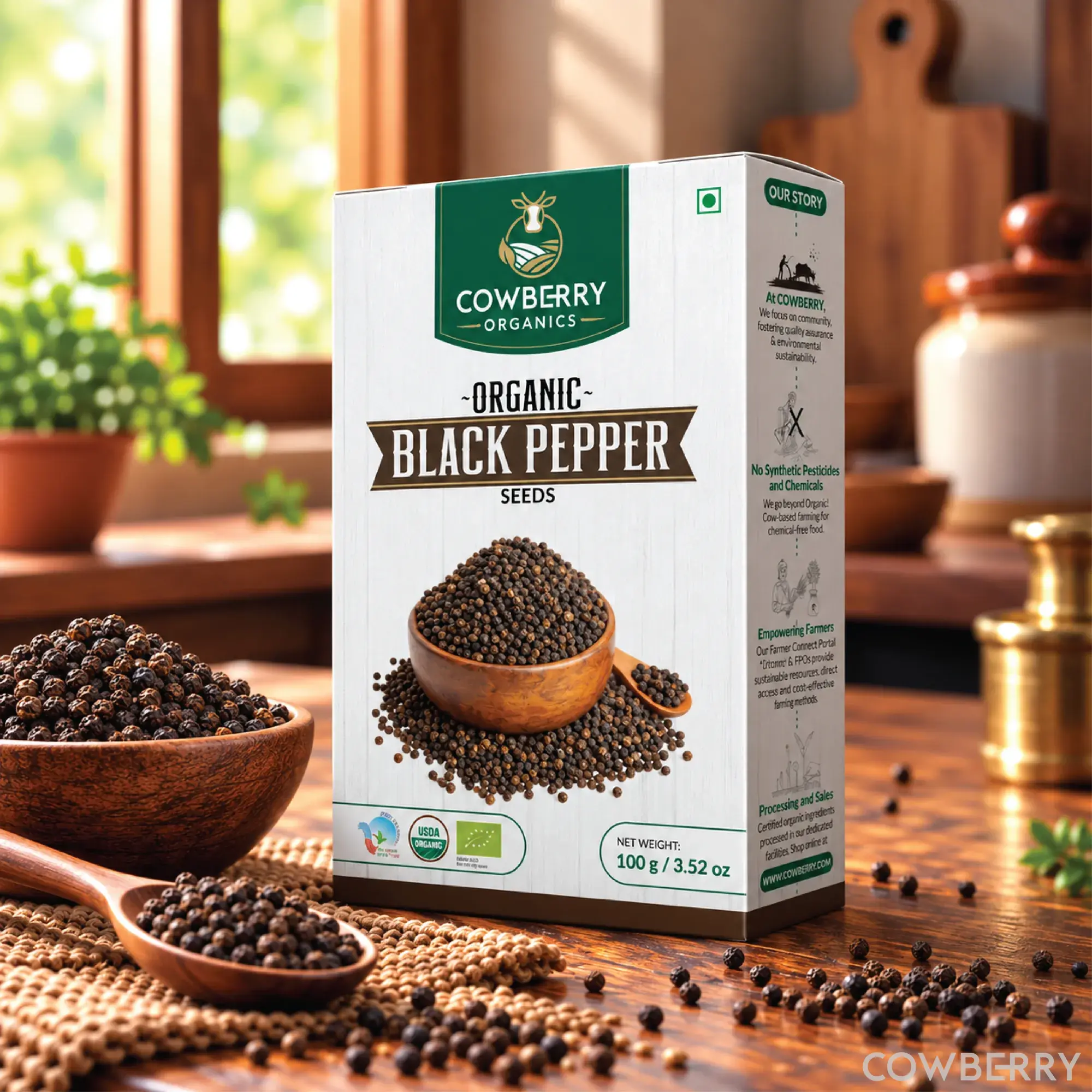
One home check costs a glass of water. FSSAI's test drops the berries into water, where pure pepper settles and papaya seeds float; the full set of checks is on the black pepper adulteration test page. That test needs whole berries, which is another reason the shopping rule above prefers them. COWBERRY's organic black pepper is India Organic, USDA & EU certified, grown on pepper vines in the Western Ghats of Kerala and packed as whole berries, so the water test works on it the day the pack opens.
FAQs
What is kali mirch?
Kali mirch is Hindi for black pepper, the dried berry of the Piper nigrum vine. IFCT 2017 prints the Hindi name as Kalimirchi, and Kali mirch is the everyday spelling of the same word. The spice's names in all 13 Indian languages are in the table above, from Gujarati Mari to Malayalam Kurumlaku.
What is black pepper powder?
Black pepper powder is the whole dried berry, ground fine; nothing is added. It is also the form that fades first, and the one more likely to be adulterated, so ICMR-NIN's advice is to buy whole, uniform spices and grind the powder yourself.
Why black pepper is called king of spices?
The 2019 systematic review opens with the phrase, describing black pepper as 'considered as the King of spices'. The grounds it gives are kitchen grounds: the spice is used around the world, adds a flavour of its own to a dish and lifts the taste of the other ingredients. The title rests on everyday use, not on any single health claim.
Does black pepper have capsaicin?
No. The compound the two black pepper reviews centre on is piperine, not capsaicin. The 2013 treatise names piperine as the spice's active ingredient, and the 2019 systematic review calls it the major bioactive compound; neither paper lists capsaicin among what black pepper contains. The two papers simply centre on a different molecule.
Can black pepper increase blood pressure?
There is no measurement either way: neither of the two black pepper reviews reports blood pressure findings in people, so neither direction is established. On the sodium side, IFCT 2017 records 24.08 mg per 100 g, which leaves the spice nearly silent in a dish's salt tally; the saltiness of a peppered meal is the cook's own doing.
Difference between black pepper and white pepper?
The difference starts from one plant: the food records for both peppers name the species Piper nigrum, so the split is in the berry. Black pepper is the dried berry in its dark, wrinkled form; white pepper is the pale version used where dark specks would show, and its taste reads as a sharper warmth with a more subtle aroma. The full comparison, numbers and all, is on the black pepper vs white pepper page.
Which black pepper is best?
The sources name no single winning variety; what they do print is a shopping checklist. ICMR-NIN advises whole, uniform spices from certified packs, and FSSAI's water test sorts the real berries from papaya seeds. Buy the whole berries, run the test, and grind your own powder. A pack that shows the certification mark answers the question before any test does.
References
- Indian Food Composition Tables (IFCT) 2017, ICMR-National Institute of Nutrition
- Dietary Guidelines for Indians, ICMR-National Institute of Nutrition
- USDA FoodData Central
- Butt MS, Pasha I, Sultan MT et al. Black pepper and health claims: a comprehensive treatise. Crit Rev Food Sci Nutr, 2013
- Takooree H, Aumeeruddy MZ, Rengasamy KRR et al. A systematic review on black pepper (Piper nigrum L.): from folk uses to pharmacological applications. Crit Rev Food Sci Nutr, 2019
- Opara EI, Chohan M. Culinary herbs and spices: their bioactive properties, the contribution of polyphenols and the challenges in deducing their true health benefits. Int J Mol Sci, 2014
- FSSAI Eat Right India: DART (Detect Adulteration with Rapid Test), salt, spices and condiments tests
Shop this article
Keep reading
Coriander water benefits: what dhania water actually does
Peanuts in Hindi (moongfali): groundnut names in Indian languages
Coriander vs cilantro: are they the same herb?