by COWBERRY

5 minute read
Kali mirch in English, Hindi and other Indian languages

Kali mirch in English is black pepper, the dried berry of Piper nigrum and the spice known as the king of spices. On this page you get every Indian name for the spice, from Hindi and Gujarati to Tamil and Malayalam, plus the full black pepper story.
Kali mirch in English and 13 Indian languages: the quick answer
Kali mirch in English is black pepper; kali mirch in Hindi is Kalimirchi, the spelling IFCT 2017 prints, and the everyday form Kali mirch is the same word. The table below lists the name IFCT 2017 records for the spice in each Indian language, with English and the botanical name at the top. Where two spellings sit in one cell, the second is the everyday spelling of the first.
| Language | Name (romanised) |
|---|---|
| English | Pepper, black |
| Hindi | Kalimirchi, Kali mirch |
| Marathi | Mire |
| Gujarati | Mari |
| Punjabi | Kalimirchi |
| Bengali | Golmarichi |
| Odia | Golomarcho |
| Assamese | Kola jaluk |
| Kannada | Kari menasu |
| Telugu | Mirayalu, Miriyalu |
| Tamil | Milagu |
| Malayalam | Kurumlaku |
| Urdu | Kaali Mirch |
| Sanskrit | Marich ushna, hapusha |
| Botanical name | Piper nigrum |
Source: IFCT 2017 (ICMR-NIN) local-names list. — means no name recorded in the source.
Hindi ‘Kali mirch’: spelling variant of the IFCT 2017 name ‘Kalimirchi’. Telugu ‘Miriyalu’: spelling variant of the IFCT 2017 name ‘Mirayalu’.
Kali mirch in English and the black pepper botanical name
IFCT 2017, the food composition tables of ICMR-NIN, records the spice under the English name "Pepper, black" with food code G031. The botanical name on the same record is Piper nigrum, the one species behind both the black and white peppercorns COWBERRY sells.
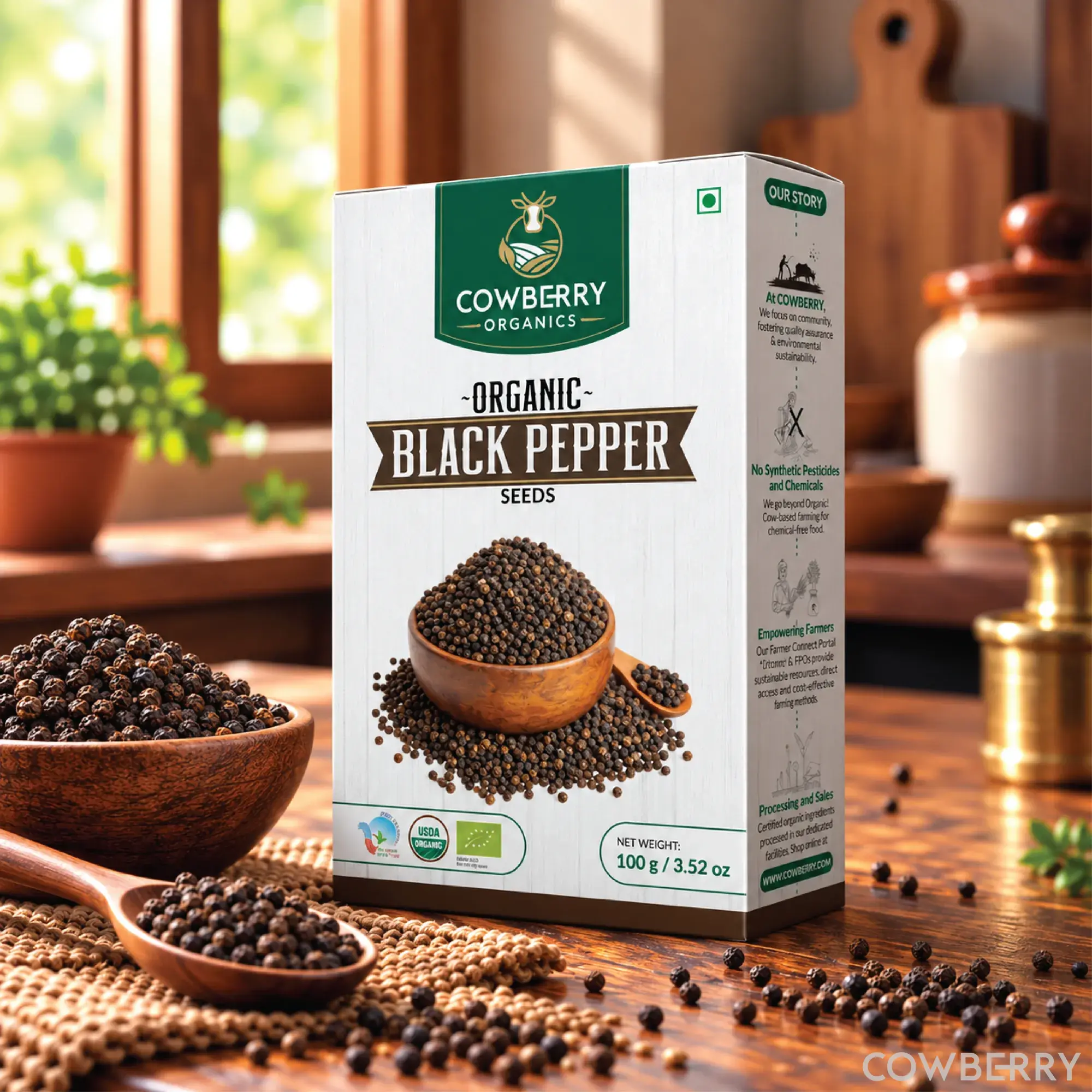
Black pepper in Hindi is Kalimirchi, also written Kali mirch and Kali mirchi, and pack listings add the trade names Tellicherry Black Pepper and Malabar Black Pepper for the same berry. The dried whole berries are what you buy as black peppercorns, and the ground form is black pepper powder.
Black pepper names by region
North India: black pepper in Hindi, Punjabi and Urdu
Hindi and Punjabi both print Kalimirchi, Urdu writes Kaali Mirch.
West India: black pepper in Gujarati and Marathi
Black pepper in Gujarati is Mari, and black pepper in Marathi is Mire. The two short names belong to the same spice.
East India: Bengali, Odia and Assamese
Bengali prints Golmarichi, Odia Golomarcho, and Assamese Kola jaluk. Golmarichi and Golomarcho are two roman spellings of one name.
South India: black pepper in Tamil, Kannada, Telugu and Malayalam
Tamil prints Milagu, Kannada Kari menasu, Telugu Mirayalu (often written Miriyalu), and Malayalam Kurumlaku.
Sanskrit
The Sanskrit record prints Marich ushna, hapusha, two Sanskrit names for the same spice.
Often confused with black pepper
Two look-alikes cause the usual mix-ups. Papaya seeds are the adulterant the FSSAI home test looks for in black pepper; how to check black pepper purity shows the water test that separates the two.
White pepper is not a different plant. Both food records name the species Piper nigrum, and the difference is the berry itself: black pepper is the dark, wrinkled berry and white pepper the pale peppercorn. The black pepper vs white pepper page lays out the full comparison, and the white pepper hub covers safed mirch on its own.
Where black pepper grows
COWBERRY's organic black pepper grows in the Western Ghats of Kerala, on land farmed without synthetic pesticides; the berries are carefully dried to retain their essential oils and packed at peak freshness. A 2019 systematic review counts India as the country with the highest number of traditional reports of Piper nigrum, for human and veterinary medicine alike.
Whole peppercorns ground at home are the start of a rasam powder recipe, and the black pepper hub links the whole cluster: nutrition, benefits, purity tests and the white pepper comparison.
FAQs
What is kali mirch called in English?
Kali mirch is called black pepper in English, and IFCT 2017 records the spice under the English name "Pepper, black". In Hindi the printed name is Kalimirchi, and Kali mirch is the everyday spelling of the same word.
What is kali mirch?
Kali mirch is the Hindi name for black pepper, the dried berry of Piper nigrum. You buy it as whole peppercorns or as black pepper powder, and whole berries stay the preferred form because ground spice is easier to adulterate; ICMR-NIN advises whole, uniform spices.
What is black pepper powder?
Black pepper powder is whole black peppercorns, ground: the same dried berry of Piper nigrum, crushed fine for quick seasoning. Powdered spices are the ones more likely to be adulterated, so ICMR-NIN says to prefer whole, uniform berries and buy certified products.
Why black pepper is called king of spices?
A 2019 systematic review calls black pepper the king of spices: it is used worldwide, adds a flavour of its own to dishes and also enhances the taste of other ingredients. The same review notes that India holds the highest number of traditional reports of Piper nigrum, for both human and veterinary medicine.
Is black pepper good for health?
Black pepper earns its place in a balanced diet rather than any single proven effect. ICMR-NIN lists pepper among the spices rich in antioxidants that can be part of a balanced diet, and the food tables give it 11.91 mg of iron and 405 mg of calcium per 100 g. Because spices are eaten in small culinary doses, a 2014 review notes their true health benefit is hard to establish; the full numbers are on the black pepper nutrition page.
Are black pepper and white pepper from the same plant?
Yes. Both the black pepper and white pepper entries in the food databases name the species Piper nigrum, so the difference is in the berry itself: black pepper is the dark, wrinkled berry and white pepper is the pale peppercorn. The black pepper vs white pepper page compares them side by side.
References
- Indian Food Composition Tables (IFCT) 2017, ICMR-National Institute of Nutrition
- Dietary Guidelines for Indians, ICMR-National Institute of Nutrition
- Takooree H, Aumeeruddy MZ, Rengasamy KRR et al. A systematic review on black pepper (Piper nigrum L.): from folk uses to pharmacological applications. Crit Rev Food Sci Nutr, 2019
- Opara EI, Chohan M. Culinary herbs and spices: their bioactive properties, the contribution of polyphenols and the challenges in deducing their true health benefits. Int J Mol Sci, 2014
Shop this article
Keep reading
Coriander water benefits: what dhania water actually does
Peanuts in Hindi (moongfali): groundnut names in Indian languages
Coriander vs cilantro: are they the same herb?