by COWBERRY

9 minute read
10 benefits of tamarind (and its side effects)

Tamarind benefits rest on two honest legs: the numbers in IFCT 2017 and what laboratory studies show. Per 100 g of pulp: 9.16 mg of iron, 149 mg of calcium, 836 mg of potassium and 5.31 g of fibre, plus antioxidant and antimicrobial findings from lab work in a 2026 review. Here are ten, then the side effects and how to eat it; the tamarind hub covers the rest.
Tamarind benefits from minerals: iron, calcium, potassium, magnesium
1. Iron: 9.16 mg per 100 g, about twice what jaggery carries
Iron is tamarind's strongest card: 9.16 mg per 100 g of pulp, roughly twice what jaggery carries, and a 10 g piece brings 0.9 mg. That is a share of iron from a souring ingredient, not a supplement, and plant iron is better absorbed with some help. The ICMR-NIN Dietary Guidelines suggest vitamin C rich fruits such as guava, pineapple and citrus, or a coriander and green chilli chutney, in the same meal, and ask that tea be avoided before, during or soon after a meal because it binds dietary iron and makes it unavailable.
2. Calcium: 149 mg per 100 g
Calcium is tamarind's second surprise: 149 mg per 100 g of pulp, and the 10 g piece in a sambar carries 15 mg of it. A souring ingredient is not a calcium food, and no guidance recommends counting on imli for it, but the mineral is in the fruit and travels with every sambar. That is what the composition shows; it is not a claim about bones.
3. Potassium: 836 mg per 100 g, beside 24.92 mg of sodium
The potassium figure is the headline mineral on this list: 836 mg of potassium per 100 g, sitting beside 24.92 mg of sodium. Read that as composition, not as medicine: no human study has shown imli lowering blood pressure. Where blood pressure is a concern, that conversation belongs with a doctor, not with a chutney ingredient.
4. Magnesium: 82.73 mg per 100 g
Magnesium follows at 82.73 mg per 100 g of pulp. Like the other minerals on this list, that is a measured amount in the fruit, not a promise about what eating the fruit does; the per-100 g numbers are averages, and a pack label may differ. The 10 g piece in a sambar carries a fraction of it all the same.
Tamarind benefits from fibre, vitamin C and the fat it does not have
5. Fibre: 5.31 g per 100 g
Tamarind brings 5.31 g of fibre per 100 g, and 0.5 g in the piece that sours a sambar. The ICMR-NIN Dietary Guidelines call dietary fibre important for proper bowel function: it slows and delays the absorption of carbohydrate and fat, and adds to a meal's satiety and to the bulk of the stools. Imli's fibre is a real part of a fibre-containing meal, even if one piece is a small part of the plate's total.
6. Vitamin C: 3.62 mg per 100 g, with 9.79 mcg of folate
Vitamin C in tamarind is small but present: 3.62 mg per 100 g, alongside 9.79 mcg of folate, and about 0.4 mg of vitamin C in a 10 g piece. Small numbers are still honest numbers: the vitamin is there to report. The dietary guidelines pair plant iron with vitamin C rich fruits, and imli is not one of them. No one should choose imli as a vitamin C source; guava, pineapple and citrus do that job better.
7. Zinc and nearly no fat
The last two entries on the nutrition side: 0.58 mg of zinc per 100 g, and fat at 0.15 g per 100 g. The fat figure matters in the kitchen — tamarind sours dal, rasam and curries without adding richness; the fruit's own energy comes from carbohydrate rather than fat. Zinc is a small bonus from the same pulp.
What the 2026 review found: tamarind compounds in the laboratory
8. Flavonoids, tannins and saponins: antioxidant findings from the lab
A 2026 review in Nutrients describes the tamarind fruit as containing flavonoids, tannins, alkaloids and saponins. Experiments on these compounds report free radical scavenging activity and improved antioxidant enzyme activity, in laboratory and preclinical work. Their scope matters: these are findings about compounds in experiments, not measurements of health in people eating tamarind.
9. Antimicrobial and anti-inflammatory effects, in the same lab frame
The same review reports antimicrobial effects for tamarind compounds, and a damping of pro-inflammatory mediators — again in laboratory and mechanistic studies. Read both as directions the research is exploring, not as reasons to dose yourself with imli. The review summarises what the fruit's compounds can do in an experiment; it does not set a medicinal use in people.
10. Regulation of lipid metabolism genes, and why that is not a fat burner
The review also reports changes in the expression of lipid metabolism genes. Notice what that phrase is not: it is gene expression shown in laboratory and preclinical settings, not a measurement of body weight in humans, and no trial in people links eating tamarind with weight loss. Claims that sell imli as a fat burner stretch this finding far beyond what it showed; the honest read of the weight-loss question is on the tamarind for weight loss page.
Why tamarind benefits are hard to prove
Every benefit above has the same honest tail: tamarind is eaten in small amounts, with other foods, and that is exactly the situation a 2014 review on culinary herbs and spices describes when it says their true health benefit is hard to establish. A 2008 paper on traditional Indian spices makes the same point from the Indian side: current research is working to give the traditional uses science-based evidence. A 10 g piece in a sambar, or a spoonful of imli chutney, is the real-life amount.
None of this makes tamarind useless; it makes it a food. The 2026 review closes with the fruit's composition, mode of action and safe use, and the safe-use framing is the sensible one for a souring ingredient. Expect composition from imli, not medicine.
Tamarind and imli side effects: what to watch and who should limit it
The side effects worth naming are mostly about the sweetened forms. Candied imli, imli candy and sweet chutneys pile jaggery or sugar onto a pulp that already holds 67.35 g of carbohydrate per 100 g; one tablespoon of the imli chutney recipe is about 21 kcal, mostly the 5.1 g of carbohydrate. Eaten as a daily snack, that energy adds up; used as a chutney, it is a condiment.
On acidity, the honest answer is that no study confirms that imli causes acidity. The fruit is sour, so anyone who finds sour foods uncomfortable tends to keep the quantity small, and how your stomach responds is individual. During pregnancy, no human study has shown tamarind causing miscarriage, but a doctor is the right judge for your own pregnancy. The plain block has nothing added; it is the preparations around it that carry the additions. If your meals follow a medical plan, or you are managing blood pressure or diabetes, talk to your doctor or dietitian about where tamarind and its sweetened companions fit.
How much imli per day: imli benefits come in cooking amounts
No dietary guidance gives a daily amount of tamarind, so no number should be read as a dose. What exists are cooking amounts: one 10 g piece, soaked and squeezed, sours a sambar or curry for four, and carries 28.9 kcal. A spoonful of imli chutney adds about 21 kcal to a plate. That is the whole dosing guide: the amount is set by the dish, and the fruit asks nothing more of you.
If you eat imli daily in sambar or rasam, that is daily tamarind in the amounts Indian cooking normally uses, and no dietary guidance sets a ceiling on it. What the review's safe-use framing suggests is simply this: keep it a food, in food amounts.
How to eat tamarind: rasam, chutney and sambar
Tamarind does the souring in Indian cooking: rasam and sambhar, chutneys, curries and dals, plus marinades and sauces all lean on it. To eat it, you soak it: the soaking and squeezing method, from warm water to pressing out seeds and fibre, is on the tamarind how to use page, and keeping the block fresh for months is on tamarind how to store. The two recipes that show it best are tomato rasam, where a 10 g piece of tamarind sours the pot, and imli chutney, which balances 100 g of tamarind with 100 g of jaggery.
Run out of tamarind? The tamarind substitute page has the swaps, and the tamarind hub gathers names, nutrition and the rest of the fruit's story. For the Hinglish version of this page, see imli ke fayde.
FAQs
What is imli good for?
Imli is good for souring food, and it travels with real nutrients: per 100 g of pulp, 9.16 mg of iron, 149 mg of calcium, 836 mg of potassium and 5.31 g of fibre (IFCT 2017). The lab findings — antioxidant, antimicrobial and anti-inflammatory — come from a 2026 review and are preclinical. In cooking amounts, the honest claim is composition and flavour.
Is imli bad for health?
Plain imli is not bad for health; the real concern is usually the sweetened forms. Imli chutney, candied imli and imli candy add jaggery or sugar to a pulp that already holds 67.35 g of carbohydrate per 100 g. A tablespoon of the imli chutney recipe is about 21 kcal. Eaten daily as a snack, the energy adds up; eaten as a chutney, it is a condiment.
Why tamarind is good for health?
Because of what is measured in it, not because of a trial. The pulp carries 9.16 mg of iron, 149 mg of calcium, 836 mg of potassium and 5.31 g of fibre per 100 g (IFCT 2017), and a 2026 review reports antioxidant and antimicrobial findings for its compounds from laboratory work. Eaten in small cooking amounts, its benefit is hard to pin down; the full list is in the sections above.
Which tamarind is good for health?
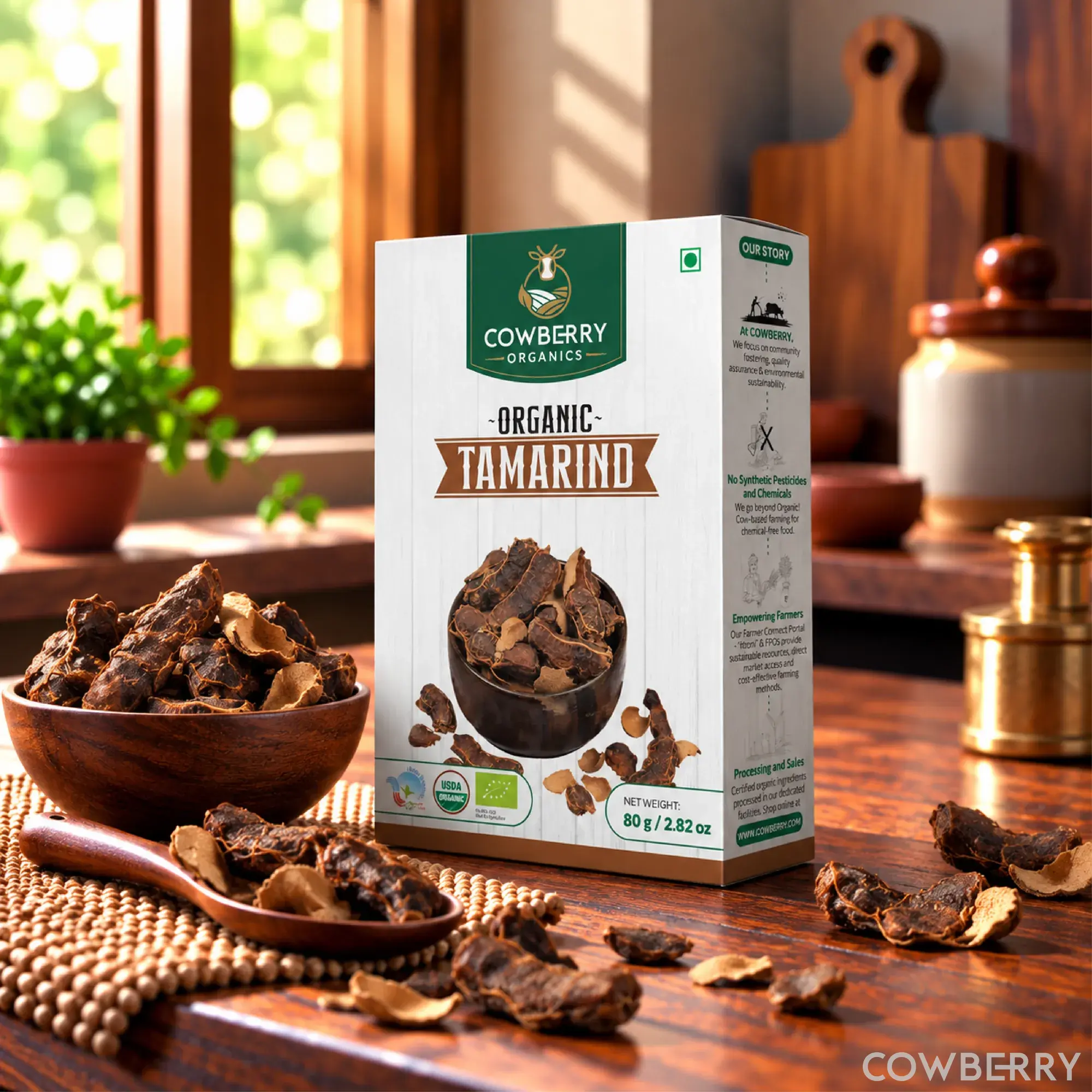
The plain block. Additive-free tamarind is simply the fruit's pressed pulp, while many imli products add sugar, salt or preservatives, and the sweetened forms are where the extra energy sits. Look for a pack with no additives and preservatives, like COWBERRY's, and use the pulp in cooking amounts.
Why imli is good for girls?
The useful answer is the iron: imli carries 9.16 mg of iron per 100 g, and a 10 g piece brings 0.9 mg. No study singles out imli as a girl-specific food, and the review's findings are preclinical, so the honest read is the same for everyone: a souring fruit with real iron.
References
- Indian Food Composition Tables (IFCT) 2017, ICMR-National Institute of Nutrition
- Dietary Guidelines for Indians, ICMR-National Institute of Nutrition
- Martinez CR, Diaz YA, Cianciosi D et al. The Health Benefits of Tamarindus indica: A Focus on the Relationship Between Phytochemical Composition and Physiological Effects. Nutrients, 2026
- Opara EI, Chohan M. Culinary herbs and spices: their bioactive properties, the contribution of polyphenols and the challenges in deducing their true health benefits. Int J Mol Sci, 2014
- Krishnaswamy K. Traditional Indian spices and their health significance. Asia Pac J Clin Nutr, 2008
Shop this article
Keep reading
Coriander water benefits: what dhania water actually does
Peanuts in Hindi (moongfali): groundnut names in Indian languages
Coriander vs cilantro: are they the same herb?