by COWBERRY

7 minute read
Sona masoori rice benefits and side effects: is it good for health?

Sona masoori rice benefits are everyday-grain benefits: 357 kcal and 78.24 g of carbohydrate per 100 g for meal energy, 0.52 g of fat and 2.34 mg of sodium, a light, non-sticky texture and a 12 to 15 minute cook. What the sources support, the side effects to watch and how the daily amount fits the guidelines follow; the sona masoori rice guide covers the grain's wider story.
What sona masoori rice is good for: benefits that hold up
The honest list is short, and every item hangs on a number. Energy first: 357 kcal per 100 g, nearly all of it from 78.24 g of carbohydrate — the energy a meal supplies. Then what the grain is low in: 0.52 g of fat and 2.34 mg of sodium per 100 g, with no additives or preservatives, a feature COWBERRY lists. And the texture side: light and non-sticky, slender and fluffy, soft and aromatic — the features COWBERRY lists for the grain — a rice that suits children and elderly family members, in the product page's own words.
None of this makes the grain a medicine — no rice is one. What it makes sona masoori is a clean everyday staple: plain, quick at 12 to 15 minutes on the stove, and gentle enough in taste to carry dal, sambar, rasam and curd without fighting them.
Gluten-free, light and quick: the everyday advantages
Gluten is the protein found in wheat, barley and rye, the three cereals the NHS names for coeliac disease; rice is not among them. COWBERRY's product page states this grain is naturally gluten-free. That, with the light, non-sticky cook, fits the two groups the product page names: children and elderly family members.
The everyday advantage is practical rather than clinical: the grain cooks in 12 to 15 minutes, and its soft, separate grains make dal-chawal, curd rice and tiffin-style meals simple. The ratios and whistles are on how to cook sona masoori rice.
Sona masoori rice glycemic index: the number behind the health question
The variety has one tested entry, and it reads 72 — the Shobana study cooked the rice in a rice cooker for 35 minutes in India and tested it on 23 people (2012). The University of Sydney scale classes 70 and above as high, so the grain sits in the high band, and a 2023 Foods review notes that rice is typically regarded as a high or medium-high GI food. That is the honest answer to "is sona masoori rice healthy": healthy in a measured katori with dal and sabzi, not in free helpings.
The 2022 BMJ Open meta-analysis pooled eight cohort studies and put the risk side in numbers: heavy white rice eating was associated with higher diabetes risk at the extremes of intake (pooled relative risk 1.16), the association growing with the dose once intake passed roughly 300 g a day, at 13 percent more for each added 158 g a day serving; brown rice pointed the other way (relative risk 0.89). The review covered white rice in general, not this variety, and the answer it supports is portion and pairing, not avoidance. The numbers behind that caution sit on the is sona masoori rice good for diabetes page.
Sona masoori rice side effects and who should limit it
The side effects are portion effects. Because the grain's 72 lands in the high band, a large helping lifts blood glucose more than a katori with dal and sabzi does — 31.3 g of carbohydrate in one katori against 62.6 g in two. Anyone managing diabetes should count the katori into the day's carbohydrate and agree the portion with a doctor; medication and insulin questions are the doctor's, not the pantry's — talk to your doctor or dietitian.
Two other limits are structural. Fibre: 2.81 g per 100 g is small next to brown rice's 4.43 g, so a week of rice-only meals misses the whole-grain share the guidelines ask for — at least half of daily cereals, minimally polished. Protein: 7.94 g per 100 g, and cereal protein is short on lysine, which pulses carry — the pairing the guidelines describe for rice and dal. Neither limit is a reason to drop the grain; both are reasons to rotate it with brown rice, millets and whole wheat.
How much sona masoori rice a day?
The guidelines' My Plate for the Day works from 250 g of cereals for the whole day — a figure rice splits with rotis, millets and every other grain, never a rice-only allowance. In katori terms, each katori of cooked rice begins from 40 g of the raw grain: 143 kcal and 31.3 g of carbohydrate; even two katoris — 80 g of raw grain, about 62.6 g of carbohydrate and 286 kcal — leave most of that 250 g budget for other grains.
Daily use sits inside that frame: the grain is low in fat (0.52 g per 100 g) and sodium (2.34 mg per 100 g), and its light cook suits everyday meals. The guidelines print no rice-only amount, so ask your doctor or dietitian what portion suits you; rotate grains across the week so the fibre the rice lacks comes in from elsewhere.
How to eat sona masoori rice for its benefits
Pair it. The classic plate — rice, dal, sabzi — is the benefit plan: dal supplies the lysine the grain's protein is short on, and vegetables add the fibre the guidelines say slows carbohydrate absorption. Then vary it: dosa and idli ferment the grain into batter, curd rice cools it into a light meal, coconut rice and puliyogare dress it up, and ven pongal cooks it soft with moong dal. All of these recipes on this site are built on sona masoori.
For the per-100 g table behind every number above, see the sona masoori rice nutrition page, and for the grain's story — names, storage, buying — the sona masoori rice guide.
FAQs
Is sona masoori rice good for health?
Yes, as an everyday staple with portion and pairing in mind — not as a health food. Each 100 g holds 357 kcal, 78.24 g of carbohydrate, 0.52 g of fat and 2.34 mg of sodium, and its tested GI of 72 lands in the high band, so the health answer rides on the katori size and what shares the plate.
Is sona masoori rice healthy?
Healthy is the plate, not the grain alone. The variety's only tested GI, 72, lands in the high band, and a 2022 meta-analysis found heavy white rice eating was associated with a higher diabetes risk, so the healthy version is a counted katori with dal and vegetables, eaten in rotation with brown rice and millets.
Is sona masoori rice good for daily use?
Yes — it is an everyday rice, and its low fat (0.52 g per 100 g) and low sodium (2.34 mg per 100 g) fit an everyday plate. The guidelines print no rice-only amount, so ask your doctor or dietitian about portion; pair it with dal and sabzi, and rotate whole grains in across the week so the fibre the rice lacks arrives from elsewhere.
Can we eat sona masoori rice daily?
Yes, within the cereals budget: the guidelines' daily plate is built on 250 g of cereals, with rice, rotis and millets sharing that figure. One katori of sona masoori is 143 kcal and 31.3 g of carbohydrate, so it uses only part of that figure, and the remaining cereals come from other grains. Ask your doctor or dietitian what amount suits you.
What is sona masoori rice good for?
Everyday meals: dal-chawal, curd rice, lemon rice, pongal, dosa and idli batters — a light, non-sticky grain that cooks in 12 to 15 minutes. With 357 kcal and 78.24 g of carbohydrate per 100 g, it is a compact energy staple, and its gentle, clean flavour lets dal and sabzi lead the plate.
Is sona masoori rice good to eat?
Yes — soft, aromatic and light, as COWBERRY lists the grain, and quick at 12 to 15 minutes. Eaten in a counted katori with dal and vegetables it is good everyday food; eaten in double helpings with a fried side, it is still just white rice, so the portion stays the point.
References
- Indian Food Composition Tables (IFCT) 2017, ICMR-National Institute of Nutrition
- Dietary Guidelines for Indians, ICMR-National Institute of Nutrition
- University of Sydney glycemic index database (GI search)
- University of Sydney: about the glycemic index
- Shobana S, Kokila A, Lakshmipriya N, et al. Glycaemic index of three Indian rice varieties. Int J Food Sci Nutr, 2012
- Yu J, Balaji B et al. White rice, brown rice and the risk of type 2 diabetes: a systematic review and meta-analysis. BMJ Open, 2022
- Ngo TV, Kunyanee K et al. Insights into recent updates on factors and technologies that modulate the glycemic index of rice and its products. Foods, 2023
- NHS: coeliac disease
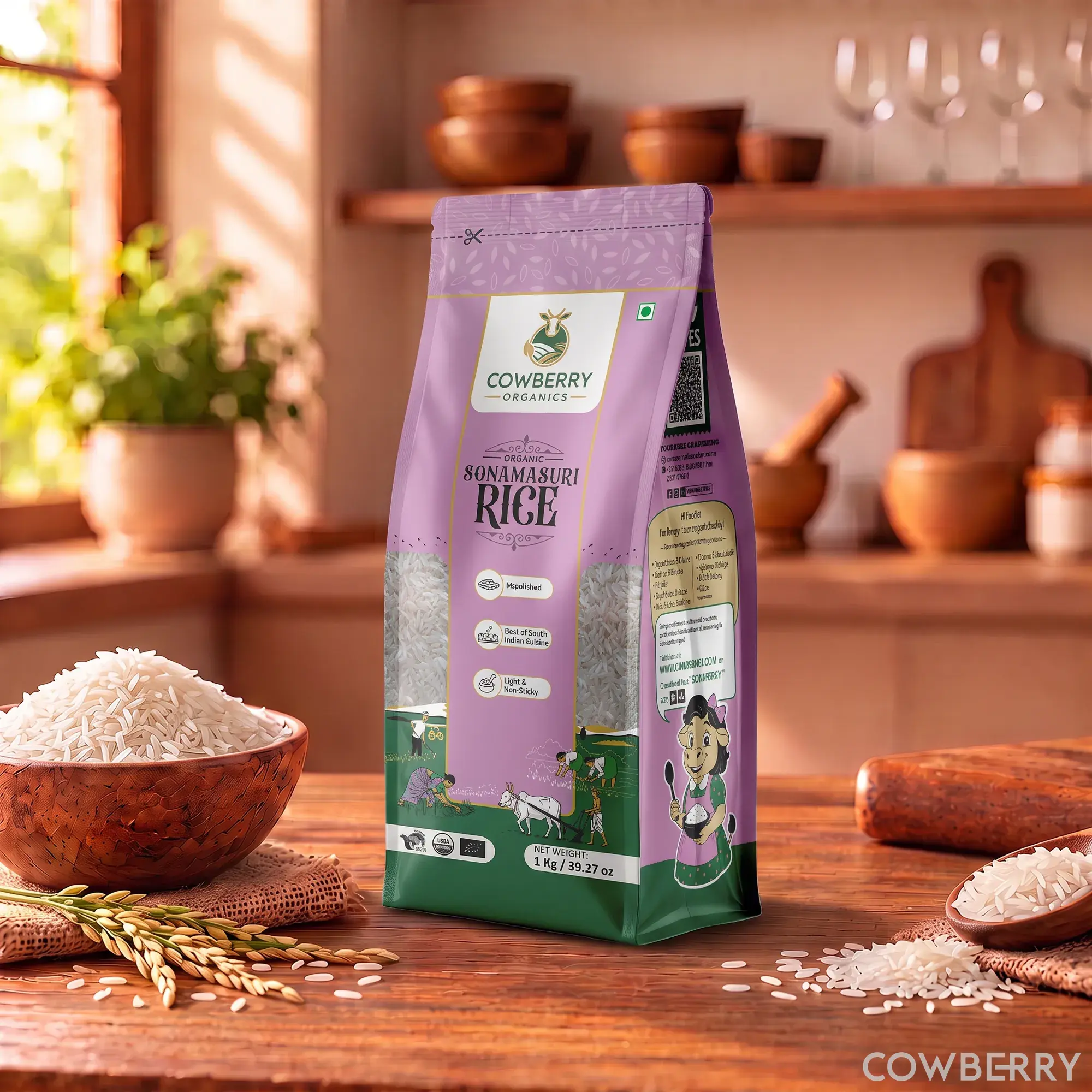
Shop this article
Keep reading
Red rice vs brown rice: the fibre, GI and honest verdict
Red rice vs black rice: nutrition, glycemic index and which to choose
Red rice nutrition per 100g: calories, protein, fibre and GI