by COWBERRY

9 minute read
Chilli powder benefits and side effects: lal mirch, red chilli

Chilli powder benefits split into what the numbers show and what research has not yet shown. Per 100 g, dry red chilli holds 12.69 g protein, 31.15 g fibre and 2245 mg potassium (IFCT 2017); a level teaspoon of powder, about 2.5 g, is 5.9 kcal on those figures. Below: each benefit with its source, side effects, daily amount and uses; the dry chilli hub covers names, storage and buying.
The evidence behind the benefits of chilli powder
Two reviews frame everything on this page. Opara and Chohan, reviewing culinary herbs and spices in the International Journal of Molecular Sciences in 2014, put the honesty on record: because people eat these seasonings in small amounts alongside other dishes, the review calls their true health benefit unclear. Krishnaswamy's 2008 overview of traditional Indian spices in the Asia Pacific Journal of Clinical Nutrition gives the standing: India is known the world over for its spices, and the biomedical work on them today tries to base the traditional uses on scientific evidence.
What follows keeps that frame. The benefits that hold are the printed numbers from IFCT 2017, the chemistry of the burn, and the kitchen uses; where the research is laboratory-only, the sentence says so in the same breath. No dose for any condition appears on this page, because neither IFCT 2017, the ICMR-NIN guidelines nor the reviews prints one.
Chilli powder benefits, one nutrient at a time
Fibre: 31.15 g per 100 g, 0.8 g per teaspoon
Dry red chilli holds 31.15 g of total fibre per 100 g (IFCT 2017), a strong figure on paper. On the plate it shrinks with the dose: a level teaspoon of chilli powder, about 2.5 g, carries 0.8 g. The Dietary Guidelines for Indians credit dietary fibre with holding back the uptake of carbohydrate and fat and with adding to satiety, but they write that about fibre foods eaten in bowls, not pinches; the teaspoon's share is a small extra, not a plan.
Potassium: 2245 mg per 100 g, with almost no sodium
Potassium is 2245 mg per 100 g and sodium just 19.45 mg, so a teaspoon brings about 56 mg of potassium and a bare 0.5 mg of sodium. In kitchen terms, lal mirch adds heat and colour while bringing almost no salt of its own; the salt in a spicy dish is the cook's hand, not the chilli's.
Iron and calcium: small extras, not a strategy
The card prints 6.23 mg of iron and 99.83 mg of calcium per 100 g; per teaspoon that is 0.16 mg and 2.5 mg. ICMR-NIN's pairing advice sits iron-rich plant foods beside vitamin C sources, naming fruits and coriander-and-green-chilli chutneys, since the vitamin C helps the iron get in; red chilli lends such a meal its colour, but the iron comes from the plant foods in it.
Protein: 12.69 g per 100 g, 0.3 g per teaspoon
Protein is 12.69 g per 100 g (IFCT 2017), which reads well until the dose is weighed: a teaspoon delivers 0.3 g. Red chilli seasons the dal or the egg that carries the protein; it is not a protein source itself.
Vitamin C: not printed for the dry chilli
IFCT 2017 prints no vitamin C value for dry red chilli, so no vitamin C claim is made for the powder.
Capsaicin: the burn, and what researchers are studying
Capsaicin is the major active constituent of chilli, as a 2018 review in Nutrients (Panchal and colleagues) records, and its principal pungent component in hot peppers, as a 2011 review in Cancer Research (Bode and Dong) records. It acts on a receptor called TRPV1; Bode and Dong describe the compound as unique among naturally occurring irritants, because the initial excitation of neurons it evokes is followed by a long-lasting refractory period. That pungency, the burn, is the one effect everyone can verify at the table.
The 2018 review then sets out what the research shows so far: TRPV1 sits on many metabolically active tissues, which makes it a potentially relevant target, and in vitro and pre-clinical studies have found effects of low-dose dietary capsaicin against metabolic disorders in models. The same review is explicit about the gap: identifying suitable ways of administering capsaicin at an effective dose is what would warrant its clinical use. In plain words, the metabolic findings are being studied in the laboratory and in animals; neither review reports a finding about weight or blood sugar in people.
Capsaicin and cancer: the two faces
The 2011 review is titled "The two faces of capsaicin" for a reason: conflicting epidemiologic data and basic research results suggest that capsaicin can act as a carcinogen or as a cancer-preventive agent. The review's evidence is conflicting epidemiologic data and basic research results, so it gives no verdict about chilli and cancer, and none follows for a pinch in food.
The review's own caution concerns creams, not food. In its authors' experiments, chronic long-term topical application of capsaicin increased skin carcinogenesis in mice that were also given a tumour promoter, and they suggest caution with capsaicin-containing topical applications in the presence of a tumour promoter such as sunlight. What a kitchen can take from all this is that the question is open.
Chilli powder side effects: who should limit it
None of the sources in the references prints side effects from eating chilli in food, so what follows sticks to what they do print and to plain kitchen sense.
- The burn. Capsaicin is the compound behind the pungency. If a dish burns your mouth, the fix is less chilli, and the same goes for anyone who simply does not enjoy the heat.
- Stomach discomfort. Whether chilli causes acidity is not answered by any of the sources in the references. A heavily spiced, oily dish can leave anyone uncomfortable; if chilli regularly brings heartburn or stomach pain, use less, and talk to your doctor or dietitian if it keeps happening.
- Creams, not food. Capsaicin creams have been in clinical use for many years for painful conditions, but their effectiveness is debated and some adverse effects have been reported (the 2011 review). That is about topical products, not about eating chilli.
- Blood pressure. None of the sources in the references prints a blood-pressure effect for chilli in either direction. The relevant number is sodium: 19.45 mg per 100 g, or 0.5 mg in a teaspoon, so the salt in a spicy meal comes from the cook, not the spice.
- Adulteration, the documented risk. ICMR-NIN notes that powdered spices are more likely to be adulterated, and the FSSAI DART manual gives the home check: powder sprinkled on water that throws colour streaks downward carries artificial colour, and sawdust floats while real chilli settles.
If your meals follow a medical plan, or chilli regularly disagrees with your stomach, talk to your doctor or dietitian before making it a bigger part of your food.
How much red chilli per day
No source prints a daily amount for red chilli: not IFCT 2017, not the ICMR-NIN guidelines, not the reviews, so this page sets none. A level teaspoon of powder weighs about 2.5 g and adds 5.9 kcal; use it for taste and heat. If a medical plan or your stomach limits spicy food, ask your doctor or dietitian how much suits you. The full per-teaspoon arithmetic is on the red chilli nutritional value per 100g page, and the same page in Hindi, lal mirch khane ke fayde, carries the same numbers.
Uses of chilli powder: whole, ground and the recipes
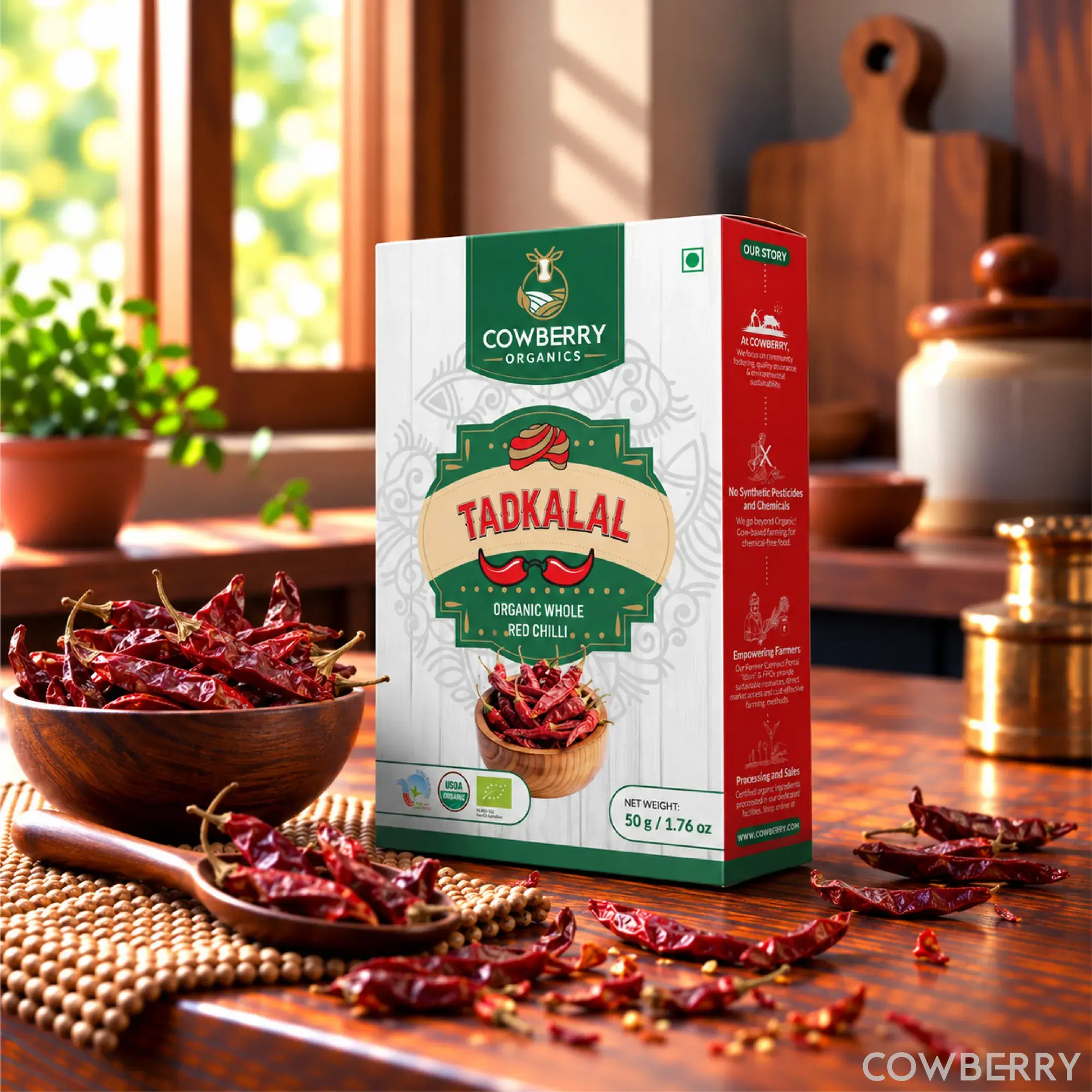
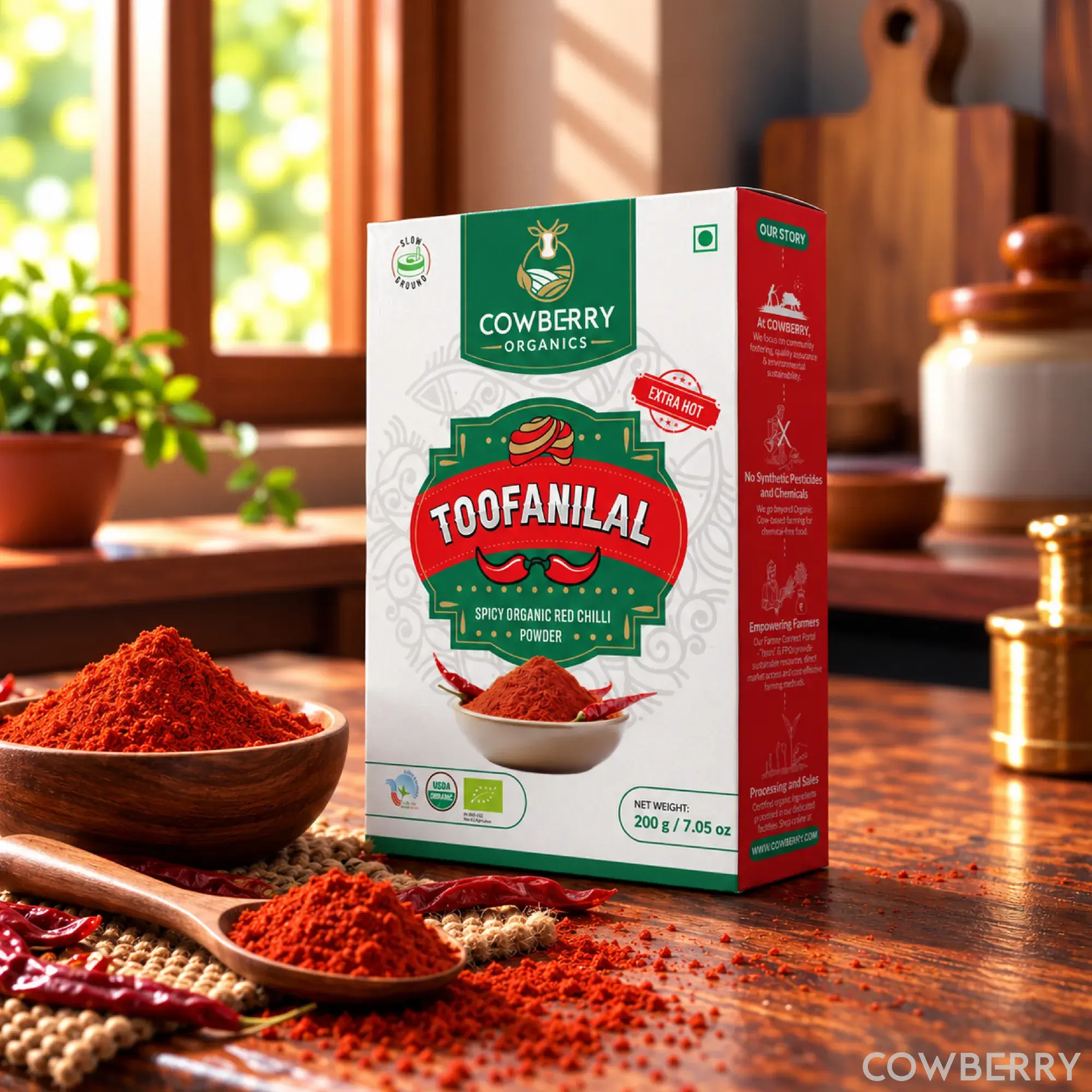
Whole dry red chillies are the tadka spice: dropped into hot oil for tempering, stirred into curries, and packed into pickles, chutneys and spice blends; a home cook can dry-roast and grind fresh powder from them. The powder goes into soups, stews and curries for colour and heat. Those are the uses printed on COWBERRY's pages for its whole Guntur chillies and its chilli powder.
A recipe that uses whole chillies end to end is idli podi, which roasts them with urad dal and sesame in one pan, and making the powder yourself follows the roast, cool and grind method set out in this guide: how to make kashmiri lal mirch powder. For the milder, deep-red end of the shelf, the kashmiri lal mirch vs lal mirch page sets out the heat-and-colour split.
For buying, two rules from the guidelines and FSSAI: whole spices over powders, since powders are the form adulteration picks first, and certified packs; the chilli packs at COWBERRY show the India Organic, USDA & EU certified line on the label. Names, storage and the full buying notes are on the dry chilli hub.
FAQs
Is red chilli powder good for health?
As a seasoning in kitchen amounts, yes: it adds heat and colour for about 5.9 kcal a teaspoon (2.5 g), with 0.8 g of fibre and 56 mg of potassium. As a remedy, it is unproven: the metabolic findings are in vitro and pre-clinical, and none of the sources in the references prints a health effect measured in people. Eat it for taste, in amounts your stomach is happy with.
Why red chilli is not good for health?
The honest negatives are few and mild. The burn is real, because capsaicin is an irritant that excites neurons, and a heavily spiced, oily dish can leave a sensitive stomach uncomfortable; none of the sources in the references measures chilli and acidity. None of them measures harm or benefit from chilli eaten in food either, so the rule is amounts that suit your own plate.
Can red chilli cause acidity?
None of the sources in the references answers that question, and no yes or no is invented. What they do print is the mechanism of the burn: capsaicin activates TRPV1, and its initial excitation of neurons is the pungency. If chilli regularly brings on heartburn, use less or leave it out of that dish, and talk to your doctor or dietitian if it keeps happening.
Does red chilli increase blood pressure?
The sources in the references print no blood-pressure effect for chilli, up or down. The one relevant number is sodium: 19.45 mg per 100 g, which is 0.5 mg in a level teaspoon, so a spicy dish's salt comes from the cook, not from the chilli. Anyone asked to watch salt can season with the powder and mind the salt jar separately.
Is lal mirch good for health?
Lal mirch is dry red chilli, so the answer matches the powder: fine as a seasoning, unproven as a remedy. Per 100 g it gives 12.69 g protein, 31.15 g fibre and 2245 mg potassium (IFCT 2017), in tiny per-teaspoon amounts. The same numbers in Hindi are on lal mirch khane ke fayde.
Is kashmiri red chilli powder good for health?
IFCT 2017 prints one entry, chillies red, and no separate kashmiri chilli entry, so no different numbers exist for it and the honest answer is the same as for any red chilli powder. What changes is the heat: the kashmiri-style chilli is recorded as mild and deep red. The side-by-side is on kashmiri lal mirch vs lal mirch.
References
- Indian Food Composition Tables (IFCT) 2017, ICMR-National Institute of Nutrition
- Dietary Guidelines for Indians, ICMR-National Institute of Nutrition
- Panchal SK, Bliss E, Brown L. Capsaicin in Metabolic Syndrome. Nutrients, 2018
- Bode AM, Dong Z. The two faces of capsaicin. Cancer Res, 2011
- Opara EI, Chohan M. Culinary herbs and spices: their bioactive properties, the contribution of polyphenols and the challenges in deducing their true health benefits. Int J Mol Sci, 2014
- Krishnaswamy K. Traditional Indian spices and their health significance. Asia Pac J Clin Nutr, 2008
- FSSAI Eat Right India: DART (Detect Adulteration with Rapid Test), salt, spices and condiments tests
Shop this article
Keep reading
Coriander water benefits: what dhania water actually does
Peanuts in Hindi (moongfali): groundnut names in Indian languages
Coriander vs cilantro: are they the same herb?