by COWBERRY

10 minute read
Dry chilli (red chilli): names, nutrition, benefits and how to use it

Dry chilli is the everyday red spice of Indian kitchens, sold whole or ground into powder. This page gathers the whole subject: what dry chilli is, its names in Indian languages, per-100 g nutrition, what the evidence shows and does not, kashmiri and byadgi varieties, cooking uses, storage and buying. Everything in one place, with IFCT 2017 behind the figures.
What is dry chilli
Dry chilli is the ripened red chilli, dried: the fruit of Capsicum annum, which IFCT 2017 files under food code G022 as chillies, red. Drying turns the fresh fruit into the pantry spice, and after that it is sold either whole or milled into powder; both forms start from the same crop and keep the same per-100 g figures, because IFCT 2017 records one food, not two. The powder is that same food ground fine, with nothing added. That single entry is also why the kashmiri chilli, the byadgi chilli and the everyday Guntur chilli all read the same numbers on a nutrition card: IFCT 2017 records the dried red spice once, and every variety sits inside it. The spice keeps one name across many Indian kitchens, lal mirch in Hindi and Mirchi in IFCT 2017's tables, and the sections below walk through the names, the numbers, the evidence and the uses in turn.
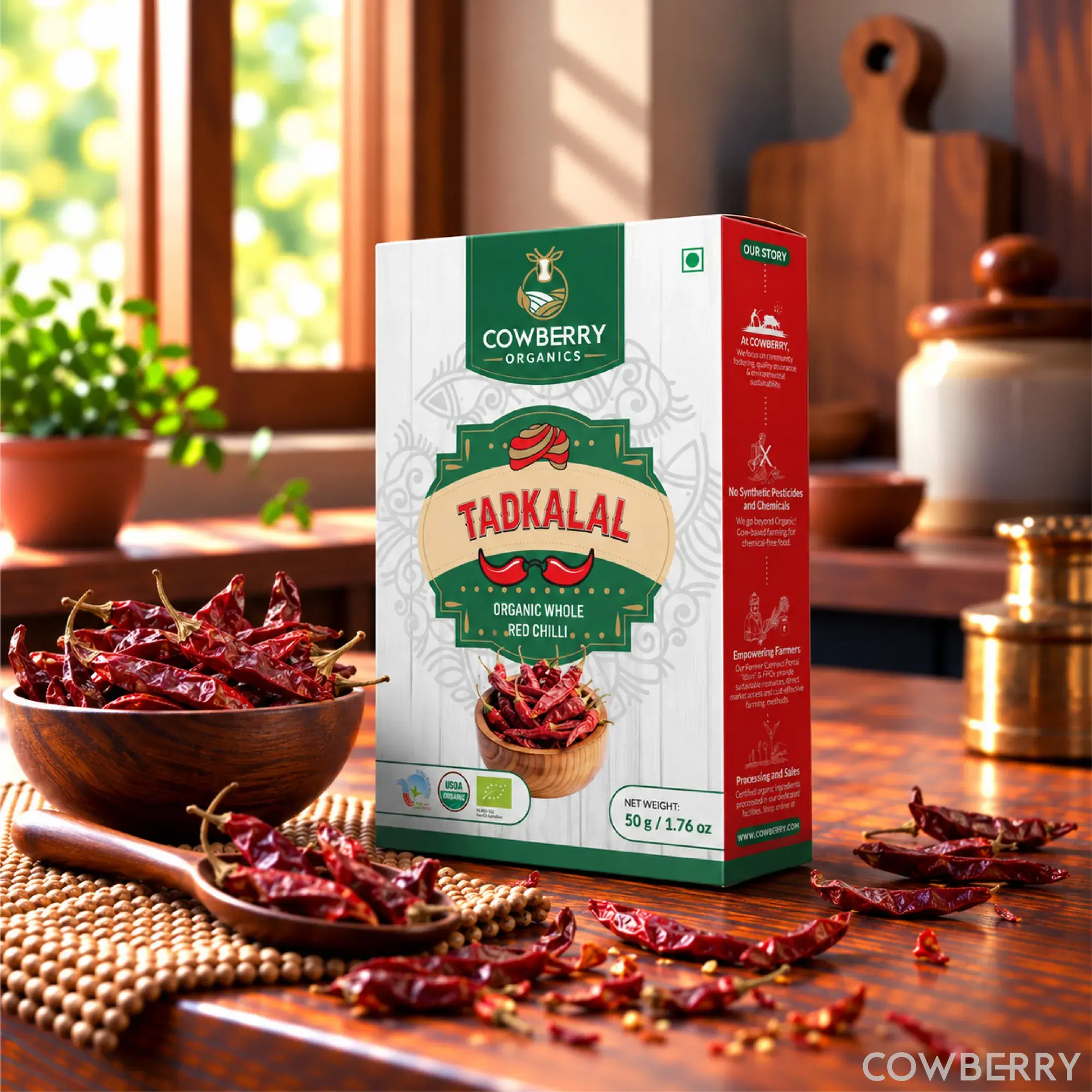
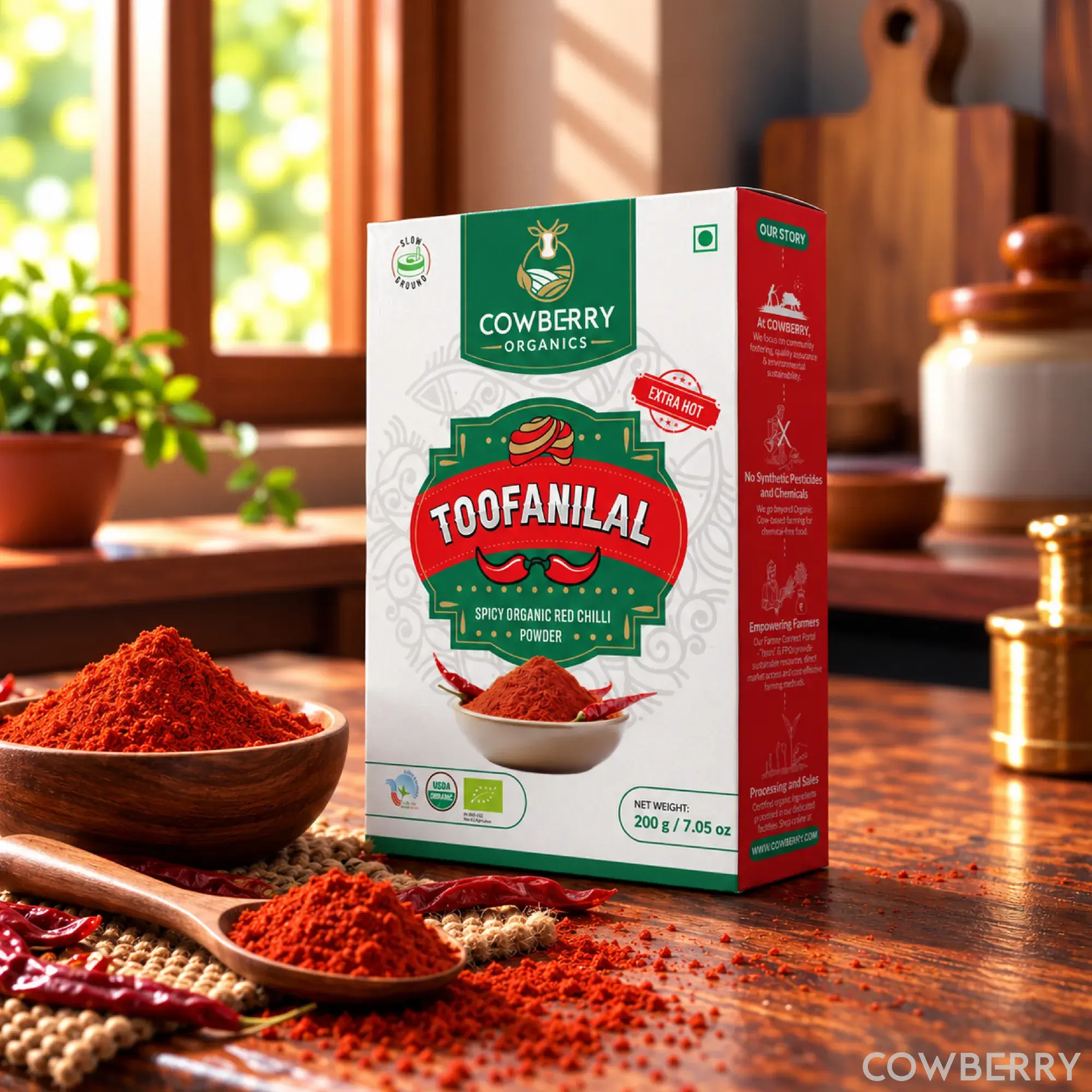
COWBERRY's shelf shows the pair. The whole form is its Guntur chilli, from Andhra Pradesh, hand-harvested at full maturity and naturally sun-dried, sold for tadka and everyday cooking. The powder is its Toofanilal, combining Guntur chillies with the mild Kashmiri-style crop grown in Himachal Pradesh's high-altitude valleys; both are sun-dried, and the powder is finely ground, with no artificial colours. Both packs carry the line India Organic, USDA & EU certified. In Hindi the spice is lal mirch; the full name list follows.
Names of dry chilli in Indian languages
IFCT 2017 prints the local names for food code G022, and they are the ones shoppers actually meet. Hindi calls it Mirchi and Urdu Lal mirchi; Marathi and Malayalam share Mulaku; Telugu says Mirapakaya, Tamil Varamilagai and Kannada Ona Menasinakayi; Odia has Lanka, Bengali Shuckhuo Lonka, Assamese Sukan jolokia, Punjabi Lal mircha and Gujarati Lal marcha (sukha); Sanskrit prints nothing. Indian English also uses the Hindi pair, lal mirch. The language-by-language story is on lal mirch in english.
| Language | Name (romanised) |
|---|---|
| English | Chillies, red |
| Hindi | Mirchi |
| Marathi | Mulaku |
| Gujarati | Lal marcha (sukha) |
| Punjabi | Lal mircha |
| Bengali | Shuckhuo Lonka |
| Odia | Lanka |
| Assamese | Sukan jolokia |
| Kannada | Ona Menasinakayi |
| Telugu | Mirapakaya |
| Tamil | Varamilagai |
| Malayalam | Mulaku |
| Urdu | Lal mirchi |
| Sanskrit | — |
| Botanical name | Capsicum annum |
Source: IFCT 2017 (ICMR-NIN) local-names list. — means no name recorded in the source.
Dry chilli nutrition per 100 g
The table below sets dry red chilli beside cumin seeds and black pepper, two everyday neighbours in the spice shelf, so the numbers are read against neighbours rather than in a vacuum, the way a masala dabba keeps them. The headline lines: 237 kcal, 12.69 g protein, 6.4 g fat, 29.46 g carbohydrate and 31.15 g fibre per 100 g, with 2245 mg of potassium and just 19.45 mg of sodium (IFCT 2017).
Two blanks stay blank: IFCT 2017 leaves vitamin C unprinted for the dried chilli, and glycemic index unprinted too, so neither is quoted. The practical dose is far smaller than 100 g anyway: one level teaspoon of powder, roughly 2.5 g, adds 5.9 kcal, with 0.3 g of protein, 0.7 g of carbohydrate and 0.8 g of fibre, plus 0.16 mg of iron, 2.5 mg of calcium and 56 mg of potassium. The full per-teaspoon arithmetic is on red chilli nutritional value per 100g.
| Nutrient | Dry red chilli | Cumin seeds | Black pepper |
|---|---|---|---|
| Energy (kcal) | 237 | 305 | 218 |
| Protein (g) | 13 | 14 | 10 |
| Fat (g) | 6.4 | 17 | 2.7 |
| Carbohydrates (g) | 29 | 23 | 36 |
| Dietary fibre (g) | 31 | 30 | 33 |
| Iron (mg) | 6.2 | 21 | 12 |
| Calcium (mg) | 100 | 878 | 405 |
| Magnesium (mg) | 231 | 442 | 196 |
| Potassium (mg) | 2245 | 1886 | 1487 |
| Sodium (mg) | 19 | 125 | 24 |
| Zinc (mg) | 1.7 | 4.3 | 1.2 |
| Folate (mcg) | 52 | 28 | 22 |
Per 100 g raw, edible portion. Composition: IFCT 2017 (ICMR-NIN). — means not reported. These are average values for the food; the label on a pack gives the values for that product.
Benefits of dry chilli: what the evidence shows
The honest position is that the numbers and the research are two different things. Opara and Chohan, in their 2014 look at culinary herbs and spices, observe that these seasonings go into food sparingly and usually alongside other ingredients, which makes any genuine health effect hard to pin down. A 2008 Asia Pacific Journal of Clinical Nutrition overview by Krishnaswamy supplies the backdrop: the world knows India for its spices, and laboratories today study them to put scientific evidence under the traditional uses. What is solid is the composition: fibre, protein and minerals per 100 g, delivered in small per-teaspoon shares, and a pungent compound whose chemistry is well recorded. The Dietary Guidelines for Indians add one usable line: dietary fibre slows and holds back the uptake of carbohydrate and fat and adds to the feeling of fullness. Written for fibre-rich foods eaten in quantity, it makes the chilli's 31.15 g per 100 g a fair card figure, and the 0.8 g in a teaspoon a small extra rather than a plan.
That compound is capsaicin, chilli's major active constituent. Its 2018 review in Nutrients records that capsaicin works through the TRPV1 receptor, and that in vitro and pre-clinical work has established low-dose capsaicin as attenuating metabolic disorders in models; the same review notes that finding a suitable way to give it at an effective dose is the step that would justify clinical use. On cancer, a 2011 review records both faces: conflicting data suggest capsaicin can act as a carcinogen or in a cancer-protective way, with no verdict for people. The full separation is on chilli powder benefits, and the same page in Hindi is lal mirch khane ke fayde.
Side effects of dry chilli: who should use less
None of the references lists side effects from chilli eaten as food, so this section works from what the references do record plus plain kitchen sense. The burn is real: capsaicin is an irritant whose initial excitation of neurons is the pungency, and anyone who finds a dish too hot simply uses less. The references give no answer on chilli and acidity, and none on blood pressure either; the spice itself carries almost no sodium, 0.5 mg in a level teaspoon, so the salt in a spicy plate is the cook's doing, not the chilli's. The documented risk is adulteration: ICMR-NIN notes that powdered spices are the form more likely to be adulterated. Capsaicin creams, a separate subject, have been in clinical use for years against painful conditions, with effectiveness still debated and adverse effects reported in the 2011 review; that is creams on skin, not chilli on a plate. Stomachs that regularly object to chilli, and meals that follow a medical plan, are matters for a doctor or dietitian; the fuller list is on chilli powder benefits.
Kashmiri lal mirch and byadgi: the other reds on the shelf
Two other red chillies share the shelf, and both sit inside the same IFCT entry as everyday dry chilli. The kashmiri-style chilli COWBERRY grinds into its Toofanilal blend comes from Himachal Pradesh's high-altitude valleys and is recorded as mild and deep red, the colour chilli; set against it, the Guntur chilli is the heat chilli, recorded with strong heat and bold flavour. How the two split the work in a kitchen is on the kashmiri lal mirch vs lal mirch page, and the kashmiri story itself is on what is kashmiri red chilli.
Byadgi chilli is dry red chilli sold under a variety name, and for it COWBERRY's product pages give no heat level of its own, no colour reading, no growing district and no ranking, so none of those is stated either; everything said about it rests on the shared entry. Its guide is at byadgi chilli.
How dry chilli is used in cooking
Whole dry red chillies go into tempering: into hot oil for a tadka, into simmering curries, and into pickles, chutneys and spice blends put up for the year; those are the uses COWBERRY prints for its whole Guntur chillies. The powder delivers the same colour and heat across soups, stews and curries. Whole chillies also roast, cool and grind at home into fresh powder, and the full walkthrough for that sits on the how to make kashmiri lal mirch powder. The fresh green chilli is a different IFCT entry and a different story; everything on this page concerns the dried red one.
For a dish built around the chilli itself, the idli podi recipe roasts whole chillies together with urad dal and sesame in a single pan, then grinds everything into the podi that seasons idlis and dosas. That podi doubles as the general lesson: whole chillies take dry heat well, cool fully, and grind into powder.
How to store dry chilli
The ICMR-NIN guidelines' storage rule applies here in full: food grains should be dried adequately and stored in airtight containers, which protects them from moisture and keeps microbes like bacteria and toxin-producing moulds away. Dry chilli obeys the same rule, whole or ground; a tightly closed jar in a dry, cool spot is the whole method, and the spice's own dryness is what the jar preserves. Since whole spices are the preferred form at purchase, a kitchen that buys whole and grinds in small batches gets the freshest powder with the least storage time on it.
Buying dry chilli: what to look for
Two documented rules cover the purchase. First, whole over powder: the Dietary Guidelines for Indians prefer whole spices, uniform in colour, size and shape, because powdered spices are the ones more likely to be adulterated, and the same lines end with the rule to always buy certified products; COWBERRY's chilli packs carry that certification line, India Organic, USDA & EU certified. Second, the FSSAI DART manual gives a home check for chilli powder: sprinkle a little on water, and artificial colour runs down in streaks, while sawdust floats and genuine chilli sinks. COWBERRY's product pages print no prices, stock or availability.
FAQs
What is red chilli?
Dry red chilli is the ripened red chilli, dried: the food IFCT 2017 records as chillies, red under food code G022, botanical name Capsicum annum. Sold whole or ground into powder, it is the spice behind tadka, curries, pickles and chutneys. Its Hindi name is Mirchi, and the Hindi phrase lal mirch means the same spice.
Is red chilli a spice?
Yes. It is one of the Indian kitchen spices, recorded in IFCT 2017 as chillies, red, and FSSAI's DART manual lists chilli powder among its salt, spices and condiments tests. A spice seasons food; it is not eaten as a dish on its own, and per-teaspoon amounts are what cooking actually uses.
What is red chilli powder?
Dry whole red chillies, milled fine and nothing else: that is the powder. COWBERRY's packs say sun-dried chillies finely ground, with no artificial colours, which is the same route a home kitchen takes; the roast, cool and grind walkthrough is on the how to make kashmiri lal mirch powder page.
What is lal mirch powder?
The Hindi name for red chilli powder: lal mirch is the everyday Hindi phrase for the red chilli, and IFCT 2017 prints Mirchi as its Hindi name. The powder is the same ground spice, so lal mirch powder and red chilli powder are one thing under two names.
What is lal mirch?
The Hindi name for dry red chilli. IFCT 2017 prints Mirchi as the Hindi name of its chillies, red entry, and lal mirch is the spoken form of that name; the other language names, from Mirapakaya in Telugu to Varamilagai in Tamil, are in the names table above and on lal mirch in english.
How red chilli is made?
The process COWBERRY's packs describe is simple: chillies ripen, are picked at full maturity, and dry in the sun; then they go out whole, or milled to powder, with nothing added at any point. The home version of the powder is a dry roast, a complete cooling, and a brief grind.
Is lal mirch cayenne pepper?
None of the references prints the name cayenne for lal mirch. IFCT 2017 records it as chillies, red, with the Hindi name Mirchi, and that entry is what lal mirch means; the two share no name in the references.
References
- Indian Food Composition Tables (IFCT) 2017, ICMR-National Institute of Nutrition
- Dietary Guidelines for Indians, ICMR-National Institute of Nutrition
- Panchal SK, Bliss E, Brown L. Capsaicin in Metabolic Syndrome. Nutrients, 2018
- Bode AM, Dong Z. The two faces of capsaicin. Cancer Res, 2011
- Opara EI, Chohan M. Culinary herbs and spices: their bioactive properties, the contribution of polyphenols and the challenges in deducing their true health benefits. Int J Mol Sci, 2014
- Krishnaswamy K. Traditional Indian spices and their health significance. Asia Pac J Clin Nutr, 2008
- FSSAI Eat Right India: DART (Detect Adulteration with Rapid Test), salt, spices and condiments tests
Shop this article
Keep reading
Coriander water benefits: what dhania water actually does
Peanuts in Hindi (moongfali): groundnut names in Indian languages
Coriander vs cilantro: are they the same herb?