by COWBERRY

6 minute read
Difference between kashmiri lal mirch and lal mirch: heat and colour

The difference between kashmiri lal mirch and lal mirch is heat and colour: kashmiri lal mirch is mild with a deep red colour, while ordinary lal mirch, like the Guntur chilli, brings stronger heat. Both are the same species, Capsicum annum, and share one entry in IFCT 2017, so the difference sits in the variety, not in the numbers. The dry chilli hub covers the spice itself.
Verdict in three lines
Kashmiri lal mirch is the colour chilli. COWBERRY's product pages record it as mild, with a deep red colour and naturally high pigment, grown in the high-altitude valleys of Himachal Pradesh.
Lal mirch is the heat chilli. The everyday red chilli COWBERRY sells, the Guntur chilli from Andhra Pradesh, is recorded with strong heat, bold flavour and rich aroma, the chilli of tadka and pickles.
Nutrition is a tie. Both are one IFCT 2017 entry, chillies, red, so the per-100 g numbers below are the same for both; the choice between them is a cooking choice, not a nutrient one.
Kashmiri lal mirch vs lal mirch: side by side
| What is compared | Kashmiri lal mirch | Lal mirch (everyday red chilli) |
|---|---|---|
| Heat | Mild; the product pages say mild warmth and gentle warmth | Strong; the product pages say strong heat, sold as extra hot |
| Colour | Deep red, chosen for colour yield and pigment | Vibrant red, with the heat alongside |
| Where COWBERRY sources it | High-altitude valleys of Himachal Pradesh | Guntur in Andhra Pradesh |
| Form on the shelf | As a mild powder, and as half of the Toofanilal blend | Whole dry chillies or as powder |
| Kitchen job | Colour with gentle warmth, in curries, soups and stews | Heat and aroma in tadka, curries, pickles and blends |
One number is missing on purpose: neither IFCT 2017 nor COWBERRY's product pages print a heat figure in Scoville units or any other scale for either chilli, so this page compares them in words, not numbers.
Nutrition: one entry covers both
Kashmiri lal mirch and lal mirch are the same food in IFCT 2017, listed once as chillies, red, so every per-100 g figure below belongs to both. Dry red chilli gives 237 kcal, 12.69 g protein, 6.4 g fat, 29.46 g carbohydrate and 31.15 g fibre per 100 g, with 6.23 mg iron, 99.83 mg calcium, 231 mg magnesium, 2245 mg potassium, 1.66 mg zinc and 51.5 mcg folate. IFCT prints no vitamin C figure for the dry chilli.
In real use the amounts are tiny. A level teaspoon of chilli powder weighs about 2.5 g, which works out to 5.9 kcal, 0.3 g protein, 0.2 g fat, 0.7 g carbohydrate and 0.8 g fibre, with 0.16 mg iron and 2.5 mg calcium. Whatever the variety, the teaspoon carries the same arithmetic, because the entry is shared.
| Nutrient | Dry red chilli (both varieties) |
|---|---|
| Energy (kcal) | 237 |
| Protein (g) | 13 |
| Fat (g) | 6.4 |
| Carbohydrates (g) | 29 |
| Dietary fibre (g) | 31 |
| Iron (mg) | 6.2 |
| Calcium (mg) | 100 |
| Magnesium (mg) | 231 |
| Potassium (mg) | 2245 |
| Sodium (mg) | 19 |
| Zinc (mg) | 1.7 |
| Folate (mcg) | 52 |
Per 100 g raw, edible portion. Composition: IFCT 2017 (ICMR-NIN). — means not reported. These are average values for the food; the label on a pack gives the values for that product.
Taste and cooking: where each one goes
The two chillies are picked for different jobs. COWBERRY's product pages describe the kashmiri-style chilli from Himachal Pradesh as mild, with rich flavour that does not overpower a dish, so it suits anything that must turn deep red while the heat stays gentle: curries, soups and stews, and any gravy where colour matters. The Guntur lal mirch is the opposite end of the pan: strong heat, bold flavour and rich aroma for tadka, curries, pickles, spice blends and chutneys, used whole or ground.
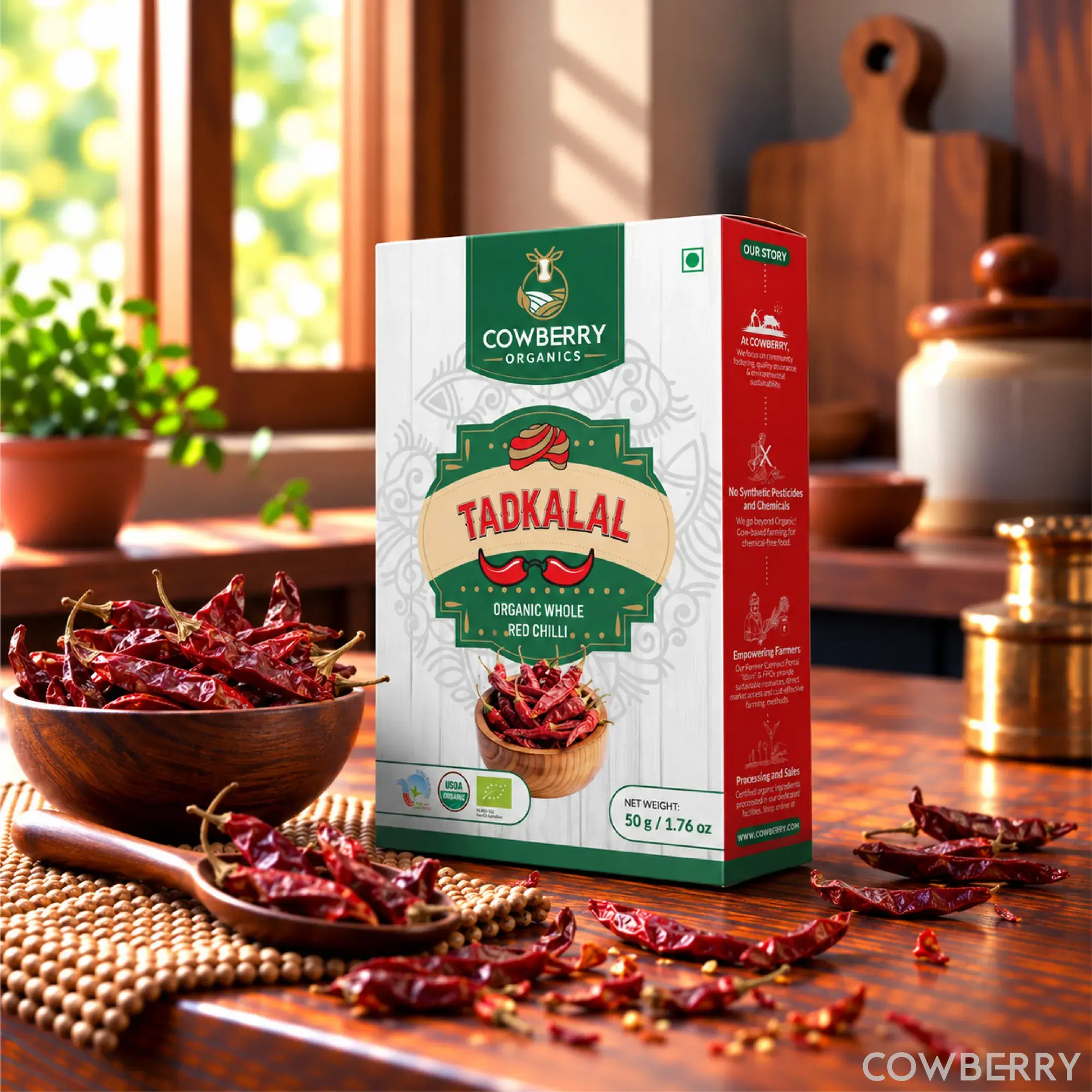
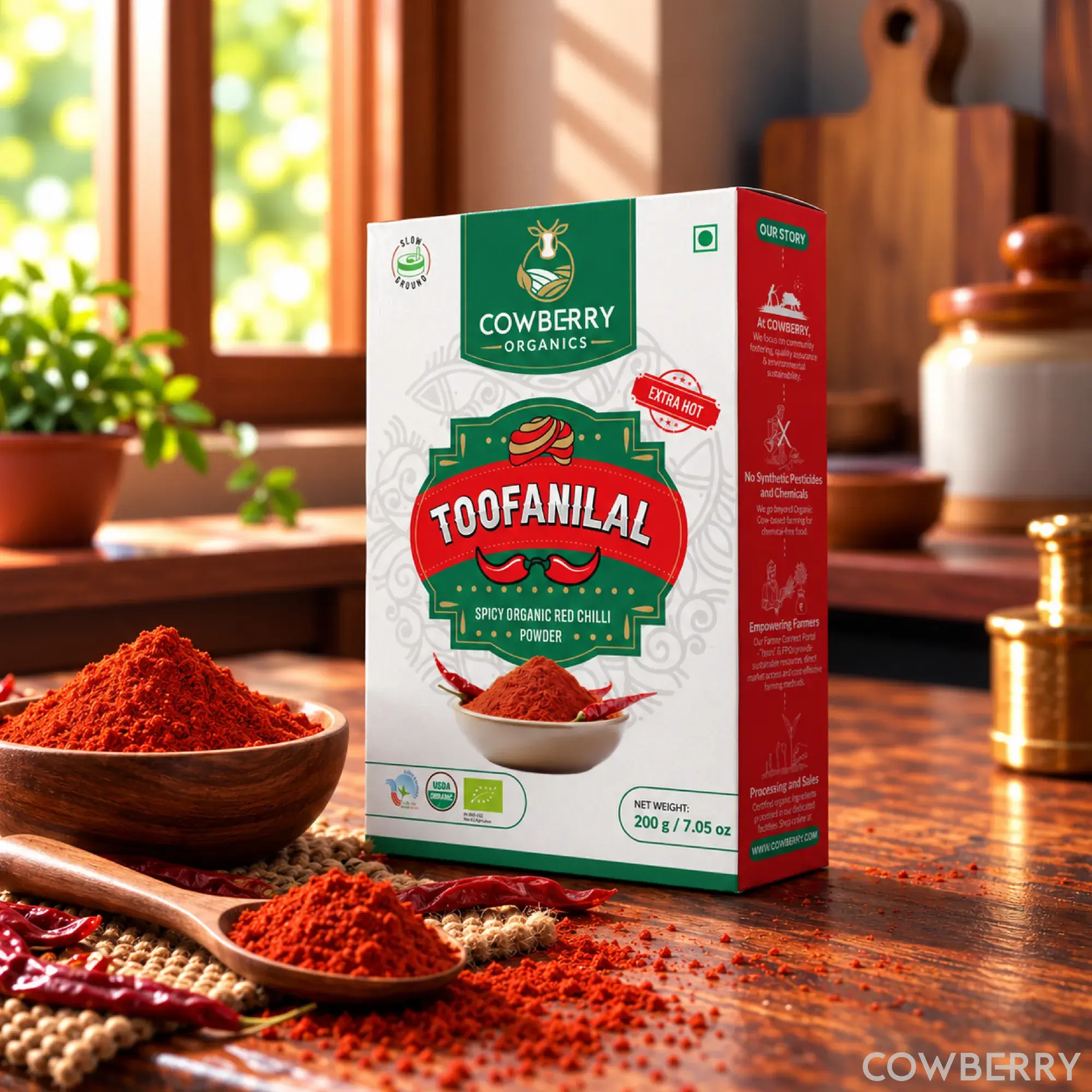
COWBERRY's own Toofanilal powder blends the two crops for exactly this reason, the fierce heat of Guntur chillies with the deep-red mildness of the Himachal (kashmiri-style) ones. Home cooks can do the same by grinding their own, following how to make kashmiri lal mirch powder, and the variety itself is explained on what is kashmiri red chilli. Shoppers also meet byadgi chilli in the same aisle; it has its own guide at byadgi chilli.
Cost and where each fits
COWBERRY's product pages print no prices, and the choice below is about heat and colour, not money.
Kashmiri lal mirch fits where colour leads: rich gravies and curries that should look red without biting back. Lal mirch fits where heat leads: tadka, pickles, spice blends and chutneys. Homes that want both buy one pack of the Toofanilal blend, which carries the Guntur heat and the Himachal colour together; homes that want each one full-strength keep the two separately. For the names of the spice in Indian languages, see lal mirch in english.
Which for whom
- Mild eaters and colour seekers: kashmiri lal mirch, the mild, deep-red option.
- Heat lovers: the everyday lal mirch, Guntur style, whole or ground.
- Households that want both in one jar: the Toofanilal blend of the two crops.
- Anyone asking about health: this page makes no health claims for either. A 2014 review in the International Journal of Molecular Sciences notes that spices are eaten in such small amounts, and with other foods, that their true health benefit is hard to establish; what studies do and do not show is separated on chilli powder benefits.
- Anyone grinding at home: the dry chilli is the starting material, and the whole-spice advice of the Dietary Guidelines for Indians, which prefers whole spices over powders because powders are more often adulterated, applies to both; the dry chilli hub has the buying and storage detail.
Cook with it: try Idli podi.
FAQs
Is kashmiri lal mirch and paprika same?
No. Kashmiri lal mirch is dry red chilli, a variety of Capsicum annum, and paprika is a different ground pepper product. IFCT 2017 carries kashmiri lal mirch under its chillies, red entry and prints no paprika name for it, so the two are not the same powder.
Is kashmiri red chilli spicy?
Only mildly. COWBERRY's product pages put the Himachal kashmiri-style chilli down as mild, its deep red colour doing the work in a dish. The product pages print no heat number for it, so the answer stays in words: gentle warmth, not a burn.
Is kashmiri lal mirch less spicy?
Yes, going by the product pages: the kashmiri-style chilli is described as mild, with gentle warmth, while the everyday lal mirch, the Guntur chilli, is described with strong, bold heat and is sold as extra hot. The product pages print no heat number for either, so the comparison is descriptive.
Is kashmiri red chilli powder hot?
Not in the way ordinary red chilli powder is. The powder COWBERRY makes from the Himachal (kashmiri-style) chillies is recorded as mild, chosen for colour and gentle warmth, unlike the extra-hot blend of Guntur chillies. Use less of a hotter powder if you want that milder effect.
Difference between kashmiri red chilli powder and red chilli powder?
The same difference as between the whole chillies: heat and colour. Kashmiri red chilli powder is mild and deep red, ground from Himachal chillies, while ordinary red chilli powder, like one ground from Guntur chillies, runs hot. Both share one IFCT 2017 nutrition entry, so the numbers per teaspoon are identical.
References
- Indian Food Composition Tables (IFCT) 2017, ICMR-National Institute of Nutrition
- Opara EI, Chohan M. Culinary herbs and spices: their bioactive properties, the contribution of polyphenols and the challenges in deducing their true health benefits. Int J Mol Sci, 2014
- Dietary Guidelines for Indians, ICMR-National Institute of Nutrition
Shop this article
Keep reading
Coriander water benefits: what dhania water actually does
Peanuts in Hindi (moongfali): groundnut names in Indian languages
Coriander vs cilantro: are they the same herb?