by COWBERRY

7 minute read
Is kolam rice boiled rice? Raw vs parboiled kolam explained

Is kolam rice boiled rice? Only when the pack says so — the food tables class kolam as raw rice, the milled white form IFCT 2017 lists as “Rice, raw, milled”, and boiled on the pack usually means parboiled. This page compares raw and boiled kolam on nutrition, GI, taste and cooking, and tells you how to read the label. The kolam rice hub covers the grain itself.
Kolam rice vs boiled rice: the verdict in three lines
Kolam rice is classed as raw. IFCT 2017 lists kolam under “Rice, raw, milled”, and every number on this page is for that raw milled form.
Boiled, on the pack, usually means parboiled. The Dietary Guidelines for Indians list “rice, parboiled, milled” and “rice, parboiled, handpounded” among their cereal forms and list no form called simply boiled; a pack of kolam marked boiled or parboiled is kolam in its parboiled form.
The two forms are told apart on the label, not by the variety. Kolam is the grain; raw and boiled are two ways it is processed and sold, and the boiled form has no nutrition or GI figures of its own on this page.
Is kolam rice raw or boiled? Reading the pack
Raw, on a rice pack, does not mean uncooked; it means the rice was not parboiled. IFCT 2017's list of Indian food names puts kolam under the English name “Rice, raw, milled” — milled white rice — and the nutrition figures on this page are for that form.
Boiled usually means parboiled. The Dietary Guidelines for Indians list “rice, parboiled, milled” and “rice, parboiled, handpounded” among their cereal forms and list no form called simply boiled; a kolam pack marked boiled or parboiled is parboiled rice.
Telling the two apart is mostly the label: a raw rice pack says raw or white rice, while a boiled rice pack says boiled or parboiled. When in doubt, the pack's own words decide.
Nutrition: raw kolam rice vs boiled, per 100 g
The side-by-side table below has one column, and that is the honest reading in itself: the nutrition figures for kolam are for raw milled rice only, so boiled kolam gets no numbers of its own here. Per 100 g, the raw milled entry gives 357 kcal, 7.9 g of protein, 78.2 g of carbohydrate, 2.8 g of fibre and 0.65 mg of iron.
Cooked as one katori, which starts from 40 g of raw rice, kolam gives about 143 kcal, 3.2 g of protein, 31 g of carbohydrate and 1.1 g of fibre. Milling costs fibre: the Dietary Guidelines for Indians put highly polished rice among the processed grains from which some fibre is also lost, and they want half or more of each day's cereals eaten as whole grains, only minimally polished. One early measured difference between the two forms survives in IFCT 2017's own history: Aykroyd's 1932 work found milled parboiled rice considerably higher in vitamin B1 than raw milled rice.
More of the per-100 g picture is on the kolam rice nutrition page.
| Nutrient | Kolam rice (raw, milled) |
|---|---|
| Energy (kcal) | 357 |
| Protein (g) | 7.9 |
| Fat (g) | 0.5 |
| Carbohydrates (g) | 78 |
| Dietary fibre (g) | 2.8 |
| Iron (mg) | 0.7 |
| Calcium (mg) | 7.5 |
| Magnesium (mg) | 19 |
| Potassium (mg) | 108 |
| Sodium (mg) | 2.3 |
| Zinc (mg) | 1.2 |
| Folate (mcg) | 9.3 |
| Glycemic index (GI) | 77 |
Per 100 g raw, edible portion. Composition: IFCT 2017 (ICMR-NIN). GI: University of Sydney GI database. — means not reported. These are average values for the food; the label on a pack gives the values for that product.
Kolam raw rice glycemic index
The kolam rice glycemic index comes from one place: the University of Sydney GI database carries one kolam entry — white rice of the Surti Kolam variety, plain cooked in a rice cooker for 32 minutes, tested in India in 23 healthy volunteers — with a GI of 77. That is the high band — on the University of Sydney's scale, anything at 70 or above is high and 55 or below is low. The 2012 study behind the entry, by Shobana and colleagues, measured three Indian varieties in healthy volunteers and classed them all as high-GI: Sona Masuri at 72.0, Ponni at 70.2 and Surti Kolam at 77.0, with the differences between them not statistically significant.
That entry does not say whether the grain was raw or parboiled before cooking, and no kolam entry is labelled parboiled, so this page gives the boiled form no GI of its own. A 2023 review in Foods notes that processing techniques could change the postprandial glucose response of rice products. With any rice, the meal around it matters: the Dietary Guidelines for Indians explain that fibre holds back carbohydrate absorption and boosts satiety, so a katori of kolam belongs beside dal, vegetables or curd. If you are managing diabetes, plan portions with your doctor or dietitian.
Taste and cooking: raw kolam rice vs boiled
Raw kolam. COWBERRY's kolam is a medium-grain rice with a soft texture and a delicate aroma, aged for flavour and light and non-sticky when cooked. Its product page puts the cooking time at about 12 to 15 minutes, and the plain kitchen way is a covered pot with the flame low once the water boils. Its copy fits kolam to dal-rice, pulaos and khichdis, and its FAQ allows biryani where a soft grain is preferred.
Boiled (parboiled) kolam. This page has no tested cooking time or nutrition for it, so follow the water and time printed on the pack you buy. Either way, give the rice a good wash but not repeated ones, per the Dietary Guidelines for Indians.
Cost and where each fits
Prices depend on brand, pack size and city, so this page gives none; the meal is the better guide. COWBERRY's product copy puts raw kolam in dal-rice, pulaos and khichdis, the day-to-day cooking it is written around, with a cooking time of about 12 to 15 minutes to plan around for the raw form. For a parboiled pack, the cooking directions on that pack decide how it suits your dish.
Which for whom: raw or boiled kolam
- Everyday meals: raw kolam — soft and quick to cook, and the form COWBERRY's dal-rice, pulao and khichdi copy is written around.
- A parboiled pack: follow the water and time printed on it; this page has no tested figures for that form.
- Biryani: raw kolam works where a soft grain is preferred, as COWBERRY's product page notes.
- Watching blood sugar: the one kolam GI in the database is 77 — high — and the entry does not say raw or parboiled. No separate figure exists for the boiled form; take your portion plan to your doctor or dietitian.
- Whole-grain balance: milled kolam is polished; the Dietary Guidelines for Indians set the floor at half of every day's cereals coming from whole grains, so let kolam share the week with whole grains and dal.
The kolam rice hub covers the grain's meaning, nutrition, benefits and cooking, and the kolam rice benefits page runs through what kolam does and does not do for health.
FAQs
Is kolam rice parboiled?
Not as the food tables class it. IFCT 2017 lists kolam under the English name “Rice, raw, milled”, the raw white form. A pack marked boiled or parboiled is kolam in its parboiled form; on an Indian rice pack, boiled usually means parboiled.
What is boiled kolam rice?
Boiled kolam rice is parboiled kolam. The word boiled, on an Indian rice pack, usually names rice that has been parboiled; the Dietary Guidelines for Indians list parboiled rice, milled and hand-pounded, among their cereal forms and list no form called simply boiled. Follow the water and time on its pack; this page gives no separate nutrition for it.
Is kolam rice raw rice?
In the food tables, yes. IFCT 2017 lists kolam under the English name “Rice, raw, milled”, so the official tables class kolam as raw milled rice. The same grain also comes boiled or parboiled — a different processing, not a different rice.
Difference between kolam rice and raw rice?
Kolam rice is the variety and raw rice is the processing. Kolam is a medium-grain rice, and COWBERRY's is grown in Maharashtra and Madhya Pradesh; raw means the rice was milled white and not parboiled. IFCT 2017's kolam entry is raw milled rice, which is why the two names are often used as if they were one thing.
Is kolam rice good for health?
It is an everyday energy food. One katori of cooked kolam rice, starting from 40 g of raw grain, brings about 143 kcal with 3.2 g of protein and 1.1 g of fibre, and the Dietary Guidelines for Indians want half or more of the day's cereals kept whole, so pair kolam with dal, vegetables and curd and keep whole grains in the rest of the day.
References
- Indian Food Composition Tables (IFCT) 2017, ICMR-National Institute of Nutrition
- Dietary Guidelines for Indians, ICMR-National Institute of Nutrition
- University of Sydney glycemic index database (GI search)
- University of Sydney: about the glycemic index
- Ngo TV, Kunyanee K et al. Insights into recent updates on factors and technologies that modulate the glycemic index of rice and its products. Foods, 2023
- Shobana S, Kokila A, Lakshmipriya N, et al. Glycaemic index of three Indian rice varieties. Int J Food Sci Nutr, 2012
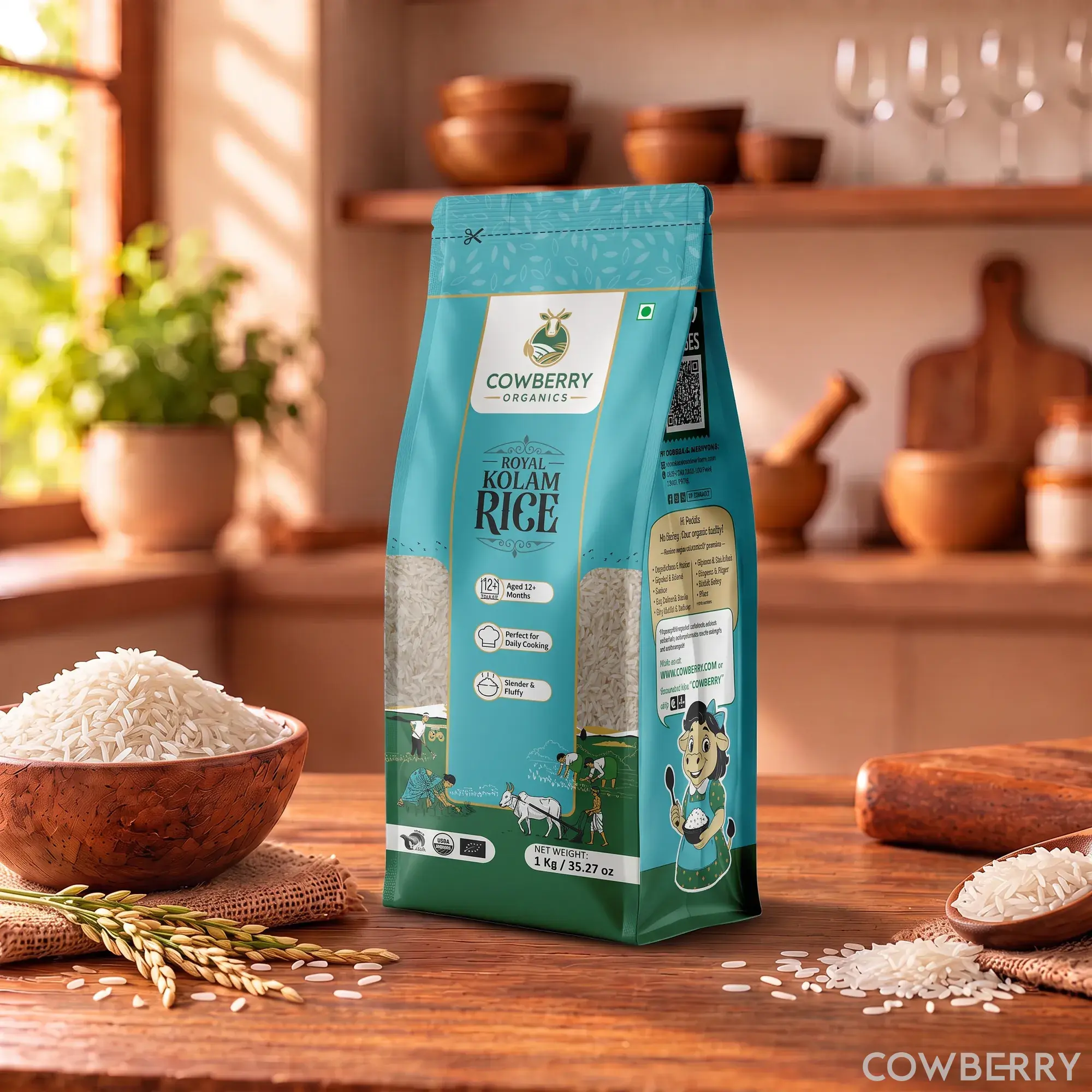
Shop this article
Keep reading
Red rice vs brown rice: the fibre, GI and honest verdict
Red rice vs black rice: nutrition, glycemic index and which to choose
Red rice nutrition per 100g: calories, protein, fibre and GI