by COWBERRY

8 minute read
Kolam rice benefits and side effects: is wada kolam good for health?

Kolam rice benefits are those of a plain everyday white rice: energy for the day, a light and non-sticky grain, natural gluten-free eating, and near-zero sodium — with one number to watch, a glycemic index of 77. Here they are, one by one: the benefits, the side effects, and the serving sizes that fit. The grain's wider story lives in our kolam rice hub.
Kolam rice benefits, one by one
Each benefit below is tied to a printed number or a product fact, not to a trend.
Energy for the day
357 kcal per 100 g of dry grain, roughly 143 kcal in a cooked katori built from 40 g of raw rice — COWBERRY's product page describes kolam as providing carbohydrate energy through the day, which is what a staple grain is for.
Light on the stomach
COWBERRY's product copy describes kolam as easy to digest and light on the stomach.
Soft and quick
It cooks in roughly 12 to 15 minutes, per COWBERRY's product page, and stays light and non-sticky — the practical reason it sits in dal-rice, pulao and khichdi every week.
Naturally gluten-free
COWBERRY's product page confirms rice is naturally gluten-free, which matters on plates that avoid wheat.
Near-zero sodium
IFCT 2017 prints 2.34 mg of sodium per 100 g, so the salt in a kolam meal is nearly all the cook's.
A pairing that improves protein
The Dietary Guidelines for Indians note that plant proteins are low in some essential amino acids and pair cereals with pulses at 3:1 for good quality protein; the dal served over kolam is that pairing on a plate.
Is kolam rice good for health? An honest answer
As a staple, yes — in the ways a white rice can be: carbohydrate energy, a grain COWBERRY's product copy calls easy to digest, quick to cook and naturally gluten-free. The caveats ride with it. Kolam is a polished grain, with 2.81 g of fibre per 100 g against brown rice's 4.43 g, and its one tested glycemic index is 77, in the high band on the University of Sydney scale, whose line sits at 55 for low and 70 for high. So the grain is good as part of a measured plate, and less good as the whole plate.
The Dietary Guidelines for Indians give the frame: at least half of the cereals eaten in a day should be whole grains, only lightly polished, and fibre in the meal slows carbohydrate absorption and adds satiety. Kolam fills the white-rice part of the plate; dal, vegetables and whole grains fill the rest. On its own, kolam is an everyday staple, not a food with a special claim. The per-100 g numbers behind this answer are on kolam rice nutrition.
Wada kolam rice benefits and side effects
Wada kolam is one of the names people search for the grain this page describes: the medium-grain kolam COWBERRY sells, grown in Maharashtra and Madhya Pradesh. The food tables carry a single entry for kolam rice, so wada kolam rice benefits and side effects are kolam's figures — 357 kcal and 7.94 g of protein per 100 g, a glycemic index of 77, and the same 2.81 g of fibre a polished white rice carries. No separate numbers exist for a wada kolam variety, so the figures above are the ones to use.
The GI test on record, in fact, belongs to the Surti Kolam name — a white rice cooked in a rice cooker for 32 minutes that scored 77 in a 2012 study. All kolam names read off the same entry; the plate advice on this page applies to every one of them.
Kolam rice side effects
The sources behind this page print no side effect specific to kolam; what they do print is the watch-list for white rice, and kolam sits on it. Three points, stated plainly.
The high GI. The one tested figure for kolam is 77, which the University of Sydney scale classes as high, and the test portion held 50 g of available carbohydrate. One katori, built from 40 g of raw rice, holds about 31 g of carbohydrate.
The white-rice diabetes question. In the cohorts pooled by a 2022 BMJ Open meta-analysis, the highest white-rice intake carried 16 percent more type 2 diabetes risk than the lowest in the pooled estimate, and above roughly 300 g a day each added 158 g daily serving tracked with 13 percent more risk. In the same pooled cohorts, eating brown rice went with a lower risk — 13 percent lower per 50 g a day. The substitution trials on cardiometabolic risk factors were inconsistent, so these numbers stay an association rather than a promise.
The fibre cost of polishing. Polishing costs fibre — the guidelines' note on highly polished grains says some is also lost in the process — which is the 2.81 g against 4.43 g gap.
How much kolam rice per day
The guidelines set no per-day portion for kolam itself, and no fixed number follows from them. What they give is the plate: 250 g of cereals for a 2000 kcal day, with whole grains, only lightly polished, filling at least half of it — so let kolam fill part of the cereal share, not all of it, and share the meal with dal, vegetables and curd.
As a working measure, one cooked katori, starting from 40 g of dry rice, is about 143 kcal, of which 31 g is carbohydrate, 3.2 g protein and 1.1 g fibre. How many katoris fit your day is for your own plan — the right number is the one your doctor or dietitian sets against your meals and activity. The raw-versus-boiled question is on is kolam rice boiled rice.
How to eat kolam rice
Kolam asks for no special preparation: a measured katori, dal or sambar over it, and vegetables or curd on the side. COWBERRY's product copy writes kolam around everyday dishes — dal-rice, pulao and khichdi — and its FAQ allows biryani where a soft grain is preferred. The grain cooks in about 12 to 15 minutes and stays soft and non-sticky, so it suits both the plain plate and one-pot meals cooked in a hurry. Since it is naturally gluten-free, it also fits plates that avoid wheat; the form question is on is kolam rice boiled rice, and the full per-katori numbers are on kolam rice nutrition.
Talk to your doctor or dietitian
Kolam rice is a staple, and for everyday eating it asks for nothing special — a measured katori, dal and vegetables beside it, whole grains elsewhere in the day.
The moment it carries a job — diabetes, weight loss, a sensitive gut, a pregnancy diet — the portion, the pairing and the timing belong to the plan your doctor or dietitian sets for you. The figures IFCT 2017 and the cited studies print are the ones above; how those figures translate to your plate is for your next appointment, not for this page to decide. If kolam is part of that plan, keep it there with their help — check with your doctor or dietitian before changing what you eat. The rest of the grain's story, from meaning to cooking, is in the kolam rice hub.
FAQs
Is kolam rice good for health?
As an everyday staple, yes: 357 kcal per 100 g of raw grain with 7.94 g of protein, described as easy to digest and light on the stomach in COWBERRY's product page, and naturally gluten-free. The watch-item is the glycemic index of 77, high on the University of Sydney scale, so health here means a measured katori with dal and vegetables, not the grain alone.
Is wada kolam rice good for health?
Wada kolam reads off the same entry as kolam in the food tables — 357 kcal, 7.94 g of protein and 2.81 g of fibre per 100 g — so the answer is the same: fine as an everyday staple on a measured plate, with the high glycemic index of 77 the one thing to portion around.
Is wada kolam rice good for diabetes?
With care. Its one tested figure is a glycemic index of 77, in the high band of the University of Sydney scale, and a 2022 BMJ Open meta-analysis tied higher white-rice intake to a higher type 2 diabetes risk in its cohort studies. One katori built from 40 g of raw rice holds about 31 g of carbohydrate; ask your doctor or dietitian what portion suits you.
Is kolam rice good?
Good as a staple, not as a claim. It gives carbohydrate energy — 143 kcal in a katori built from 40 g of raw rice — cooks in roughly 12 to 15 minutes, and stays soft and non-sticky. The other half: a polished grain with 2.81 g of fibre per 100 g, best paired with dal and vegetables.
What are the side effects of kolam rice?
The sources print no side effect that belongs to kolam alone. What they do print is the white-rice watch-list: a high glycemic index of 77, and in a 2022 BMJ Open meta-analysis a higher type 2 diabetes risk tied to higher white-rice intake in cohort studies — an association, with the substitution trials inconsistent.
Does kolam rice increase weight?
Only in the way any food does when it is eaten beyond need: kolam carries 357 kcal per 100 g of raw grain. A measured katori is about 143 kcal, which fits a normal meal; an overflowing plate repeated daily does not.
References
- Indian Food Composition Tables (IFCT) 2017, ICMR-National Institute of Nutrition
- Dietary Guidelines for Indians, ICMR-National Institute of Nutrition
- University of Sydney glycemic index database (GI search)
- University of Sydney: about the glycemic index
- Yu J, Balaji B et al. White rice, brown rice and the risk of type 2 diabetes: a systematic review and meta-analysis. BMJ Open, 2022
- Shobana S, Kokila A, Lakshmipriya N, et al. Glycaemic index of three Indian rice varieties. Int J Food Sci Nutr, 2012
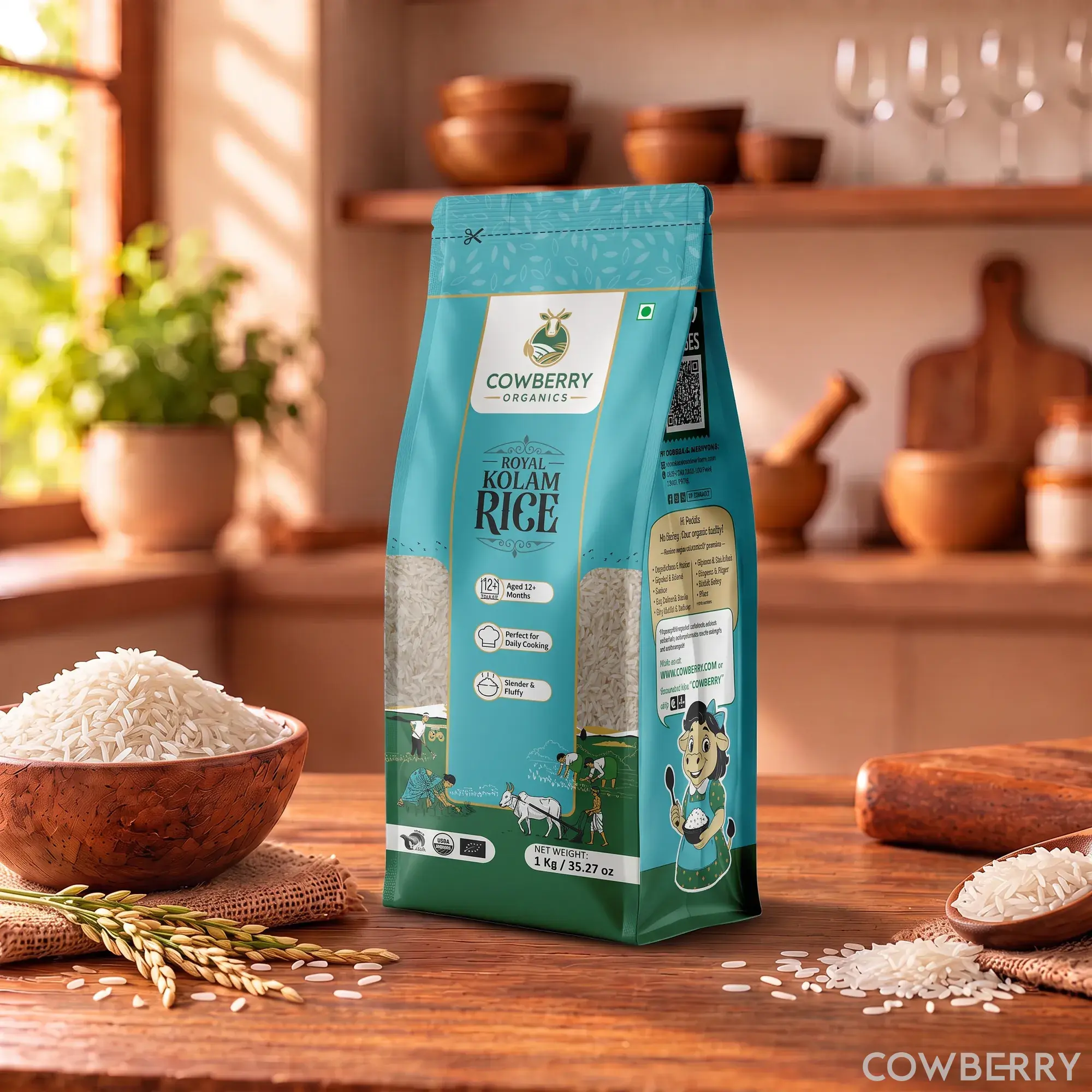
Shop this article
Keep reading
Red rice vs brown rice: the fibre, GI and honest verdict
Red rice vs black rice: nutrition, glycemic index and which to choose
Red rice nutrition per 100g: calories, protein, fibre and GI