by COWBERRY

10 minute read
Kolam rice (wada kolam): meaning, nutrition, benefits and cooking

Kolam rice is a medium-grain white rice of Maharashtra and Madhya Pradesh: the food tables class it as raw milled rice, and COWBERRY grows it organically as its soft, non-sticky everyday grain. This page answers what kolam is, its Indian names, nutrition and glycemic index, benefits and side effects, the raw-versus-boiled question, and how to cook it.
What is kolam rice?
Kolam is a medium-grain white rice, and the grain COWBERRY sells as its organic everyday rice. The food tables place kolam where polished white rice sits: under the English name 'Rice, raw, milled' — the raw form, milled to remove the bran. So kolam is a variety name, while raw and boiled are ways the same grain is processed; the tables give the raw form one composition, and every kolam number on this page is that entry.
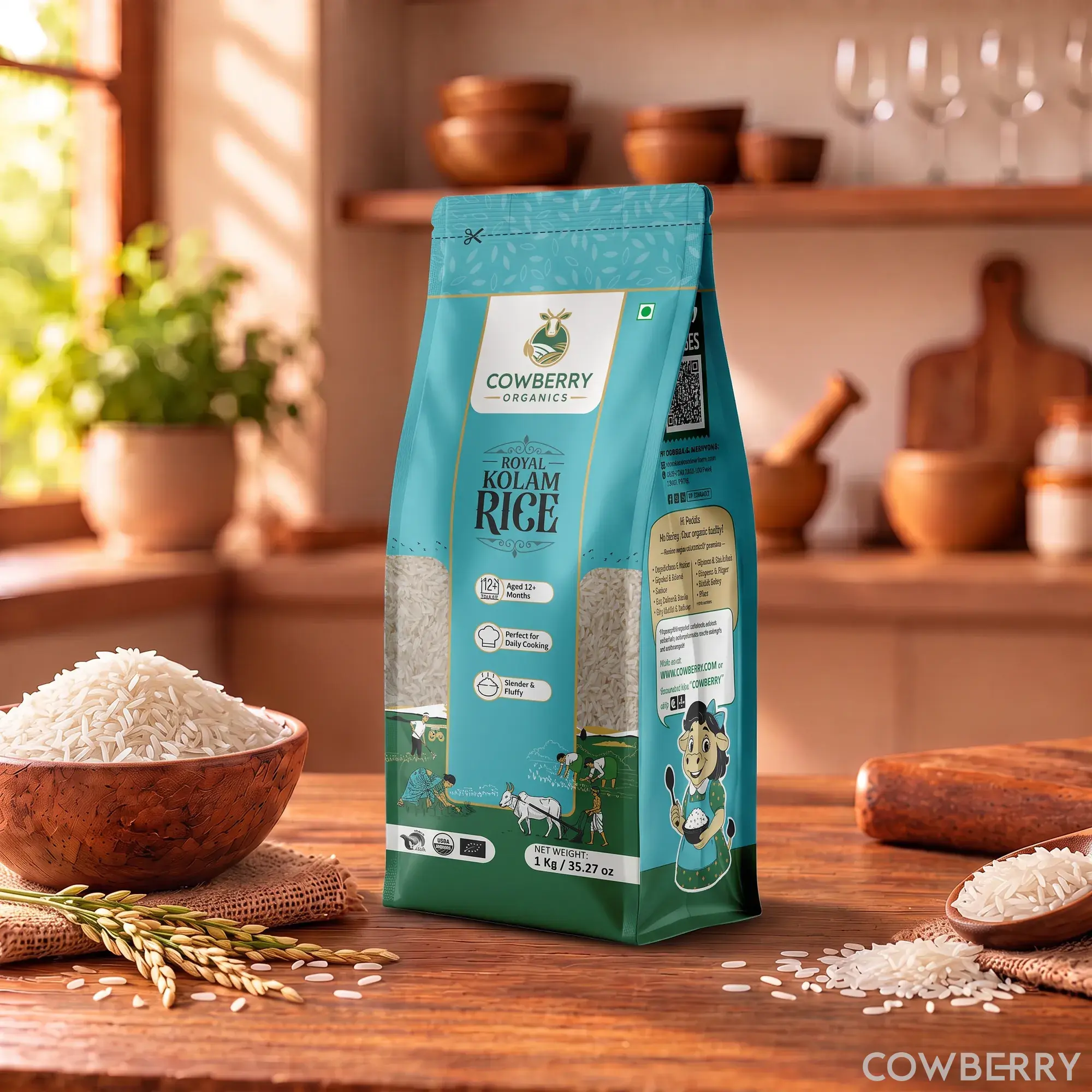
The grain itself, as COWBERRY's product page describes its crop: grown in Maharashtra and Madhya Pradesh on fertile, well-irrigated plains with alluvial soil, organically, without synthetic chemicals; medium-grain, fragrant, with a delicate aroma and a soft texture that cooks light and non-sticky, and aged for flavour. The botanical name on record is Oryza sativa. Wada kolam is a name people search for this same grain, and it reads the same figures.
Kolam rice names in Indian languages
Kolam travels under many names across Indian kitchens, and the list of Indian food names in IFCT 2017 prints them all in the table below — from the Hindi chawal and the Marathi tondool to the Assamese milat khunda chaul, with akki, biyyam and arisi carrying the grain through the south. Three columns — Malayalam, Urdu and Sanskrit — carry no recorded name, and the table leaves them blank.
One note on reading the list: English gets 'Rice, raw, milled', the tables' own name for the processed form — the name that matters when you compare numbers across sources.
| Language | Name (romanised) |
|---|---|
| English | Rice, raw, milled |
| Hindi | Chawal |
| Marathi | Tondool |
| Gujarati | Choka |
| Punjabi | Chaul |
| Bengali | Chowl |
| Odia | Chaula |
| Assamese | Milat khunda chaul |
| Kannada | Akki |
| Telugu | Biyyam |
| Tamil | Arisi |
| Malayalam | — |
| Urdu | — |
| Sanskrit | — |
| Botanical name | Oryza sativa |
Source: IFCT 2017 (ICMR-NIN) local-names list. — means no name recorded in the source.
Kolam rice nutrition per 100 g
The headline numbers for raw kolam, per 100 g: 357 kcal, 7.94 g of protein, 0.52 g of fat, 78.24 g of carbohydrate and 2.81 g of fibre, with iron at 0.65 mg, calcium at 7.49 mg, magnesium at 19.3 mg, potassium at 108 mg, sodium at 2.34 mg and zinc at 1.21 mg. The table below sets kolam beside brown rice, where the gap lives — not in calories, which nearly match at 354 kcal, but in fibre, 4.43 g against 2.81 g, and protein, 9.16 g against 7.94 g.
Scaled to the plate, a katori of cooked kolam, from 40 g of dry rice, comes to roughly 143 kcal, of which carbohydrate is 31 g, protein 3.2 g and fibre 1.1 g; a teaspoon of ghee on top adds about 45 kcal. The deeper per-serving arithmetic — cups, iron and zinc per katori, and kolam against poha — lives on the kolam rice nutrition page.
| Nutrient | Kolam rice (raw, milled) | Brown rice (raw) |
|---|---|---|
| Energy (kcal) | 357 | 354 |
| Protein (g) | 7.9 | 9.2 |
| Fat (g) | 0.5 | 1.2 |
| Carbohydrates (g) | 78 | 75 |
| Dietary fibre (g) | 2.8 | 4.4 |
| Iron (mg) | 0.7 | 1 |
| Calcium (mg) | 7.5 | 11 |
| Magnesium (mg) | 19 | 94 |
| Potassium (mg) | 108 | 199 |
| Sodium (mg) | 2.3 | 3.6 |
| Zinc (mg) | 1.2 | 1.7 |
| Folate (mcg) | 9.3 | 12 |
| Glycemic index (GI) | 77 | 58 |
Per 100 g raw, edible portion. Composition: IFCT 2017 (ICMR-NIN). GI: University of Sydney GI database. — means not reported. These are average values for the food; the label on a pack gives the values for that product.
Kolam rice glycemic index: 77, the high band
The glycemic index on record for kolam is 77, from the one kolam entry in the University of Sydney GI database: white rice of the Surti Kolam variety, cooked plain in a rice cooker for 32 minutes and tested on 23 healthy volunteers in India. The University of Sydney scale draws the line at 55 for low and 70 for high, so kolam's 77 sits in the high band, and the Dietary Guidelines note that foods containing sugar or refined carbohydrates have a high glycemic index.
The 2012 Shobana study that produced the number also measured two other Indian rices — Sona Masuri at 72.0 and Ponni at 70.2, differences from kolam's 77.0 not statistically significant — and classed all three as high-GI. One consequence worth keeping: the tested portion held 50 g of available carbohydrate, while a katori of cooked kolam carries about 31 g, so the meal's glucose load is set by the katori, not the grain's reputation. Portion planning for diabetes belongs with a doctor or dietitian, and the raw-versus-boiled angle is on is kolam rice boiled rice.
Kolam rice against basmati, sona masoori and brown rice
People comparing rices often ask where kolam stands among the other names on the shelf. On composition, the answer is: shoulder to shoulder. IFCT 2017 has no variety-specific rows, so kolam, basmati and sona masoori all read the same raw milled figures — 357 kcal and 7.94 g of protein per 100 g — and the choice between them is not a calorie choice. Brown rice is the one with a different profile: 354 kcal, 9.16 g of protein and 4.43 g of fibre per 100 g, the bran's contribution.
The difference between the white rices shows up in the GI database instead. Surti Kolam is the kolam name tested at 77; basmati rice, for contrast, is tested at 50 in the same database, and sona masoori at 72. Those numbers come from single tests of single varieties, so they compare the tested lots, not every bag on the shelf — and the kolam test's own three varieties came out statistically close to one another, which shows how tight a rice family can sit.
On the plate, then, the differences are the ones this page has already named: the GI number, the fibre gap to brown rice, and the form on the pack — raw or parboiled. Between kolam and sona masoori the nutrition figures are a tie, so taste and cooking habits decide.
Kolam rice benefits and side effects
The benefits page takes them one by one; the short version is that kolam earns its place on the everyday plate the way a good white rice does. It is an energy staple — 357 kcal per 100 g raw, about 143 kcal per cooked katori — and COWBERRY's product page calls it easy to digest and light on the stomach. It is naturally gluten-free, cooks in about 12 to 15 minutes, and carries near-zero sodium at 2.34 mg per 100 g, so the salt in the meal is the salt you add. Cereal protein gains quality when pulses join it at the guidelines' 3:1 cereal-to-pulse mix, which a dal-chawal plate does without being told.
The side effects are the white-rice watch-list, not a kolam-specific one. Its tested glycemic index of 77 is high, its 2.81 g of fibre is what polishing leaves behind against brown rice's 4.43 g, and the guidelines want whole grains, minimally polished, in at least half of the day's cereals. Kolam fills the white-rice share of a measured plate; dal, vegetables and whole grains fill the rest. The full point-by-point reading is on kolam rice benefits.
Raw or boiled: which kolam am I buying?
Kolam, as the food tables have it, is a raw rice: IFCT 2017's entry is 'Rice, raw, milled', and that raw milled form carries every nutrition number on this page. Raw here means not parboiled, not uncooked. A kolam pack labelled boiled is usually the parboiled form — the guidelines' cereal list carries parboiled rice in its milled and hand-pounded forms, and no form at all called simply boiled, so the word boiled on an Indian pack points to parboiled.
For the plate, the differences run through nutrition, GI and cooking: the printed figures belong to the raw form, the one GI test on record does not say which form it used, and a parboiled pack carries no separate numbers on this page — follow that pack's own directions. The full comparison is on is kolam rice boiled rice.
How to cook kolam rice
The number that matters is small: about 12 to 15 minutes, the cooking time on COWBERRY's product page. Before that, wash the grain well, but not repeatedly — the Dietary Guidelines' own rule, whose job is removing contaminants such as pesticide residues and parasites before cooking. Cook it plain in a covered pot on a low flame once the water boils, and it comes out soft, light and non-sticky.
No water ratio is printed for kolam, so follow your usual rice pot or the directions on the pack. A measured katori — 40 g of raw rice — keeps the portion honest while the rice cooks, and a teaspoon of ghee is the only addition this page will count: 45 kcal.
What to cook with kolam rice
Kolam is an everyday rice, and the dishes COWBERRY's product copy is written around are the everyday ones: dal-rice, pulao and khichdi, with biryani allowed where a soft grain is preferred, as the product FAQ puts it. Its soft, non-sticky texture suits the plain plate with dal and vegetables, and because it is naturally gluten-free it fits households that avoid wheat.
One batch-cooking trick is worth knowing: cooked white rice that spent 24 hours in the fridge and was then reheated measured a lower glucose response than freshly cooked rice in a 2015 study published in the Asia Pacific Journal of Clinical Nutrition. The study's numbers, and everything else per katori, are on the kolam rice nutrition page.
Buying and keeping kolam rice
When you buy kolam, two things on the pack decide the cooking: the form — raw or parboiled — and the origin. COWBERRY's organic kolam rice is grown in Maharashtra and Madhya Pradesh without synthetic chemicals, aged for flavour, and India Organic, USDA & EU certified; for any organic pack, look for the certification mark on the label.
At home, keep it the way the product FAQ says: sealed airtight in a cool, dry spot. A dry grain stored airtight keeps for many months, which is why kolam suits the pantry as a standing everyday rice. The pack comes in 1 kg, 5 kg, 10 kg and 26 kg sizes, so a small pack suits a household that uses rice slowly.
FAQs
What is kolam rice?
A medium-grain white rice from the plains of Maharashtra and Madhya Pradesh. The food tables class it under 'Rice, raw, milled' — polished white rice — and COWBERRY grows it organically, describing it as soft, light and non-sticky with a delicate aroma, aged for flavour. It is an everyday rice for dal-rice, pulao and khichdi.
What is wada kolam rice?
A name people search for the same grain. The food tables print one kolam entry, with no separate numbers for a wada kolam variety, so wada kolam reads the same nutrition and GI as kolam — 357 kcal per 100 g and a glycemic index of 77. The GI test on record is for the Surti Kolam name; all kolam names share that one entry.
Where is kolam rice grown?
COWBERRY's organic kolam rice is grown in Maharashtra and Madhya Pradesh, on fertile, well-irrigated plains with alluvial soil, without synthetic chemicals — the origin on record for the kolam COWBERRY sells.
Is kolam rice sticky?
Not the way COWBERRY grows and describes it: the product page calls the cooked grain soft, light and non-sticky, with a delicate aroma. Any rice can turn sticky when it is overcooked in too much water, so the 12 to 15 minute cook time is what keeps kolam fluffy.
Can kolam rice be used for biryani?
Yes, where a soft grain is preferred — COWBERRY's product FAQ says exactly that. Kolam's product copy is written around dal-rice, pulao and khichdi first, and its soft, non-sticky texture is what those everyday dishes want.
How to cook kolam rice?
About 12 to 15 minutes, the time on COWBERRY's product page, with the grains washed well but not repeatedly, per the Dietary Guidelines for Indians. Cook plain in a covered pot on a low flame once the water boils; it comes out soft, light and non-sticky.
References
- Indian Food Composition Tables (IFCT) 2017, ICMR-National Institute of Nutrition
- Dietary Guidelines for Indians, ICMR-National Institute of Nutrition
- University of Sydney glycemic index database (GI search)
- University of Sydney: about the glycemic index
- Sonia S, Witjaksono F, Ridwan R. Effect of cooling of cooked white rice on resistant starch content and glycemic response. Asia Pac J Clin Nutr, 2015
- Shobana S, Kokila A, Lakshmipriya N, et al. Glycaemic index of three Indian rice varieties. Int J Food Sci Nutr, 2012
Shop this article
Keep reading
Red rice vs brown rice: the fibre, GI and honest verdict
Red rice vs black rice: nutrition, glycemic index and which to choose
Red rice nutrition per 100g: calories, protein, fibre and GI