by COWBERRY

10 minute read
10 benefits of jowar atta (sorghum) and its side effects

Jowar atta benefits start with two numbers: 10.22 g fibre and 9.97 g protein per 100 g of sorghum, with only 1.73 g fat (IFCT 2017), in a grain that is naturally gluten-free. Below are ten benefits of jowar, each tied to its nutrient or study, then side effects, daily amount and the easiest ways to eat it. The grain itself is in the jowar guide.
Jowar benefits 1 to 5: fibre, protein, gluten-free, iron and minerals
1. Fibre that keeps you full
Jowar has 10.22 g dietary fibre per 100 g (IFCT 2017), so a 40 g bhakri carries 4.1 g. The ICMR-NIN Dietary Guidelines note that dietary fibre delays the absorption of carbohydrates and fats and increases the satiety value of a meal. That is the plain reason jowar appears in Indian weight-management diets: it is a swap for a refined grain, not a food with any special slimming action.
2. Protein on par with wheat
At 9.97 g per 100 g, jowar is within a gram of whole wheat and ahead of ragi, so switching rotis costs almost no protein. ICAR-IIMR notes two limits: lysine is the limiting amino acid in millets, and kafirin, the main sorghum protein, becomes less digestible on cooking. Eating sorghum with other foods improves its protein quality, which is why bhakri goes with dal, curd or milk.
3. Naturally gluten-free
Jowar contains no gluten, which makes it a workable everyday roti for anyone with coeliac disease or a wheat sensitivity; the NHS page on coeliac disease lists the grains that contain gluten (wheat, barley and rye), sorghum is not one of them, and ICAR-IIMR describes sorghum as suitable for people with celiac disease. Because there is no gluten, jowar dough needs boiling water and hand-patting, and a jowar dosa uses a little rice flour to crisp.
4. Iron for haemoglobin
Jowar gives 3.95 mg iron per 100 g, about the same as whole wheat; two bhakris (80 g flour) give 3.2 mg. Plant iron is absorbed poorly on its own. Even so, a 2021 meta-analysis in Frontiers in Nutrition found that regular millet meals raised haemoglobin in people with anaemia and raised serum ferritin in four human studies, and a squeeze of lemon or a tomato sabzi with the bhakri adds the vitamin C that the ICMR-NIN guidelines say improves iron uptake.
5. Magnesium, potassium, zinc and folate
Per 100 g jowar also brings 133 mg magnesium, 328 mg potassium, 1.96 mg zinc and 39.42 mcg folate, with only 5.42 mg sodium. These minerals sit in the bran that polishing strips from rice; a whole grain like jowar keeps them, and stone-ground atta keeps them in the flour.
Jowar benefits 6 to 10: blood sugar, polyphenols, low fat, digestion and versatility
6. A steadier blood-sugar response than refined grains
Jowar's GI of 66 (University of Sydney database, boiled de-husked grain) is medium, not low, so it is no free pass. Still, a 2021 meta-analysis in Frontiers in Nutrition found that long-term millet eating lowered fasting and post-meal blood glucose in people with diabetes, and a 2016 systematic review of 19 sorghum studies in Nutrition Reviews found evidence that sorghum dampened blood glucose responses. How much you eat, and the dal beside the bhakri, still matter. Numbers per roti are on jowar roti calories and nutrition per 100 g.
7. Polyphenols and antioxidants in the bran
ICAR-IIMR's millet bulletin describes sorghum's phenolic acids and flavonoids, the condensed tannins of some varieties and the 3-deoxyanthocyanidins of pigmented grain, and notes that sorghum fractions show high antioxidant activity in laboratory tests; the 2016 Nutrition Reviews study also found that eating sorghum lowered markers of oxidative stress. These compounds are concentrated in the outer layers, so whole-grain jowar atta keeps them and a sifted, refined flour loses part of them.
8. Low fat, moderate calories
With 1.73 g fat and 334 kcal per 100 g, jowar is about as lean as whole wheat, while bajra carries three times its fat. A 30 g roti is about 100 kcal before ghee, much the same as a wheat roti, so the calorie saving comes from the ghee and the number of rotis rather than the grain.
9. Easy on the stomach
Jowar tastes mild, and ICAR-IIMR's bulletin describes millets as easy to digest and non-acid forming. Most of its fibre is insoluble (ICAR-IIMR), and the ICMR-NIN guidelines note that dietary fibre adds bulk to stools and supports proper bowel function.
10. Versatile and easy to keep
The same grain makes bhakri, roti, dosa, upma, khichdi, porridge, popped snacks and gluten-free bakes, so it is easy to eat every day without repetition. Whole grain keeps longer than flour: ICAR-IIMR notes that whole-grain flour goes rancid as oil from the crushed germ oxidises, and jowar, with about a third of bajra's fat, has less oil to spoil. Half the benefit of any grain is whether you actually keep eating it.
Side effects of jowar: who should limit it
Jowar in normal portions suits almost everyone. The problems people report come from quantity, preparation or a medical condition rather than from the grain itself.
- Gas and bloating: going from white rice to two jowar bhakris a day is a jump of several grams of fibre per meal. Start with one roti, drink more water, and the bloating usually eases once you are used to it.
- Constipation, oddly: the same fibre that normally keeps you regular can back up if you eat a lot of dry bhakri without fluids. Jowar needs water, buttermilk or dal alongside.
- Iron and zinc absorption: ICAR-IIMR notes that phytates and tannins in millets reduce the bioavailability of minerals, though most sorghum carries no condensed tannins. Soaking whole grain overnight, sprouting it or fermenting dosa batter are household methods the ICMR-NIN guidelines say improve the bioavailability of nutrients.
- Coeliac disease: the grain has no gluten, but flour from a chakki that also grinds wheat can carry traces. Buy whole grain and grind it, or a pack that says it is milled away from wheat.
- Diabetes: 67.68 g carbohydrate per 100 g and a medium GI of 66 mean jowar is a portion-controlled swap for rice or wheat, not an extra.
- Kidney disease: 328 mg potassium per 100 g is a lot for a potassium-restricted diet.
- Acidity: ICAR-IIMR describes millets as non-acid forming, but a very large dry bhakri late at night can still sit heavy; keep dinner portions small.
Jowar protein is low in lysine, so a diet that is all jowar and no dal would be short of it. Anyone managing a medical condition should talk to their doctor or dietitian before changing their staple grain.
How much jowar per day
One to two bhakris a day, 40 to 80 g of jowar atta, gives 134 to 267 kcal, 4 to 8 g protein and 4.1 to 8.2 g fibre from the grain, before the dal and vegetables that go with it. That is a share of the day's cereal, not the whole of it: the ICMR-NIN Dietary Guidelines for Indians ask adults to take 20 to 30 percent of their cereals (raw weight) from millets, so one bhakri suits a lighter eater and two a more active adult. The same guidelines ask for a mix of whole grains and millets rather than one grain at every meal, so rotate jowar with wheat, rice, ragi and bajra through the week.
For children and the elderly, start with a thin jowar porridge or a half-jowar, half-wheat roti, since a dry bhakri is hard to chew. If you are moving from polished rice, stay at one roti a day until your stomach is used to it, then go to two. More is not better: three or more bhakris a day crowd out the other grains the guidelines ask you to rotate, and pile on the fibre behind the gas described above.
How to eat jowar: bhakri, upma, dosa and more
The point of a benefits list is a grain you will actually eat, so start with the dishes India already makes with it.
- Jowar bhakri: boiling-water dough, patted by hand, puffed on the flame; eat it with pithla, thecha, dal or any sabzi. The standard 40 g bhakri is the unit most of the numbers on this page use.
- Jowar upma: whole jowar soaked overnight, pressure-cooked and tossed in a sooji-upma tempering of mustard seeds, curry leaves and vegetables; ready in about 50 minutes once soaked, and it packs well for lunch.
- Jowar dosa: an instant dosa of jowar atta, a little rice flour and sour curd, with no soaking or fermenting; eight dosas in about 50 minutes.
- Cooked whole jowar in khichdi, pulao or a salad in place of rice; jowar ambali, the cold buttermilk porridge, in summer; popped jowar as chivda.
Two habits make the nutrients count: put a source of vitamin C at the meal (lemon, tomato, amla chutney) for the iron, and keep dal, curd or milk on the plate for the protein. The full set of dishes is in the jowar recipes roundup, the same benefits in Hinglish are on jowar ki roti ke fayde, and the grain's names, storage and buying guide are in the jowar guide.
FAQs
Is jowar good for health?
Yes, as a staple in place of rice or maida: 10.22 g fibre, 9.97 g protein and 3.95 mg iron per 100 g with 1.73 g fat and no gluten (IFCT 2017). Its GI is medium, so portion matters, and its protein needs dal to complete it. One or two bhakris a day with dal and vegetables is the sensible pattern.
Why jowar roti is good for health?
A jowar roti brings fibre (4.1 g in a 40 g bhakri), protein (4 g), iron (1.6 mg) and magnesium with very little fat, and it has no gluten. The ICMR-NIN guidelines note that dietary fibre increases the satiety value of a meal; against a wheat roti, the main difference is that jowar is gluten-free. The dal and sabzi with it complete the meal.
Does jowar roti cause gas?
It can at first, if you jump from white rice or maida to two bhakris a day, because 10.22 g fibre per 100 g is a big step up. Start with one roti, drink more water and eat it with dal or buttermilk rather than dry, and the gas usually settles as the gut adjusts.
Can jowar roti cause acidity?
Not usually: ICAR-IIMR's bulletin on millets describes them as non-acid forming and easy to digest. What can sit heavy in the stomach is a very large, dry bhakri eaten late at night, so keep dinner to one roti with a wet dal or sabzi, and chew it well.
Does jowar cause constipation?
Usually the opposite: jowar has 10.22 g fibre per 100 g, and the ICMR-NIN guidelines note that dietary fibre adds bulk to stools and reduces constipation. Constipation happens when someone eats a lot of dry bhakri without enough water, or when fibre is increased suddenly. Add jowar gradually, drink more water, and pair it with buttermilk, dal or a wet sabzi.
How jowar roti helps in weight loss?
By replacing a refined grain with a high-fibre one: a 40 g jowar bhakri gives about 134 kcal with 4.1 g fibre, and fibre, the ICMR-NIN guidelines note, increases the satiety value of a meal. It only works as a swap for rice or maida, not as an extra, and ghee on top adds calories. Talk to your doctor or dietitian before starting a weight-loss diet.
Which jowar is best?
No single type is best for everyone. ICAR-IIMR groups the grain by colour (white, yellow or red) and notes that most sorghum carries no condensed tannins; white grain gives the pale bhakri most people know, yellow grain carries beta carotene, and pigmented grain carries 3-deoxyanthocyanidins. Whichever you choose, whole-grain, stone-ground atta keeps the fibre and polyphenols that a sifted flour loses.
References
- Indian Food Composition Tables (IFCT) 2017, ICMR-National Institute of Nutrition
- University of Sydney glycemic index database (GI search)
- Anitha S et al. A systematic review and meta-analysis of the potential of millets for managing and reducing the risk of developing diabetes mellitus. Front Nutr, 2021
- Anitha S et al. Millets can have a major impact on improving iron status, hemoglobin level and reducing iron deficiency anaemia: a systematic review and meta-analysis. Front Nutr, 2021
- Simnadis TG, Tapsell LC, Beck EJ. Effect of sorghum consumption on health outcomes: a systematic review. Nutr Rev, 2016
- NHS: coeliac disease
- Nutritional and health benefits of millets, ICAR-Indian Institute of Millets Research (PDF)
- Dietary Guidelines for Indians, ICMR-National Institute of Nutrition
Shop this article
Keep reading
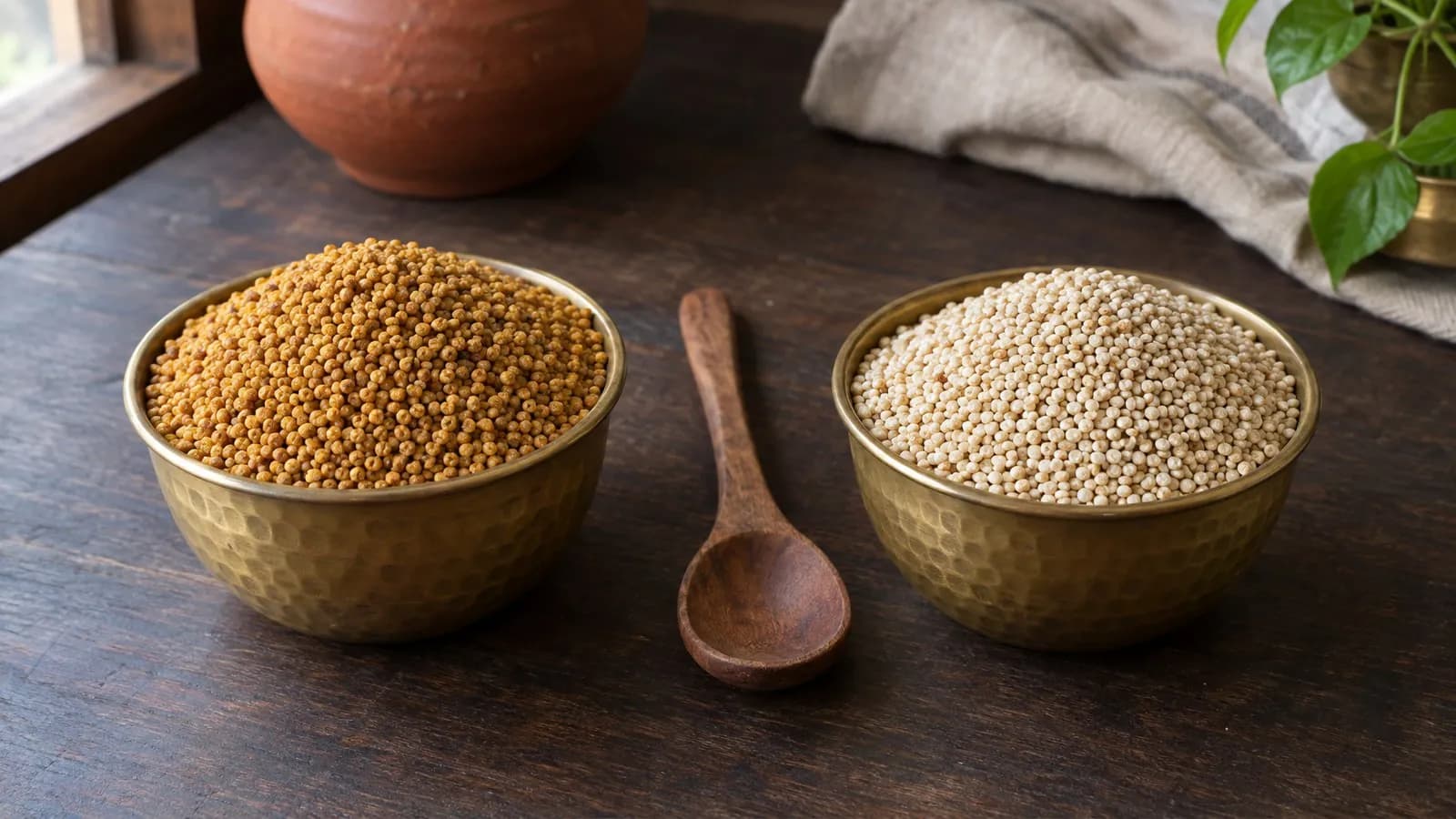
Foxtail millet vs quinoa: nutrition, taste and which to choose
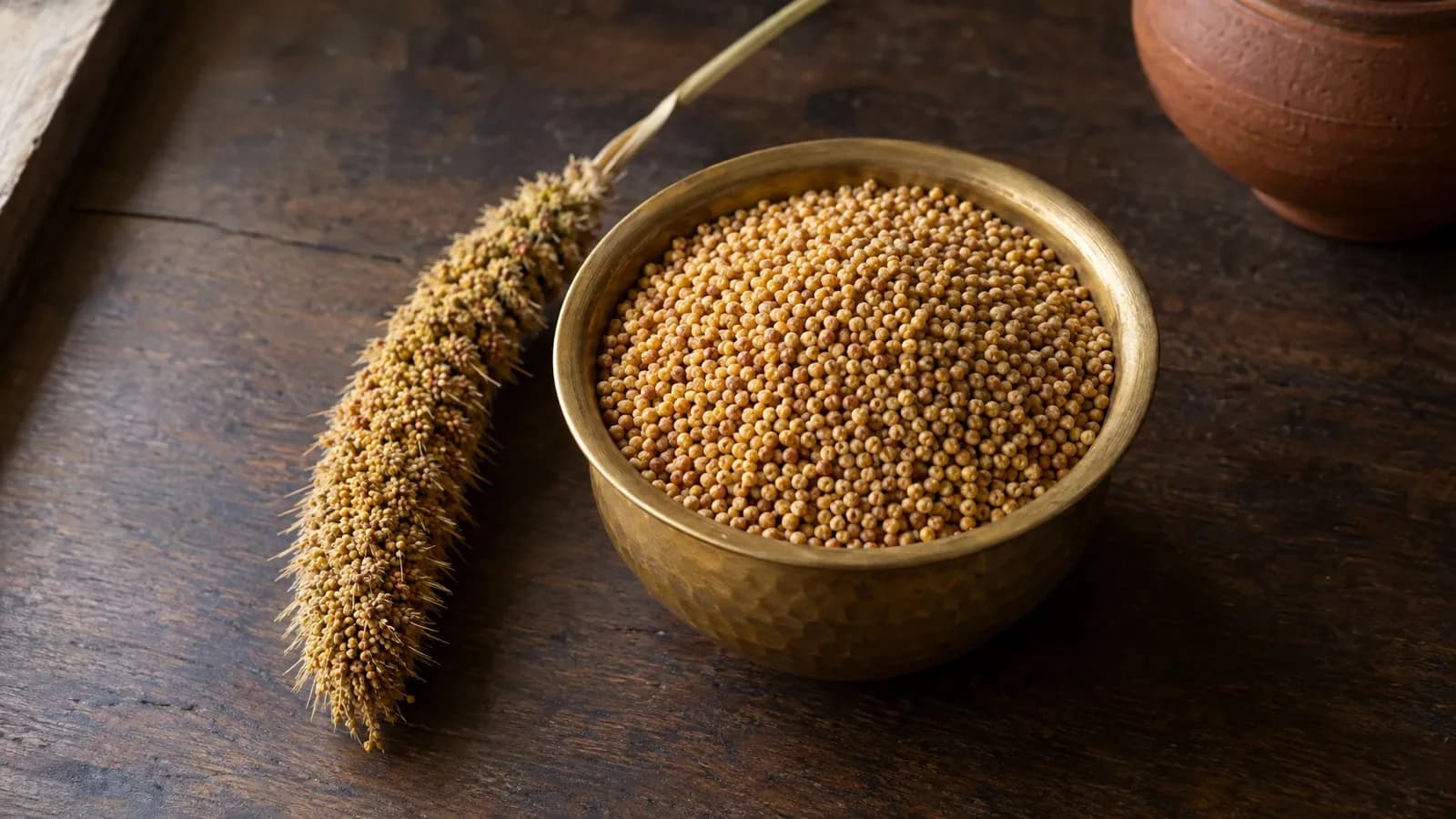
Foxtail millet in Kannada, Hindi, Tamil and other Indian names
10 benefits of kangni (foxtail millet) and its side effects