by COWBERRY

8 minute read
Indrayani rice benefits and side effects: is it good for health?

Indrayani rice benefits come from honest numbers: 357 kcal, 7.94 g protein, 0.52 g fat and 2.34 mg sodium per 100 g (IFCT 2017), a soft quick-cooking texture and no glycemic index listed for it. Each benefit below is tied to the figure behind it, followed by the side effects, the daily amount and how to serve it; the indrayani rice hub covers names, storage and buying.
Is indrayani rice good for health? The straight answer
Yes, as a staple eaten in normal portions, and the answer is the same as for any milled white rice. Indrayani is a food of carbohydrate: 78.24 g per 100 g, with 357 kcal of energy, 7.94 g of protein, 0.52 g of fat and 2.81 g of fibre (IFCT 2017, values for raw milled rice). It is not a mineral powerhouse, and no health claim beyond the numbers is being made here; what it does well is feed a household quickly, softly and without much fat or salt.
Its place is the everyday Indian plate of rice, dal, vegetables and curd, and it earns that place through texture and cooking, not through outranking other grains in any column. Those are the honest benefits, listed below one by one with their numbers.
Indrayani rice benefits, one nutrient at a time
1. Energy for the day, with almost no fat or salt
A 100 g portion of raw rice holds 357 kcal, mostly as 78.24 g of carbohydrate; fat is just 0.52 g and sodium 2.34 mg. A katori of cooked rice (40 g of raw rice) comes to about 143 kcal and 0.2 g of fat, so the ghee, oil and salt in a rice meal are the cook's choices, not the grain's. For a staple eaten day after day, that low-fat, low-sodium profile is the real practical benefit.
2. Protein that pairs with dal
Protein is 7.94 g per 100 g, and one katori gives about 3.2 g — useful, not remarkable. What lifts it is the company it keeps: the ICMR-NIN Dietary Guidelines explain how cereal and pulse proteins complement each other, a combination of the two covering most of the amino acids, and varan-bhat puts that pairing on one plate. A katori of rice beside a katori of varan is a better protein story than either alone.
3. Naturally gluten-free
Plain rice is naturally gluten-free, indrayani included, so it fits meals built without wheat, barley and rye. Khichdi and varan-bhat made with it stay gluten-free as long as the other ingredients are; anyone with coeliac disease should read every pack that goes into the recipe, spices included.
Texture, blood sugar and the honest mineral column
4. A soft, quick-cooking staple for everyday meals
COWBERRY's product page describes indrayani as short-grained, with a soft, slightly sticky texture and a mild aroma, and that texture is what varan-bhat and khichdi are built on. It cooks in about 12 to 15 minutes. For a house that cooks rice daily, a fast, forgiving grain is a genuine convenience, and soft grains suit a table that spans ages.
5. Blood sugar: an honest reading
No GI is listed for indrayani rice, so it cannot honestly be called low GI; the nearest tested Indian white rices, Sona Masuri, Ponni and Surti Kolam, came in at 72, 70 and 77 in a 2012 study of healthy volunteers, all high on the scale. The wider evidence points the same way: a 2022 meta-analysis in BMJ Open associated heavier white-rice eating with a higher risk of type 2 diabetes. In practice that means portion and plate, not panic — a measured katori with dal and vegetables, and a smaller one if your doctor or dietitian advises it.
6. The minerals, honestly small
The mineral column is modest: 0.65 mg of iron, 1.21 mg of zinc, 108 mg of potassium, 19.3 mg of magnesium and 7.49 mg of calcium per 100 g, plus 9.32 mcg of folate, and IFCT 2017 reports no vitamin C. A katori supplies about 0.3 mg of iron. The mineral list is not what makes indrayani worth eating; its value is in texture and cooking.
Indrayani rice side effects: who should limit it
No side effects are documented for indrayani rice itself, and for most people it is an ordinary everyday grain. The cautions are the cautions of milled white rice, and they are about amount and context rather than about this variety.
- Blood sugar. With the nearest tested white rices all high GI and no GI of its own listed, a person watching blood sugar should handle indrayani like any white rice: a measured portion, not free helpings. Settle the portion with your doctor or dietitian.
- Weight. At 357 kcal per 100 g, a cup of raw rice (about 200 g) is about 714 kcal before dal and ghee; seconds and extra katoris add up. It is portion, not the grain, that decides the scale.
- A day built only on rice. The ICMR-NIN guidelines ask for variety within the food groups and say to diversify staples with millets, so let indrayani share the rotation with wheat, millets and other rice.
- Leftovers. Cooked rice belongs in the fridge within two hours of cooking and should be eaten within two days, the leftover limit the UK Food Standards Agency gives.
On a prescribed diet, talk to your doctor or dietitian before indrayani becomes your main rice.
How much indrayani rice per day
There is no set daily amount for indrayani rice itself, so the honest guideposts are the ICMR-NIN reference numbers. Their vegetarian 2000 kcal reference plate gives 250 g of cereals and millets a day (raw weight), and the guidelines ask that a balanced diet take no more than 45 percent of its calories from cereals and millets. In indrayani terms, 250 g of raw rice is a little over six katoris once cooked, and one katori (40 g raw) is about 143 kcal; the guidelines' own note is to diversify staples with millets, so some of the day's grains come from roti or millet too, not rice alone.
For everyday use, count by the katori, not by the pot: each katori is 40 g of raw rice and about 143 kcal, so the day's rice is easy to tot up and easy to trim if your doctor or dietitian asks you to. No single figure fits every household; the portion that works for yours is the one your doctor or dietitian confirms.
How to eat indrayani rice: varan-bhat, khichdi and more
Indrayani rice is built for the Maharashtrian table, and each use below is plain kitchen method.
- Varan-bhat: the everyday plate — rice boiled soft, served with varan (toor dal), a spoon of ghee and lemon. Use 2.5 cups of water per cup of rice in the cooker, or boil and drain.
- Khichdi: rice and moong dal cooked together until soft, the comfort meal the short, soft grain suits.
- Pulao: keep the water at 1.75 cups per cup of rice and the grains stay separate under the masala.
- Kheer: simmered in milk until soft.
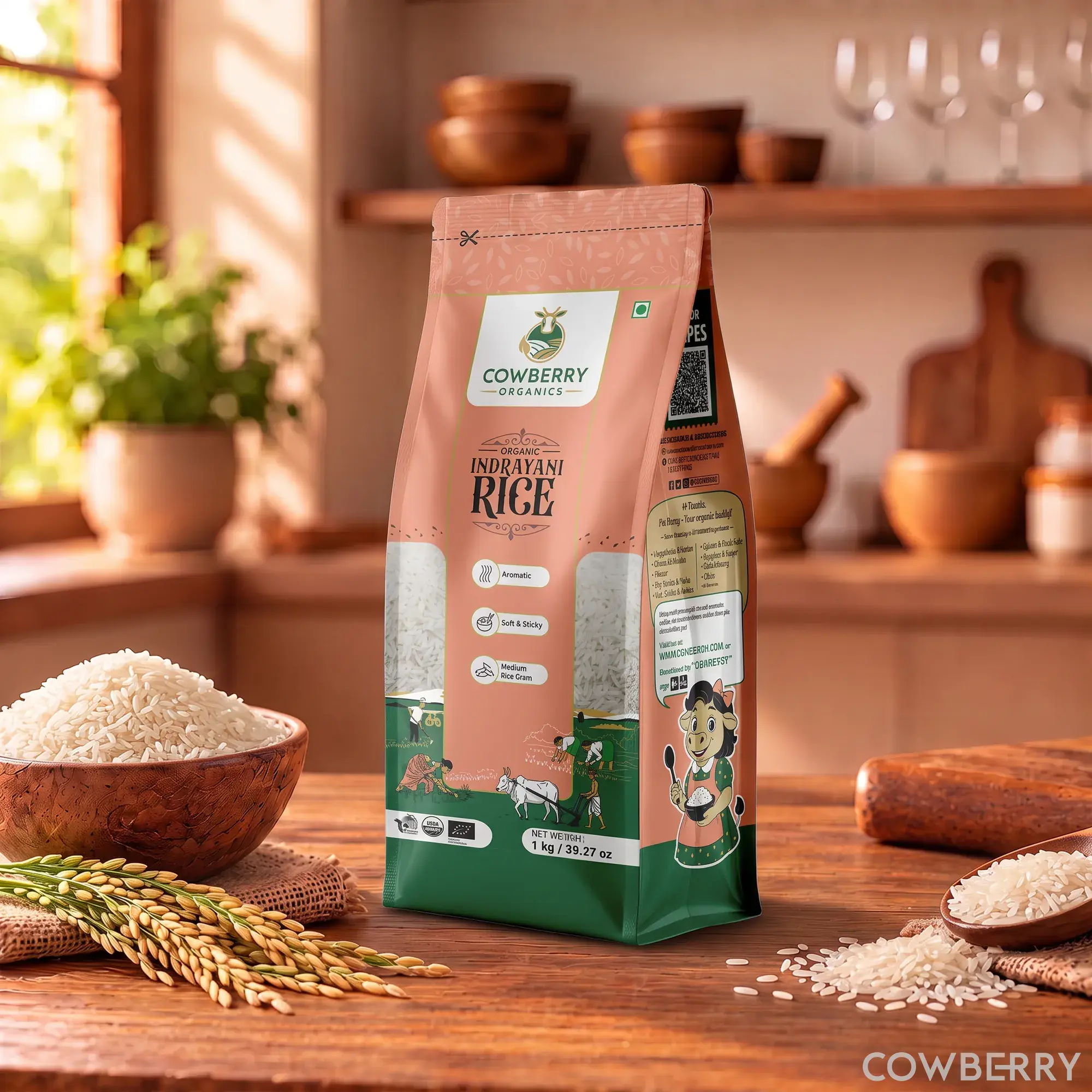
The full water ratios, cooker timings and the non-sticky tricks are on the how to cook indrayani rice page, and the per-100 g numbers behind every claim here are on the indrayani rice nutrition page. COWBERRY's organic indrayani rice is the grain described above: short-grained, from the Pune and Maval regions. Names, storage and buying are on the indrayani rice hub.
FAQs
Is indrayani rice good for health?
Yes, as an everyday staple in sensible portions. Per 100 g it gives 357 kcal, 7.94 g protein and 2.81 g fibre (IFCT 2017), with very little fat and sodium, and no GI is listed for it. It is not a medicine and not a nutrition outlier: its value is in being the carbohydrate of a meal that also has dal, vegetables and curd.
Is indrayani rice good for sugar patients?
Indrayani rice has no listed GI, so its own effect on blood sugar has not been measured; the nearest tested Indian white rices all came out high GI in a 2012 study. Handle it as a regular white rice: a measured katori with dal and vegetables, counted into the day's carbohydrate, and settle the portion with your doctor or dietitian.
Is indrayani rice good for weight loss?
It can sit in a weight-loss diet as the rice part of the plate, not as an extra. A katori of cooked rice, from 40 g of raw rice, is about 143 kcal, and the 200 g cup about 714 kcal, so the portion is the lever; it has 2.81 g of fibre per 100 g. Swap a second katori for dal and vegetables; a dietitian can set the numbers.
Is indrayani rice good for babies?
It can be one of the first rice foods once a baby's solids begin. The ICMR-NIN guideline is to start semi-solid home-made complementary foods soon after six months of age, and its example first foods include rice slurry, one new food at a time. Cook it soft, with no sugar and only a bare minimum of salt, as the guidelines ask. Introduce it only after your paediatrician's advice.
Is indrayani rice good for kheer?
Yes. COWBERRY's product page lists kheer and rice pudding among its uses. Cook the rice in milk on a low flame until the grains are soft, then sweeten and finish with cardamom and nuts.
Does indrayani rice cause cough?
There is no published evidence connecting indrayani rice, or plain rice in general, to cough. It is an ordinary staple served in everyday meals. If a child or adult coughs after eating it, that is a matter for a doctor to look into, not something the grain explains.
References
- Indian Food Composition Tables (IFCT) 2017, ICMR-National Institute of Nutrition
- Dietary Guidelines for Indians, ICMR-National Institute of Nutrition
- University of Sydney glycemic index database (GI search)
- Shobana S, Kokila A, Lakshmipriya N, et al. Glycaemic index of three Indian rice varieties. Int J Food Sci Nutr, 2012
- Yu J, Balaji B et al. White rice, brown rice and the risk of type 2 diabetes: a systematic review and meta-analysis. BMJ Open, 2022
- UK Food Standards Agency: How to chill, freeze and defrost food safely
Shop this article
Keep reading
Red rice vs brown rice: the fibre, GI and honest verdict
Red rice vs black rice: nutrition, glycemic index and which to choose
Red rice nutrition per 100g: calories, protein, fibre and GI