by COWBERRY

10 minute read
Indrayani rice: what it is, nutrition, benefits and how to cook it

Indrayani rice is the short-grained, mildly aromatic white rice of Maharashtra — the grain behind varan-bhat and khichdi, grown in the Pune and Maval regions and cooked soft in about 12 to 15 minutes. This page gathers the whole story: its names across Indian languages, its nutrition numbers, the honest benefits and side effects, how to cook it, how to store it and what to look for when buying.
What is indrayani rice?
Indrayani rice is a short-grained white rice of Maharashtra's Pune and Maval regions, with a mild aroma and a soft, slightly sticky texture when cooked — the rice of varan-bhat, khichdi and the everyday Maharashtrian plate. Its botanical name is Oryza sativa, the rice species. The grains are short, and the cooked rice reads soft rather than fluffy; it cooks quickly, in about 12 to 15 minutes, which makes it a natural for meals cooked day after day.
In the IFCT 2017 food tables there is no separate indrayani entry, so the nutrition numbers shown on this site are those of raw milled rice, shared by all plain white rices. The variety is regional: COWBERRY's product description ties the Pune and Maval microclimate and the water of the Indrayani river to the grain's character. The same product description calls it a rice for daily meals across all age groups. Its softness and aroma are what set the eating experience apart, and its place at the table is what this guide walks through — nutrition, benefits, cooking, storage and buying.
Names of indrayani rice in Indian languages
Indrayani rice travels under many names across India. In Hindi it is chawal, in Marathi tondool, in Gujarati choka, in Punjabi chaul, in Bengali chowl, in Odia chaula, in Assamese milat khunda chaul, in Kannada akki, in Telugu biyyam and in Tamil arisi. Several of those are plainly the same word in neighbouring scripts — chaul, chowl and chaula — while the rest are each language's own word for rice. In Marathi the rice is indrayani tondool: the variety's name followed by the local word for rice. English has no name of its own for this variety; the IFCT 2017 tables list it as rice, raw, milled. The table below is that list; indrayani itself keeps its Marathi identity everywhere, since the variety comes from Maharashtra.
| Language | Name (romanised) |
|---|---|
| English | Rice, raw, milled |
| Hindi | Chawal |
| Marathi | Tondool |
| Gujarati | Choka |
| Punjabi | Chaul |
| Bengali | Chowl |
| Odia | Chaula |
| Assamese | Milat khunda chaul |
| Kannada | Akki |
| Telugu | Biyyam |
| Tamil | Arisi |
| Malayalam | — |
| Urdu | — |
| Sanskrit | — |
| Botanical name | Oryza sativa |
Source: IFCT 2017 (ICMR-NIN) local-names list. — means no name recorded in the source.
Indrayani rice nutrition at a glance
Per 100 g of raw rice, indrayani carries 357 kcal of energy, 7.94 g of protein, 0.52 g of fat, 78.24 g of carbohydrate and 2.81 g of fibre; the figures are those of raw milled rice, as IFCT 2017 gives them. In kitchen terms, a katori of cooked rice, made from 40 g of raw rice, holds roughly 143 kcal and 3.2 g of protein, and a 200 g cup of raw rice is about 714 kcal. One cup of raw rice cooks into roughly five katoris, so those 714 kcal split into five modest servings at the table. The minerals sit low on the scale, as they do in any milled rice: iron 0.65 mg, zinc 1.21 mg, calcium 7.49 mg, magnesium 19.3 mg, potassium 108 mg and sodium 2.34 mg per 100 g, with 9.32 mcg of folate — background numbers, not headlines.
In the table beside it, brown rice carries 4.43 g of fibre and 9.16 g of protein per 100 g, and whole wheat 11.23 g of fibre and 10.59 g of protein — the honest distance between a milled grain and a whole one. On energy the three sit close together. There is no published GI for indrayani itself; the tested Indian white rices around it — Sona Masuri, Ponni and Surti Kolam — measured 72, 70 and 77, all in the high band. The full table and the per-serving arithmetic are on the indrayani rice nutrition page.
| Nutrient | Indrayani rice | Brown rice | Whole wheat |
|---|---|---|---|
| Energy (kcal) | 357 | 354 | 322 |
| Protein (g) | 7.9 | 9.2 | 11 |
| Fat (g) | 0.5 | 1.2 | 1.5 |
| Carbohydrates (g) | 78 | 75 | 65 |
| Dietary fibre (g) | 2.8 | 4.4 | 11 |
| Iron (mg) | 0.7 | 1 | 4 |
| Calcium (mg) | 7.5 | 11 | 39 |
| Magnesium (mg) | 19 | 94 | 125 |
| Potassium (mg) | 108 | 199 | 366 |
| Sodium (mg) | 2.3 | 3.6 | 2.5 |
| Zinc (mg) | 1.2 | 1.7 | 2.9 |
| Folate (mcg) | 9.3 | 12 | 30 |
| Glycemic index (GI) | — | 58 | 47 |
Per 100 g raw, edible portion. Composition: IFCT 2017 (ICMR-NIN). GI: University of Sydney GI database. — means not reported. These are average values for the food; the label on a pack gives the values for that product.
Indrayani rice benefits and side effects, in brief
As a daily staple, indrayani's honest strengths are energy with very little fat or salt (357 kcal, 0.52 g fat and 2.34 mg sodium per 100 g), a gluten-free grain that suits wheat-free plates, and protein that arrives best in company: the ICMR-NIN guidelines describe cereal-and-pulse combinations as the everyday way most of the amino acids reach the plate, and varan-bhat is one such combination. Its soft texture and quick cook make daily meals easier, which for a house that eats rice every day is a real benefit. What it will not do is outperform a whole grain on fibre or carry a GI label of its own; anyone wanting a published figure has brown rice at GI 58 and whole wheat at GI 47 to compare against — medium and low on the scale — and a doctor or dietitian to settle the plan.
On the caution side, indrayani is milled white rice: no GI is published for it, the neighbouring tested white rices sit in the high band, and a 2022 meta-analysis found heavier white-rice eating went with a higher chance of type 2 diabetes. The answer is the plate, not the grain — measured portions with dal and vegetables, and a doctor's or dietitian's word for anyone managing diabetes or weight. No side effects are documented for the grain itself. The full case, benefit by benefit, is on the indrayani rice benefits page.
How to cook indrayani rice
Cooking indrayani rice is a measured-water job: a rinse or two first, then the right amount of water, then a rest before serving. The pressure cooker wants 1.5 to 2 cups of water for each cup of rice, and the whole cook takes roughly 12 to 15 minutes; a pot wants 1.75 to 2 cups on a low covered simmer with a 5 to 10 minute rest. The pot rice is done when the water has been absorbed and little holes pock the surface; boil-and-drain rice is done when a grain pressed between thumb and finger flattens completely. For the clinging texture varan-bhat wants, either push the cooker water up to 2.5 cups or cook the rice in plenty of boiling water and strain it. A 20-minute soak before cooking is optional and softens the grains further.
Around those basics sit the grain's everyday uses: varan-bhat with toor dal and khichdi with moong dal, the two the product page names, plus a pulao at 1.75 cups of water and kheer simmered in milk. The indrayani rice recipe most people mean is really a method — the sticky rice for varan-bhat, made by raising the cooker water or by boiling and draining — and each use leans on the same character: the short grain softens through a dal gravy without falling apart, thickens a kheer as it cooks and takes on masala without turning mushy. The usual mistakes are the usual fixes: too much water makes paste, stirring mid-cook works out starch, and peeking lets the steam go. Water ratios, timings and the fixes for sticky or mushy rice are all on the how to cook indrayani rice page.
How to store indrayani rice
Dry rice wants a sealed container in a cool, dry spot, which is how its mild aroma holds — exactly what COWBERRY's pack advice says. Kept dry and sealed, the grain lasts many months without spoiling. Dry grains need no refrigeration; the whole routine is a dry scoop and a lid that closes.
Cooked rice follows the leftover rule instead: cool it, get it into the fridge within two hours and finish it within two days, the window the UK Food Standards Agency sets for leftovers. A batch that will not be finished in two days can be frozen instead, the alternative the same guidance gives, and thawed rice is best used within 24 hours of full defrosting. The fridge slows bacterial growth, which is the reason behind the two-day line.
Buying indrayani rice
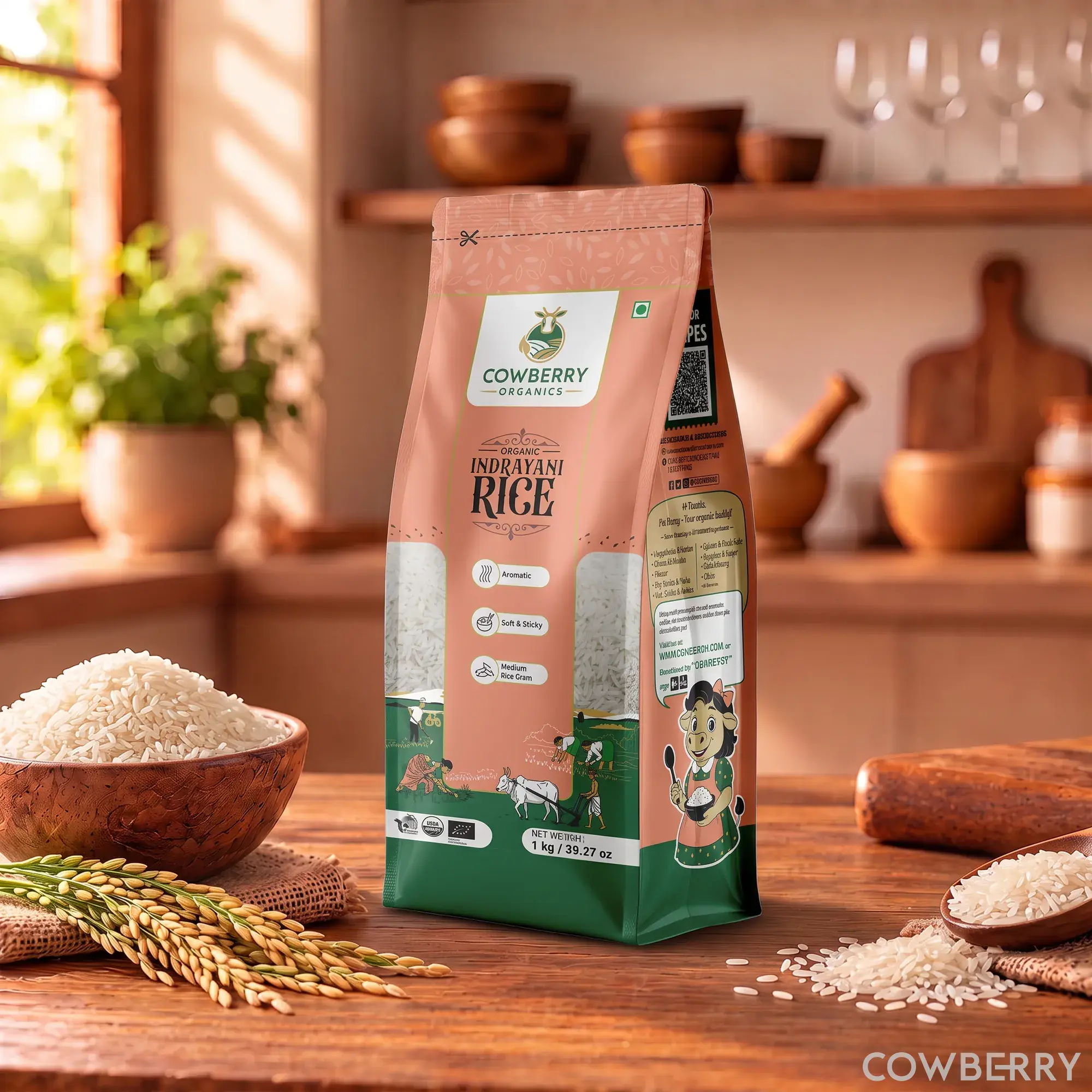
What to look for in a pack of indrayani rice is short and practical: a short grain, a mild aroma and a Maharashtra origin, since the variety is tied to the Pune and Maval regions. Look also for grains that are whole and uniform, and cook a test batch the first time: the right rice softens within the stated 12 to 15 minutes without turning to paste. The texture after cooking is the other test — soft with a light cling rather than long, separate grains. COWBERRY's organic indrayani rice is grown in those regions, and its certification is exactly what the phrase says: India Organic, USDA & EU certified. Beyond the pack, keep the grain airtight and cook it as above, and it will do what it does best: become everyday varan-bhat.
FAQs
What is indrayani rice called in english?
Indrayani rice has no English name of its own: the Indian Food Composition Tables (IFCT 2017) list it under the general name rice, raw, milled, the name used for plain milled rice, so an English label on a pack of indrayani may simply read milled rice. Around India the same grain is chawal (Hindi), tondool (Marathi), choka (Gujarati), akki (Kannada), biyyam (Telugu) and arisi (Tamil), among other names.
What is indrayani rice in hindi?
Chawal — the ordinary Hindi word for rice, since indrayani is one variety of the chawal family. Its home name is Marathi: tondool, while shop labels carry indrayani itself. In other states the same grain is choka (Gujarati), chaul (Punjabi), chowl (Bengali) and chaula (Odia).
Why indrayani rice is famous?
For its place at the Maharashtrian table: it is the rice of varan-bhat and khichdi, short-grained with a soft, slightly sticky texture, a mild aroma and a quick 12 to 15 minute cook. The fame is textural and regional, not nutritional — its per-100 g numbers are ordinary for milled white rice, and its reputation rests on the table, not on any medical claim.
How to cook indrayani rice?
Wash the rice in two changes of water, cook it in measured water and let it rest before serving. A pressure cooker wants 1.5 to 2 cups of water for each cup of rice and roughly 12 to 15 minutes; a pot wants 1.75 to 2 cups on a low covered simmer; for sticky varan-bhat rice, push the water up to 2.5 cups or boil and drain. The step-by-step methods are on the how to cook indrayani rice page.
Difference between indrayani rice and basmati rice?
Indrayani is short-grained and cooks soft and slightly sticky, the rice of varan-bhat and khichdi; basmati is long-grained and stays separate, the rice of pulao and biryani. Choose by dish: separate grains for pulao and biryani, soft grains for varan-bhat and khichdi. Nutritionally both are milled white rice, and the per-100 g figures used for indrayani here are the raw milled rice values. On GI the database prints one India-tested entry of 50 for basmati, while indrayani has none.
How does indrayani rice taste?
Mild and gentle: a soft, slightly sticky texture with a light aroma, less perfumed than basmati. COWBERRY's product page describes exactly that — soft texture, mild aroma — and in the bowl the rice takes on varan, ghee and lemon rather than competing with them. It is a quiet rice: no strong perfume, no hard bite, just softness that carries the dal.
Can indrayani rice be used for sushi?
Nothing published covers indrayani in sushi, and no recipe on this site uses it that way. It is a short-grained rice that cooks soft and slightly sticky, so it behaves more like the rice sushi is usually made with than a long-grained rice does. Its documented uses are varan-bhat and khichdi; for sushi, follow a recipe written for short-grain Japanese rice and test a small batch first.
References
- Indian Food Composition Tables (IFCT) 2017, ICMR-National Institute of Nutrition
- Dietary Guidelines for Indians, ICMR-National Institute of Nutrition
- University of Sydney glycemic index database (GI search)
- Shobana S, Kokila A, Lakshmipriya N, et al. Glycaemic index of three Indian rice varieties. Int J Food Sci Nutr, 2012
- Yu J, Balaji B et al. White rice, brown rice and the risk of type 2 diabetes: a systematic review and meta-analysis. BMJ Open, 2022
- UK Food Standards Agency: How to chill, freeze and defrost food safely
Shop this article
Keep reading
Red rice vs brown rice: the fibre, GI and honest verdict
Red rice vs black rice: nutrition, glycemic index and which to choose
Red rice nutrition per 100g: calories, protein, fibre and GI