by COWBERRY

6 minute read
Nutmeg vs mace: difference between the seed and its aril

The difference between nutmeg and mace is where each sits on one fruit: nutmeg is the seed inside, mace the aril wrapped around it. In Hindi the pair is jaiphal against javitri. Both are pinch-sized spices from the same tree; the nutmeg hub covers the seed in depth, and this page compares the pair.
Verdict in three lines
One fruit, two spices. Nutmeg is the seed; mace is the aril around it. A 2022 review in Phytotherapy Research lists the essential oil of leaf, mace, kernel and seed of Myristica fragrans side by side.
The one measure the 2022 review records is oil yield. The same review compiles oil yields across the extraction methods it gathered: 8.1 to 10.3 percent for mace, 6.2 to 7.6 percent for the kernel and 0.3 to 12.5 percent for the seed. The ranges overlap, so they show no clear winner.
For nutrition, only the seed has an entry. IFCT 2017 has an entry for nutmeg and none for mace, so the comparison below works from what IFCT 2017 prints and says plainly where it is silent.
The jaiphal-javitri naming question is answered right below; the side-by-side table settles what each one is, and the nutrition section has the seed's numbers.
Nutmeg vs mace: side by side
The difference between jaiphal and javitri is the same answer in Hindi names: jaiphal is the seed and javitri is the aril around it, while English calls the pair nutmeg and mace. The table sets out what the 2022 review and IFCT 2017 record for each.
| Nutmeg (jaiphal) | Mace (javitri) | |
|---|---|---|
| Part of the fruit | The seed inside | The aril around the seed |
| Essential oil yield (2022 review) | 6.2 to 7.6 percent (kernel); 0.3 to 12.5 percent (seed) | 8.1 to 10.3 percent |
| Entry in IFCT 2017 | Yes: 464 kcal, 36.5 g fat per 100 g | No entry |
One cell stays empty on purpose: IFCT 2017 has no entry for mace, so nothing is guessed into that column.
Nutrition
Per 100 g, IFCT 2017 gives nutmeg 464 kcal, 36.5 g fat, 27.6 g carbohydrate, 12 g fibre and 6.3 g protein, with 148 mg calcium, 2.33 mg iron, 212 mg magnesium and 474 mg potassium. For mace IFCT 2017 has no entry, so no numbers are given for the aril; the only comparison the 2022 review gives is the essential-oil yield above, and its ranges overlap. In kitchen amounts the gap shrinks to nothing visible: a 0.5 g pinch of grated nutmeg carries about 2.3 kcal and fractions of a gram of everything else, and mace is used in the same pinch-sized way. Spice nutrition, in short, is a per-100 g curiosity; per pinch, both are trace seasonings, which is also why a 2014 review in the International Journal of Molecular Sciences cautions that the true health benefit of culinary spices is hard to deduce.
| Nutrient | Nutmeg (seed) |
|---|---|
| Energy (kcal) | 464 |
| Protein (g) | 6.3 |
| Fat (g) | 37 |
| Carbohydrates (g) | 28 |
| Dietary fibre (g) | 12 |
| Iron (mg) | 2.3 |
| Calcium (mg) | 148 |
| Magnesium (mg) | 212 |
| Potassium (mg) | 474 |
| Sodium (mg) | 14 |
| Zinc (mg) | 1.4 |
| Folate (mcg) | 75 |
Per 100 g raw, edible portion. Composition: IFCT 2017 (ICMR-NIN). — means not reported. These are average values for the food; the label on a pack gives the values for that product.
Taste and cooking
COWBERRY's product notes describe nutmeg's flavour as warm, slightly sweet and earthy, and the seed is used freshly grated so the aroma comes through; that is how it goes into warm milk, kheer, bakes and rich curries, added near the end. For mace neither the 2022 review nor COWBERRY's product notes prints tasting notes, so none is claimed; what the 2022 review records instead is an oil-yield range for mace, 8.1 to 10.3 percent, that overlaps the seed's. In the kitchen the two parts share one rule: both are pinch spices. The seed is grated at the moment of use; mace is added in small amounts where a recipe calls for it. Grating and storage for the seed are on the how to use nutmeg page, and the names of both parts sit on the jaiphal in english page.
Cost and where each fits
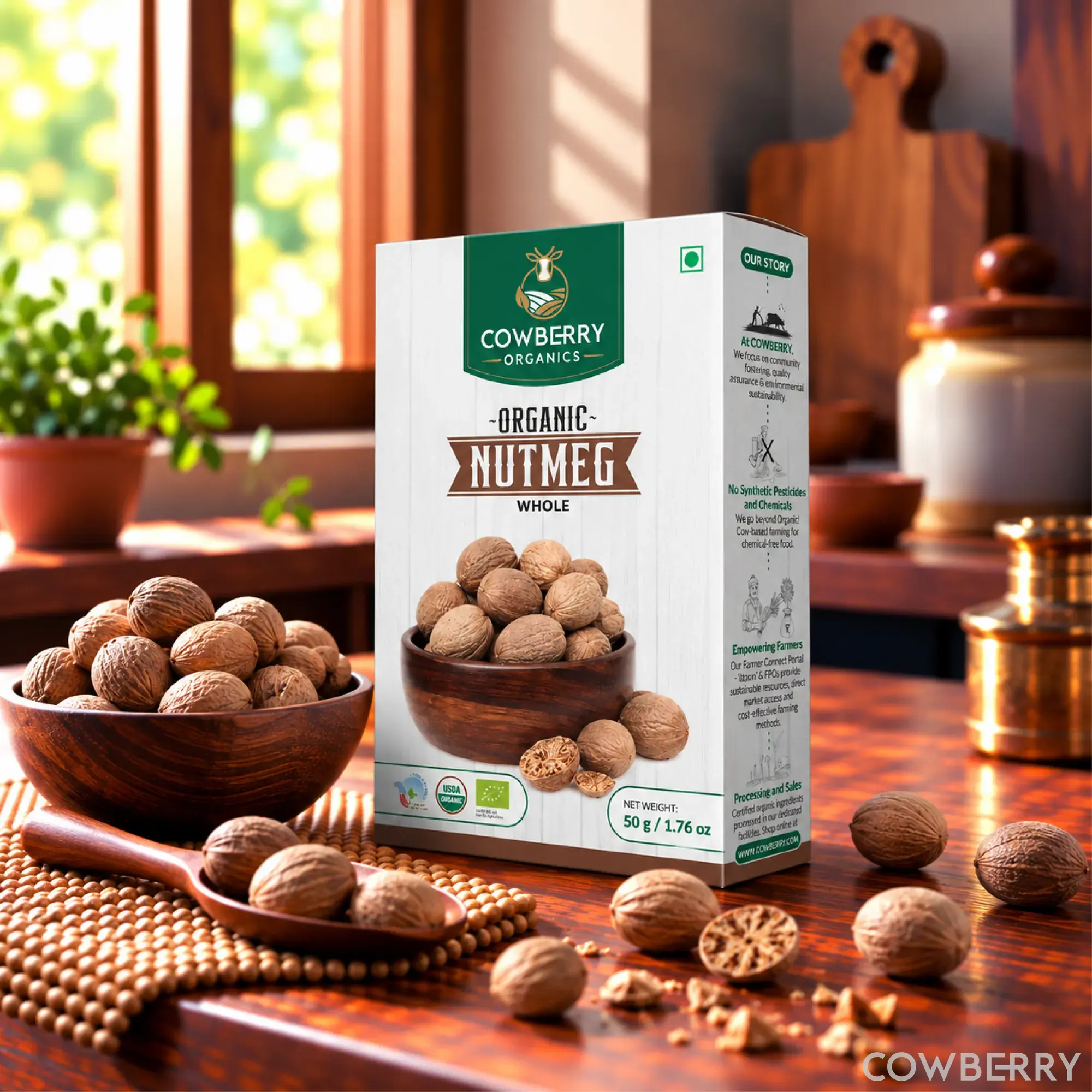
Both are whole spices bought in small quantities and used in pinches, so the per-dish cost of either is tiny; cost rarely decides between them. What decides is which one the recipe names. Nutmeg is the seed grated over warm milk, into kheer, into bakes and into the occasional gravy. Mace is bought for the dishes that call for it by name, and because it is used in pinches too, a small pack goes a long way. If a kitchen is buying its first of the pair, the seed is the one to start with, and it is sold whole as organic nutmeg.
Which for whom
- Everyday Indian cooking: nutmeg. It is the seed itself, sold whole and grated fresh; the names, nutrition and side effects of the seed are collected on the nutmeg hub.
- A recipe that names javitri: buy mace. It is the aril, a different part of the fruit.
- Anyone counting nutrition: nutmeg has IFCT numbers, listed above; mace has none in IFCT 2017, so count it as a trace seasoning.
- Safety-minded cooks: both stay at kitchen amounts. A 2025 review reports gastrointestinal and hepato-renal adverse effects for nutmeg at high doses, and the 2014 review's point about small culinary quantities applies to both parts of the fruit.
- Anyone offered supplement-sized doses of either: neither the 2025 review nor the 2014 review supports that use; as a cooking spice, both parts stay at pinch amounts.
FAQs
Is jaiphal and javitri same?
No. Jaiphal is nutmeg, the seed inside the fruit of Myristica fragrans, and javitri is mace, the aril wrapped around that seed. They come from one fruit but are two different spices, and the one difference a 2022 review records is oil yield: 8.1 to 10.3 percent for mace, 6.2 to 7.6 percent for the kernel and 0.3 to 12.5 percent for the seed, ranges that overlap.
What is the difference between nutmeg and mace?
The difference is the part of the fruit each one is. The seed at the centre is nutmeg, and the aril that wraps it is mace. In Hindi the names are jaiphal and javitri. Only nutmeg has an entry in IFCT 2017 (464 kcal, 36.5 g fat per 100 g); mace has none, and a 2022 review records an oil-yield range of 8.1 to 10.3 percent for mace against 0.3 to 12.5 percent for the seed.
Does mace have the same nutrition as nutmeg?
IFCT 2017 carries an entry for nutmeg and none for mace, so the two cannot be compared nutrient by nutrient. What is recorded is oil yield, compiled across extraction methods in a 2022 review: 8.1 to 10.3 percent for mace, 6.2 to 7.6 percent for the kernel and 0.3 to 12.5 percent for the seed.
Do nutmeg and mace come from the same plant?
Yes. A 2022 review in Phytotherapy Research lists the essential oil of leaf, mace, kernel and seed as parts of one plant, Myristica fragrans, the nutmeg tree. That is why the two spices sit on one tree and why their names get confused: jaiphal is the seed and javitri its covering.
Can I use mace instead of nutmeg?
The 2022 review prints no substitution ratio. As a kitchen matter, start with a small pinch, then taste and adjust. Either way, keep the swap to a pinch, as both spices are used in small amounts.
Which is better for sweets: nutmeg or mace?
Nutmeg suits sweets: grated into warm milk, kheer, payasam and bakes, where COWBERRY describes the warm, slightly sweet, earthy flavour of its whole nutmeg as working well in desserts. Neither the 2022 review nor COWBERRY's product notes prints tasting notes for mace, so none is claimed; if a recipe says javitri, use javitri.
References
- Indian Food Composition Tables (IFCT) 2017, ICMR-National Institute of Nutrition
- Ashokkumar K, Simal-Gandara J, Murugan M et al. Nutmeg (Myristica fragrans Houtt.) essential oil: A review on its composition, biological, and pharmacological activities. Phytother Res, 2022
- Tariq D, Sultan MT, Noman AM et al. Nutmeg Beyond Spice: A Review on Its Therapeutic Potential, Safety and Industrial Promise. Food Sci Nutr, 2025
- Opara EI, Chohan M. Culinary herbs and spices: their bioactive properties, the contribution of polyphenols and the challenges in deducing their true health benefits. Int J Mol Sci, 2014
Shop this article
Keep reading
Coriander water benefits: what dhania water actually does
Peanuts in Hindi (moongfali): groundnut names in Indian languages
Coriander vs cilantro: are they the same herb?