by COWBERRY

10 minute read
Nutmeg (jaiphal): names, nutrition, benefits and how to use it

Nutmeg is the seed of Myristica fragrans, sold whole and grated fresh into Indian sweets, warm drinks and the occasional rich gravy; in Hindi it is jaiphal. Per 100 g the seed carries 464 kcal and 36.5 g fat (IFCT 2017), yet a dish uses a 0.5 g pinch, about 2.3 kcal. This page covers names, nutrition, benefits, safety, cooking, storage and buying.
What is nutmeg?
Nutmeg is the seed of Myristica fragrans, an evergreen tree the 2022 Phytotherapy Research review traces to the Maluku Islands of Indonesia. One fruit gives two spices: the seed at the centre, and the red aril wrapped around it, which is dried and sold separately as mace, javitri in Hindi. Indian kitchens buy the seed whole and grate it fresh, and COWBERRY describes the flavour as warm, slightly sweet and earthy, working in spice blends, curries, gravies, rice dishes, desserts, bakes and warm beverages. The same 2022 review notes that the kernel, the seed's inner part, is extensively used in Indian traditional medicines: a record of use, not a proof of effect. Today the seed grows in Indian spice country as well; COWBERRY grows it in the spice regions of Karnataka and Kerala. In Hindi the spice is jaiphal, the first name in the table below.
Nutmeg names in Indian languages
Nutmeg kya hai and jaiphal kya hai are one question in two languages: jaiphal is nutmeg in Hindi. The table below carries the 13 Indian-language names IFCT 2017 prints for the seed. Four languages print the same word, jaiphal: Hindi, Punjabi, Odia and Assamese. Tamil and Malayalam share jathikai; Marathi prints jayaphala, Gujarati jayaphad, Bengali jayphal, Kannada jayikayi mara, Telugu jajikaya and Urdu jaifal. Sanskrit records jatiphala, the name jaiphal sits closest to. A pack that says jaiphal and a pack that says nutmeg hold the same seed, whatever the label language. What each name means, and how the seed is told apart from supari, is on the jaiphal in english page.
| Language | Name (romanised) |
|---|---|
| English | Nutmeg |
| Hindi | Jaiphal |
| Marathi | Jayaphala |
| Gujarati | Jayaphad |
| Punjabi | Jaiphal |
| Bengali | Jayphal |
| Odia | Jaiphal |
| Assamese | Jaiphal |
| Kannada | Jayikayi mara |
| Telugu | Jajikaya |
| Tamil | Jathikai |
| Malayalam | Jathikai |
| Urdu | Jaifal |
| Sanskrit | Jatiphala |
| Botanical name | Myristica fragrans |
Source: IFCT 2017 (ICMR-NIN) local-names list. — means no name recorded in the source.
Nutmeg nutrition per 100 g
Per 100 g of raw seed, IFCT 2017 prints 464 kcal, 36.5 g fat, 27.6 g carbohydrate, 12 g fibre and 6.3 g protein, with 148 mg calcium, 2.3 mg iron, 212 mg magnesium, 474 mg potassium, 14.3 mg sodium, 1.45 mg zinc and 74.8 mcg folate. The fat carries most of that energy, which is why the seed is so dense; potassium prints highest among its minerals at 474 mg. The table below sets the seed beside cloves and ground cinnamon, three spices on one 100 g basis.
No dish uses 100 g of nutmeg, so the honest per-serving line is the pinch: 0.5 g of grated nutmeg carries about 2.3 kcal, 0.18 g fat, 0.03 g protein and 0.14 g carbohydrate. For anyone counting intake, the practical instruction is the same: nutmeg is counted in pinches, not portions, because no dish uses enough of it for the per-100 g figures to apply. Two blanks matter as much as any number. IFCT 2017 prints no glycemic index for nutmeg and no vitamin C figure, and neither is guessed; for mace it has no entry either. Every pinch figure and the cloves-and-cinnamon comparisons sit on the nutmeg nutrition facts 100g page.
| Nutrient | Nutmeg (raw seed) | Cloves (raw) | Cinnamon (ground) |
|---|---|---|---|
| Energy (kcal) | 464 | 187 | 247 |
| Protein (g) | 6.3 | 5.9 | 4 |
| Fat (g) | 37 | 8.4 | 1.2 |
| Carbohydrates (g) | 28 | 19 | 81 |
| Dietary fibre (g) | 12 | 35 | 53 |
| Iron (mg) | 2.3 | 9.4 | 8.3 |
| Calcium (mg) | 148 | 567 | 1000 |
| Magnesium (mg) | 212 | 334 | 60 |
| Potassium (mg) | 474 | 1434 | 431 |
| Sodium (mg) | 14 | 183 | 10 |
| Zinc (mg) | 1.4 | 1.1 | 1.8 |
| Folate (mcg) | 75 | 33 | 6 |
| Vitamin C (mg) | — | — | 3.8 |
Per 100 g raw, edible portion. Composition: IFCT 2017 (ICMR-NIN); USDA FoodData Central (SR Legacy), FDC ID 171320, NDB 2010. — means not reported. These are average values for the food; the label on a pack gives the values for that product.
Benefits of nutmeg
What is shown and what is tradition sit on different shelves, and this page keeps them apart.
- Traditional use. A 2022 review records the kernel's extensive place in Indian traditional medicines, and a 2008 Asia Pacific Journal of Clinical Nutrition paper notes that India is recognized the world over for its spices and medicinal plants.
- Named compounds. A 2025 Food Science and Nutrition review lists the seed's contents: alkaloids, terpenoids, phenols, flavonoids and glycosides, with sabinene, safrole, macelignan and myristicin as prime bioactive components.
- Laboratory findings. The 2022 review compiles what the essential oil has shown in the laboratory: antimicrobial, antioxidant, anti-inflammatory and activity against cancer cells among them, plus antimalarial, anticonvulsant, hepatoprotective, antiparasitic, insecticidal and nematocidal reports; these are experimental findings, and the review adds that further investigations are needed to understand the mechanisms.
- IFCT minerals. Per 100 g the seed carries 212 mg magnesium, 474 mg potassium and 148 mg calcium, worth knowing per 100 g and trace-sized per pinch.
- The honest reading. Opara and Chohan, in their 2014 International Journal of Molecular Sciences review, explain why such findings are hard to carry into a kitchen: spices are eaten in small quantities, mixed into other foods, so the true health benefit is unclear.
The ten benefits, one by one with their sources, are on the nutmeg benefits page, and the same ten in Hindi on nutmeg khane ke fayde in hindi.
Side effects: who should limit nutmeg
At kitchen amounts nutmeg is an everyday spice. The caution sits at the other end of the scale. The 2025 Food Science and Nutrition review names myristicin among the prime bioactives of the seed and records gastrointestinal and hepato-renal adverse effects at high doses; its own advice is careful usage. The review gives no gram figure that counts as a high dose, so the safe reading is the kitchen one: pinches, not spoonfuls, and no supplement-style dosing, which the reviews in the references do not support. Anyone tempted to use nutmeg as a medicine rather than a seasoning should think twice, and anyone managing a health condition should first ask their doctor rather than swapping prescribed medicines for spices or supplements. The full side-effect list is on the nutmeg benefits page.
How to cook with nutmeg
Buy the whole seed and grate it at the dish. Whole nutmeg usually keeps its aroma longer than ready powder, so the seed is rubbed across the fine holes of a grater straight over the dish, one small pinch at a time, and added late in the cooking or once the pot is off the heat. Warm milk, kheer, payasam, bakes and the rare rich gravy all take it that way, and a pinch in a warm drink works the same way. In bakes, the grated nutmeg is mixed into the dry flour, where the flavour spreads evenly through the crumb. Jaiphal powder made at home is pounded in small batches and used soon. One seed covers many dishes, so a 50 g pack goes a long way. The pinch is the whole rule: 0.5 g, about 2.3 kcal, seasons a dish, and larger amounts are where the reported harms sit. The grating steps, the common mistakes and the honest daily-limit answer sit on the how to use nutmeg page.
Nutmeg vs mace
Nutmeg and mace grow on one fruit: the seed inside is nutmeg, and the red aril wrapped around it is mace, javitri in Hindi. A 2022 review in Phytotherapy Research gathers the essential-oil yields from the extraction methods it compiled: mace runs 8.1 to 10.3 percent, the kernel 6.2 to 7.6 percent and the seed 0.3 to 12.5 percent. The ranges overlap, so the sources show no clear winner between the two. For nutrition, only the seed has an entry; IFCT 2017 carries none for mace. The side-by-side comparison sits on the difference between nutmeg and mace page.
How to store nutmeg
A whole nutmeg keeps well in a sealed jar stood in a dark cupboard, away from the stove, and stays usable for many months. Ready-ground powder usually fades faster, so grind jaiphal powder at home in small batches and use each batch soon; powder that has sat long is better replaced with a freshly grated seed. Any seed that has turned soft, smells musty or shows mould belongs in the bin. The same dark cupboard keeps every other whole spice on the shelf at its best, each in its own jar so the flavours stay separate. These are simple dry-spice rules: the seed is sold whole for a reason, and freshness is the one thing to protect.
How to buy nutmeg
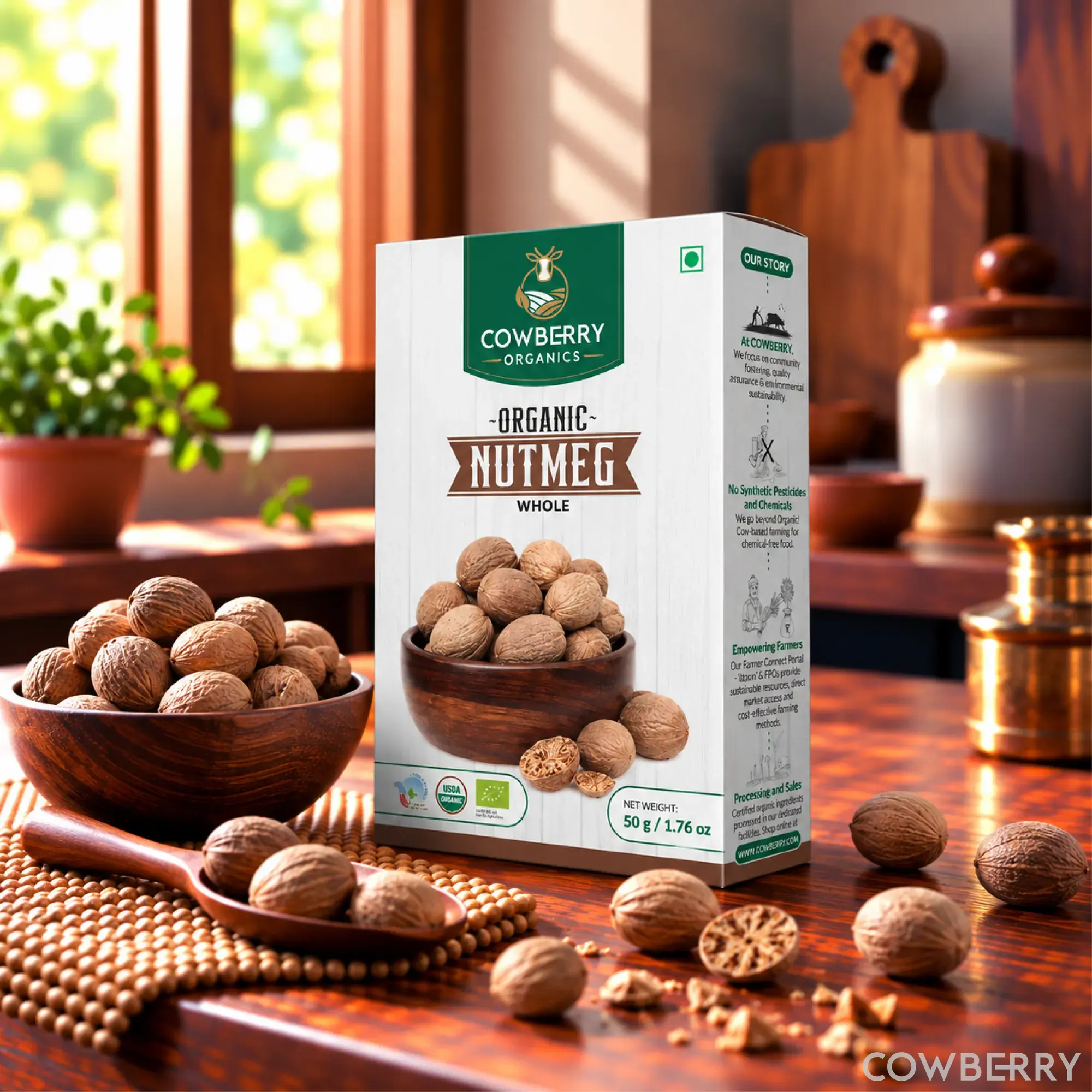
The Dietary Guidelines for Indians give the buying rule straight: powdered spices are the ones more likely to be adulterated, so uniform whole spices, matched in colour, size and shape, are the better buy, and certified packs the safest. That guidance fits nutmeg exactly, because the seed is sold whole and grated at home. Choose whole seeds over a long-sitting powder, and prefer a pack that states its farming and certification. COWBERRY's nutmeg is grown in Karnataka and Kerala's spice-growing regions through traditional cow-based farming, sold whole in a 50 g pack as organic nutmeg, with no additives or preservatives.
FAQs
What is nutmeg?
Nutmeg is the dried seed of Myristica fragrans, grated into sweets, warm milk and gravies; the red aril wrapped around the seed is sold separately as mace. In Hindi it is jaiphal, and a dish takes only a pinch of it. Per 100 g the seed carries 464 kcal, but the pinch a kitchen uses is about 2.3 kcal.
What is jaiphal?
Jaiphal is the Hindi name for nutmeg, the seed of Myristica fragrans; Sanskrit records jatiphala, and the 13 Indian-language names are in the table above. The part used is the seed itself, also called the kernel, grated fresh in the kitchen. Wrapped around that seed is the aril, dried and sold as mace, javitri in Hindi.
Difference between nutmeg and mace?
Nutmeg is the seed inside the fruit and mace the red aril around it; in Hindi, jaiphal against javitri. A 2022 review records essential-oil yields of 8.1 to 10.3 percent from mace, 6.2 to 7.6 percent from the kernel and 0.3 to 12.5 percent from the seed — ranges that overlap, so no clear winner. Only the seed has an entry in IFCT 2017; the full comparison sits on the difference between nutmeg and mace page.
How to use jaiphal?
Rub a whole jaiphal seed across the fine holes of a grater right over the dish, one small pinch at a time, and add it late in the cooking; warm milk, kheer, payasam and bakes take it off the heat. Grind jaiphal powder at home in small batches and use it soon. The grating steps and the daily-limit answer are laid out on the how to use nutmeg page.
Which part of jaiphal is used?
The seed, also called the kernel, is the part that gets used: kitchens grate it fresh into dishes. The aril that wraps the seed is a separate spice, mace or javitri, dried and sold on its own. Both parts come from one fruit of Myristica fragrans, and both are used in pinches.
Is jaiphal good for babies?
The Dietary Guidelines for Indians include nutmeg powder in an egg-pudding recipe among their complementary-food recipes for infants, with no amount printed, and the note beside those recipes keeps salt minimal and sugar avoided in infant food. The Dietary Guidelines for Indians state nothing about jaiphal making a baby sleep and set no daily amount, so none is given. Introduce any new food on your paediatrician's advice.
Does nutmeg help you sleep?
None of the studies in the references shows a pinch of nutmeg bringing on sleep, so no sleep benefit is claimed. The pinch in warm milk is a kitchen comfort, nothing more. What the 2025 review records about the spice's stronger effects sits at high doses — a warning against large amounts, not a bedtime licence.
What can i use instead of nutmeg?
Mace works as a substitute because it comes from the same fruit: it is the aril around the seed. The 2022 review prints no substitution ratio, so start with a small pinch and taste before adding more. In sweets, cardamom or cinnamon can cover the warm note, and any swap stays at cooking amounts.
References
- Indian Food Composition Tables (IFCT) 2017, ICMR-National Institute of Nutrition
- Dietary Guidelines for Indians, ICMR-National Institute of Nutrition
- Ashokkumar K, Simal-Gandara J, Murugan M et al. Nutmeg (Myristica fragrans Houtt.) essential oil: A review on its composition, biological, and pharmacological activities. Phytother Res, 2022
- Tariq D, Sultan MT, Noman AM et al. Nutmeg Beyond Spice: A Review on Its Therapeutic Potential, Safety and Industrial Promise. Food Sci Nutr, 2025
- Opara EI, Chohan M. Culinary herbs and spices: their bioactive properties, the contribution of polyphenols and the challenges in deducing their true health benefits. Int J Mol Sci, 2014
- Krishnaswamy K. Traditional Indian spices and their health significance. Asia Pac J Clin Nutr, 2008
Shop this article
Keep reading
Coriander water benefits: what dhania water actually does
Peanuts in Hindi (moongfali): groundnut names in Indian languages
Coriander vs cilantro: are they the same herb?