by COWBERRY

7 minute read
How to use nutmeg: daily limit, grating and storage

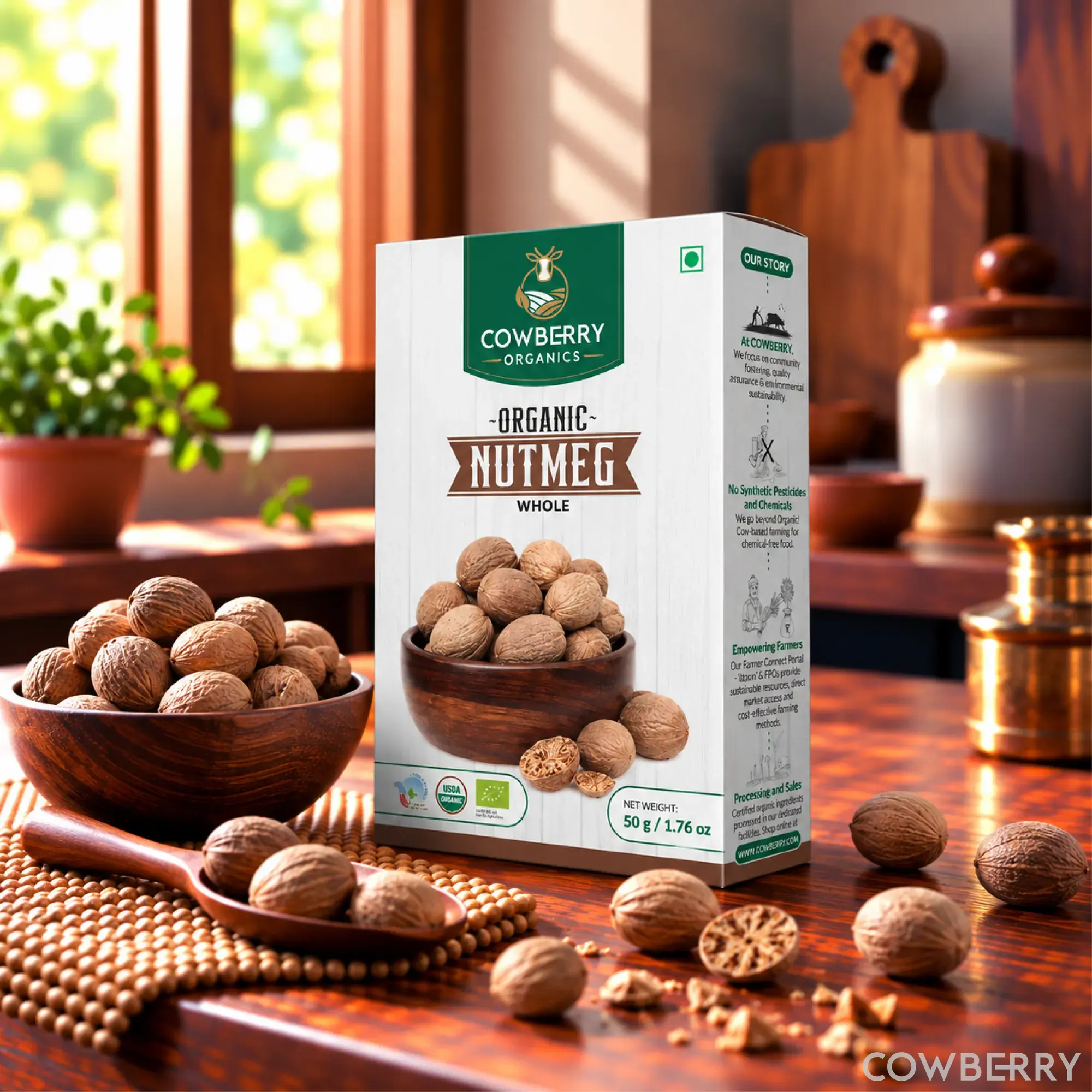
Nutmeg how to use comes down to three habits: buy the whole seed, grate it fresh at the dish, and keep the jar airtight and dark. A small pinch seasons; large amounts are where the reported harms sit. This page gives the grating, the honest daily-limit answer and the storage rules; the nutmeg hub covers the spice itself.
Short answer
Grate whole nutmeg straight over the dish, a small pinch at a time, and add it near the end of cooking or off the heat. Whole seeds are grated as required, so the natural aroma comes through fresh; ready-ground powder usually loses some of it. In Indian cooking the grated seed goes into sweets, warm milk and the occasional rich gravy, always in pinches. That smallness is not fussiness: a 2025 review in Food Science and Nutrition records gastrointestinal and hepato-renal adverse effects of nutmeg at high doses, and a 2014 paper by Opara and Chohan notes that culinary spices are eaten in tiny amounts, usually mixed into other foods, which makes their true health benefit hard to pin down. Per 100 g, IFCT 2017 prints 464 kcal, 36.5 g fat, 6.3 g protein, 12 g fibre, 148 mg calcium and 212 mg magnesium for the seed; a 0.5 g pinch of grated nutmeg carries about 2.3 kcal, which shows how little a dish actually takes.
How to use jaiphal: grating, powder and the right moment
- Start with whole seeds. Buy the whole seed rather than ground powder, and smell it before you buy.
- Grate, do not slice. Rub the seed across the fine holes of a box grater or a zester-style grater, directly over the dish, and grate only what the recipe needs.
- Add near the end. In curries, gravies and rice dishes, grate the nutmeg in during the last minute of cooking or after the flame is off, so the aroma reaches the table.
- Warm milk and sweets. For warm milk, kheer or payasam, stir in a small pinch once the dish is off the heat. In bakes, mix the grated nutmeg into the dry flour before the wet ingredients.
- Make powder in small batches. To make jaiphal powder at home, pound a seed in a mortar or pulse it in a small spice grinder and press the result through a fine sieve. Make only what you will use soon; ground nutmeg usually loses its aroma faster than whole seeds.
- Return the rest to the jar. Put the unused seeds back into an airtight jar in a cool, dark cupboard, away from the stove.
How much jaiphal per day: the honest limit
Neither IFCT 2017 nor the cited reviews give a daily gram allowance for nutmeg, so none is set. What the cited review does say is a caution on the other side. A 2025 review in Food Science and Nutrition names myristicin among nutmeg's main active components and records that at high doses, gastrointestinal and hepato-renal adverse effects have been reported; the review's own advice is careful usage. In the kitchen that means the smallest amount that seasons each dish: pinches, not spoons, and no supplement-style dosing, because neither review supports doses beyond the culinary one. Opara and Chohan, in a 2014 review for the International Journal of Molecular Sciences, put the same point the other way: herbs and spices are normally eaten in tiny quantities, usually mixed into other foods, so their true benefit is unclear and health claims around them are hard to establish. For what a pinch adds in numbers, the nutmeg nutrition facts 100g page does the arithmetic.
How to store nutmeg nuts and powder
Whole nutmeg keeps best in an airtight jar in a cool, dark cupboard, away from heat and light, where it stays usable for many months. Ground powder usually does not keep as long, so grind in small batches and use each one soon; a jar of powder that has sat for a long time is best replaced by a freshly grated seed. Throw out any seed that has gone soft, smells musty or shows mould. Mace, the covering of the seed, is compared with it on the difference between nutmeg and mace page.
Common mistakes
- Buying ground powder and keeping it for months. Ground spice usually loses its aroma with time. Buy whole seeds and grate as needed.
- Using a spoonful instead of a pinch. High doses are where the reported harms sit, so the kitchen amount stays small.
- Adding nutmeg at the start of a long simmer. The aroma fades with long cooking; add it near the end, or off the heat in milk and sweets.
- Storing in an open masala box near the stove. Heat and light dull the spice; an airtight jar in a dark cupboard keeps it right.
- Using nutmeg as medicine. Neither review supports supplement-style doses; keep it as a cooking spice.
- Confusing the seed with its covering. Mace is the aril around the seed, not another word for nutmeg.
Time and quantity table
The numbers below are kitchen working figures; the pinch weight is stated so the arithmetic is checkable.
| Step | Time or quantity |
|---|---|
| Grate | A few seconds over the dish, only as much as the recipe needs |
| Add | In the last minute of cooking, or off the heat in milk and sweets |
| A pinch | About 0.5 g of grated nutmeg, roughly 2.3 kcal |
| Whole seeds, airtight and dark | Usable for many months |
| Home-ground powder | Grind small batches and use them soon |
| Daily practice | Small culinary pinches; no daily allowance in IFCT 2017 or the cited reviews |
| High doses | Gastrointestinal and hepato-renal adverse effects reported (2025 review) |
The storage line above covers the whole seed; the names, nutrition and side effects of the seed sit together on the nutmeg hub page, and the Hindi and regional names are on the jaiphal in english page.
FAQs
How to use jaiphal?
Grate a whole jaiphal seed fresh over the dish and add it near the end of cooking, a small pinch at a time. Warm milk, kheer, payasam and bakes take it once the dish is off the heat; in bakes it is mixed into the dry flour. Keep the unused seeds in an airtight jar in a cool, dark place. The point is freshness: the seed carries the aroma, and it is at its best grated only as needed.
How much jaiphal per day?
Neither IFCT 2017 nor the cited reviews give a daily gram allowance for jaiphal, so none is set. The safety evidence works from the other end: a 2025 review reports gastrointestinal and hepato-renal adverse effects at high doses and notes that careful usage matters. It does not say what counts as a high dose, so the sensible pattern is the smallest amount that seasons each dish, a pinch rather than a spoon.
Can nutmeg cause intoxication?
Large amounts are where the concern lies, which is why the kitchen amount matters. A 2025 review in Food Science and Nutrition, which names myristicin among nutmeg's prime bioactive components, reports gastrointestinal and hepato-renal adverse effects at high doses and notes that careful usage matters. It gives no amount for "high", so keep to a pinch per dish and do not take nutmeg in larger amounts.
What can i use instead of nutmeg?
Mace is the natural stand-in, since it is the aril of the same seed; the difference between nutmeg and mace page compares the two. In sweet dishes, cardamom or cinnamon usually step in when nutmeg runs out, and in bakes a pinch of either covers the warm note. Substitution is a flavour choice, not a health one, and any substitute stays at cooking amounts.
Does nutmeg help you sleep?
None of the studies in the references shows nutmeg improving sleep in people, so no sleep benefit is claimed. A 2014 review explains why such claims stay hard to prove for culinary spices in general: they are eaten in tiny amounts and mixed with other foods. A pinch of nutmeg in warm milk is a comforting kitchen habit, and that is all the evidence supports.
How to store nutmeg nuts?
Whole nutmeg nuts keep in an airtight jar in a cool, dark cupboard, away from the stove, and stay usable for many months. Ground powder usually loses its aroma faster, so grind small batches and use them soon. Throw out any seed that has turned soft or smells musty; a quick smell of the jar now and then is the simplest freshness check.
References
- Indian Food Composition Tables (IFCT) 2017, ICMR-National Institute of Nutrition
- Tariq D, Sultan MT, Noman AM et al. Nutmeg Beyond Spice: A Review on Its Therapeutic Potential, Safety and Industrial Promise. Food Sci Nutr, 2025
- Opara EI, Chohan M. Culinary herbs and spices: their bioactive properties, the contribution of polyphenols and the challenges in deducing their true health benefits. Int J Mol Sci, 2014
Shop this article
Keep reading
Coriander water benefits: what dhania water actually does
Peanuts in Hindi (moongfali): groundnut names in Indian languages
Coriander vs cilantro: are they the same herb?