by COWBERRY

9 minute read
How to identify pure mustard oil at home: tests and the label

How to identify pure mustard oil at home: begin with the tests on FSSAI's household list that apply to oils, then read the label, because the adulterants named for edible oils only show up in a laboratory. This page walks through the quick tests, what each result means and what a pack of mustard oil should carry.
Why mustard oil adulteration happens
Mustard oil is, for practical purposes, all fat: the USDA FoodData Central entry lists 100 g of fat and 884 kcal per 100 g; protein, carbohydrate and every vitamin and mineral it records read zero. Its sharp, pungent flavour is the point of buying it, and the 2024 Begum and Jain review in the International Journal of Biochemistry and Molecular Biology records consistent adulteration reports for edible oils and ghee as demand has grown in domestic and global markets. For edible oils, the review names cottonseed oil, mineral oil and lower-cost oils like palm olein as the distinctive contaminants, while ghee gets animal fats, synthetic materials or vanaspati mixed in.
Adulteration has a health cost: the same review links contaminated oils and trans fats in the diet to adverse effects that include cardiovascular diseases, digestive disorders and even cancer, and it calls awareness among consumers essential for fighting these adulterations. The Detect Adulteration with Rapid Test (DART) list from FSSAI assembles rapid checks for adulterants commonly found in India, aimed at households and at consumer awareness about food safety.
How to identify pure mustard oil at home: the tests on FSSAI's list
FSSAI's household list has three tests under oils and fats. One is written for oils and fats in general, one for coconut oil, and one for refined winterized salad oils, whose bottle must stay brilliant, clear and limpid after 5.5 hours in ice water. None of the three is written for mustard oil, so read each one for what it actually covers.
TOCP test for oils and fats
TOCP (tri-ortho-cresyl-phosphate) is the adulterant this test looks for. FSSAI's method: take 2 ml of the oil, add a little yellow butter (solid), and watch the colour.
What you see
- Red at once: the sample points to TOCP; put that bottle aside and raise the matter with the seller.
- No red: TOCP did not show up in that sample, and nothing else has been ruled out either.
Take the sample with a separate spoon and discard it afterwards; do not return the tested oil to the bottle.
The fridge test is written for coconut oil
The list's fridge test is specific to coconut oil: a glass of coconut oil goes into the refrigerator for 30 minutes (not the freezer), after which pure coconut oil solidifies while added oils remain as a separate layer. The list does not extend this test to mustard oil, so it gives no way to read a chilled bottle of mustard oil.
The argemone check works on the seeds, not the oil
The one DART test that names mustard is a seed test. Spread a small quantity of mustard seeds on a plate and look closely: mustard seeds have a smooth surface and are yellow inside when pressed, while argemone seeds have a grainy, rough surface, are black, and are white inside when pressed. This is a check on the seeds, not on the oil pressed from them, and no test on the household list checks the oil in your bottle for argemone.
Know what the list cannot do. It has no paper test, colour test or smell test for mustard oil, and no test that finds cottonseed oil, mineral oil or palm olein in a bottle of oil. A clean result on every household test says nothing about those; finding them needs a laboratory.
How to check purity of mustard oil: lab tests and what pure may claim
For cottonseed oil, mineral oil and palm olein, the detection technologies the review describes for edible-oil adulteration are chromatography- and spectroscopy-based biochemical methods run on high-precision analytical instruments, and none of them has a kitchen version. If you suspect a bottle, the practical answer is to stop using it and take it up with the seller; proving what is inside is a laboratory's job.
What may a label claim as pure? FSSAI's Advertising and Claims Regulations, 2018, answer this. Under these rules, only a single-ingredient food with nothing added, free of avoidable contamination and with unavoidable contaminants within the prescribed limits, may be called pure. Compound foods, as a rule, should not be described as pure, and the word may not sit inside a brand or fancy name to imply a purity the food does not have.
So a mustard oil labelled pure claims to be a single oil with nothing added, and that claim is regulated. What it does not prove is that the oil in the bottle is the oil named on the label; for that, the checks that matter are the FSSAI licence on the pack and a seller you trust, which the next section covers.
How to check if mustard oil is pure: what to read on the label
No label can prove purity. What a label does is name who answers for the bottle and what the pack claims. ICMR-NIN's Dietary Guidelines for Indians list the entries a food label carries, from the food's name and ingredients to net weight, brand, the maker's name and address, the date of manufacture, use-by or expiry dates, storage instructions, allergen declaration and shelf life. On a bottle of mustard oil, check these:
- Product name: it should say mustard oil. A refined oil, however clear it looks, is a different product; how the two differ is set out in our comparison of mustard oil and refined oil.
- Ingredients: every ingredient is declared in descending order of quantity, so a single oil should carry a one-line ingredient list.
- FSSAI logo with licence number: this mark on the pack means the manufacturer is licensed by the regulator, as the guidelines explain. Oil ladled loose from an open drum carries none of it, and the guidelines caution that buying fats and oils loose from unsealed containers invites adulteration.
- Dates and storage instructions: compare the manufacturing date against the use-by or expiry date, and follow the storage instructions for where to keep the bottle and for how long.
- Cold-pressed or kachi ghani: the guidelines describe cold-pressed oils (kachi ghani tel) as expeller-pressed without heat, so antioxidants and phytonutrients are preserved, though such oils also contain undesirable compounds, similar to crude oil. If cold-pressed is what you want, the pack should say so; kachi ghani is the Indian name for the same method.
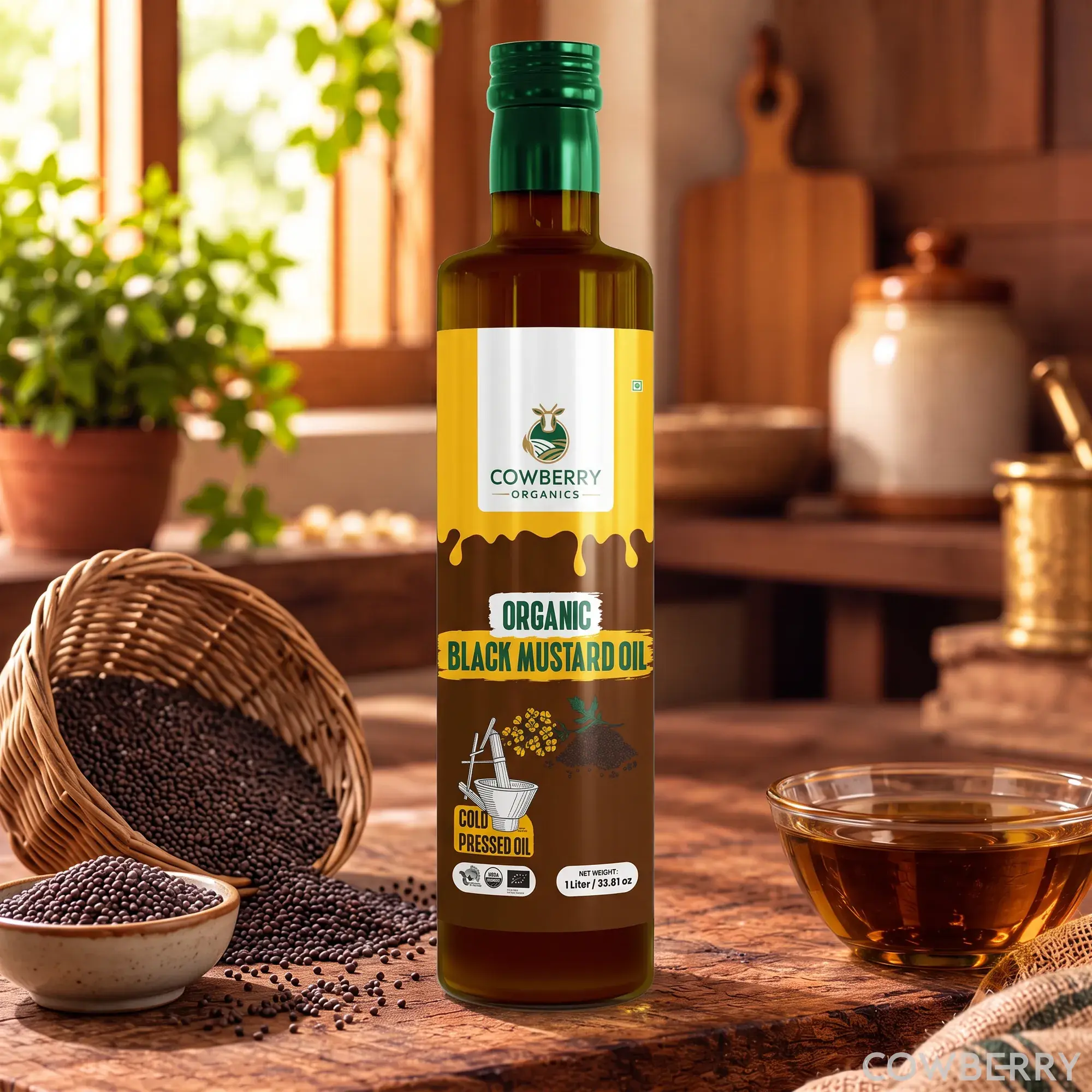
- Certification marks: some pre-packaged foods display quality marks; the example the guidelines give is AGMARK on agricultural products including oils. Organic packs carry their own marks, and COWBERRY's cold-pressed mustard oil is India Organic, USDA & EU certified.
Run the same checks on every bottle, whether the oil is for the daily tadka or for a batch of mango pickle. For what genuine mustard oil is worth in the kitchen, the mustard oil guide covers its names, nutrition and uses.
How to store mustard oil so it stays good
The first guide is the bottle itself: the storage instructions printed on it say where to keep the oil and for how long, and the dietary guidelines tell buyers to read them. COWBERRY's advice for its cold-pressed mustard oil is a cool, dry place away from direct sunlight, and the guidelines add that temperature and storage time influence food quality, so keep the bottle closed and away from the stove.
Once the oil has been used for frying, the rules change. The same guidelines say to filter oil that has been used for frying and keep it only for curry preparation, not for frying again, and to use it within a day or two, because deterioration is faster in used oil. Fresh mustard oil, kept sealed and cool, is fine until the use-by date printed on the pack.
FAQs
How to check purity of mustard oil?
At home the one thing you can rule out is TOCP. FSSAI's household test takes 2 ml of oil, adds a little yellow butter, and reads an immediate red colour as TOCP. Every other common adulterant of mustard oil, such as cottonseed oil, mineral oil or palm olein, needs a laboratory, so the label and a reliable seller stay your main checks.
How to identify pure mustard oil at home?
Run the tests FSSAI's household list actually offers: the TOCP test for oils and fats, and, when you buy whole seeds, the argemone check, in which mustard seeds look smooth and press yellow while argemone seeds look grainy and press white. Then read the pack for the FSSAI licence number and buy sealed oil from a reliable source. Anything beyond that needs a laboratory.
Which mustard oil is best?
Neither FSSAI's tests nor ICMR-NIN's guidelines rank brands or types of mustard oil. What they support is a checklist: sealed and labelled, cold-pressed if that is what you want, from a reliable seller, and honest about what is inside the bottle. Compare that against your own cooking and pick the bottle that passes every check.
Is mustard oil good for health?
It is a fat for the pan, 884 kcal and 100 g of fat per 100 g, so the amount you pour decides. ICMR-NIN's guidelines limit cooking oil to 20 g to 50 g per person daily, set by physical activity, which is where the health decision lives. For the wider case, see the benefits and side effects of mustard oil.
How mustard oil is made?
Mustard oil is pressed from the seeds of mustard (Brassica spp.). A cold-pressed, kachi ghani version is expeller-pressed without heat, which the dietary guidelines note preserves antioxidants and phytonutrients, though such oils also contain undesirable compounds, as crude oil does; crude seed oil that is refined is cleaned with chemicals, a process that removes unwanted compounds and the odour. COWBERRY's version is cold-pressed from mustard seeds grown in Rajasthan and Bengal.
What is mustard oil?
Mustard oil (sarson ka tel) is the oil pressed from mustard seeds, botanically Brassica spp. It is nearly all fat: 100 g per 100 g, at 884 kcal. Its names run across India, from sarson ka tel in Hindi to kadugu ennai in Tamil, and its sharp, pungent taste is what carries pickles, curries and traditional preparations.
References
- FSSAI DART: Detect Adulteration with Rapid Test, common quick tests for food adulterants at household (Eat Right India)
- Begum A, Jain BP. Adulteration in edible oil (mustard oil) and ghee; detection and their effects on human health. Int J Biochem Mol Biol, 2024
- Dietary Guidelines for Indians, ICMR-National Institute of Nutrition
- FSSAI Food Safety and Standards (Advertising and Claims) Regulations 2018, compendium (PDF)
- USDA FoodData Central (SR Legacy): Oil, mustard, FDC ID 172337
Shop this article
Keep reading
Cold pressed oil benefits: why they survive processing better
Mustard oil vs refined oil: nutrition, cooking and which to choose
Mustard oil omega 3: nutrition, calories and fat per 100g