by COWBERRY

6 minute read
Little millet vs foxtail millet: nutrition, taste and which to choose

Little millet vs foxtail millet in one line: samai and kangni are two different small millets that share a shelf and a GI entry — 89 each — but only little millet has full IFCT 2017 composition numbers. This page compares what is known, admits what is not, and points each grain where it fits; the samai side of the story lives on the little millet hub page.
Verdict in three lines
Same family, different paper trail. Little millet (samai, Panicum miliare) has a full IFCT 2017 entry: 347 kcal, 10.1 g protein and 7.7 g fibre per 100 g. Foxtail millet (kangni, Setaria italica) has no composition values in IFCT 2017 — the book has no foxtail food code — and none in the USDA tables either: their 'Millet, raw' entry is proso millet, not foxtail.
The one number they share is not flattering. The GI database records 89 for each — the mean of one entry, India-tested, plain cooked unpolished grain — and the Chennai study behind both entries found most shop samples highly polished and the labels misleading.
Choose by what is known, not by winner. Little millet has published numbers to work with; foxtail millet's composition numbers are simply not published. Neither needs a health halo.
Little millet vs foxtail millet: side by side
The table below is one-sided on purpose: it carries the little millet entry from IFCT 2017 and no foxtail column, because IFCT 2017 records no Setaria italica code — A017, the book's varagu, is kodo millet, Paspalum scrobiculatum — and the USDA entry 'Millet, raw' is proso millet, not foxtail. Printing borrowed numbers would be a guess, so the table carries none.
Read the row that exists: 347 kcal, 10.1 g of protein, 3.9 g of fat, 65.6 g of carbohydrates, 7.7 g of fibre, plus 1.3 mg of iron, 16.1 mg of calcium, 91.4 mg of magnesium and 36.2 mcg of folate, all per 100 g raw.
| Nutrient | Little millet (samai), raw |
|---|---|
| Energy (kcal) | 347 |
| Protein (g) | 10 |
| Fat (g) | 3.9 |
| Carbohydrates (g) | 66 |
| Dietary fibre (g) | 7.7 |
| Iron (mg) | 1.3 |
| Calcium (mg) | 16 |
| Magnesium (mg) | 91 |
| Potassium (mg) | 105 |
| Sodium (mg) | 4.8 |
| Zinc (mg) | 1.8 |
| Folate (mcg) | 36 |
| Glycemic index (GI) | 89 |
Per 100 g raw, edible portion. Composition: IFCT 2017 (ICMR-NIN). GI: University of Sydney GI database. — means not reported. These are average values for the food; the label on a pack gives the values for that product.
Nutrition: what the GI actually says
Both grains carry a GI of 89 in the University of Sydney database, each the mean of a single entry for plain cooked unpolished grain tested in India. The study behind those entries, in 12 healthy volunteers, measured high GI values for both — and, after a survey of 100 Chennai stores that found 48 brands of minor millets, reported that most samples were highly polished and the labels misleading. Unpolished grain was what the study tested; polished grain is what most shelves held.
A 2021 systematic review and meta-analysis complicates the picture usefully: it groups foxtail millet among the millets with a low mean GI and places little millet in the intermediate group because its data is inconsistent. The honest reading is that neither grain's GI is settled: one entry each, and most shop samples are polished while the test used unpolished grain. For diabetes, one entry of 89 per grain is a thin base for a claim either way; ask your doctor or dietitian before making either grain a staple.
Taste, look and cooking
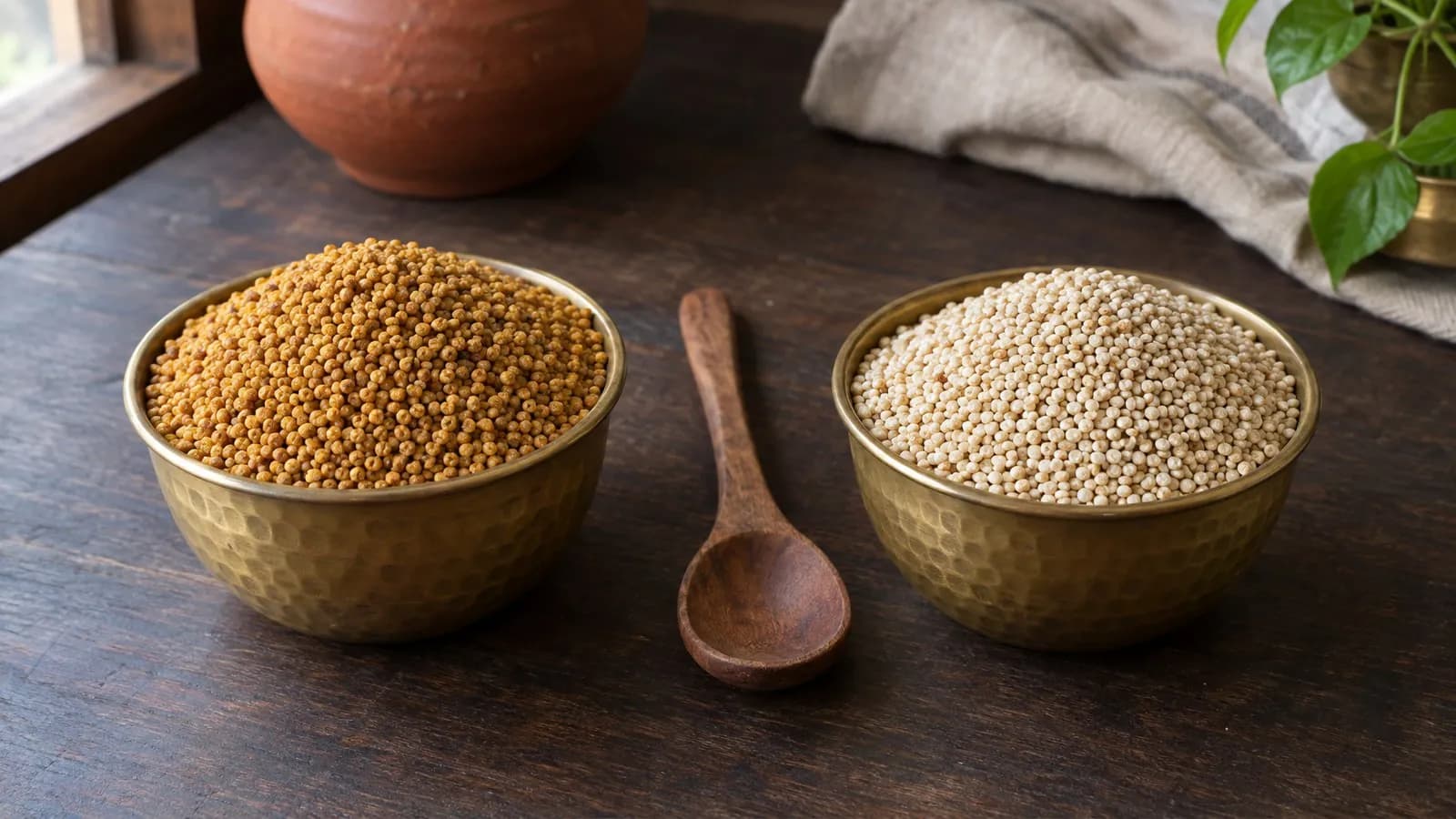
The grains tell themselves apart in the hand. The ICAR-IIMR bulletin sizes little millet at 1.8 to 1.9 mm and calls its seed round and smooth, smaller than common millet's; foxtail millet is the other small grain, described as a native of China, grown from sea level to 2000 m and unable to stand waterlogging, and ranked second in the world's millet production. No taste description for either grain is on record.
For a cooking method, the foxtail millet khichdi recipe shows foxtail in a pot. Cooked grain of either keeps in the fridge for up to two days.
Cost, storage and where each fits
Neither grain has a listed price — prices move and shops differ. What matters is where each fits. Little millet is the one with published composition numbers. Foxtail millet has a recorded GI entry and, the bulletin notes, its grain also goes to poultry and cage-bird feed.
Storage of cooked grain is the same for both: chilled for up to two days in the fridge.
Which for whom
- Tracking calories or macros: little millet, because IFCT 2017 prints its 347 kcal, 10.1 g protein and 7.7 g fibre per 100 g; foxtail has no published composition to track against.
- Weight loss: both are whole grains; the portion numbers for samai are on little millet for weight loss.
- Diabetes: the GI evidence is the same 89 for both and unsettled for both; the millet view is on is millet atta good for diabetes.
- Name confusion: samai, kutki and shavan are little millet; kangni, navane and korra are foxtail — the full lists are on samai millet in english and foxtail millet in kannada.
- Cooking: the foxtail millet khichdi recipe is the worked example for foxtail.
The wider samai picture is on the little millet hub page, and the kangni side on foxtail millet.
FAQs
Is little millet and foxtail millet same?
No. Little millet is samai, Panicum miliare; foxtail millet is kangni, Setaria italica, a grain the bulletin also names Italian millet. IFCT 2017 has an entry for little millet and no code at all for foxtail. They share a shelf and a GI of 89, but they are two grains.
What is the difference between little millet and foxtail millet?
The published numbers. Little millet has a full IFCT 2017 entry — 347 kcal, 10.1 g protein and 7.7 g fibre per 100 g — while foxtail millet has no composition values in IFCT or USDA, only a GI entry of 89. The bulletin describes little millet's seed as round and smooth, 1.8 to 1.9 mm long.
Difference between kodo millet and little millet?
Kodo millet is a third grain: varagu in Tamil, Paspalum scrobiculatum, IFCT code A017. The varagu entry matters here: it shows the book's A017 is kodo millet, not foxtail, which gets no code of its own. Little millet is A016; kodo and little millet are different grains with different entries.
Difference between barnyard millet and little millet?
Barnyard millet is a fourth small millet: the ICAR-IIMR list records sanwa for it in Hindi and kuthiraivolly in Tamil, and like foxtail it has no IFCT composition entry. Little millet is samai, Panicum miliare, with the full A016 numbers above. Different grains, same shelf.
Does little millet have protein?
Yes: IFCT 2017 prints 10.1 g of protein per 100 g raw for little millet. Foxtail has no published figure to compare, because IFCT 2017 prints no composition for it. Grains add to the day's protein rather than carrying it; pair either with dal.
Is little millet good for diabetes?
The GI database records 89 for both little and foxtail millet, each the mean of one entry, India-tested, for plain cooked unpolished grain, and a 2021 meta-analysis found little millet's data inconsistent, grouping it as intermediate. The Chennai study adds that most shop samples are highly polished. For diabetes, a single India-tested reading per grain and a review that groups them differently leave the GI picture unsettled; clear a staple change with your doctor or dietitian first.
References
- Indian Food Composition Tables (IFCT) 2017, ICMR-National Institute of Nutrition
- University of Sydney glycemic index database (GI search)
- ICAR-Indian Institute of Millets Research: millets information and vernacular names
- Nutritional and health benefits of millets, ICAR-Indian Institute of Millets Research (PDF)
- Anitha S et al. A systematic review and meta-analysis of the potential of millets for managing and reducing the risk of developing diabetes mellitus. Front Nutr, 2021
- UK Food Standards Agency: How to chill, freeze and defrost food safely
- Malavika M, Shobana S, Vijayalakshmi P, et al. Assessment of quality of minor millets available in the south Indian market & glycaemic index of cooked unpolished little & foxtail millet. Indian J Med Res, 2020
Keep reading
Foxtail millet vs quinoa: nutrition, taste and which to choose
Foxtail millet in Kannada, Hindi, Tamil and other Indian names
10 benefits of kangni (foxtail millet) and its side effects