by COWBERRY

10 minute read
Honey (shahad): nutrition, GI, benefits and how to eat it

Honey is the sweet, golden syrup bees make from flower nectar: a high-carbohydrate food whose sugars are mainly fructose and glucose. This hub covers what honey is, its names, nutrition per 100 g, the benefits with evidence behind them, who should limit it, how to use and store it, the recipes and how to buy it. Every deeper page is linked below.
What is honey (shahad)?
Honey is the food bees produce from flower nectar, and the flowers decide its character: a 2008 review from the Swiss Bee Research Centre, in the Journal of the American College of Nutrition, notes that honey differs in appearance, taste and composition with its botanical origin. The same review describes it as a high-carbohydrate food whose main components are carbohydrates, mainly fructose and glucose, with about 25 different oligosaccharides. Around those sugars sit proteins, enzymes, amino acids, minerals, trace elements, vitamins, aroma compounds and polyphenols in small amounts.
The USDA record for honey puts water at 17.1 g per 100 g and total sugars at 82.1 g, of which 40.9 g is fructose and 35.8 g glucose. Because the composition follows the flowers, the review also reports a wide glycemic index spread, 32 to 85 by botanical source; the figure these pages use is 63, an average of seven plain-honey measurements in the University of Sydney database, walked through on the honey glycemic index page. Beside the two main sugars, the USDA record lists small amounts of sucrose (0.89 g), maltose (1.44 g) and galactose (3.1 g) per 100 g, and the review reports its positive health effects at higher doses of 50 to 80 g per intake, far above the spoon in tea. The Hindi name for the jar is shahad, and the next section covers the names.
Honey names in Indian languages
The USDA FoodData Central record lists only the English name for honey, so the table below carries a single name. In these pages you will also meet shahad, the Hindi word for honey, kept beside the English wherever a recipe or a common question carries it: shahad garam pani is honey water, and shahad ke laddu are honey laddus. Shahad uses are honey uses, the same recipes and the same spoon. For the one-line answer to the name question, see the FAQ below.
| Language | Name (romanised) |
|---|---|
| English | Honey |
| Hindi | — |
| Marathi | — |
| Gujarati | — |
| Punjabi | — |
| Bengali | — |
| Odia | — |
| Assamese | — |
| Kannada | — |
| Telugu | — |
| Tamil | — |
| Malayalam | — |
| Urdu | — |
| Sanskrit | — |
| Botanical name | — |
Source: USDA FoodData Central record 169640 (English and scientific name only; no Indian-language names in source). — means no name recorded in the source.
Honey nutrition per 100 g
Honey is almost all carbohydrate and water. Per 100 g, the USDA record lists 304 kcal, 82.4 g of carbohydrate, 0.3 g of protein, no fat and 0.2 g of fibre, with small mineral and vitamin amounts: iron 0.42 mg, calcium 6 mg, magnesium 2.0 mg, potassium 52 mg, sodium 4 mg, zinc 0.22 mg, folate 2 mcg and vitamin C 0.5 mg. The table below shows the same values.
Because a jar is eaten by the spoon, the spoon numbers matter more than the 100 g figures: 1 tsp (7 g) of honey carries about 21 kcal and 5.8 g of carbohydrate. The honey calories page runs through teaspoons, tablespoons and the 100 g figures; the full table with every mineral is on honey nutritional value per 100 g. Since the carbohydrates are almost entirely sugars, does honey contain sugar answers the sugar question directly, and the honey glycemic index page covers the 63. How that stacks up against white sugar is the honey vs sugar page.
| Nutrient | Honey (USDA FDC 169640) |
|---|---|
| Energy (kcal) | 304 |
| Protein (g) | 0.3 |
| Fat (g) | 0 |
| Carbohydrates (g) | 82 |
| Dietary fibre (g) | 0.2 |
| Iron (mg) | 0.4 |
| Calcium (mg) | 6 |
| Magnesium (mg) | 2 |
| Potassium (mg) | 52 |
| Sodium (mg) | 4 |
| Zinc (mg) | 0.2 |
| Folate (mcg) | 2 |
| Vitamin C (mg) | 0.5 |
| Glycemic index (GI) | 63 |
Per 100 g raw, edible portion. Composition: USDA FoodData Central (SR Legacy), FDC ID 169640, NDB 19296. GI: University of Sydney GI database. — means not reported. These are average values for the food; the label on a pack gives the values for that product.
Benefits of honey
The studies behind honey's reputation are real but specific. Here are the findings in one line each, attributed to their sources.
Coughs in children
A 2018 Cochrane review of six trials in 899 children from 12 months up judged honey probably better than doing nothing, diphenhydramine or placebo for cough symptoms, and probably more effective than placebo or salbutamol over up to three days, while against dextromethorphan the difference may be little or none; no trial enrolled an infant. The authors found no difference in side effects between honey and the comparison arms, and add that there was no strong evidence for or against using honey and that most children received honey for one night.
Cardiometabolic markers
A 2023 meta-analysis of 18 controlled trials in 1,105 people reported that honey reduced fasting glucose, total cholesterol, LDL cholesterol, triglycerides and alanine aminotransferase, at low certainty of evidence, and raised HDL cholesterol with high certainty; robinia, clover and raw honey showed benefits on fasting glucose and total cholesterol in subgroup analyses, and the authors concluded honey may help glycemic control and lipid levels inside a healthy dietary pattern.
Antibacterial action
A 2011 review in the Asian Pacific Journal of Tropical Biomedicine puts most honeys' antimicrobial activity down to an enzyme reaction that makes hydrogen peroxide; for the non-peroxide kind, manuka, it points to honey's low pH and high sugar content.
The deeper pages are honey benefits and side effects in English and honey ke fayde aur nuksan in Hindi.
Side effects of honey: who should limit it
Honey is a sugar, and every rule that limits sugar limits honey. India's dietary guidelines list honey among added sugars, beside sucrose and jaggery, and ask adults to avoid sugar or restrict it to 20 g to 25 g a day; for children below 2 years, added sugar must be totally avoided, and overweight pregnant women are asked to avoid added sugars. A 2015 crossover trial makes the same point from the blood side: 55 adults took 50 g of carbohydrate a day from honey, table sugar or high-fructose corn syrup for two weeks each, and the three produced similar metabolic effects in glucose-tolerant and glucose-intolerant people.
The age rules are the strict ones. The NHS rule is no honey before a child's first birthday, because honey can occasionally carry bacteria that produce toxins inside a baby's gut; for children aged 4 or younger it advises keeping food and drink with sugar away, honey's natural sugar counting among them. The honey for babies page walks through both rules.
For adults with diabetes, honey counts in the carbohydrate plan like any sugar; honey for diabetes covers the GI, the spoon numbers and the evidence. On a weight plan, honey fits only inside the day's sugar budget; honey for weight loss explains why no sweetener does the work for you. In pregnancy, the counted-spoon logic applies with a doctor's sign-off; honey in pregnancy has the detail. For your own case, talk to your doctor or dietitian.
How to cook or use honey
Honey's kitchen manners are simple. Stir it into warm water, milk or tea, or into a dish once it is off the heat; drizzle it over porridge, yogurt, toast and fruit; and let it work as the sweetener and binder in cooking and baking. Measure it by the spoon, not the pour, so each 7 g teaspoon stays counted. Warm honey pours more easily; the laddu recipe stands the jar in hot water rather than cooking the honey. For the full set of honey uses, warm drinks and breakfast included, plus the honest answer on the best time to eat it, see how to eat honey.
How to store honey
Store honey the way COWBERRY's own guidance says: somewhere cool and dry, out of direct sunlight, in an airtight container. The same advice is given on both COWBERRY product pages, multiflora and tulsi. Use a clean, dry spoon each time. No shelf life for honey is given in the references, so judge a jar by its label and by look and smell.
Honey recipes to start with
Three full recipes and a roundup of quick methods make up the honey kitchen. The honey recipes roundup groups dishes by meal, from drinks and breakfasts to snacks and sweets, with a two-line method for each. The three recipes with complete steps:
- Honey water — honey dissolved in warm water, finished with lemon, ginger and mint.
- Honey laddu — sesame and peanuts roasted and pressed into balls with warm honey as the binder; no sugar syrup to cook.
- Honey chilli potato — potato fingers fried twice for crispness, then tossed in a warm honey-chilli glaze with garlic and sesame.
Each recipe counts its honey by the spoon, so the numbers stay honest: honey water makes two glasses in about 8 minutes, honey laddu makes 12 balls in about 25 minutes of work plus cooling, and honey chilli potato serves four in about 40 minutes.
How to buy honey
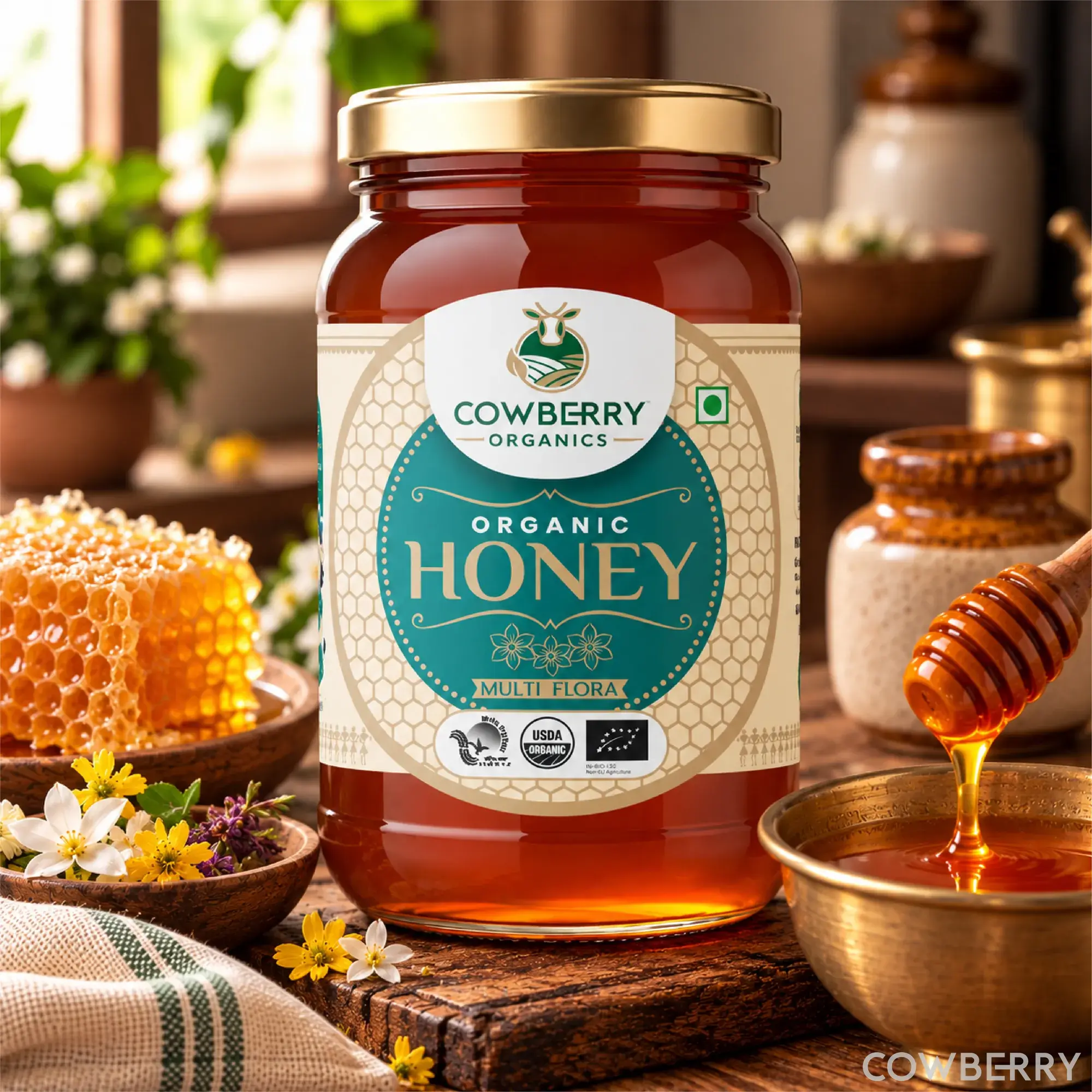
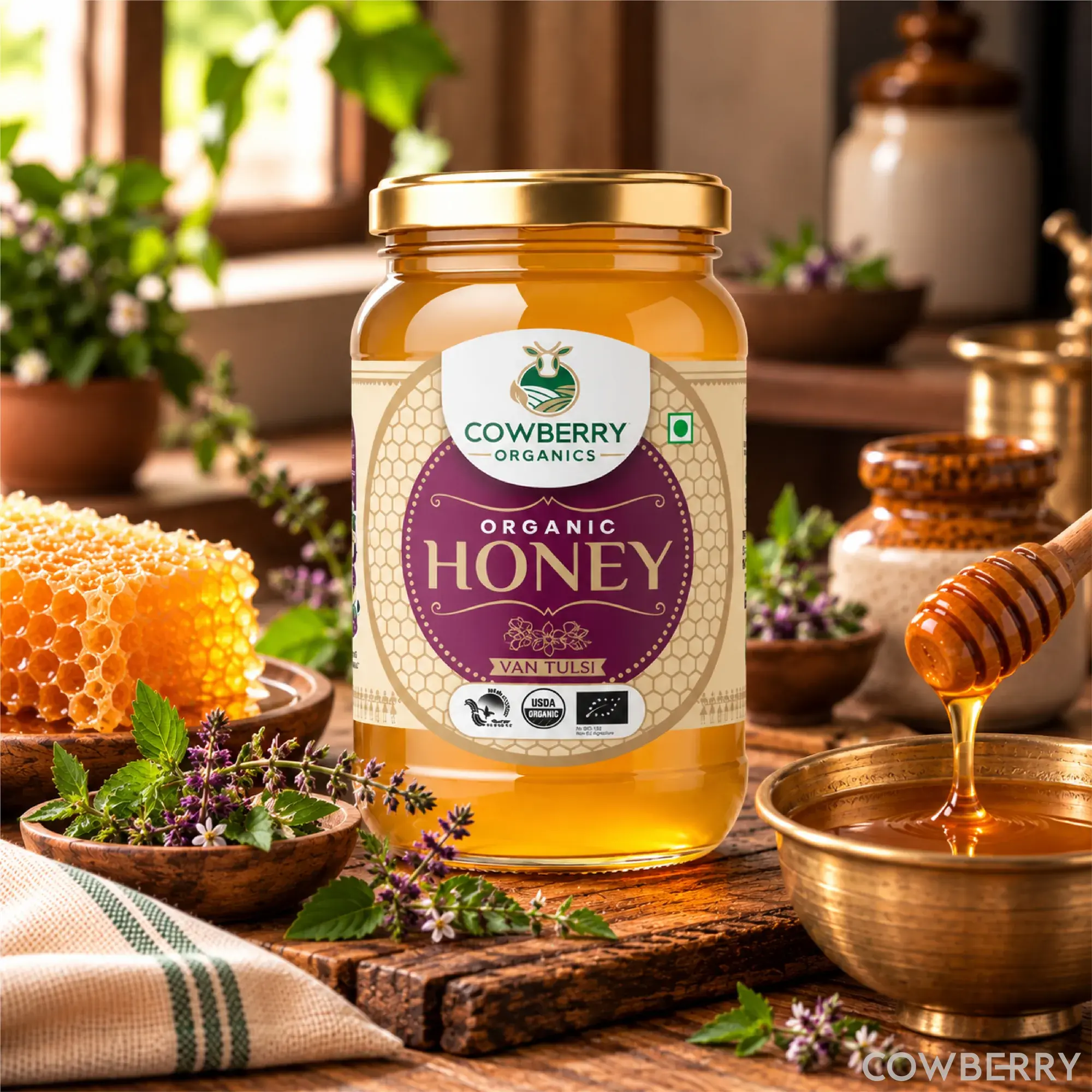
What a honey jar should promise is modest: honey from a known place, handled gently, with nothing added. COWBERRY's multiflora honey is raw honey from the wildflowers of the Shivalik foothills in Uttarakhand, and its tulsi honey comes from bees gathering tulsi nectar in the Himalayan foothills; both are minimally processed with no heat applied and no additives, and both are India Organic, USDA & EU certified.
Labels and certificates say a lot, but not everything, and the home tests people try tell much less. The how to check if honey is pure page runs six home tests and says what each can and cannot tell you. The two jars named above are the ones these pages cook with, and both come in 250 g and 500 g sizes.
FAQs
What is honey?
Honey is what bees make from flower nectar: mostly the sugars fructose and glucose with water, and in small amounts proteins, enzymes, minerals, vitamins and polyphenols. Per 100 g the USDA record lists 304 kcal, 82.4 g of carbohydrate and 17.1 g of water. It is eaten as a sweetener and used in cooking and baking, and it is a sugar, so the counted-spoon rules apply.
What is shahad?
Shahad is the Hindi word for honey, the same jar and the same numbers: 304 kcal and 82.4 g of carbohydrate per 100 g. Everything said about honey on this hub applies to shahad; the names section above shows where the word sits beside the English one.
Which honey is best in India?
None of the studies and guidelines in the references rank Indian honeys, so the honest answer is to judge what the jar states: where the honey comes from, how it was handled and whether anything was added. The buying section above judges COWBERRY's two jars on exactly those three points.
Does honey expire?
No shelf life for honey is given in the references, so trust the jar's own date and your nose and eyes. Keep it the way the storage section above says, and throw out a jar that ever looks or smells off.
Can honey be heated?
Yes. The guidance in the references sets no heating limit for honey, and it is gently warmed whenever it meets hot tea or a cake batter. Warming it only loosens it so it pours; what the spoon adds stays the same.
Is honey good for diabetes?
Honey is a sugar, so the useful frame is the numbers. Honey is 82.4 g of carbohydrate per 100 g with a GI of 63, and a 7 g teaspoon holds 5.8 g of carbohydrate, so count honey in the carbohydrate plan like any sugar; the full answer, with the trial evidence, is on honey for diabetes.
What is the glycemic index of honey?
The figure these pages use is 63, averaged from the seven plain-honey entries in the University of Sydney database; the individual tests run from 49 to 87 across China, Germany, Egypt, Canada and Australia. The full walk-through is on the honey glycemic index page.
References
- USDA FoodData Central (SR Legacy): Honey, FDC ID 169640
- University of Sydney glycemic index database (GI search)
- NHS: Foods to avoid giving babies and young children
- Dietary Guidelines for Indians, ICMR-National Institute of Nutrition
- Bogdanov S, Jurendic T, Sieber R et al. Honey for nutrition and health: a review. J Am Coll Nutr, 2008
- Mandal MD, Mandal S. Honey: its medicinal property and antibacterial activity. Asian Pac J Trop Biomed, 2011
- Oduwole O, Udoh EE, Oyo-Ita A, et al. Honey for acute cough in children. Cochrane Database Syst Rev, 2018
- Ahmed A, Tul-Noor Z, Lee D et al. Effect of honey on cardiometabolic risk factors: a systematic review and meta-analysis. Nutr Rev, 2023
- Raatz SK, Johnson LK, Picklo MJ. Consumption of Honey, Sucrose, and High-Fructose Corn Syrup Produces Similar Metabolic Effects in Glucose-Tolerant and -Intolerant Individuals. J Nutr, 2015
Shop this article
Keep reading
Raw Sugar vs Brown Sugar: Is Demerara the Same Thing?
Does honey contain sugar? Carbs per 100g and the WHO sugar limit
Date Jaggery (Khejur Gur in English): Types, Forms and How to Use It